
On this page
- Why international SEO keyword research needs a market-by-market approach
- Step 1: Conduct market research before choosing languages
- Step 2: Build local seed terms and discover search terms
- Step 3: Validate demand with local tools and data beyond Google
- Step 4: Analyze search intent in local search engine results
- Step 5: Group keywords and prioritize the right opportunities
- Step 6: Map keyword groups to localized URLs and hreflang
- Step 7: Measure results and refresh the research
- Best practices, common mistakes and what we keep learning
- Conclusion
- FAQs
International keyword research starts with a country and its searchers, not a translated list. A phrase that works in the U.S. may be unfamiliar, too formal or mean something else in Mexico, and even international markets that share a language use different words, spellings and product names. This guide gives you a market-by-market workflow for international SEO: choosing markets, finding local seed terms, validating demand with keyword research tools (including beyond Google), understanding search intent in local results, and mapping keyword groups to localized URLs and hreflang.
Key takeaways
- Translation is a brainstorming step, not keyword research. Validate every term with local data and a native speaker.
- Research each country separately, even when countries share a language. Spanish keyword research for Spain, Mexico and Argentina gives three different lists.
- Keyword volume outside Google is patchy. Triangulate with the local engines, autocomplete, PPC tests and competitors.
- Intent changes by market. Check the local SERP before assigning a term to a URL.
- One group, one localized URL, correct hreflang. Keep the evidence for each decision in one sheet.
Why international SEO keyword research needs a market-by-market approach
Direct translation produces relevant-looking search terms that nobody uses. International SEO keyword research instead checks how people in a specific market describe a need, what they expect to find and which search engines they use. Search volume is useful, but it doesn't tell you whether a query is informational or transactional, or whether your business can serve that target audience.
So treat every country as a separate research project. Your keyword research process should record the country, language, source, intent and the page you plan to target for every priority term, and your international SEO strategy should be built from those records rather than from a global list.
Translation vs localization vs transcreation for multilingual content
Translation transfers meaning between languages. Localization adapts wording, units, currency, examples and tone to a market. Transcreation goes further and recreates the message so it resonates with the local audience, which is what good marketing copy needs. Keyword research sits closest to localization: the goal is the relevant keywords local searchers type, which are often not the words a translator would choose. Translating with Google Translate or a similar tool can generate draft candidates; a native speaker decides which ones people use.
Step 1: Conduct market research before choosing languages
Start with business fit, not the languages your team can translate. International markets vary: one may have search demand but still be a poor target if you can't ship there, support local customers, meet regulations or compete on price. Conducting thorough market research for different regions means checking:
- Existing demand. Filter the Search Console performance tab by country, and look at sales records and support requests for organic traffic or enquiries already coming from a country to your website.
- Business viability. Delivery, payment options, customer service hours and legal requirements.
- Competition and cost. A market with moderate demand and a workable entry cost may beat a larger market you can't yet serve.
- Search engine and language mix. Google leads in most of the world, but Baidu dominates China, Yandex is strong in Russia, Naver in South Korea, Yahoo Japan still matters in Japan, and Bing has real share in some English markets.
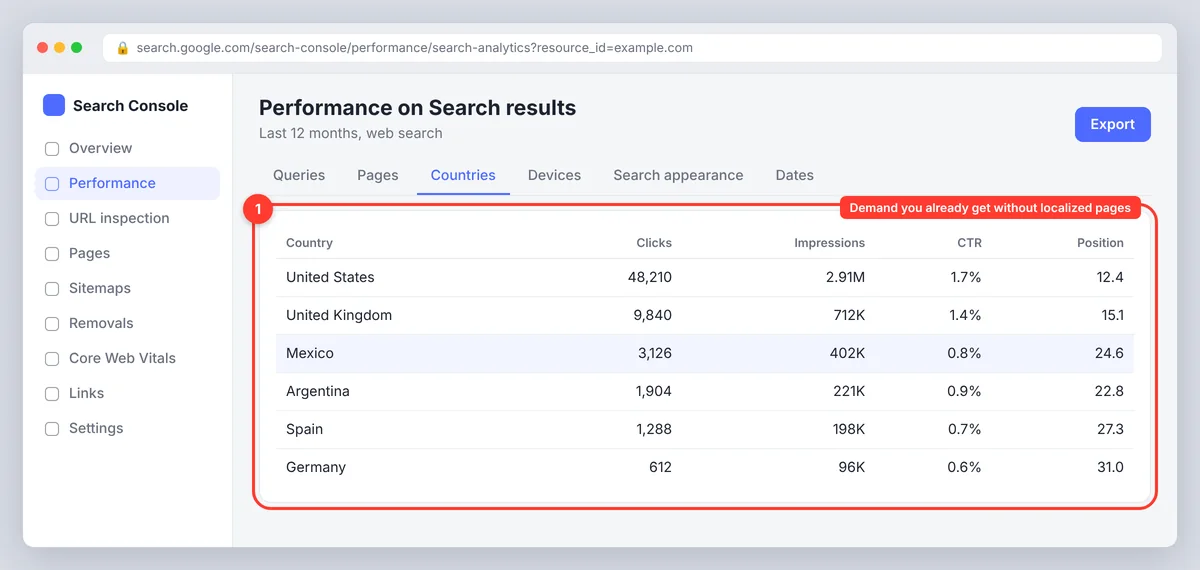
Give each market a priority rating based on expected demand, readiness, competition and the cost of localized content. The insights from this step shape everything after it. That makes it easy to explain why Argentina is a better first test than a bigger market you can't support.
Step 2: Build local seed terms and discover search terms
For each target market, start with local seed terms: the words customers use for your products, problems and alternatives. Gather them from local sales calls, reviews, support tickets, your own website's catalog and competitor websites. Add spelling differences (colour vs color), abbreviations and local names for product categories; a "mobile" in the UK is a "cell phone" in the U.S. and a "celular" in Latin America.
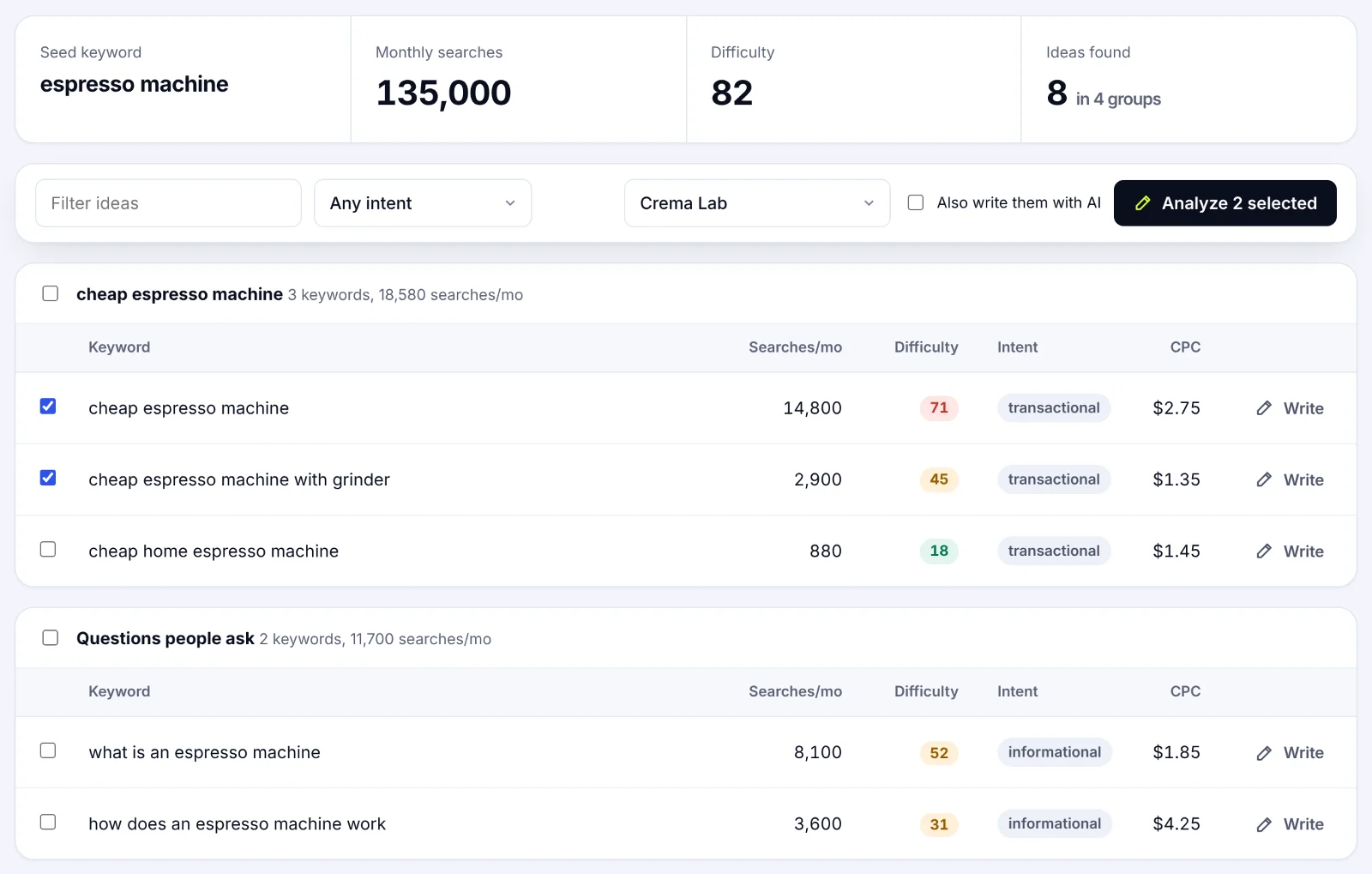
Then expand the seeds with keyword research tools into related keywords, questions and long-tail keywords. SerpPal's Content Planner takes a seed in the target country and language and returns keyword ideas with monthly search volume, keyword difficulty, intent and CPC, grouped into topics, so you can identify the right keywords for that market in one pass. You pick the country and language per search, and the analysis of a keyword later uses the same setting, so the brief comes from the pages that actually rank in that market. The countries and languages page lists what's supported.
Work with native speakers
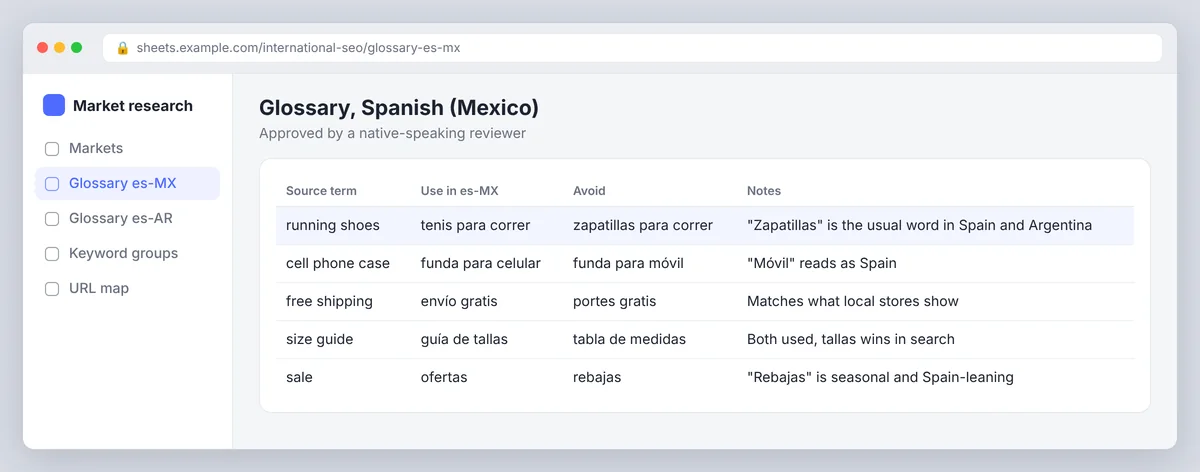
A native-language SEO specialist spots local keywords, unnatural wording and cultural references a general translator misses. Give them the product context and audience, then ask which phrases sound natural in a search box, not just in polished copy. Keep their answers in a glossary of approved terms and terms to avoid; it becomes the reference for every piece of multilingual content in that market, and the preferences it records save every later project time.
Step 3: Validate demand with local tools and data beyond Google
Use multiple sources, because keyword data is an estimate. A keyword tool built for one country is often blind in another, so multiple sources beat one. Google Keyword Planner shows search ranges and advertiser activity for a chosen country and language. Google Trends compares relative interest by region and over time. Search Console, filtered by country, shows the queries already bringing visitors to your website, and Google search autocomplete in the local language shows what people type next.
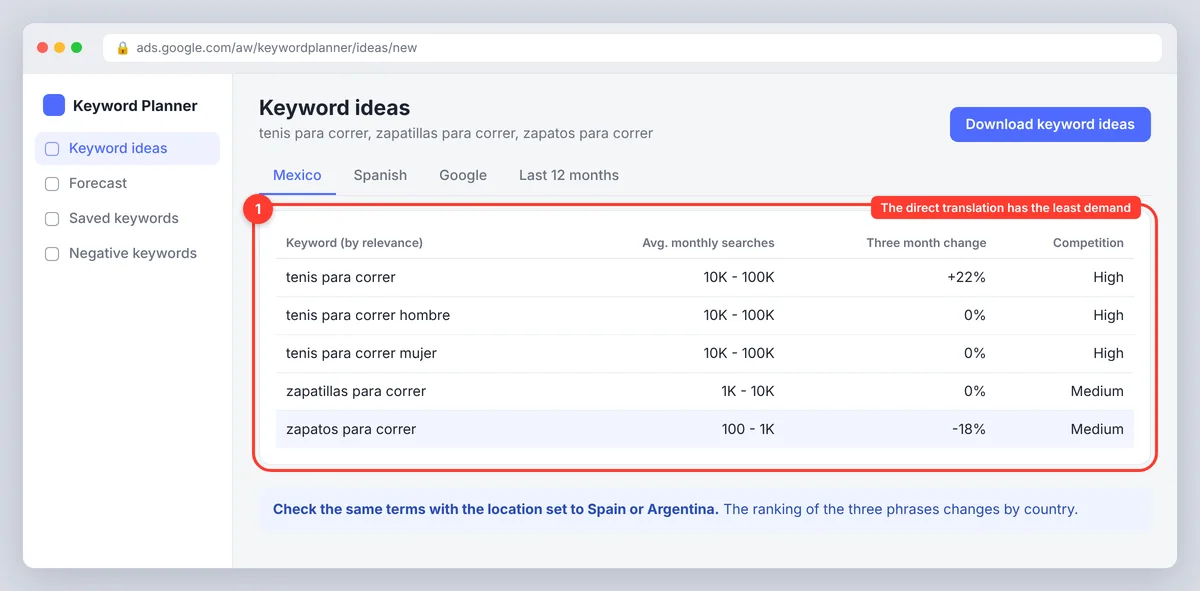
For markets where Google isn't the main engine, look at the local platform's own tools: Baidu's keyword planner for China, Yandex Wordstat for Russia, Naver's keyword tool for Korea. Coverage and volume estimates differ and can't be compared directly with Google's numbers. Global SEO suites such as Semrush and Ahrefs Keyword Explorer cover many countries in one interface, which helps when conducting keyword research across different languages, but their data is still thinnest exactly where local engines dominate. When volume is sparse, triangulate: local autocomplete, the related searches on the results page, trend patterns, customer language, competitor pages and paid-search data. Record the source, the date retrieved and your confidence for every estimate; numbers retrieved six months apart aren't comparable.
Use competitors and PPC to find commercial terms
Identify businesses that actually compete in the target market, not the global brands you recognize. Review their category pages, product names and search snippets for local terminology. SerpPal's competitor view shows which pages rank for a keyword in the chosen country and how they're structured, which is faster than opening a VPN and reading multiple websites one by one. A small Google Ads campaign in the market can then test whether a commercial term attracts qualified clicks before you invest in organic pages.
Step 4: Analyze search intent in local search engine results
Understanding search intent means knowing what a person wants to accomplish with a query: learn, compare, find a site or buy. The informational, navigational and transactional split goes back to Andrei Broder's 2002 taxonomy of web search, later tested on real query logs by Jansen, Booth and Spink in 2008, and it still holds in every market. Transactional intent is the smallest slice and the most valuable. Check the local results for each priority term before assigning it to a page. Look at the content types that appear (guides, category pages, product listings, videos, map results) and the SERP features (maps, shopping, AI Overviews, featured answers). A query that triggers product listings in one country may call for a guide in another, even when the translated words match. AI search results such as AI Overviews are rolling out market by market too, so note where they appear.
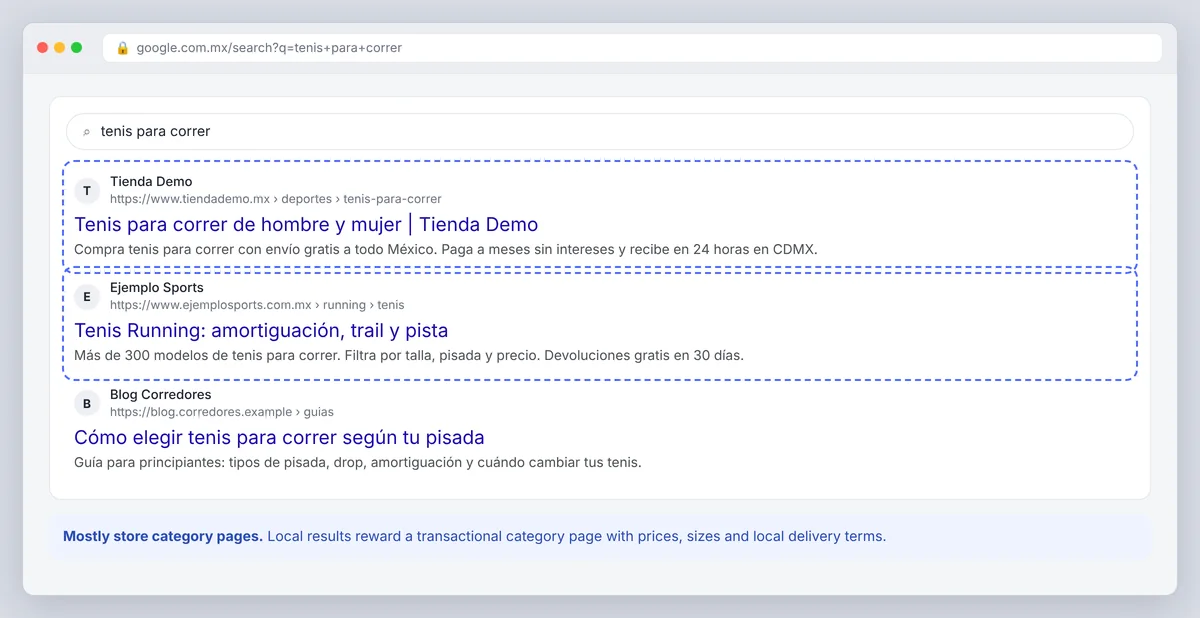
Compare macro intent (the broad goal) with micro intent (the immediate need). "Best running shoes" is a short-tail keyword signalling comparison; a specific model and size is a long-tail keyword signalling readiness to buy. Navigational intent is the hardest to place and usually not worth targeting unless the brand is yours.
Step 5: Group keywords and prioritize the right opportunities
Group terms by shared intent and the page that could satisfy them. Keyword clustering tools can do the first pass by comparing the local search results, as our guide to keyword clustering tools explains. Grouping is a way to decide which terms belong together, not a reason to put every similar term on one URL. Review the local SERP, since queries that look alike may lead to different result types in different markets.
Prioritize groups by business relevance, demand, competition, intent and the effort to create a useful page. A smaller long-tail keyword with clear buying signals beats a broad short-tail term with heavy competition for a first launch, and a keyword strategy built on those wins faster visibility. Keep the evidence in one sheet:
| Field | What to record |
|---|---|
| Market and language | Country, language and any regional variant (es-MX, pt-BR, fr-CA) |
| Keyword and intent | Local term, likely goal, SERP observations |
| Demand and source | Volume estimate, tool, date checked, confidence |
| Page and priority | Proposed page, group, business value, next action |
| Reviewer | Native speaker who approved the term, and notes |
Step 6: Map keyword groups to localized URLs and hreflang
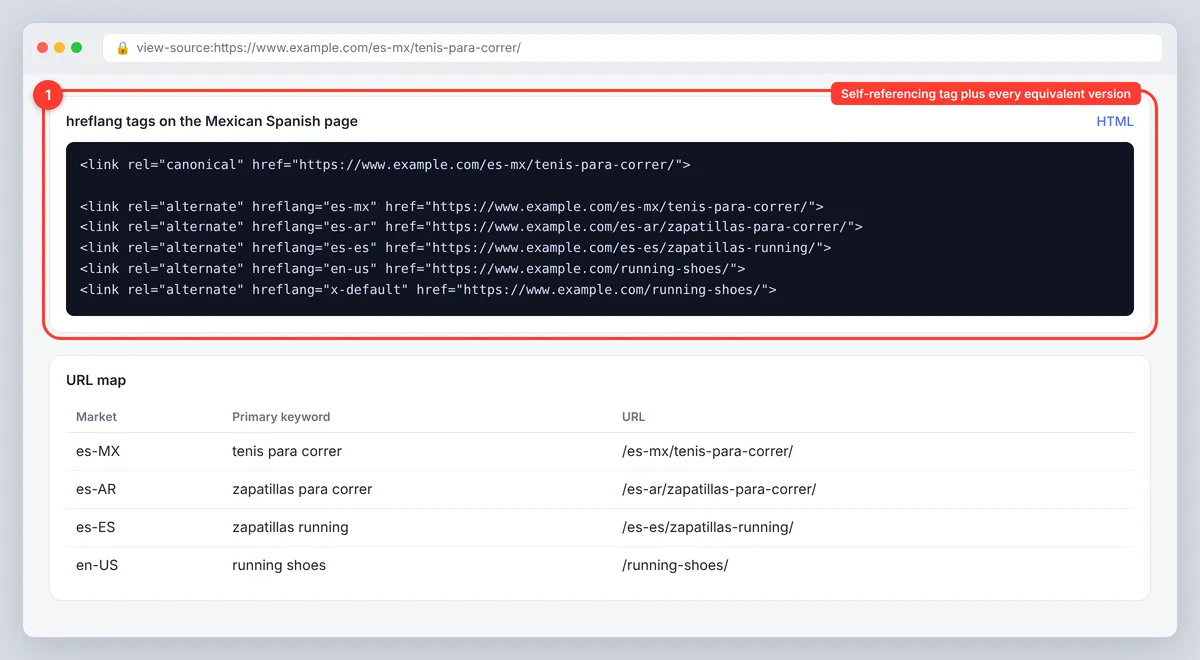
Assign each group to the most suitable localised URL for that market. Google's guide to managing multi-regional and multilingual sites compares the options. A localized website can live on country-code domains (example.de), subdomains (de.example.com) or subdirectories (example.com/de/). Subdirectories are the easiest to maintain and share the main domain's backlinks; ccTLDs send the strongest local signal but each needs its own authority. Choose a structure your team can keep consistent, then make sure internal links point to the correct localized content.
Hreflang connects equivalent language or regional versions of a page so search engines show the right one to each searcher. Keyword findings tell you which localized versions to create and what each should target; they don't replace implementing hreflang correctly. Only mark versions as alternatives when they serve the same purpose in different locales, use a self-referencing tag on every version, and keep the canonical tag pointing at each version itself. Google's own guide to localized versions covers the details.
Governance before translation
Decide who owns the glossary, who signs off terms, and how pages get updated when a term changes. Budget for research, writing, native review, technical work and ongoing updates; costs rise when a market needs original content rather than light edits. Before a localized version goes live, confirm its target terms still read naturally in the final copy, and check product facts, units, prices, calls to action and anything that needs local approval. Writing the localized content in an editor that scores it against the local ranking pages, as SerpPal's does for each supported country, catches gaps a translator wouldn't notice.
Step 7: Measure results and refresh the research
Track rankings, impressions, clicks and conversions by country, language and page. Search Console shows whether your website earns impressions for the search terms you targeted; analytics and sales data show whether that visibility brings useful visits. Compare each market against its own baseline. International SEO takes time: new localised content needs to be discovered, indexed and assessed against local competitors, so expect months rather than weeks. Revisit the keyword list when rankings stall, customer language changes or seasonal trends shift.
Best practices, common mistakes and what we keep learning
- Don't translate a U.S. keyword list and call it research. Local vocabulary and demand come first.
- Don't pool countries that share a language. Research by country and document each separately.
- Don't trust a single tool's volume estimate, especially where local search data is thin.
- Don't choose terms by volume alone. Intent and business fit decide.
- Don't publish localized content without native-language review or a clear site structure plan.
- Don't set hreflang on pages that aren't genuine regional or language alternatives.
- Do keep the query, market, source, intent, proposed page and reviewer notes together so the next update starts from evidence.
Conclusion
International keyword research works when you treat each market as its own project. Pick markets you can actually serve, build seed terms from local language with a native speaker, validate demand with more than one source, read the local search results for intent, then map each keyword group to one localized URL with correct hreflang implementation. Keep the evidence in one sheet, and the next market gets easier. If you're new to the basics, start with our keyword research guide and come back to this workflow per country.
FAQs
Can I just translate my keyword list for international SEO?
No. Translation is a starting point for brainstorming, but it won't tell you whether people use the phrase, what they mean by it or what the local results reward. Validate every term with market data and a native speaker.
Should I research each country separately if they share a language?
Yes. Spanish searches in Argentina differ from Spain and Mexico in vocabulary, spelling, intent, competition and demand. Research and document each country, even if you later reuse some content.
Where do I get keyword volume for non-Google markets?
From the local engine's own tools (Baidu, Yandex Wordstat, Naver), local PPC platforms, autocomplete, trends and competitor pages. When no volume exists, label the evidence as directional and test commercial terms with a small paid campaign.
How does keyword research relate to hreflang?
Research decides which localized versions to create and what each targets. Hreflang then tells search engines which language or regional version to show each user. It can't make untranslated content relevant or fix a version that targets the wrong local term.
How long does international SEO take to show results?
Usually several months per market. New localized content needs to be crawled, indexed and judged against local competitors, and markets with their own search engines move at their own pace. Measure against a baseline and judge by trend, not by week-to-week rankings.