On this page
- Key takeaways
- What keyword clustering (keyword grouping) is
- How keyword clustering tools work
- What the best keyword clustering tools have in common
- Types of keyword clustering tools: pros and cons
- How to choose the right keyword clustering tool
- How to use a keyword grouping tool, step by step
- Turning clusters into topic clusters and content
- Common keyword clustering mistakes
- Frequently asked questions
Keyword clustering is the practice of grouping keywords that can rank on the same page, so you write one strong article per topic instead of ten thin ones that compete with each other. Keyword clustering tools do the grouping automatically, either by comparing the pages that rank for each keyword or by comparing what the keywords mean, and a good one organizes keywords into a plan you can act on.
This guide explains how keyword clustering works, the benefits, the difference between SERP-overlap and semantic keyword clustering, what the best keyword clustering tools have in common (with the pros and cons of each type), how to choose one for your keyword volume and budget, and how to turn the clusters into a content strategy that doesn't cannibalize itself.
Key takeaways
- A keyword cluster is a group of keywords with the same search intent that one page can satisfy. Clustering decides your page list.
- SERP-based clustering groups keywords whose top results match; semantic clustering groups by meaning. Shared results are more reliable for page targeting.
- The best keyword clustering tools show the grouping logic, let you adjust the threshold, carry search volume and difficulty through, and export cleanly to Excel or CSV.
- Every tool makes mistakes: review each cluster against the live search results before assigning a page.
- Clustering is part of keyword research, not a replacement for it. Start with a clean keyword list and end with a page plan.
What keyword clustering (keyword grouping) is
Google ranks one page for many related keywords. "Keyword clustering tools", "keyword grouping tool" and "best keyword clustering tool" return nearly the same results, so they belong to one cluster and one article. "What is keyword clustering" returns explainers rather than tool lists, so it's a different intent and a different article, even though the words overlap.
Keyword clustering (also called keyword grouping) sorts a list of keywords into these groups, organizing similar keywords by what they share. Each cluster gets a primary keyword, the supporting keywords, a user intent and a target page. Done manually, it takes hours for 500 keywords; an automated clustering tool does 1,000 keywords or 10,000 in minutes, with mistakes you then fix.
Benefits of keyword clustering: why it matters for SEO
- It prevents keyword cannibalization. Solving content cannibalization issues is the most common reason teams start clustering. Two of your pages targeting the same cluster split the ranking signals and often both lose, whether they're a blog post and a landing page or two posts.
- It builds topical authority. A pillar page plus supporting articles that cover a topic's clusters tells search engines you own the subject.
- It makes briefs better. A cluster is a list of the sub-questions one page must answer, which is most of a content brief.
- It turns research into a plan. A thousand keywords is a spreadsheet; sixty clusters mapped to pages is a publishing calendar and a keyword strategy.
- It shows content gaps. Clusters with no page of yours are the gap in your coverage, and the next things to write.
How keyword clustering tools work
SERP-overlap clustering
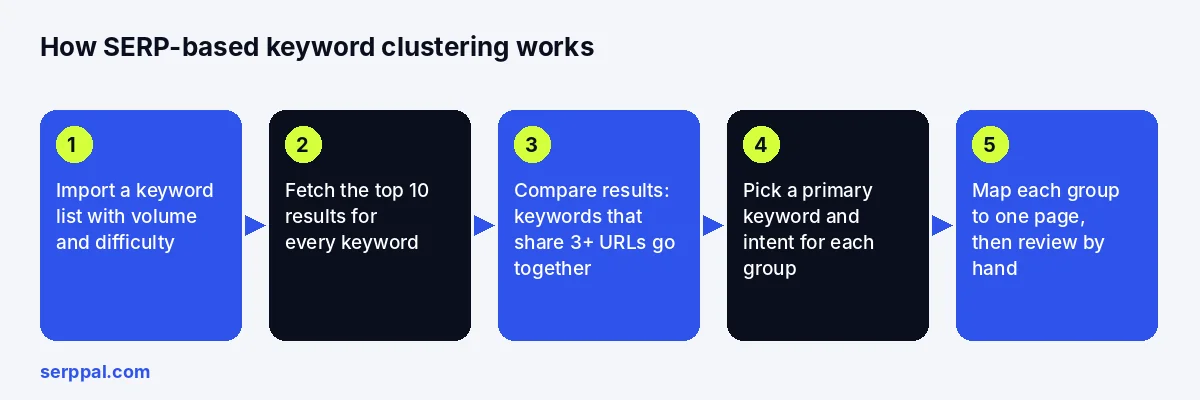
The tool runs a SERP analysis: it fetches the top 10 results for every keyword and analyzes which URLs they share. If two keywords share enough of the same ranking pages (a common threshold is 3 or more of the top 10), Google already treats them as one topic, and the tool puts them in the same group, so the clusters are based on evidence rather than wording, which is what makes accurate clusters possible. You can tighten the threshold for smaller, stricter groups or loosen it for bigger ones. This is the most reliable method for deciding which keywords one page can rank for, because it uses Google's own verdict.
Understanding semantic clustering
Semantic tools use NLP (natural language processing) to compare meaning, so semantically related phrases such as "cheap running shoes" and "budget running shoes" cluster even without SERP data. It's fast and cheap, good for a first sort of a huge list, and useful for spotting related subtopics. But similar meaning doesn't guarantee the same results page, so semantic clusters need a results check before they become pages. Thematic grouping is a start, not a verdict.
AI keyword clustering vs manual grouping
Manual grouping, dragging keywords into columns in a spreadsheet, works for a few hundred keywords and teaches beginners what a cluster is. Past that, AI clustering with a drag-and-drop review step is faster and more consistent. Better tools label each cluster with its search intent (informational, commercial, transactional, navigational) from the Google SERP, and some use AI to name the cluster, generate a working title and suggest a page type. That's what you need for planning: not just "these keywords go together" but "this group wants a comparison page".
| Method | How it groups | Strength | Weakness |
|---|---|---|---|
| SERP overlap | Shared ranking pages | Matches what Google actually ranks together | Needs search data for every keyword, so it costs credits and time |
| Semantic | Meaning and wording | Fast, cheap, finds related phrasing | Groups keywords Google splits, and splits ones it merges |
| Hybrid with intent | Shared results plus NLP plus intent labels | Most useful output for a content plan | Still needs a human review |
What the best keyword clustering tools have in common
Rather than ranking brands, here's the checklist that separates a useful clustering tool from a toy, whatever it's called: a keyword grouper, a cluster generator or a planner with clustering features.
| Feature | Why it matters |
|---|---|
| Results-based grouping with an adjustable threshold | Lets you trade tighter clusters for bigger ones; keywords based on the same results stay together |
| Intent labels per cluster | Tells you the page type before you write |
| Volume, difficulty and CPC carried through | So you can prioritize clusters, not just see them |
| Visible grouping logic | Shows the shared pages, so you can check a cluster in seconds |
| A great user interface | Reviewing 60 clusters is the slow part; a clear interface halves it |
| Data export features | Export to CSV without copy-paste errors; groups should keep their metrics |
| Location and language settings | Results differ by country; your clusters should too |
| Clean export (CSV, spreadsheet) and integrations | Clusters are useless stuck inside the tool; keyword data should travel |
| Capacity that matches your list | Credits per keyword, pay-as-you-go, keywords per month or unlimited; the units aren't interchangeable |
| A path to the brief | The best tools turn a cluster into an analysis and a draft without copying data |
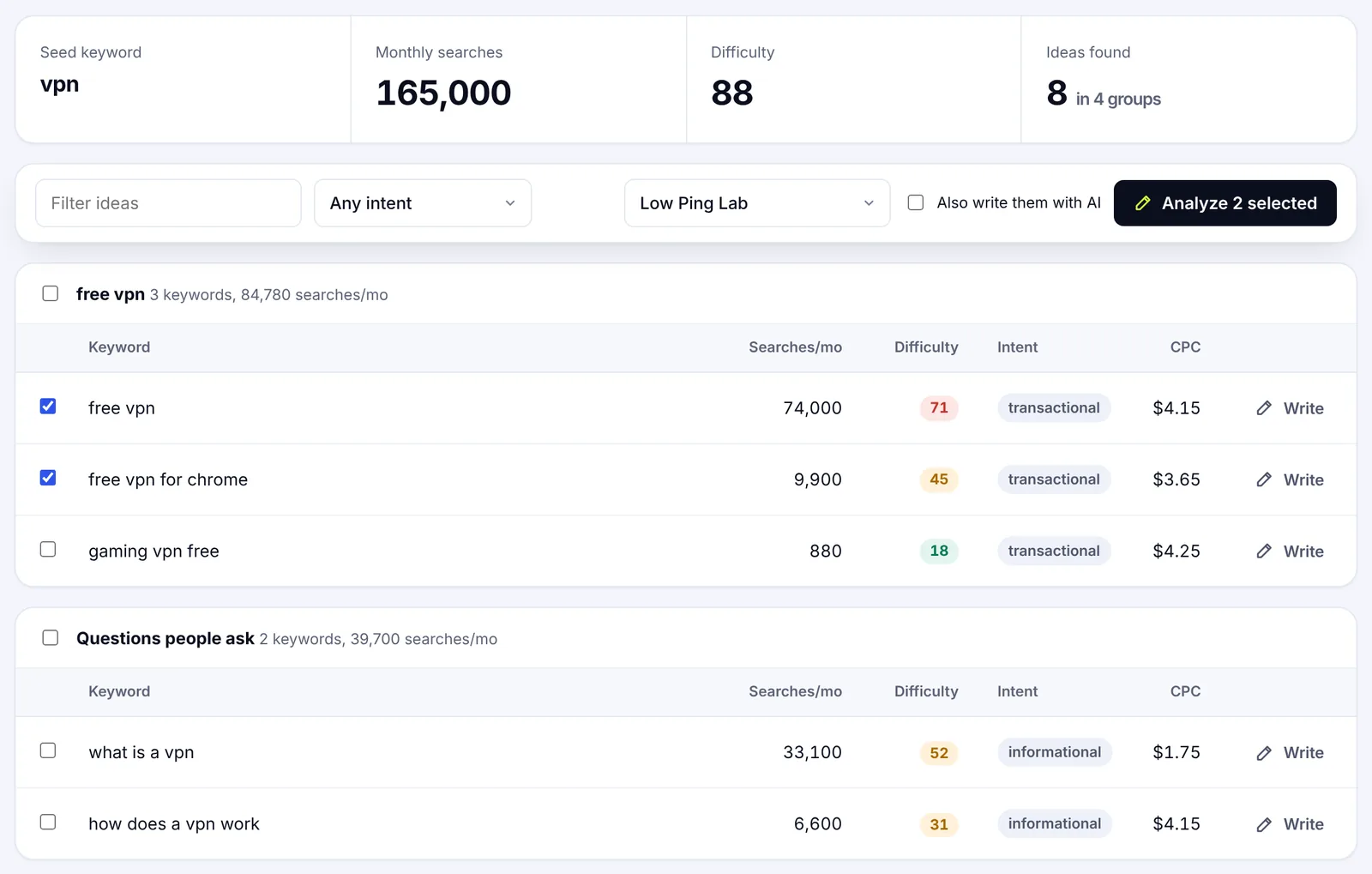
The last row is where an all-in-one SEO tool beats a standalone grouper. In SerpPal, the content planner finds keyword ideas for a topic with volume, difficulty, intent and CPC, groups them into clusters, and lets you analyze or AI-write up to 20 of them at once; the features page shows how the planner feeds the editor. It simplifies the step from keyword insights to a draft, which is the step most teams lose a week on.
Types of keyword clustering tools: pros and cons
- Standalone clustering tools. You paste or upload a keyword list, they return groups. Pros: built for large lists and agencies, accurate, data-driven clusters from search data. Cons: you still need other keyword research tools for research and writing.
- SEO platforms with a grouping feature. Clustering sits next to keyword research, rank tracking and site audits. Pros: one subscription, often a free trial. Cons: the clustering is sometimes basic, and the suite costs more than you need for this job.
- Content planners with clustering. Research, clustering and writing in one place, aimed at content creators and content teams rather than technical SEOs. Pros: clusters become briefs and drafts directly. Cons: less tuning of thresholds.
- Free keyword clustering tools. Usually semantic, usually capped at a few hundred keywords, often without exports. Pros: free. Cons: no SERP data, so the groups need checking.
- Spreadsheets and scripts. A SERP API plus a formula does overlap clustering for the cost of the API calls, if someone on the team can maintain it. Pros: cheap at scale, fully yours. Cons: maintenance.
How to choose the right keyword clustering tool
Here's how we'd choose among the options, and how we chose the criteria above.
- Start with the volume. A few hundred keywords for one site is a free tool or a planner. Thousands per client per month needs a dedicated tool with credits or an unlimited plan.
- Pick the method. For page targeting, insist on results-based grouping. Semantic-only tools are for a first pass, not for deciding pages.
- Check the output. Run a sample of 100 keywords you understand. Does the tool show why it grouped them? Does it label intent? Did it merge two intents you'd keep apart? Actionable clusters show the ranking keyword, the shared pages and the relevance of each member.
- Follow the data. Can it export clusters with their metrics, and can the clusters flow into briefs, analyses or a content calendar without retyping?
- Count the real cost. Credits per keyword, queries per month, seats, and whether PPC keyword data is included if you also run ads. Then add the hours of manual review the tool's accuracy will still require.
How to use a keyword grouping tool, step by step
- Compile and import a comprehensive keyword list. Pull keywords from Google Search Console, autocomplete, Reddit threads, competitors and a keyword tool, remove duplicates and off-topic phrases, and keep the volume and difficulty columns. New keywords can be added to a cluster later; a messy start can't be fixed later. The keyword research guide covers this part.
- Set location, language and threshold. Match the market you sell in. Start with a mid threshold (around 3 shared pages) and tighten it if clusters look mixed.
- Run a sample first. Cluster 100 keywords, check a few groups against live results, adjust, then run the full list.
- Review every cluster that will become a page. Look for mixed intents, outliers, and synonyms that landed in separate groups. Move keywords by hand; note the rule you applied so the clusters are based on consistent decisions.
- Assign a primary keyword and a page. The primary keyword is usually the highest-volume one with the clearest intent. Check your existing pages first: if one already ranks for the cluster, improve it instead of adding a competitor.
- Export and plan. Each cluster becomes a row in the content plan with its page type, status (new, update, merge, skip) and priority. Pro tips for making the most of the results: keep the rejected keywords in a sheet, and generate the briefs straight from the clusters so nothing is retyped.
Turning clusters into topic clusters and content
A keyword cluster is a page. A topic cluster is a set of pages: one pillar page on the broad topic and supporting articles on each sub-cluster, linked to each other. Keyword clustering gives you the list; the content strategy gives it structure, and the SEO strategy decides the order. Think of each topic cluster as a silo with doors: silos organize the site, the links between them keep it from fragmenting.
- Pick the broadest, topically central cluster with commercial or informational intent as the pillar.
- Map the narrower clusters to supporting articles and link them to the pillar with descriptive anchor text.
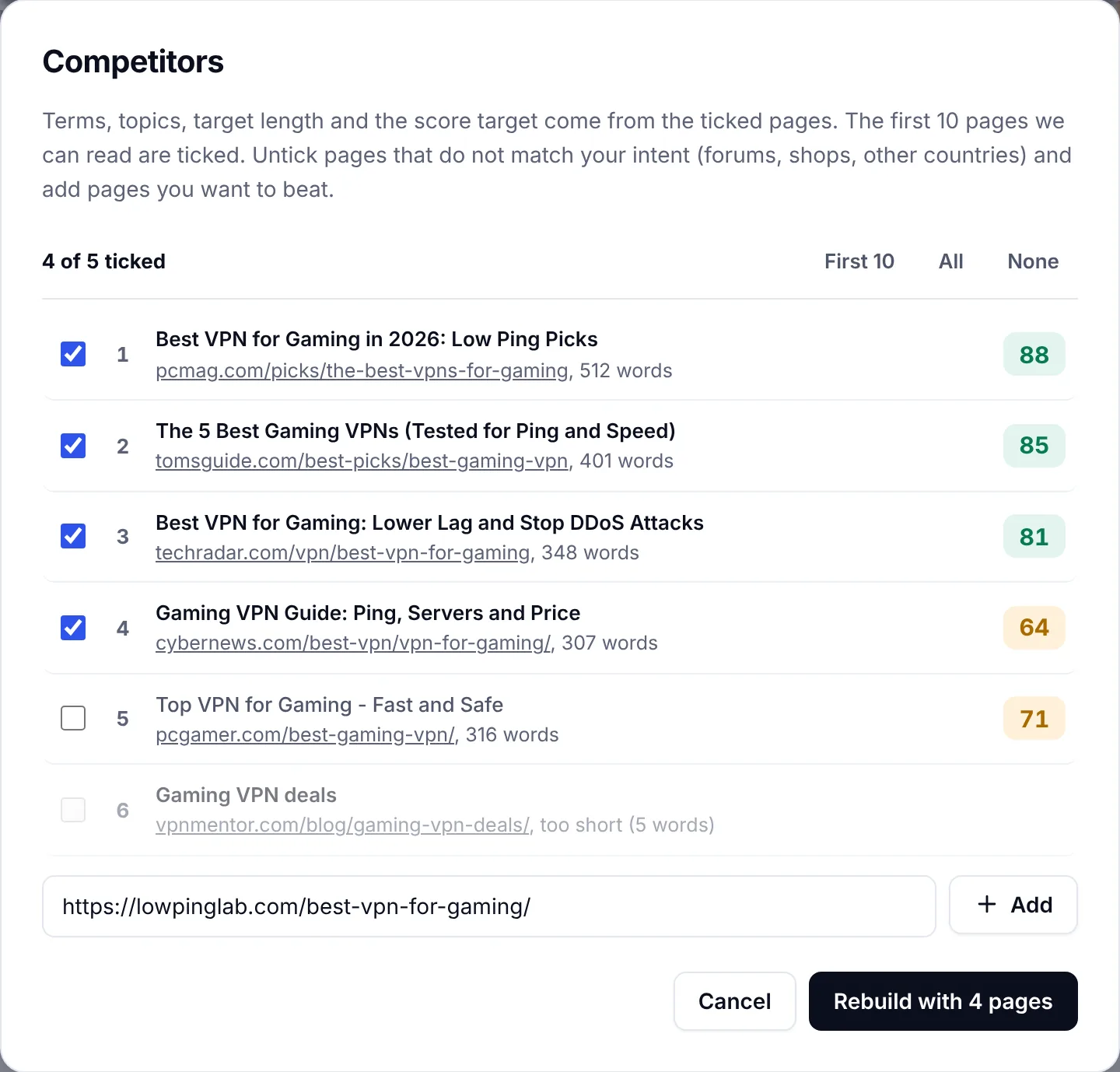
- Give each cluster a brief: primary keyword, supporting keywords, intent, questions to answer, target length from the top results.
- Write and optimize each page against the pages that already rank for its cluster, then publish and track the cluster's keywords in Search Console. The optimization step is where a content score earns its keep, and where a site with low Domain Authority can still win a narrow cluster.
Internal linking is what makes a topic cluster work. A sitemap-aware editor that suggests links to your own related pages while you write saves this step from being forgotten, and generating the links while drafting is one way to streamline it.
Common keyword clustering mistakes
- Trusting semantic similarity for page decisions. "Email marketing examples" and "email marketing platform" are related words with different intents. Check the SERP.
- One page per cluster, no exceptions. Sometimes two small clusters belong on one page, and sometimes a huge cluster needs two pages. The results decide.
- Forgetting existing pages. Clustering a fresh list without mapping current pages creates cannibalization instead of fixing it.
- Skipping the review. Every tool merges and splits wrongly sometimes. A ten-minute check of the clusters that become pages prevents months of wasted content.
- Clustering once. Search results change. Re-cluster a topic when you refresh its content, and whenever a cluster's rankings stall. Optimizing a cluster is ongoing, like the rest of SEO.
Frequently asked questions
What is a keyword clustering tool?
A keyword clustering tool groups a list of keywords into clusters that one page can target, by comparing the pages that rank for each keyword (overlap) or the meaning of the keywords (semantic), with AI handling the work on larger lists. Good ones label the intent of each cluster, keep the volume and difficulty data, and export the groups for a content plan.
What's the difference between keyword clustering and keyword grouping?
Nothing in practice; the terms are used interchangeably. Some people use "grouping" for simple sorting by wording and "clustering" for results-based analysis, but most tools use both words for the same feature, and the strategy behind them is the same.
Are free keyword clustering tools worth using?
For a small site or a first look, yes. A free tool is usually semantic, capped at a few hundred keywords and short on exports, so verify the clusters against the search results before building pages on them. Paid tools earn their fee on large lists, accuracy and integration with the rest of the workflow; many offer a free trial, which is the right way to test them on your own keyword data.
How many keywords should be in a cluster?
As many as share the same intent and the same top results, which can be two or forty. Cluster size isn't a goal; the test is whether one page can answer every keyword in the group well. A cluster with two clearly different intents should be split, whatever its size.
Do keyword clusters improve rankings?
Indirectly. Clustering stops your pages from competing with each other, makes each page cover its topic fully, and gives supporting pages a structure to link within. Rankings still depend on the quality of the page and the strength of the site; clustering makes sure the effort goes to the right pages.