On this page
- Key takeaways
- What AI writing tools do
- What AI tools do well for content creation
- Where AI-powered writing tools fail
- The best AI writing tools by type: a comparison
- How to choose an AI writing tool
- Pricing: free AI writing tools and paid plans
- A practical workflow for AI-assisted writing
- Accuracy, originality, fact-checking and responsible use
- Conclusion
- Frequently asked questions
An AI writing tool is software that uses a large language model to generate, expand, summarize, translate or edit text from your instructions. The best ones are reliable at first versions, outlines, variations and tone changes, and unreliable at facts, original experience and knowing your audience.
This guide explains what AI writing tools do well, where they fall short, the main types on the market, what they cost and how to choose one for your work: blog posts, marketing copy, emails, SEO articles, fiction or school assignments. It doesn't rank vendors; it gives you the test to run before you pay.
Key takeaways
- AI writing tools are good at the blank page problem: structure, first versions, variations, summaries and tone. They're bad at facts they weren't given.
- The tool matters less than the model behind it and the context you give it. A clear brief beats a clever prompt.
- Pick by task: a general AI writing assistant for varied work, an SEO AI tool for articles that need to rank, a text generator for ads and landing pages, an editor for polish.
- Free plans exist for every category; paid plans start around $9/month for light tools and $20/month for general assistants.
- Always verify the facts, humanize where needed, and keep a person responsible for what gets published.
What AI writing tools do
AI writing tools are products built on powerful LLMs (large language models) such as the GPT models from OpenAI, Claude from Anthropic and Gemini from Google. The model predicts text; the tool wraps it in an interface, templates, saved instructions and integrations so the output fits a job.
The category covers several kinds of products:
- Chat helpers that take any request: ChatGPT, Claude, Gemini and similar conversational chatbots, with paid tiers such as ChatGPT Plus, Claude Pro and Gemini Advanced for the newer models.
- Content generators that produce blog posts, landing pages, social media posts and ad copy from a template, built for copywriting and marketing teams.
- SEO AI tools that research the top-ranking pages first, then generate content built to cover the keyword, often with an AI article writer and a content score in one platform.
- Editing assistants that fix grammar, tighten sentences, improve readability and change tone in text you already wrote.
- Built-in AI inside Google Docs, Gmail, Google Workspace and most CMSs, usually a lighter version of the above.
The labels blur. A chat tool can polish, an editor can suggest a sentence, an SEO tool can summarize. Compare what a product does in your actual writing workflow, not the label on its pricing page.
AI model versus AI writing assistant
Two products built on the same model, or on the same APIs, can feel very different. One gives you a blank chat window; the other gives you a brief, a brand voice, a content score and a publish button. When a tool claims a "proprietary AI", it usually means a well-known model plus custom instructions. That's fine, but it means you're paying for the workflow, so judge the workflow.
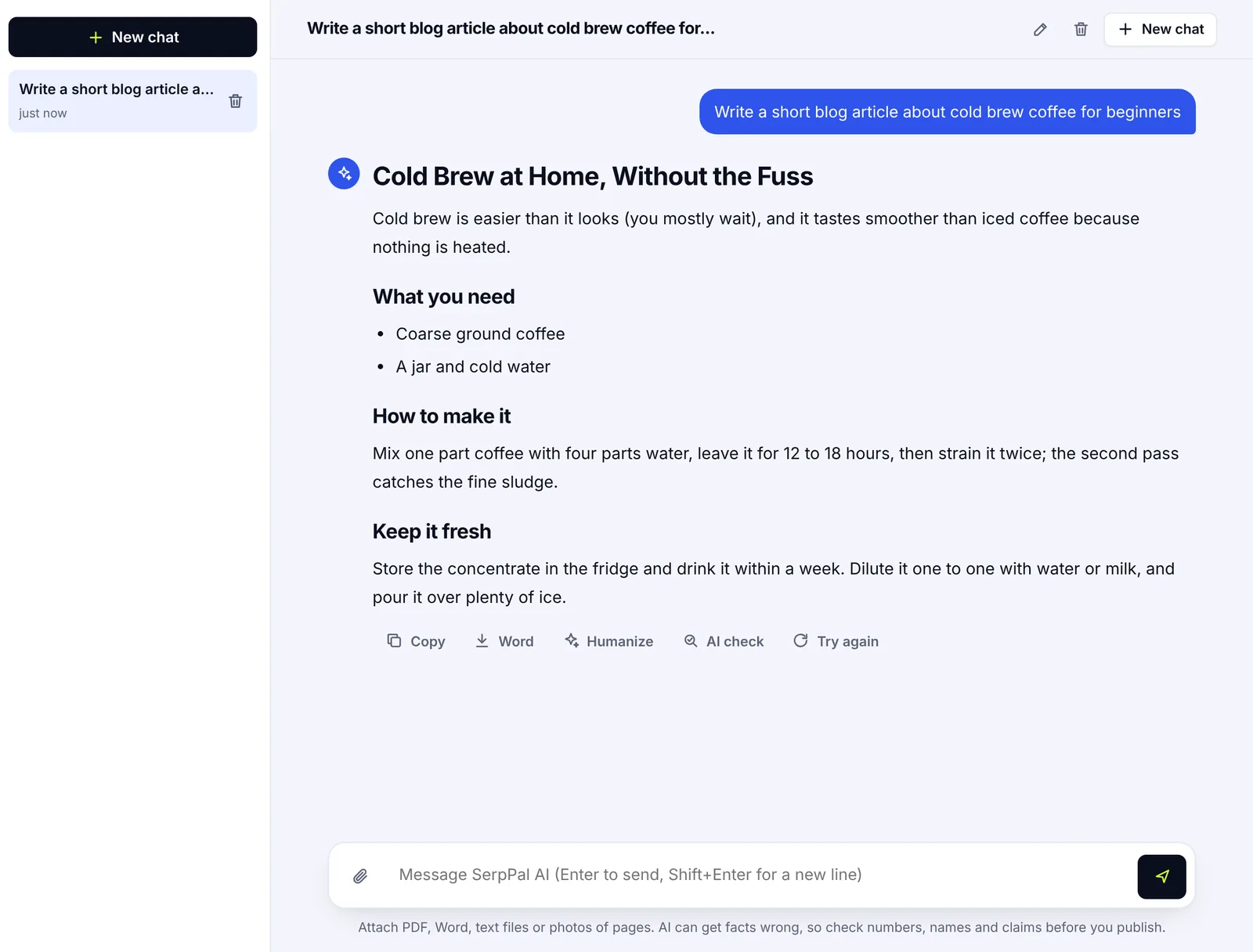
What AI tools do well for content creation
Used for the right job, these tools save content creators hours a week. They're strong at:
- Outlines and structure. Give the topic and audience, get a sensible structure to react to.
- First versions. A rough first pass in a minute that you refine, instead of a blank page you stare at.
- Variations. Ten subject lines, five social media captions, three versions of a Google Ads headline.
- Repurposing. Long-form content into a LinkedIn post, a newsletter and a short script.
- Summaries. Long reports, transcripts and PDFs into bullet points.
- Tone and writing styles. The same paragraph in a casual, formal or simple voice.
- Explaining. Plain-language explanations of a technical paragraph you need to understand before you write about it.
- Organizing. Turning messy notes and ideas into a structured document.
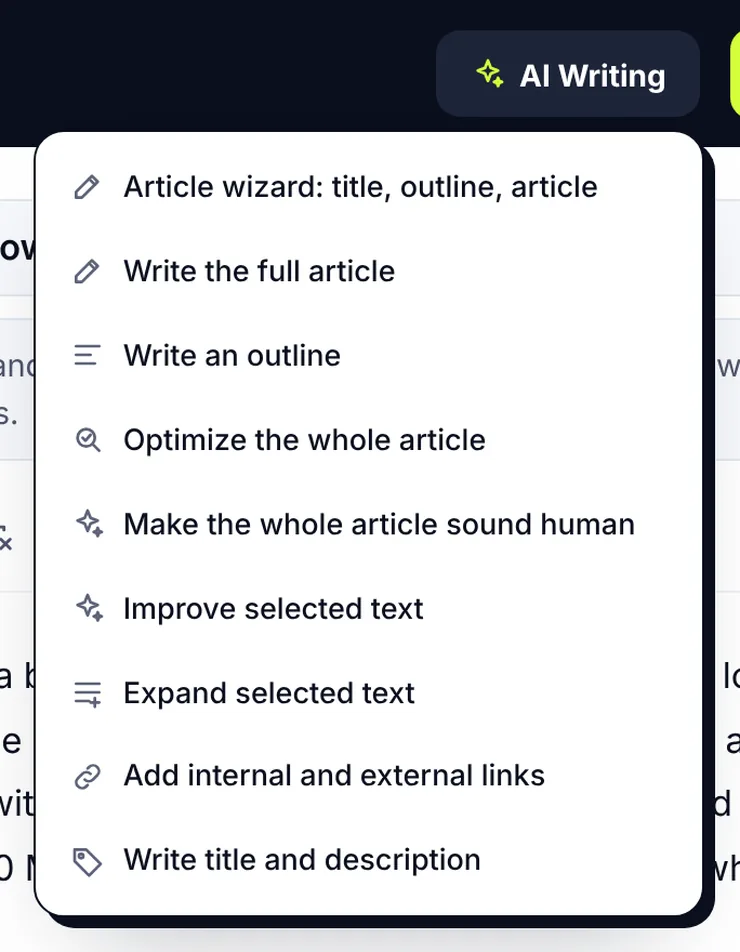
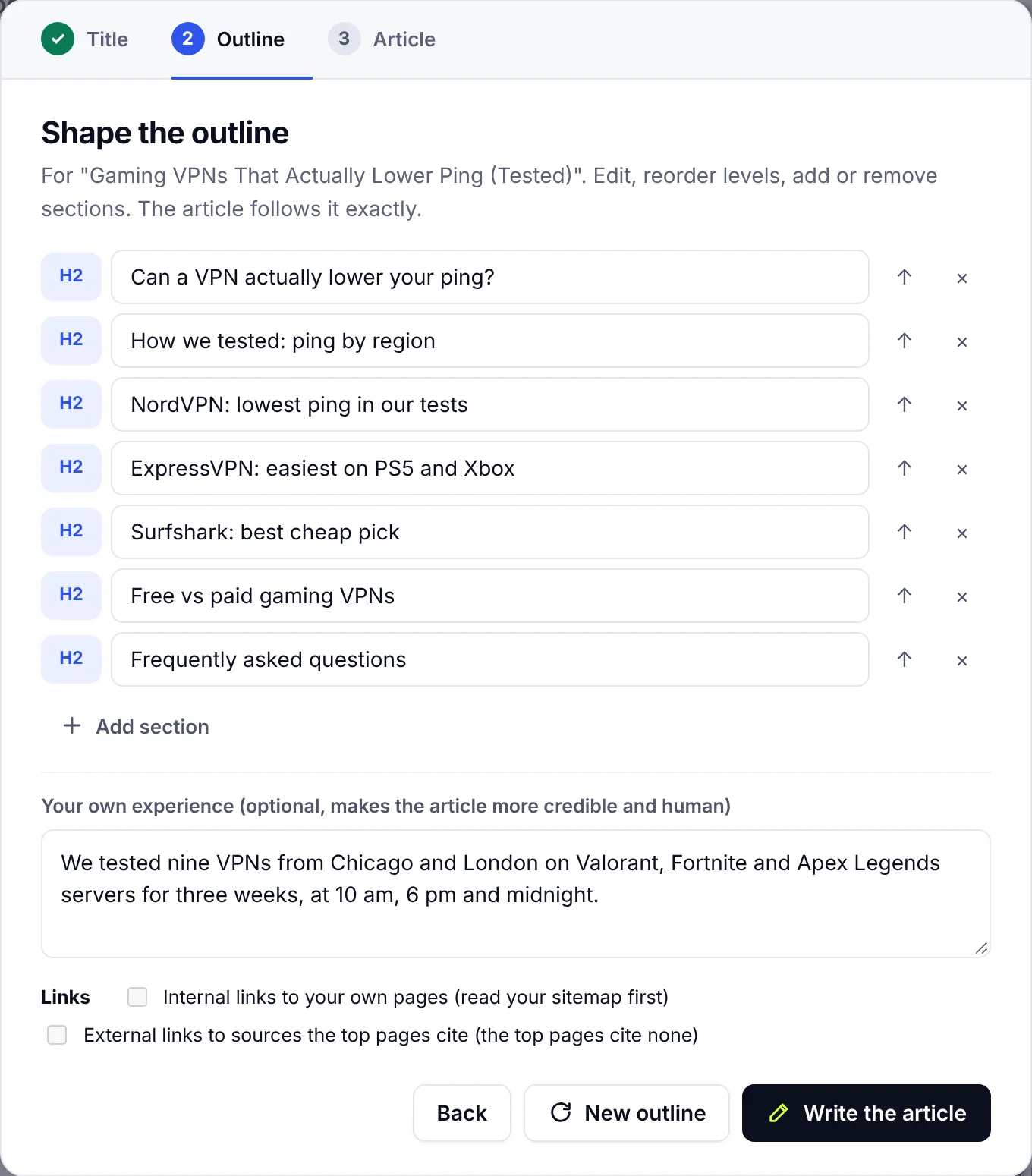
For SEO content, there's an extra win when the tool analyzes the top-ranking pages first. AI content that starts from the terms, headings and questions those pages share is on-topic from the first sentence, and the content score tells you what's still missing. That's how SerpPal's AI writer works: analysis, brief, article, score, humanize, publish, in one editor, so the output is ready for search instead of generic.
Where AI-powered writing tools fail
The failures are consistent across every product, because they come from the models. Even your favorite AI assistant has them.
- Invented facts. A model will state a statistic, a quote or a source that doesn't exist, in a confident tone. Treat every number, name and claim as unverified until you check it.
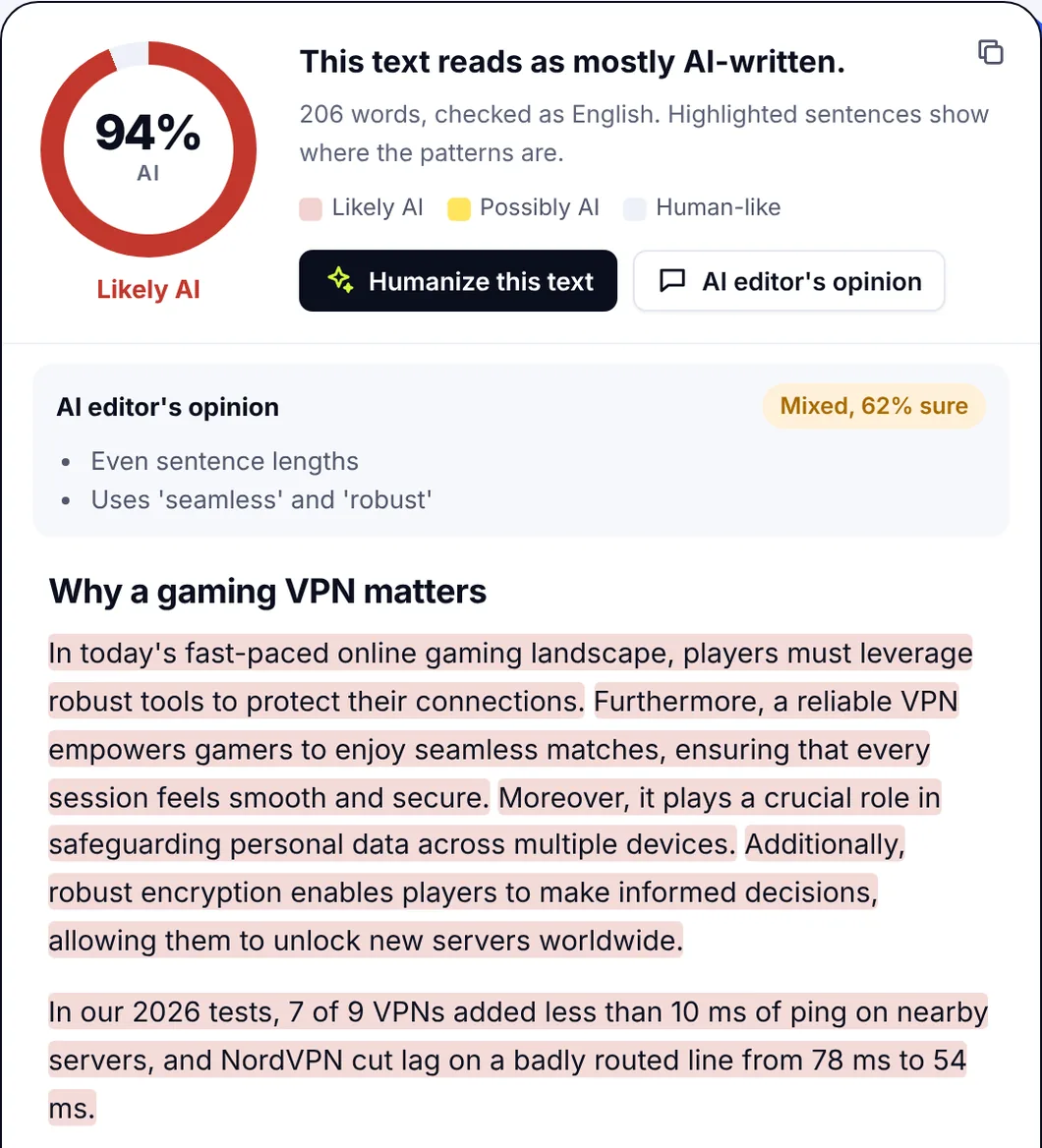
- Generic copy. Without specifics about your product and audience, the output reads like everyone else's. The patterns AI text tends to have are easy to spot: even sentence lengths, stock phrases, tidy three-part lists. The model lacks a point of view.
- No experience. The model has never used your product, visited the city or made the mistake. That's the part people want from your article, and it has to come from you.
- Drift from the brief. Long outputs forget constraints given at the start. Required wording, a legal claim or a banned word can slip.
- Detection and trust. An AI checker is imperfect, but readers and editors still notice unedited AI text. Heavily AI-written pages that add nothing tend to do badly in search over time.
Google's position is clear: it rewards helpful content however it's produced and penalizes content made mainly to game rankings. Its guidance on AI-generated content is worth reading before you build a publishing process around any tool.
The best AI writing tools by type: a comparison
Rather than brand names, here are the categories, with their pros and cons and who each one suits. Choosing the right type matters more than choosing the right logo.
Strengths and limitations of each tool type
| Type | Pros | Cons | Best for |
|---|---|---|---|
| General chat assistant | Flexible, cheap, handles anything, long context | No research, no brand memory beyond a session, needs good prompts | Writers who can brief and polish |
| SEO AI writer | Analyzes the SERP, writes to a brief, scores the article, publishes | Built specifically for search content, less use for emails | Bloggers, marketers, agencies writing to rank |
| Marketing copy generator | Templates for ads, sales pages, product descriptions, brand voice | Output needs a human pass; costs climb with seats | Marketing teams producing lots of short-form content |
| Proofreading assistant | Grammar, clarity, tone, integrates everywhere via plugin | Doesn't research or draft long pieces | A final pass on anything |
| Fiction and creative tools | Scene ideas, descriptions, alternatives, long-form writing support | Niche; not for business copy | Fiction writers and screenwriters |
| Built-in AI in Docs, Gmail, CMS | Already there, no new login, fits existing workflows | Lighter models, fewer controls | Quick drafts and replies |
Most creators end up with two: a general tool for messaging, emails and thinking, and one specialist specifically designed for the work they do most. Paying for four overlapping subscriptions is the common mistake.
Fiction, creative and niche writing tools
Tools for writing fiction are a category of their own: a muse on demand that suggests prose, describes a scene three ways, or keeps a character consistent across chapters. They're designed for novelists, not marketing copy, and a general chat tool does a fair imitation for occasional use. Other niche tools exist for legal drafting, academic writing and technical documentation; the same evaluation rules apply.
How to choose an AI writing tool
Step 1: Pick the best tool for the writing task you repeat most
If you publish SEO articles every week, an SEO writer with a content score pays for itself faster than a general assistant. If you write ad copy and sales pages all day, a copy generator with brand voice saves the most time. Content creation at that volume needs templates, and pricing per seat matters. If you write one newsletter a month, the free tier of ChatGPT or another chat tool is enough.
Step 2: Decide how much control you need
Beginners usually want guided templates and clear suggestions. Experienced writers want a conversational interface where they can paste a brief, source notes and precise instructions, then improve in stages. Make sure you can rewrite one paragraph without regenerating the whole piece. A straightforward interface beats an in-depth feature list you never open.
Step 3: Check the workflow and integrations
Where does the text need to end up? If it's Google Docs, you want clean export. If it's WordPress or another CMS, direct publishing removes a copy-paste step. If it's a team, you need comments, versions and shared brand instructions. Automation is only useful when it connects to the SEO tools and the platform you already use.
Step 4: Read the data terms
Before pasting client material, unpublished research or customer data into any tool, read how prompts and files are stored and whether they're used for training. For agency work, this is often the deciding factor.
Step 5: Hands-on testing: run the same evaluation in each tool
Prepare a short test pack: a product description, a business email and a section of a blog post, with the same audience, facts, tone and length for every tool. Then judge:
- Accuracy: did it keep the facts you supplied and avoid adding new ones?
- Usefulness: does the draft answer the reader's question with the detail you asked for?
- Revision effort: how much work to make it publishable?
- Control: could you improve a passage with a specific instruction?
- Fit: could you save, share and move the draft into your tools without friction?
Don't score tools by which one writes the longest answer. Concise and accurate beats long and polished. Generating more words is the easy part.
Pricing: free AI writing tools and paid plans
Every category has a free AI option. Chat assistants have generous free tiers with the newer, more powerful models reserved for paid plans, typically around $20/month. Proofreading tools are free for grammar and charge for tone and full sentence suggestions. SEO writers and copy generators usually offer a free plan or trial with a monthly cap on AI words, and paid plans from roughly $9/month for light use to $39/month or $49/month for teams, often billed yearly for a discount.
The useful question isn't "is it free" but "what's the limit and what happens when I hit it". Count your monthly output in words or articles, look up what the free plan allows, and compare the next plan up with the time it would save you. Pricing pages change often, so read them on the day you decide.
A practical workflow for AI-assisted writing
The quality of the output tracks the quality of the brief more than the choice of tool. A simple process:
- Set the assignment. Who the reader is, what they need, what the text should make them do or understand.
- Give context. Verified facts, examples of your tone, the format, the length, anything to avoid.
- Ask for structure first. An outline or three angles before a full draft, so you can steer early.
- Generate, then improve in stages. Structure, then content, then sentences. Give specific instructions ("cut the second section to three bullets") rather than "make it better".
- Verify and personalize. Confirm every claim, add the examples only you have, remove the filler.
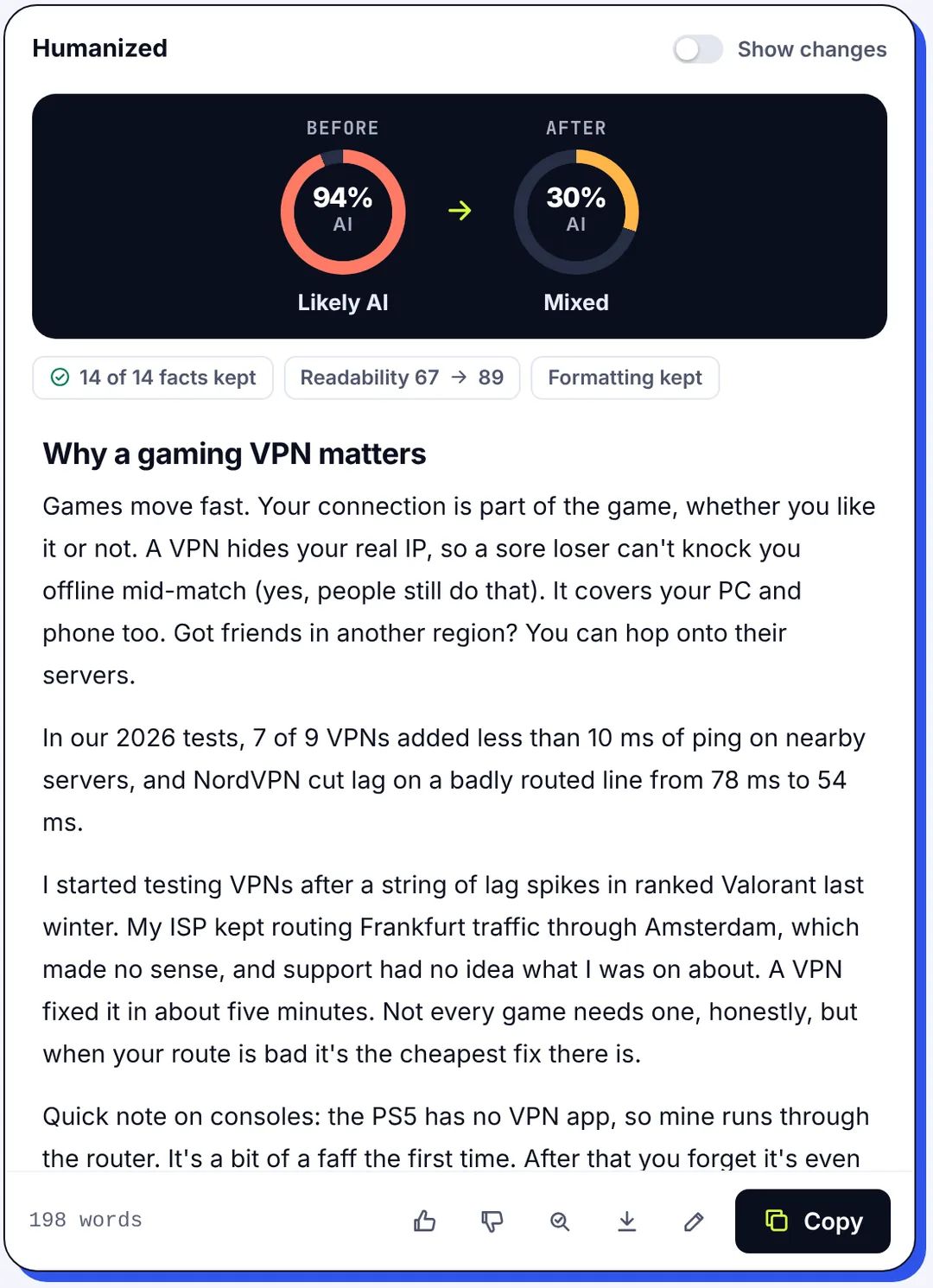
- Humanize and verify. Run the text through a humanizer if it reads stiff, then an AI detector to see which sentences still read machine-made, and fix those by hand.
- Optimize for search if it's a web page. Title, meta description, headings, internal links, keyword placement and a content score against the pages that rank. The SEO content writing guide covers that part, and the same optimization helps with GEO, showing up in AI answers.
This is the writing process whether you use ChatGPT, a dedicated AI writer or a drafting tool inside your CMS. The tool changes how fast steps 3 and 4 go; it doesn't remove steps 5 to 7.
Accuracy, originality, fact-checking and responsible use
AI-generated content can include errors, invented citations and phrasing that echoes other sources. Verify claims against reliable sources, open every cited page, and add reporting, examples or expert review where the topic deserves it. Originality is about substance, not wording, and a plagiarism checker only confirms the wording.
AI detection and search performance
An AI detector can tell you which sentences read machine-made, which is useful for revision, but it can't prove authorship and it misfires on polished human writing. Search performance depends on whether the page helps the reader, not on which tool helped write it: pages with real detail and experience hold their positions, generic ones fade.
Privacy, ownership and responsible use
Follow the rules of your school, client, workplace or publisher. Some require disclosure, some forbid AI drafts for certain work, and most expect a person to stand behind the final text. Don't generate fake reviews, testimonials or endorsements, and don't paste confidential information into a tool whose data terms you haven't read.
Conclusion
The best AI writing tools remove the slow parts of writing, the blank page, the tenth variation, the summary of a 40-page PDF, and leave the parts that need a person: judgment, facts and experience. Who would benefit most? Anyone who writes regularly and can judge the result. Choose by the task you repeat most, test with a real brief, read the data terms, and build a process where every draft gets checked before it ships. If most of your writing is content that needs to rank, an AI writer that starts from the search results, like the one in SerpPal's editor, saves more time than a general assistant with a good prompt, and the AI Chat docs show what that looks like in practice.
Frequently asked questions
What is an AI writing tool?
An AI writing tool is software that uses a language model to generate, expand, summarize, translate or edit text from your instructions. It can be a general chat assistant, a template-based content generator, an SEO writer that researches the top pages first, or an editing assistant that improves text you wrote.
Is ChatGPT an AI writing tool?
Yes. ChatGPT is a general-purpose assistant, and writing is one of its main uses: outlines, emails, summaries, first versions and revisions. It doesn't research search results or track a content score, so SEO writers add those steps on top of a similar model.
Are AI writing tools free?
Most offer a free plan or trial with a cap on messages, words or features. Free tiers are enough for occasional ideas and brainstorming. Regular publishing, team features, newer models and integrations are where paid plans start, typically from $9/month to $49/month depending on the category.
Can AI writing tools be detected?
Sometimes. AI detectors look for the patterns AI text tends to have, and unedited output often shows them. Revised, verified and personalized text is much harder to tell apart, and detectors also misfire on polished human writing. Treat a detector score as a reason to look at a sentence, not as proof of who wrote it.
Are AI writing tools good for SEO?
They can be, when the article starts from research into what already ranks and a person adds accuracy, examples and experience. Generic AI articles published at volume without editing tend to lose visibility over time, because they add nothing the existing results don't.