On this page
- Key takeaways
- What SEO content writing is and why it matters
- Step 1: Set a goal and pick the topic
- Step 2: Do keyword research and take a strategic approach to keywords
- Step 3: Read the search intent
- Step 4: Plan the structure before you write
- Step 5: Write the draft
- Step 6: On-page SEO best practices: optimize your content and metadata
- Step 7: Publish, measure rankings and refresh
- SEO writing example for a blog post or service page
- Common SEO content writing mistakes
- Doing it yourself or hiring SEO writing services
- A quick SEO content writing checklist
- Frequently asked questions (FAQs) about SEO content writing
SEO content writing is the practice of creating content that answers what people search for, in a form search engines can understand and reward. Done well, it brings organic traffic from people who already want what your page offers, and it keeps bringing that traffic for months after you hit publish.
This guide walks through the whole process: keyword research, reading search intent, planning the structure, writing the draft, on-page optimization and measuring what the content does once it's live. It works for blog posts, landing pages, product descriptions and long-form guides alike.
Key takeaways
- Effective SEO content starts with a clear goal and a keyword people actually search for, then matches the format those searchers expect.
- Structure matters: header tags, short paragraphs, lists and tables help both people and search engine algorithms understand the page.
- Use the main keyword and relevant keywords naturally. Keyword stuffing hurts readability and does nothing for search rankings.
- Metadata (title tag, meta description, image text) decides whether people click; the body decides whether they stay.
- Measure impressions, clicks and conversion rate in Google Search Console and analytics, then refresh content that underperforms.
What SEO content writing is and why it matters
Search engine optimization has two halves. The technical half makes a site crawlable and fast. The content half, which is what SEO content writing covers, makes each page the best answer for a specific search. A copywriter persuades; an SEO content writer informs, persuades and makes sure the page is found.
Content marketing and SEO overlap heavily here. Most of the organic traffic a business earns comes from well-written, optimized content that targets informational search queries, such as "how to", "what is" and "best way to". That traffic is cheaper than ads, compounds over time and supports every other part of a digital marketing strategy. A content strategy without SEO leaves visibility on the table; an SEO strategy without good content has nothing to show.
Positions are never guaranteed. Google's systems weigh hundreds of signals, including site quality, links and how well a page satisfies the user intent behind a query. What you control is the quality content on the page and how clearly it's presented. That's where this guide focuses.
SEO writer versus copywriter
SEO copywriting and SEO content writing both should be clear, accurate and engaging. SEO writing adds a deliberate focus on discoverability: what the target audience searches for, which content types rank for that search and how the page fits into the rest of the site. Good SEO content is still written for people first. Search engines have become very good at telling the difference between helpful content and content stuffed with keywords.
Step 1: Set a goal and pick the topic
Decide what the page should do before you write a word. A SaaS company might want a guide that attracts people comparing software. A local service business might need a page that answers questions about one service area. Align the topic with a business goal: leads, trials, sales or fewer support tickets. Then align it with your content marketing calendar so it supports a campaign instead of standing alone.
Then check whether your site can answer the question better than the pages already on page one. If the top search results are thorough, well-structured guides from established sites, a thin 500-word post won't compete. If they're outdated or shallow, there's an opening.
Step 2: Do keyword research and take a strategic approach to keywords
Keyword research tells you how your audience searches for the topic and how much demand there is. Start with a plain description of the problem, then expand it into the words people use. Google's autocomplete, the "People also ask" box and the related searches at the bottom of the results page are free sources, and Google Keyword Planner gives rough volumes. SEO tools add search volume, difficulty and cost-per-click estimates so you can compare options and analyze the competition.
Prioritize relevance over raw volume. A long-tail keyword such as "seo content writing checklist" may bring far fewer searchers than "seo", but those searchers are much closer to needing what you offer. Group relevant keywords by the need they express (topic clustering) rather than creating a separate page for every wording variation. One strong page that covers a cluster usually performs better than five thin ones.
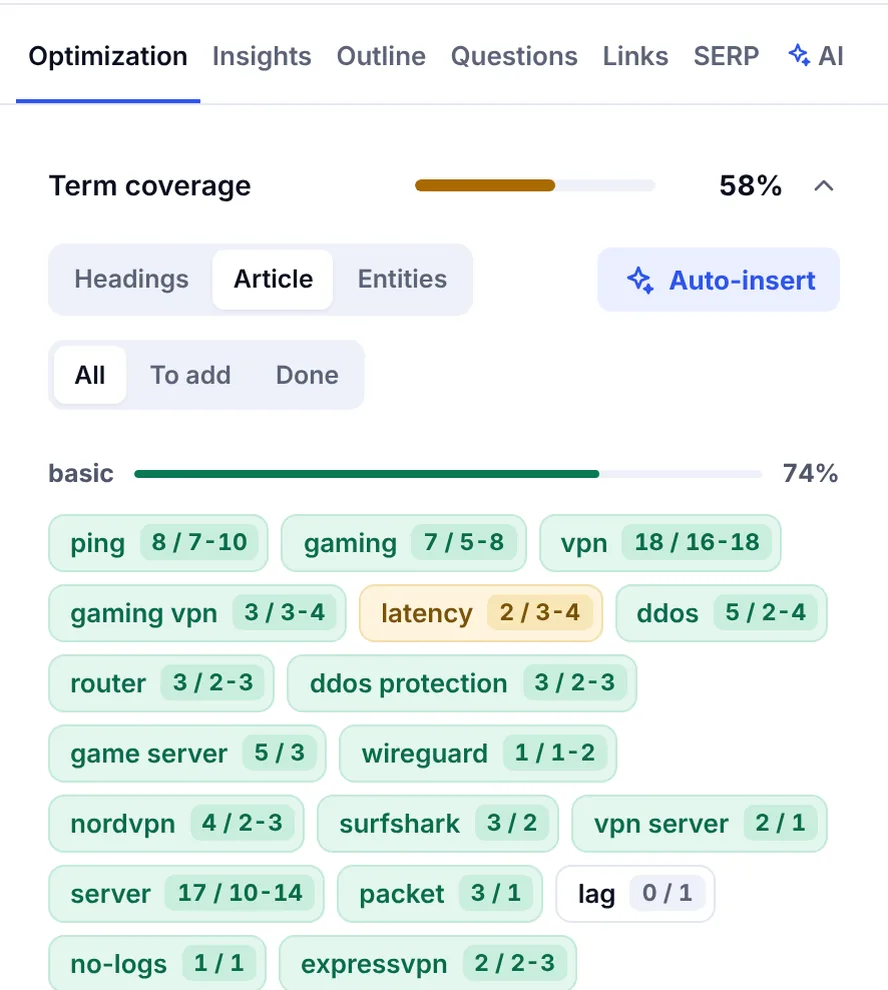
Keep a short list: one primary keyword and a handful of semantically related keywords. You'll use them in the title, headings and body, but only where they fit. SerpPal's AI writer reads the top pages for your keyword and turns them into a brief with the terms, headings and questions those pages share, so this step takes minutes instead of an afternoon.
Step 3: Read the search intent
Search the keyword and look at what Google ranks. The format of the top results shows the intent behind the query: informational searches get guides and explainers, commercial searches get comparisons and reviews, transactional searches get product and landing pages.
Use those results as evidence, not as a template to copy. Note the content types, the average length, the questions they answer and anything they all miss. If every result is a step-by-step guide, a short sales page won't satisfy the visitor no matter how well it's written. Google's ranking systems, including RankBrain and BERT, use natural language processing (NLP) to match search queries with meaning rather than exact words, so a page that covers the topic well can show up for hundreds of related searches it never mentions word for word.
Step 4: Plan the structure before you write
A clear structure makes long-form content easy to scan and helps search engines map the page. Start with a short intro that gives the main answer in the first two sentences. Then develop supporting points in a logical order, and finish with next steps.
Structure matters: headers, subheaders and sub-subheaders
Header tags are the skeleton of the page. Use one H1 (the title), H2s for the main sections and H3s for the points inside them. Each header should describe what follows in plain words, because people scan headings before they read, and search engines use them to understand the topic hierarchy.
A rough rule for readability: a new H2 every 200 to 350 words, two to four sentences per block of text, and bullet lists or a table wherever you compare things. The outline for this article, for example, was planned as a goal, a workflow, examples, mistakes and a FAQ before any text was drafted.
Aim for featured snippets and voice search
Featured snippets are the answer boxes above the regular results, and the same short answers are what voice assistants read aloud for voice search. Google pulls them from pages that answer a question directly in 40 to 60 words, usually right under a heading that restates the question. To give your page a chance: ask the question in an H2 or H3, answer it in the first sentence of the paragraph below, and use a numbered list for processes and a table for comparisons.
Step 5: Write the draft
Write for one person who needs to understand or decide something. Explain unfamiliar terms, use concrete examples and say where the limits are. Contractions, short sentences and plain words make content easier to read and more informative; they don't make it less authoritative.
What high-quality content looks like
Google's guidance on creating helpful, reliable, people-first content asks the same questions a good editor asks. Does the page demonstrate first-hand experience? Does it add something the top results don't? Would someone bookmark it or share it? Quality content shows its work: a clear process, real examples, honest trade-offs and credible sources for the claims that need them. That's what builds credibility with readers and trustworthiness in Google's eyes.
Originality means adding something useful, not just rewording the pages already on page one. Align every section with a question a real person asked. Bring in your own data, a screenshot of a real result, a mistake you made and fixed. That's what E-E-A-T (experience, expertise, authoritativeness, trustworthiness) means in practice, and it's also what earns backlinks: people link to pages that taught them something.
Using AI in content creation
AI-powered writing assistants are now part of most content teams' workflow, and that's fine when they're used well. They can generate first drafts, outlines and summaries, and they're quick at finding gaps against the competition. They're bad at facts they weren't given, at original experience and at knowing your product. Give the tool a brief, check every claim, cut the filler and add what only you know. AI-generated text that nobody edited reads generic, and readers notice. The writer is still responsible for what gets published.
Step 6: On-page SEO best practices: optimize your content and metadata
To optimize content for search, make the page's subject obvious to search engines without making it awkward for people. A few best practices cover most of it, whether you publish in WordPress or any other CMS.
| Element | What to do | Why it matters |
|---|---|---|
| Title tag | Put the main keyword near the front, keep it under 60 characters, make it specific | It's the headline in search results and the strongest on-page signal |
| Meta description | Summarize the page in 120 to 160 characters with a reason to click | Google may rewrite it, but a good one lifts click-through rate |
| H1 and header tags | One H1 that matches the title; H2s and H3s that describe each section | Structure for people and for crawlers |
| URL | Short, lowercase, with the keyword | Easier to read, share and remember |
| Body copy | Main keyword in the first 100 words, secondary terms where natural | Shows relevance without stuffing |
| Images | Descriptive alt text, compressed files, useful captions | Accessibility, image search, page speed |
| HTML | Clean markup, one H1, no hidden text | Crawlers read the HTML, not the design |
| Internal links | Link to related pages with descriptive anchor text | Helps discovery and spreads authority |
| Schema markup | Add FAQ, HowTo or Article structured data where it matches the page | Can earn richer search results |
Meta tags don't rank a page on their own, but they decide whether anyone clicks, which is why optimizing them is worth ten minutes on every post. Preview how the title and description will look before you publish; a free SERP preview tool shows where Google will cut them off.
Keyword use and keyword density
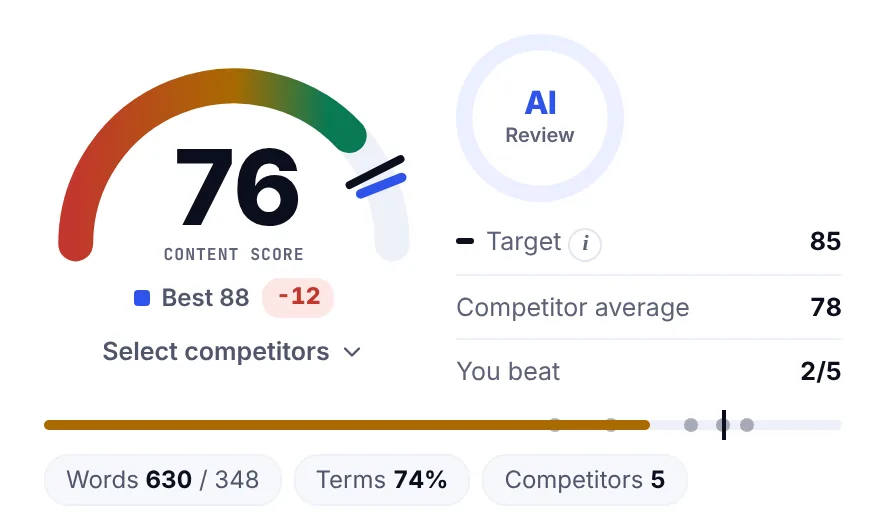
There's no magic density. The top pages for a keyword use the main term and its related terms within a natural range, and that range is what you should aim for. Optimized content covers the topic; stuffed content repeats a phrase. Too few mentions and the topic is unclear; too many and the text reads like spam. A content score, such as the one in the SerpPal editor, measures your draft against the top pages and shows which terms are missing, low or overused. What a content score is explains how to use one without stuffing.
Interactive and visual elements
Tables, charts, screenshots, calculators and videos keep people on the page and make complex points easier to follow. They also give you more ways to showcase expertise while enhancing the page for people who skim. Every image needs descriptive alt attributes, and every video needs a short text summary nearby, because search engines index words, not pixels.
Step 7: Publish, measure rankings and refresh
Before publishing, check facts, spelling, links, mobile layout and page speed. After publishing, Google Search Console shows impressions, clicks, click-through rate and average position for each query the page shows up for. Google Analytics shows what people do next: read another page, sign up, buy.
Pick metrics and KPIs that match the goal, and use the insights from both tools together. A guide meant to attract future customers should be judged on relevant visits and conversions, not traffic alone. Give the page a few weeks to gather data, then look for patterns:
- Impressions but few clicks: the title and meta description don't match what the person wants. Rewrite them.
- Clicks but short visits: the intro doesn't deliver the promised answer fast enough, or the format is wrong for the query.
- Stuck on page two: the page is relevant but not the best answer yet. Add the missing subtopics, improve the structure, earn a few links.
Content updates pay off when facts change, when Search Console shows queries the page doesn't answer well, or when a competitor publishes something better. Don't rewrite a page just because it hasn't moved in two weeks. Positions move around, and pointless edits can remove what was working. Track the same metrics each month so you can tell a real drop from noise.
SEO writing example for a blog post or service page
Before: "Our team offers the best SEO content writing services. SEO content writing helps SEO content rank, and our SEO writers create SEO content writing for businesses." The phrase repeats five times and the reader learns nothing.
After: "We write search-focused service pages and blog posts that answer customer questions, explain your offer and guide people to a clear next step. Each page starts with keyword and intent research and goes through editorial review before it's published."
The second version uses the keyword once, reads like a person wrote it and tells the prospect exactly what they get. That's the whole idea of effective SEO content: the optimization is invisible, the usefulness is obvious.
Common SEO content writing mistakes
Most SEO writing that fails to perform fails for one of these reasons:
- Writing before researching. Picking a topic nobody searches for, or one the site can't compete on.
- Ignoring intent. Publishing a sales page for an informational query, or a 3,000-word guide for a question with a one-line answer.
- Keyword stuffing. Repeating the main phrase in every section instead of covering the topic with related terms.
- Thin or duplicated pages. Several near-identical posts that split the same topic cluster and compete with each other.
- Walls of text. No headers, no lists, no images, ten-sentence blocks. Visitors leave.
- Chasing word count. Long-form content wins when the topic needs depth, not because length itself is a signal.
- Never measuring. Publishing and moving on, instead of checking Search Console and improving the pages that are close.
Marketers who avoid these mistakes and adapt the content to what the data shows usually see steady growth in organic traffic and visibility within a few months. Search engine algorithms change, but the core of SEO content strategies doesn't: understand the search, create content that answers it better than anyone else, and make the answer easy to find and read. Domain Authority and other third-party scores are estimates, so judge your SEO strategy by real search results.
Doing it yourself or hiring SEO writing services
Most small teams can follow this process themselves, and a tool that shows the brief, scores the draft and flags missing terms removes most of the guesswork. Hiring makes sense when you need volume, when the topic needs a subject expert, or when nobody on the team has time to do the research properly.
What good SEO content writing services include
Whoever writes the content, the deliverable should include the keyword research, a note on the intent and format chosen, the draft with headings and metadata, sources for factual claims, and a plan for measuring the page after publication. A writer who only sends words, with no research and no sources, is selling copy, not SEO content.
A quick SEO content writing checklist
- Goal set and primary keyword chosen, with secondary terms grouped.
- Search intent confirmed by looking at the live search results.
- Outline with descriptive H2 and H3 headings, answer in the first two sentences.
- Draft that's original, well-written, specific and backed by sources where needed.
- Title tag, meta description, URL, alt text and internal links in place.
- Content score checked against the top pages, missing terms added naturally.
- Published, tracked in Search Console, refreshed when the data says so.
If you want the writing side handled faster, the guide to writing SEO content that ranks goes deeper on drafting, and SerpPal's editor scores your draft live against the top pages while you write.
Frequently asked questions (FAQs) about SEO content writing
What is SEO content writing?
SEO content writing is creating web content, such as blog posts, guides, product descriptions and landing pages, that answers a specific search and is structured so search engines can understand and surface it. It combines keyword research, clear writing and on-page optimization.
How many keywords should I use in an article?
One primary keyword and a small set of secondary terms is enough. Use the main term in the title, the first paragraph and a couple of headings, and let the related terms appear where they fit naturally. A content score that compares your draft with the top pages tells you if a term is missing or overused.
How long should SEO content be?
As long as it takes to answer the search fully, and no longer. Check the length of the pages on page one for your keyword: if they average 2,000 words, a 600-word post is unlikely to compete; if they're short answers, a long guide may be the wrong format. Depth and structure matter more than the word count itself.
Does AI-written content rank on Google?
Google's guidance says it rewards helpful content regardless of how it was produced, and it penalizes content made mainly to manipulate search results regardless of who wrote it. AI drafts that are fact-checked, edited for a real audience and enriched with original experience can do well. Unedited, generic AI text usually doesn't.
How long does SEO content take to rank?
New pages on established sites can show up within days and settle into their position over a few weeks. On a new site with little authority it often takes several months. Track impressions and position in Google Search Console rather than checking by hand every day.