On this page
An AI SEO tool is software that uses machine learning or a large language model to do part of the search engine optimization work for you: grouping keywords, comparing your draft with the top results, drafting text, flagging technical problems, or checking whether AI answer engines mention your brand. The best AI SEO tools save hours on the repetitive SEO tasks. None of them can decide what your site should be about, verify a fact, or rank a page by itself.
This guide explains what the different kinds of AI SEO tools actually do, where they are reliable, where they are not, and how to pick one for the task in front of you without paying for a suite you will never open.
Key takeaways
- AI SEO tools fall into five jobs: keyword research and clustering, content optimization, AI content creation, site audits, and AI search tracking.
- They are good at pattern work: analyzing hundreds of search results, counting terms, grouping queries, generating structure.
- They are bad at judgment: intent, originality, factual accuracy and whether a page deserves to exist.
- A WordPress SEO plugin manages on-site settings; it is not a research or writing tool, and vice versa.
- Choose by task and by how many posts you publish a month, not by feature count. Weigh the pros against the pricing.
What AI SEO tools do
Every AI SEO tool is built on the same raw material: search results, keyword data, your own site, and a model that can read and write text. The artificial intelligence part is the layer that turns that data into suggestions. What it suggests depends on which job the tool was built for.
| Job | What the AI does | Typical output | Where it breaks |
|---|---|---|---|
| Keyword research and clustering | Groups thousands of queries by meaning and intent | Topic groups, keyword plans | Mixes intents that look similar but are not |
| Content optimization | Compares your draft with the top-ranking results for a keyword | Content score, term list, content gaps | Rewards keyword padding if you chase the score |
| AI content creation | Drafts outlines, sections, metadata, whole blog posts | SEO-optimized draft | Invents facts, repeats what already ranks |
| Site audits (technical SEO) | Crawls the site and prioritizes issues | Audit report with suggested changes | Cannot tell which issues actually cost organic traffic |
| AI search tracking | Asks ChatGPT, Perplexity, Gemini and Google AI Overviews about your topics | Mention and citation reports | Answers change by prompt, region and day |
Most products do two or three of these. A few all-in-one platforms try to do all five, usually with one or two done well and the rest bolted on. The question is never "what is the best AI SEO tool" in the abstract; it is which of these five jobs is your bottleneck.
What an AI SEO tool can do well
The reliable uses share a trait: they are pattern work a person could do by hand, slowly.
Keyword research, competitor analysis and SEO strategy
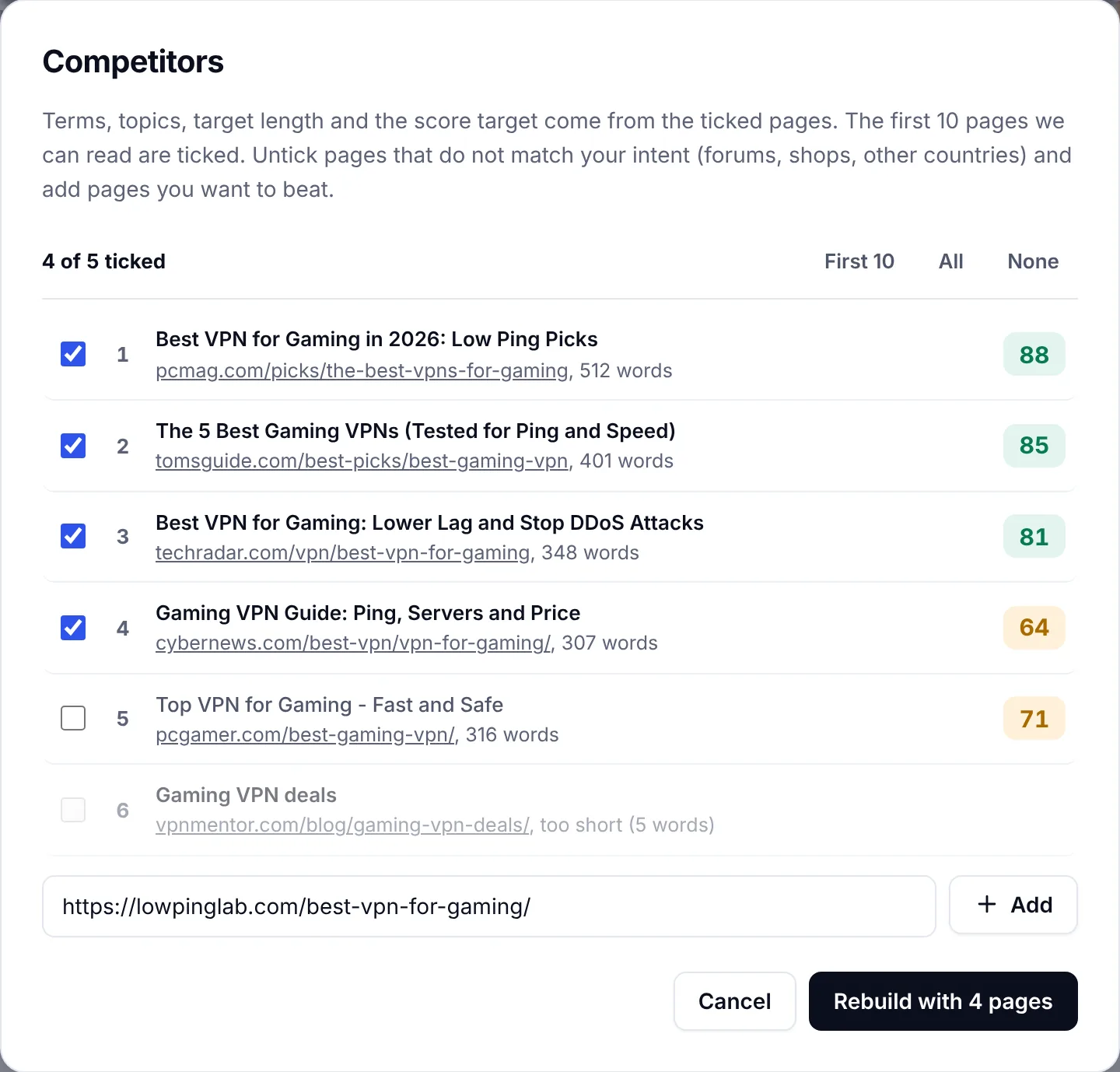
An AI research tool can take a keyword export of several thousand rows and group it into topical clusters by semantic similarity and search intent in minutes. Marketers used to do this manually in spreadsheets over days. The grouping is usually 80 to 90 percent right, which is good enough to plan a content calendar as long as someone reviews the groups that look odd. The same tools run competitor analysis: which keywords a rival ranks for that you do not, and where the backlink gap is. Our keyword clustering guide shows what that review looks like.
Content optimization
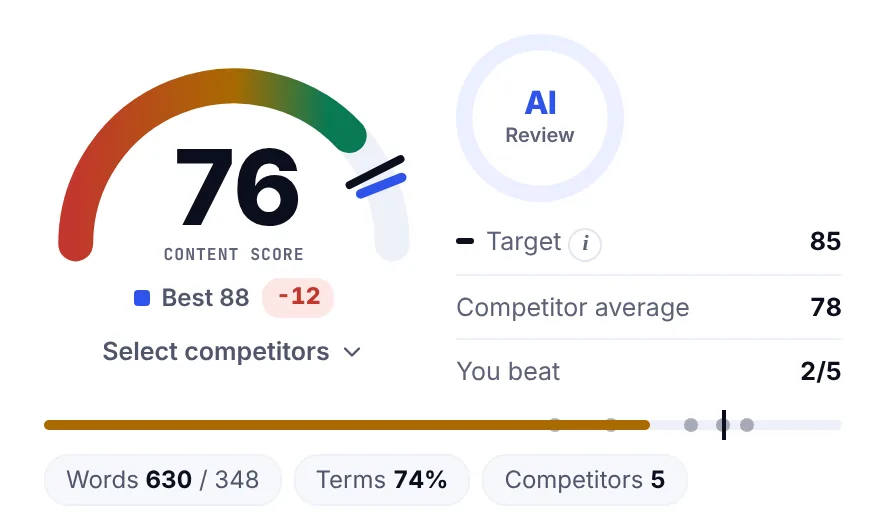
A content optimization tool analyzes the results that rank for your target keywords, extracts the terms, headings, questions and entities they share, and scores your draft against them. This is the most mature kind of AI SEO software and the most actionable: real-time content insights that tell you every top result covers a subtopic you skipped. It fits naturally into on-page optimization, right before you publish, and it is the simplest way to optimize content you have already written. For how the score works, read what a content score is.
AI content with search data attached
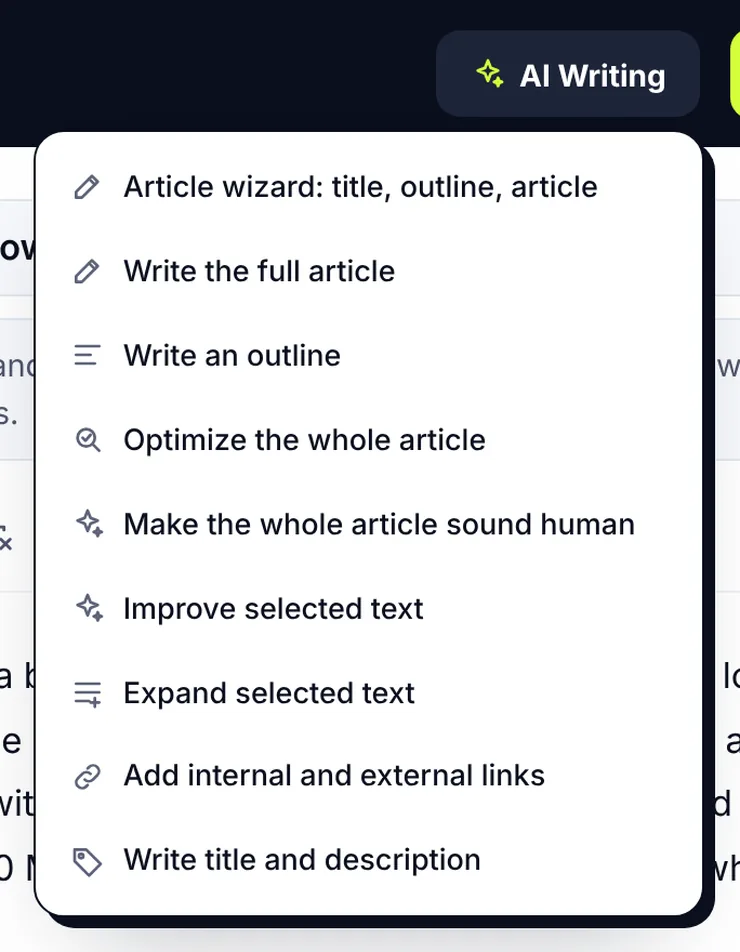
An AI-powered writing tool that has the search analysis in front of it produces much better first drafts than a general chatbot: the outline follows what ranks, the terms are placed, the questions are answered. SerpPal's AI writer works this way, drafting from the analysis of the top results rather than from a bare prompt. The draft is still a draft. It needs a person to add experience, check every claim and cut what sounds like everyone else. The guide to AI writing tools goes into what to expect.
Site audits and routine checks
Crawlers have flagged missing title tags, broken links and duplicate metadata for years. AI adds prioritization and plain-language insights, and some tools now generate the missing elements for you and automate the fixes. That is useful on large sites where the audit list runs to thousands of items. It is less transformative on a 50-page site where you could read the whole list in ten minutes.
AI search and GEO tracking
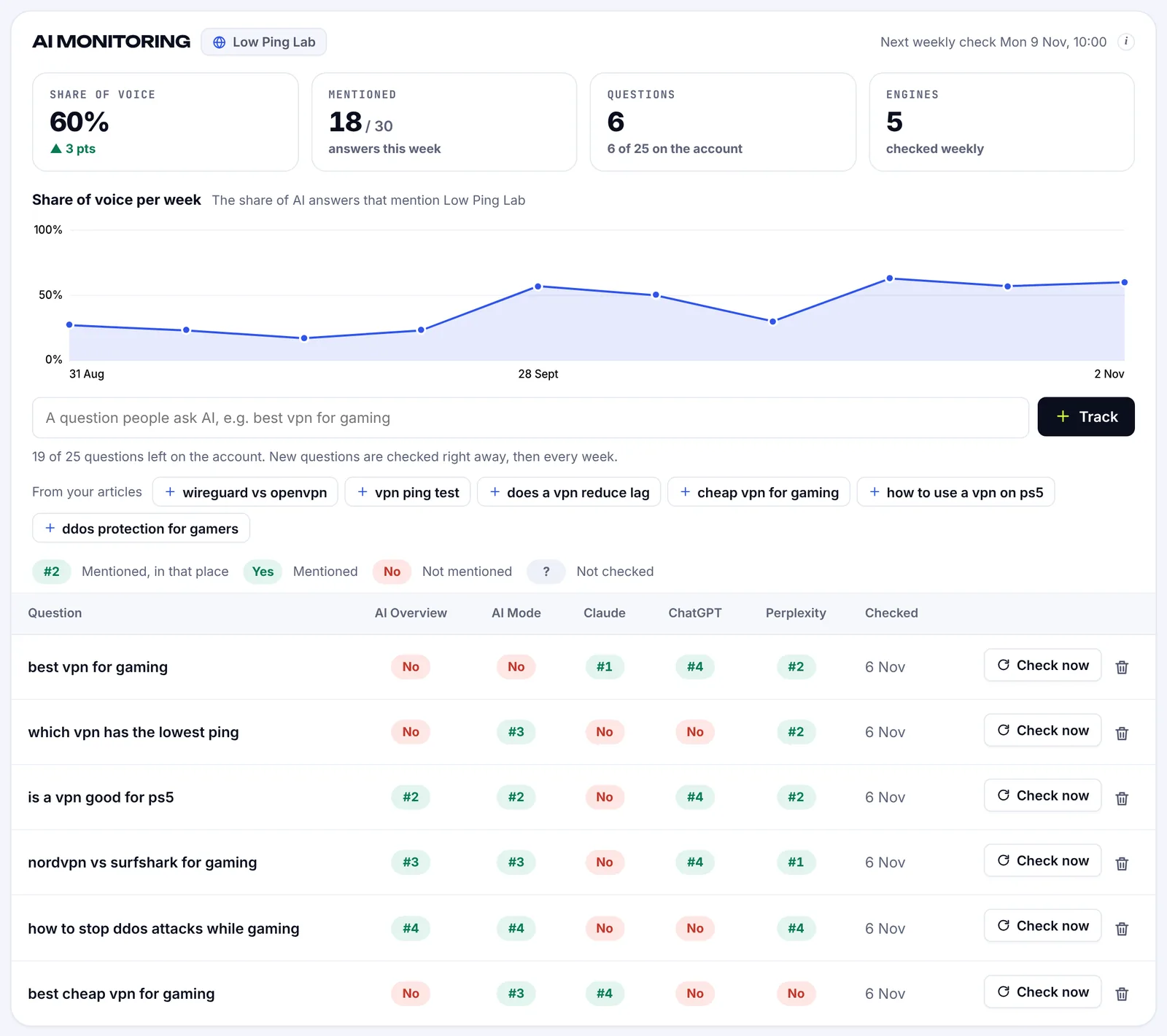
The newest category tracks visibility in AI answers: whether your brand or URLs appear in responses from AI assistants and Google AI Overviews. Generative engine optimization (GEO, sometimes AEO) is the practice of earning those mentions. The tools work by sending a fixed set of prompts to each engine on a schedule and recording the brands and sources that come back. SerpPal's AI visibility check does this per keyword, and the AI Monitoring add-on does it weekly for a list of questions.
What AI SEO tools cannot do
The failures are just as consistent, and they all come from the same place: the model is working from patterns in text, not from knowledge of your business or your readers.
- Decide what deserves a page. A tool can show that a keyword has volume. It cannot tell you that the people searching it will never buy from you, or that the topic is outside your expertise.
- Verify facts. AI-generated content reads fluently and is confidently wrong at a steady rate. Dates, prices, statistics, product specifications and legal or medical claims all need a human check against a source.
- Create experience. Google's guidance on helpful content asks for first-hand expertise. An LLM has none. It can only recombine what is already published, which is exactly the content Google has the least reason to rank twice.
- Rank a page by itself. No tool, plugin or automation gets a site to rank in search engines. They make the work faster; the work still has to be done, and it still competes with everyone else doing it.
- Replace Google Search Console. First-party performance data is the ground truth. Every AI SEO tool estimates; Search Console reports what happened.
A useful rule: let the tool do anything you could check in a minute, and keep anything that would take an hour to check in human hands.
Best AI SEO tool by task
Rather than ranking products, match the tool type to the task. The categories below are what SEO professionals actually buy, and the questions are what to ask before paying. Every new AI tool fits one of them, whatever the launch post says.
For keyword research and planning
Look for: a keyword database with volume and difficulty, grouping by intent, and a planner that turns groups into a schedule. Ask whether the tool explains its groupings and whether you can split or merge groups by hand, plus real-time search visibility data for the keywords you already rank for. A planner that produces a list you cannot edit is a report, not a tool.
For content optimization and on-page SEO
Look for: analysis of the current top results for your keyword, a term list with recommended ranges rather than raw counts, heading and question suggestions, structured content briefs, and a score that explains itself. Ask what the score is built from. If the answer is vague, the score is decoration. Avoid tools that push you to hit 100; the top-ranking pages themselves usually score in the 70s and 80s, and an optimized article is one that reads well at 85, not one padded to 100.
For AI-powered content
Look for: drafts that start from search data, a brand voice or style setting, fact-checking support, and a humanizing pass for text that comes out stiff. Ask whether the output is checked against the terms and questions from the analysis, or whether it is a generic generator with an SEO label. The difference shows in the first paragraph.
For technical SEO
Look for: a crawler that handles JavaScript rendering, issue prioritization by likely impact, and exports your developer can work from. AI-generated explanations are nice; an issue list sorted by what matters is essential.
For AI search: traditional rank trackers vs AI analytics
Look for: coverage of the engines your audience uses, a prompt set you control, source and competitor reporting, and a trend over time. Ask how often it checks and from which region. A single snapshot of an AI answer is nearly meaningless; the value is in the trend. A traditional rank tracker records a position in a fixed SERP; AI analytics record mentions in answers that change daily, so compare the two rather than expecting one to replace the other.
WordPress SEO plugins versus AI SEO platforms
People often ask whether an AI SEO tool for WordPress is the same thing as an SEO plugin. It is not. A plugin lives in your CMS and manages on-site settings: titles, meta descriptions, canonical URLs, XML sitemaps, schema. Some now include an AI add-on that writes the description or scores a post against a keyword.
A SaaS AI SEO platform does the work before and after the CMS: research, planning, optimization against the live SERP, drafting, and tracking across sites. Most sites need one plugin for settings and, if they publish regularly, one platform for research and content. Two plugins that both control metadata are a recipe for duplicates. If you write in SerpPal, publishing through the WordPress connection sends the post, images and description across in one step, and the plugin on the receiving end handles the rest.
Pricing, free AI SEO tools and value
Pricing for AI SEO tools is almost always a monthly subscription with limits on analyses, AI words, projects or seats. Free plans and trials exist across the category, including SerpPal's, which includes every tool with small monthly limits and needs no card; the pricing page has the current numbers. Free standalone tools, such as a keyword density checker, a SERP preview or a readability checker, cover single checks without an account; SerpPal's are listed under free tools.
Judge value by hours saved per month, not by key features on a comparison grid. Weigh the pros (hours back, more high-quality posts out) against the pricing. A content tool that saves an editor four hours a week pays for itself at almost any price. An enterprise suite with reports nobody opens does not, whatever the discount.
How to build your hybrid SEO stack
- Solo creator or small blog: Google Search Console, a CMS plugin, and a content optimization tool with AI drafting once you publish more than a couple of posts a month.
- Small business: the same, plus rank tracking for the dozen keywords that drive leads, and an AI search check for your brand terms.
- Agency: multi-project research and content optimization with team seats and shareable reports; AI monitoring if clients ask about ChatGPT and AI Overviews, which marketers increasingly do.
- Enterprise: API access, CMS integration, permissions and an approval step before anything automated reaches the site.
Expert tips for AI SEO tool success
AI-driven SEO goes wrong when the tool is allowed to publish. It goes right when it is allowed to prepare. Automate the preparation, never the approval. A workflow that integrates AI safely looks like this:
- Research. Group keywords with the tool, then review the groups and drop the ones outside your expertise.
- Plan. Analyze each target keyword to get the terms, headings and questions from the top results; write a one-page brief.
- Draft. Let the generative AI produce a first draft from the analysis, or write it yourself with the term panel open.
- Edit. Add first-hand experience and examples, verify every fact against a source, cut generic passages, run a humanizing pass on anything stiff, and check readability.
- Optimize. Bring the content score into the range of the top results without padding; fix title, meta and internal links.
- Publish and measure. Push to the CMS, then watch Search Console and AI mentions over the following months and update rather than rewrite.
The human steps are 1 (review), 4 and the decision at 6. Everything else is where the tools earn their subscription.
Measuring AI's impact
Measure the tool, not just the rankings. Record hours per post before and after, posts published per month, organic traffic to the posts it touched, and any AI citations. If the hours did not fall or the traffic did not rise within a quarter, the tool is not the bottleneck and the subscription can go.
Conclusion
The best AI SEO tools are the ones that take a job you understand and do the tedious part of it quickly: grouping keywords, SERP analysis, scoring, drafting, technical audits, monitoring. The pros are real when the workflow keeps a person in charge. They are worth paying for when you publish regularly and the bottleneck is hours, not ideas. They are not worth paying for as a substitute for knowing your audience, and none of them should be left alone with a publish button. Pick the tool by the task, keep a person on the facts and the final decision, and treat the score as a floor, not a target.
Frequently asked questions
What are AI SEO tools?
AI SEO tools are software that uses machine learning or a large language model to assist with search engine optimization tasks: keyword research and clustering, content optimization against the top-ranking results, AI content creation, site audits and AI search tracking. They analyze data and generate suggestions or drafts; a person still decides what to publish.
Is there a free AI SEO tool?
Yes. Most platforms, including SerpPal, offer a free plan with a small number of analyses and AI words each month, and many single-purpose checkers (keyword density, SERP preview, readability, word count) are free without an account. Free tiers are enough to evaluate a tool and run a small site; regular publishing usually needs a paid plan.
Can an AI SEO tool rank my site by itself?
No. A tool can speed up research, optimization and drafting, and a plugin can fix on-site settings, but rankings come from content that matches intent, earns links and mentions, and loads on a technically sound site. Automation that publishes AI-generated content at volume without review tends to produce posts search engines have no reason to rank.
Do AI SEO tools help with Google AI Overviews and ChatGPT citations?
They help you measure and improve, not guarantee. AI search tools show whether you are mentioned and who is cited instead, and content tools help you structure articles so an answer engine can quote them. The citation itself depends on the engine, the prompt and the day. Our guide to ranking in AI Overviews covers what you can control.
Is an AI SEO tool the same as a WordPress SEO plugin?
No. A plugin manages on-site settings inside WordPress (titles, meta, sitemaps, schema) and sometimes adds a small AI assistant. An AI SEO tool or platform does research, planning, optimization, drafting and tracking outside the CMS. Most sites that publish regularly use one of each, and they should not both be setting the same metadata.