On this page
- What Google AI Overviews are and how they work
- How Google selects sources for AI Overviews
- Ranking in AI Overviews starts with helpful content
- Optimize structure and format so passages are easy to extract
- On-page optimization and SEO strategy still decide who is eligible
- Fix crawling, indexing and structured data
- Measure AI visibility and adapt your SEO strategy
- Conclusion
- Frequently asked questions
How to rank in AI Overviews comes down to being the page Google's AI can quote with confidence: a direct answer high on the page, clear headings, claims it can verify, and a site Googlebot can crawl without friction. There is no separate ranking system to game. Google says the same signals that decide regular Search results also decide which pages get cited, so most of the work is good SEO done with extraction in mind.
This guide explains what Google AI Overviews are, how Google appears to pick sources, and what on-page optimization you can do yourself. It ends with a short plan for measuring whether any of it worked.
Key takeaways
- AI Overviews are generative summaries at the top of some Google results, built from pages that already rank well for the search query or closely related user queries.
- Pages that get quoted answer the question in the opening, then back the answer with specifics, sources and clear structure.
- Traditional on-page SEO, crawlability and topical authority still decide eligibility. Structured data helps Google understand a page but does not guarantee a citation.
- Track presence in AI answers separately from clicks. A citation and a click are not the same thing.
What Google AI Overviews are and how they work
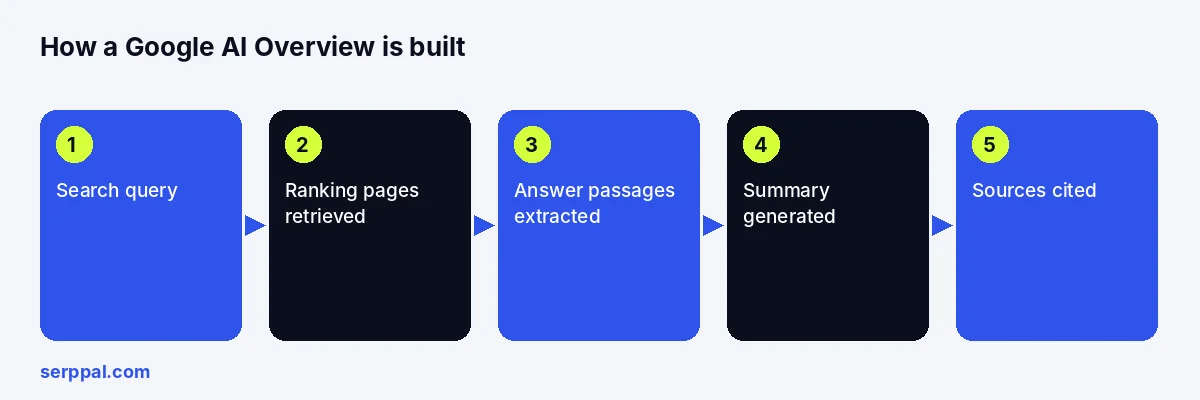
Google AI Overviews are AI-generated summaries that appear above the organic results for some searches. Gemini models write the summary from a set of web pages, and the overview shows those pages as linked sources, usually in a carousel or expandable panel beside the text. Users can click a source, scroll past the overview to the regular results, or ask a follow-up question that opens AI Mode, Google's conversational search experience.
They differ from featured snippets in one important way. A featured snippet quotes one page. An AI Overview combines several pages, paraphrases them, and may cite a page for a single line deep in the article rather than for its headline answer. That is why the same page can rank fifth organically and still be the first source in the overview.
Overviews do not show for every query. They appear most often on informational searches where Google believes generative AI adds value, and less often on simple navigational queries or sensitive topics. Availability also varies by country and language, so check results in the market you care about.
Why AI Overviews matter for SEO
Two things change when an overview appears. First, the organic search results move down the page, so a position-one ranking gets less attention than it used to. Second, the overview creates a new way to be seen: a quoted page can win search visibility even when it is not the top organic result.
The honest downside is that an overview can answer the question without a visit. Clicks on informational queries tend to fall when one shows up. The right response is not to abandon those queries but to measure them properly and to make sure the pages that do get clicked convert.
How Google selects sources for AI Overviews
Google has not published a formula, and anyone claiming to have reverse-engineered one is guessing. What Google has said in its own guidance is consistent: AI Overviews draw on the same core systems as Search, favour high-quality content that is helpful, reliable and relevant to the query, and only consider pages that are indexed and eligible to appear in search results. There is no separate set of tactics for the AI systems involved; the Google Search Essentials guide remains the rulebook. You can read Google's documentation on AI features and your website for the official position.
In practice, patterns are visible when you compare cited pages against the results below them:
- Quoted pages usually rank in the top ten for the query or a close variant. Being indexed is the floor, ranking well is the normal case.
- The quoted passage is almost always a self-contained, concise block of text or a list that answers one sub-question directly.
- Pages with clear topical authority on the subject appear more than one-off blog posts from sites that cover everything.
- Credible, authoritative sources with visible signals (an author with relevant experience, references, dates) appear more than anonymous pages.
What this means for your strategy
Treat the overview as a second layer on top of ranking, not a replacement for it. If you do not rank for the query, work on that first. If you do rank, make the specific passages that answer common user queries easy to find and easy to quote. The rest of this guide is about that second part.
Ranking in AI Overviews starts with helpful content
The first filter is whether your page is the most helpful content for the question. Google's helpful content guidance and its E-E-A-T framework (experience, expertise, authoritativeness and trustworthiness) are the best public description of what that means. Google E-E-A-T is not a score you can check, but the behaviours behind it are concrete.
Follow Google's E-E-A-T framework and answer the intent early
Lead with the answer. If the query is "how long does a passport renewal take", the opening line should give the timeframe, and the first few lines should give the main factors that change it. Context, caveats and examples come after, not before. This serves readers who skim and it gives the AI a quotable passage at the top of the page.
A useful test: read your intro without the title. If a stranger cannot tell what question it answers within a few seconds, rewrite it. Keep the passage self-contained too. Pronouns like "it" or "this approach" that refer to something above are hard to quote cleanly.
Add original, verifiable substance
Summaries are built from pages that say something checkable. Give the AI systems, and your readers, facts they can confirm:
- First-hand experience: what you tested, what happened, what you would do differently.
- Specific numbers with a source, and a link next to the claim rather than a reference list at the bottom.
- Named trade-offs and exceptions, which are the parts generic articles skip.
- A clear author with a short bio. Author bios, publication dates and an editorial policy page are small signals of credibility that cost little.
Avoid publishing AI-written pages that restate what already ranks. They add nothing new for the overview to cite, and they rarely rank in the first place. If you draft with AI, an editor needs to add real insight and verify every claim before it goes live. For more on this, see how to write SEO content that ranks.
Build topical authority, not one lucky page
Sites that get quoted repeatedly tend to cover a topic in depth: a pillar page on the broad subject linked to deeper pages on each sub-question. Internal links between them show Google the cluster, and the deeper pages give the overview many precise passages to draw from. Look for content gaps by listing the questions people ask about your topic and checking which ones you have no page for.
Optimize structure and format so passages are easy to extract
Structure is where most pages lose the citation. The information is there, but it is buried in a long block of text with no heading that says what it answers. Optimizing for AI Overviews mostly means making the page scannable and readable for search engines and LLMs alike.
- Descriptive H2s and H3s. Use the question or the specific sub-topic as the heading, not a clever phrase. "How long the process takes" beats "The waiting game".
- One idea per paragraph, kept short. Two to four lines is plenty; short paragraphs are quotable paragraphs.
- Bullet points and numbered lists for steps and criteria. Lists are extracted more cleanly than prose that hides five items in one sentence.
- Tables for comparisons. When the question is "X vs Y", a table is the clearest format for both readers and AI models.
- Plain HTML headings. Bold text styled to look like a heading does not communicate structure to a crawler.
Readability matters here more than in classic SEO. Overviews paraphrase, and plainly written passages survive paraphrasing with their meaning intact. Aim for clarity over polish: short sentences, concrete nouns, and defined terms, so the meaning aligns with what the reader asked. SerpPal's editor shows readability alongside the content score, which makes it easy to spot sections that run long. You can see how it fits the rest of the workflow on the features page.
Use FAQ sections honestly
An FAQ page or FAQ section at the end of an article works when it answers real follow-up questions in one tight passage each. It does not work as a keyword dump. Write the questions the way people ask them, answer them directly, and keep each answer independent of the others.
On-page optimization and SEO strategy still decide who is eligible
Nothing about AI search removes the need for on-page SEO. The pages Google considers are the pages it already ranks, so every classic signal still counts. Prioritize the basics below before any AI-driven tactic.
| Area | What to check | Why it matters for AI Overviews |
|---|---|---|
| Title tag and meta | Match the query, keep titles under 60 characters | Confirms relevance for the search query before extraction |
| Headings | Question-style H2s and H3s with the target phrases | Help the AI locate the passage that answers each sub-question |
| Internal links | Pillar to cluster and back, descriptive anchors | Shows topical authority and gets deeper pages crawled |
| Backlinks and brand mentions | Earned links from relevant domains, mentions in forums and communities | Off-site credibility that correlates with being quoted |
| Page experience | Fast load, usable on mobile, no intrusive overlays | A baseline for ranking, and therefore for eligibility |
| Freshness | Updated facts, dates and screenshots | Overviews lean toward current, accurate pages |
Distribute content across social and community platforms
Brand mentions deserve a note. Overviews, and AI assistants such as ChatGPT and Perplexity, pull from community discussions on Reddit and specialist forums as well as from publisher sites. The same goes for the prompt someone types into an assistant: LLMs answer from what they have read, and third-party mentions shape that. Honest participation in those places, with your affiliation disclosed, can put your brand into the conversations the AI reads. Disguised promotion gets removed and can hurt your reputation, so treat it as off-site PR, not a shortcut.
If you want a structured way to work through the basics, our on-page SEO checklist covers the title, headings, internal links and technical checks in order.
Fix crawling, indexing and structured data
A page that Googlebot cannot reach or render cannot be quoted, however good it is. Before you polish copy, confirm the plumbing:
- Robots directives. Make sure the robots.txt file does not block the page or the resources it needs, and that there is no stray noindex tag. A single Disallow line in robots.txt has kept whole sections out of search results. Google also honours a nosnippet or max-snippet directive, which limits what can be shown in an overview, so check you have not set one by accident.
- Status and canonicals. The URL should return 200 and point to itself as canonical. If the canonical points elsewhere, the other page is the one being evaluated.
- Rendering. If key content loads with JavaScript, test that the rendered page contains it. Use the URL inspection tool in Google Search Console to see what Google crawled and whether the page is indexed.
- Internal discovery. Pages with no internal links get crawled late and ranked poorly. Link new pages from the relevant pillar page the day they go live.
Structured data: useful, not magic
Structured data, or schema markup, in JSON-LD describes the page in a machine-readable way: Article with an author and dates, HowTo for step-by-step content, FAQPage for question-and-answer sections, Organization for the brand. It helps Google understand what the page is and who wrote it, and it can earn rich results. It does not guarantee an AI Overview citation, and FAQPage markup no longer produces the rich result it once did for most sites.
Keep markup truthful and matched to visible content, validate it with Google's Rich Results Test, and then move on. Schema is a supporting signal. The passage that gets quoted is still the words on the page.
Measure AI visibility and adapt your SEO strategy
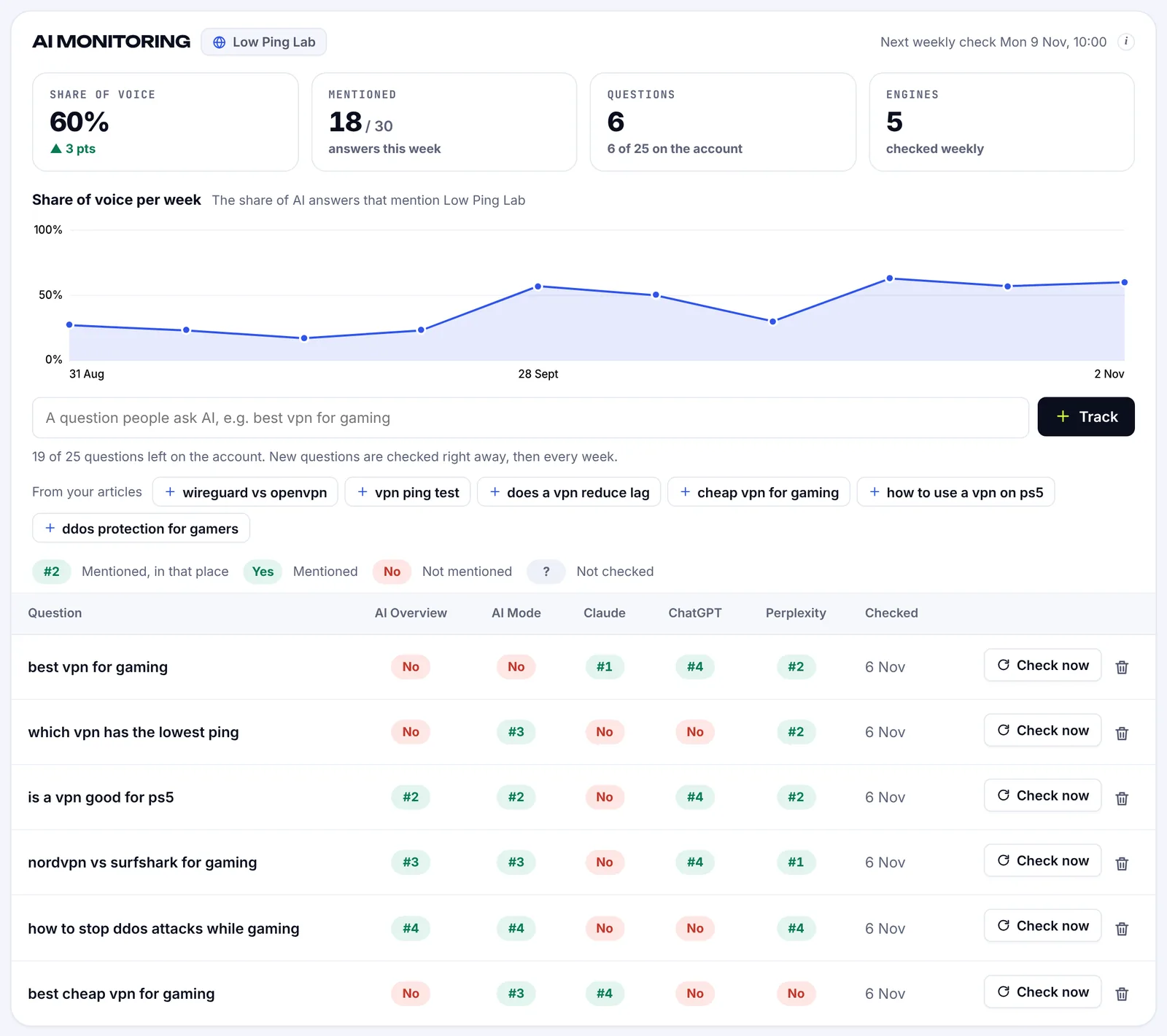
Google Search Console does not report AI Overview citations as a separate metric. Impressions and clicks from an overview are folded into the normal Search performance data, which means you cannot see a clean citation count there. You have to measure in three layers.
- Manual checks. Search your priority queries in the target country, note whether an overview appears, whether you are cited and in what position. Record the date, because results change week to week.
- Automated checks. SerpPal's AI visibility check asks Google's AI Overview, ChatGPT and Claude about an article's keyword and reports whether your brand or site is mentioned, who gets named instead, and which sources they cite. Running it before and after an update shows whether the change moved anything. The AI Monitoring add-on does the same for a list of questions every week, with a trend.
- Business outcomes. In Google Analytics or your own reporting, watch engaged sessions, leads and conversions from organic search for the pages you are optimizing. A citation that sends no useful visitors is a vanity metric.
How to get started: a 3-month AI search rank optimization plan
Give any change at least a quarter before judging it. Overviews are regenerated often, but the ranking signals beneath them move slowly.
- Month one, baseline. Pick ten to twenty queries where you rank in the top ten. Record organic position, overview presence, whether you are a source, clicks and conversions. Audit each page for intent match, structure, author info and crawl issues.
- Month two, optimize. Rewrite the opening of each page to answer first. Break long sections under question-style headings. Add or update sources, dates and author bios. Fix any indexing problems and link the pages from their pillar.
- Month three, review. Re-run the manual and automated checks. Keep what improved citations or clicks, revisit what did not, and expand the method to the next batch of pages.
Expect mixed results. Some pages gain a citation and lose a few clicks, others gain both, and a few see no change because Google stopped showing an overview for that query. That is normal, and it is why the baseline matters.
Conclusion
Ranking in AI Overviews is not a separate discipline. Rank for the query, answer it in the opening, structure the page so every sub-question has a clearly labelled, quotable passage, keep the facts current and sourced, and make sure Googlebot can crawl and index everything. Then measure your presence in AI answers on its own terms, because a citation is a different outcome from a click. Do that across a cluster of related pages and your odds of being the source Google quotes go up, even though nobody can promise the citation itself.
Frequently asked questions
Can a small website rank in AI Overviews?
Yes. Overviews cite the page that answers a specific sub-question best, not necessarily the biggest site. A focused page with first-hand detail on a narrow query is often cited above a broad guide from a larger brand. Small sites struggle when they try to compete on broad head terms rather than on precise questions they can answer better than anyone.
Does structured data guarantee a citation?
No. JSON-LD helps Google understand the page type, author and dates, and it can produce rich results, but Google has said there is no special markup that gets a page into an AI Overview. Valid, truthful schema is worth adding. Expecting it to do the heavy lifting is a mistake.
Do AI Overviews reduce clicks?
Often, on informational queries, yes. When the overview fully answers the question, fewer people click through. Pages that appear as sources tend to lose fewer clicks than pages that are pushed down without a citation, and queries with commercial or complex intent still send traffic. Measure your own pages rather than assuming an average.
How do I track AI Overview visibility in Search Console?
You cannot isolate it. Search Console blends overview impressions and clicks into regular Search performance reporting. Use manual spot checks or an AI visibility tool to record mentions, then compare those dates against the Search Console trend for the same pages.
Should I block my content from AI Overviews?
You can limit it with nosnippet or max-snippet directives, which also restrict regular snippets, and Google Extended controls use for Gemini training rather than Search display. For most publishers the trade-off is poor: you give up the visibility of a citation and keep the loss of position. Blocking makes sense mainly for paywalled or licensed content where the preview itself is the product.