On this page
Topical authority in SEO is the degree to which a website is seen, by search engines and by readers, as a trusted source on a specific subject because it covers that subject thoroughly, accurately and in an interconnected way. You build it by choosing a topic you can speak to credibly, mapping every question people ask about it, publishing a pillar page plus supporting content clusters that answer those questions in depth, and linking them so the relationship is obvious. This guide explains what topical authority is and isn't (it's not a Google score and not the same as domain authority), why it matters more now that AI search summarizes the web, and a seven-step process for building and measuring it.
Key takeaways
- It's earned through comprehensive, high-quality coverage of one subject, organized into pillar pages and content clusters, not through publishing volume.
- It isn't an official ranking factor or a number. Third-party authority scores measure links, not topical expertise.
- The process: pick a niche you can cover credibly, do topic-based keyword research, plan clusters, write in-depth pages, interlink them, earn relevant citations, audit and refresh.
- Measure it at the topic level: impressions and rankings across a whole cluster, not one URL.
- Strong topical coverage is also what AI Overviews and LLM-based answer engines draw from, so the same work supports AEO.
What topical authority means in SEO (and E-E-A-T)
Topical authority refers to how completely and reliably a website covers a given topic. A site with twenty linked, accurate guides on composting (what it is, bin types, ratios, troubleshooting, winter composting, apartment composting) demonstrates expertise in a way a single "ultimate guide" can't. Search engines use many signals to judge relevance for a query; a site that has answered every related question, with pieces that link to each other and are cited elsewhere, gives those algorithms more evidence that it's the authoritative, go-to resource on the subject.
The concept maps closely onto Google's E-E-A-T framework (experience, expertise, authoritativeness, trustworthiness) from the Search Quality Rater Guidelines. E-E-A-T isn't a ranking factor you can set; it's a description of what Google's systems are trying to reward, and Google's guide to creating helpful, people-first content explains it in plain terms. Topical authority is the content-strategy version of the same idea: become the go-to resource that has clearly done the work on a specific topic.
Is topical authority a Google ranking factor?
Not as a named signal. Google has never confirmed a "topical authority score", and you can't look one up. What Google does confirm, in its guide to ranking systems, is that it evaluates relevance, helpfulness and expertise, and that it understands topics and entities rather than just keywords. Building topical authority is how you give those systems what they're looking for. Treat it as a strategy that improves many signals at once, not a metric to optimize directly.
Topical authority vs domain authority
| Topical authority | Domain authority (and similar scores) | |
|---|---|---|
| What it describes | Depth and trustworthiness of coverage on a specific subject | A third-party estimate of a domain's link strength |
| Who defines it | A content strategy concept; no official number | SEO tool vendors, each with their own formula |
| Based on | Content coverage, structure, accuracy, internal links, relevant citations | Mostly backlink quantity and quality |
| Scope | Per topic; a site can be authoritative on one subject and not another | Whole domain |
| Used by Google? | Indirectly, through relevance and quality systems | No; these are not Google metrics |
A small niche website with a modest link score routinely outranks large general sites on its subject. That's topical authority at work: relevance and depth beating raw link counts for queries inside the niche.
Why topical authority matters
- Rank higher across a cluster, not one URL. Once a site is established on a topic, new posts on that topic tend to rank higher and faster in the SERPs than they would on an unrelated site.
- More organic traffic from the long tail. Comprehensive coverage captures hundreds of long-tail keywords and relevant keywords that individual keyword targeting would never reach.
- Resilience to algorithm updates. Core updates tend to reward sites with deep, trustworthy coverage and punish thin blog posts published for volume.
- Visibility in AI search. AI Overviews, ChatGPT search and other LLM-based answer engines cite sources that cover a question thoroughly and clearly. Answer engine optimization (AEO) is, in practice, topical authority with direct answers near the top of each page.
- Trust and conversions. Readers who find five useful answers on your site come back and buy. Credibility compounds.
How to build topical authority in 7 steps: a content strategy
Step 1: Choose a core topic you can cover credibly
Start with what your business actually knows and what your audience asks. A tax adviser can own "small business tax preparation"; "finance" is too broad for anyone but a bank. The right scope is a niche narrow enough to cover comprehensively within a year and broad enough to matter commercially. Write down the specific topic in one sentence and the three to five audience problems inside it. Marketers who try to establish authority on everything establish it on nothing.
Step 2: Do topic-based keyword research and map user intent
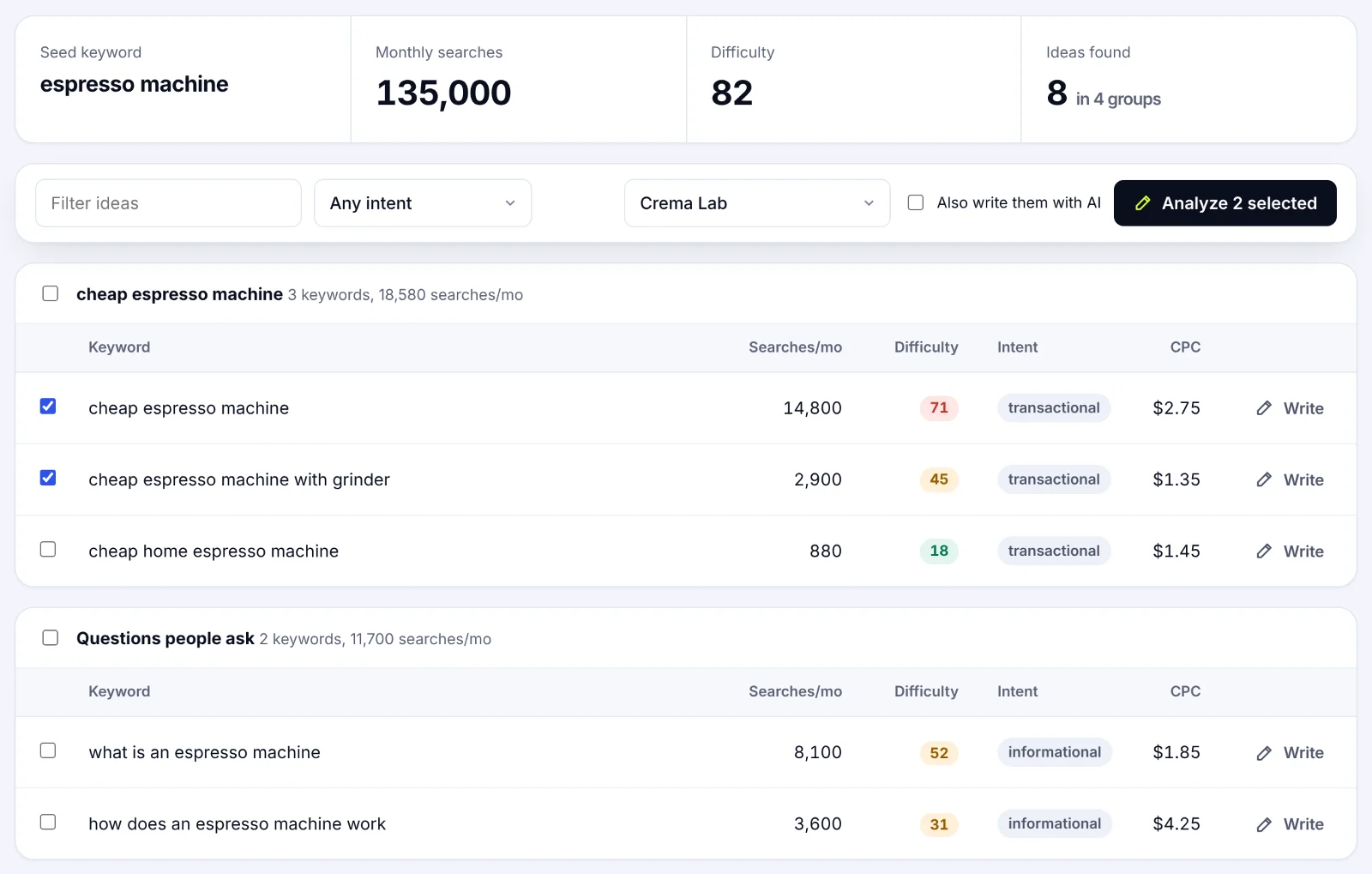
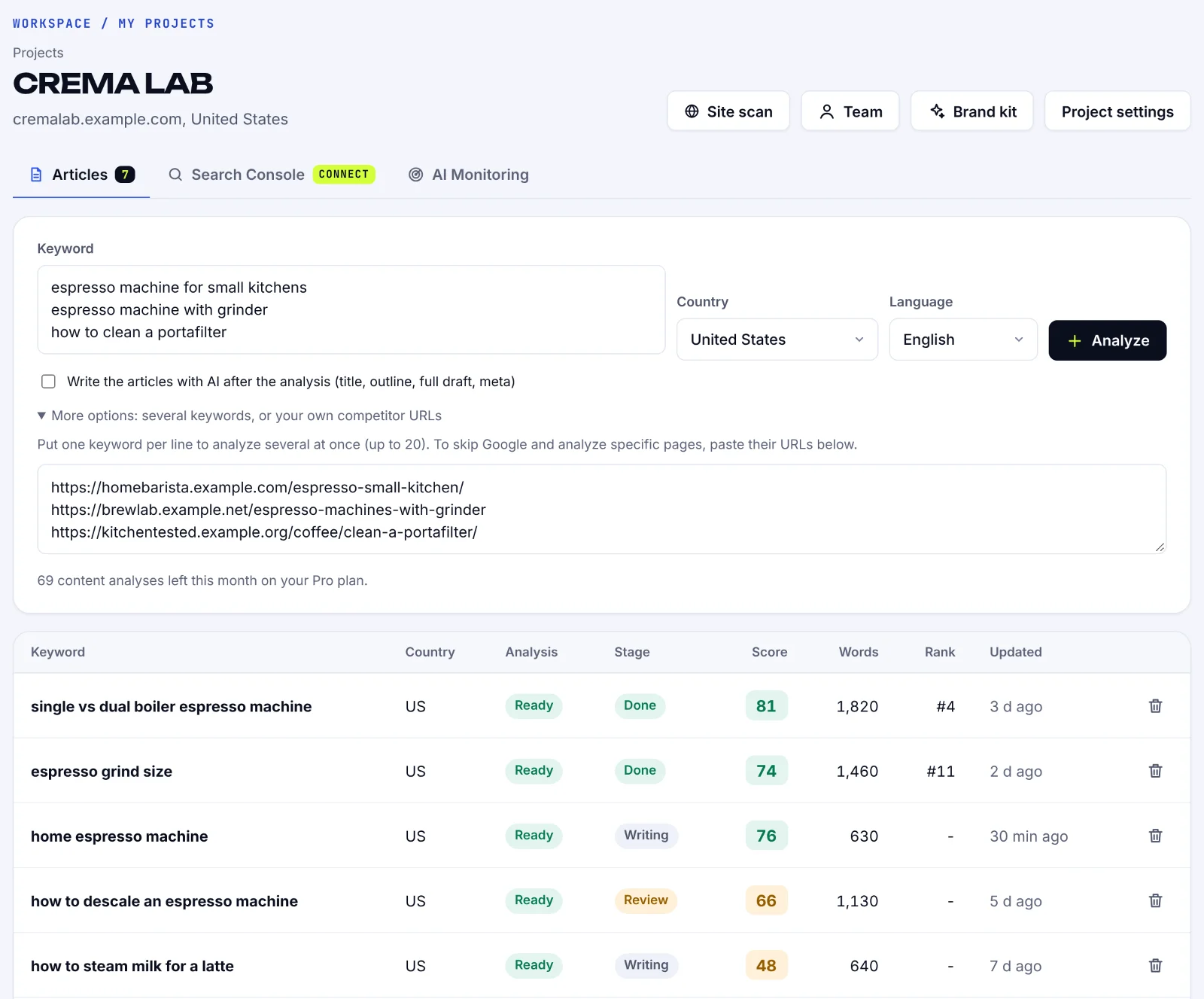
Shift from individual keywords to the whole topic. Take a seed keyword, expand it into every related question, comparison, how-to and definition people search for, group the results by user intent, and note the trends in how your audience phrases things. Google's Keyword Planner, Search Console (for queries you already appear for) and the People Also Ask boxes are free sources. SerpPal's Content Planner does the expansion and clustering in one step: seed in, grouped keyword ideas with volume, difficulty and intent out. Our guide to niche keyword research covers finding the long-tail keywords general tools miss.
Step 3: Plan content clusters around a pillar page
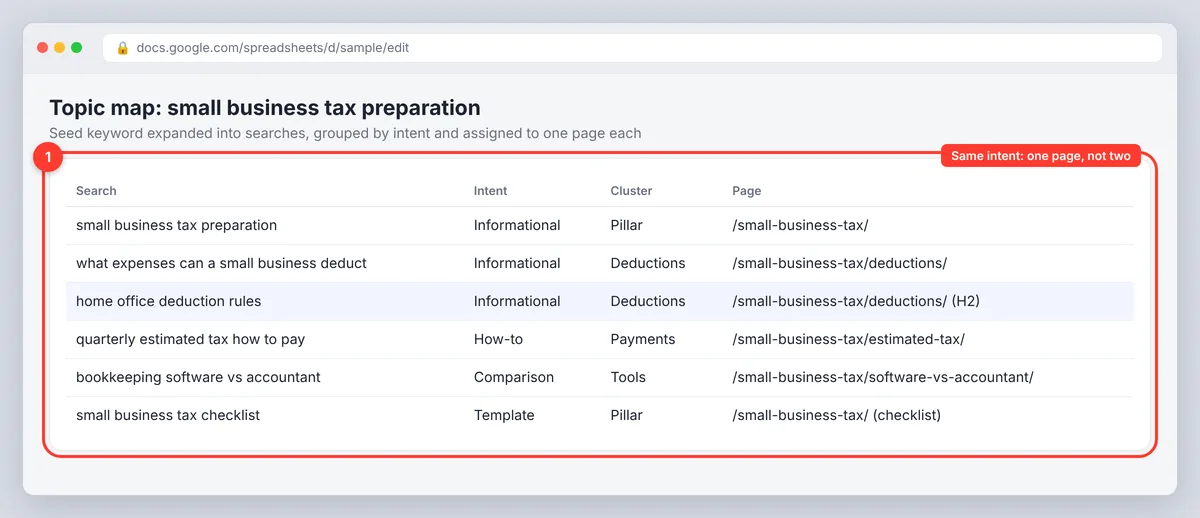
A content cluster (one of several topic clusters a site can build) is a main pillar page that covers the subject broadly, plus supporting posts that each answer one narrower question in depth. The main pillar links to every supporting piece; each one links back to the pillar content and to its closest siblings. For "road bike maintenance", the pillar is the overview and the cluster includes cleaning the chain, fixing a puncture, indexing gears, replacing brake pads and a maintenance schedule. Map the whole cluster before writing, give every piece a distinct purpose, prioritize the high-value questions, and merge any two that would answer the same question so the cluster stays cohesive. Use a content hub page as the pillar when the topic is big enough to need navigation.
Step 4: Create in-depth, high-quality content for each piece
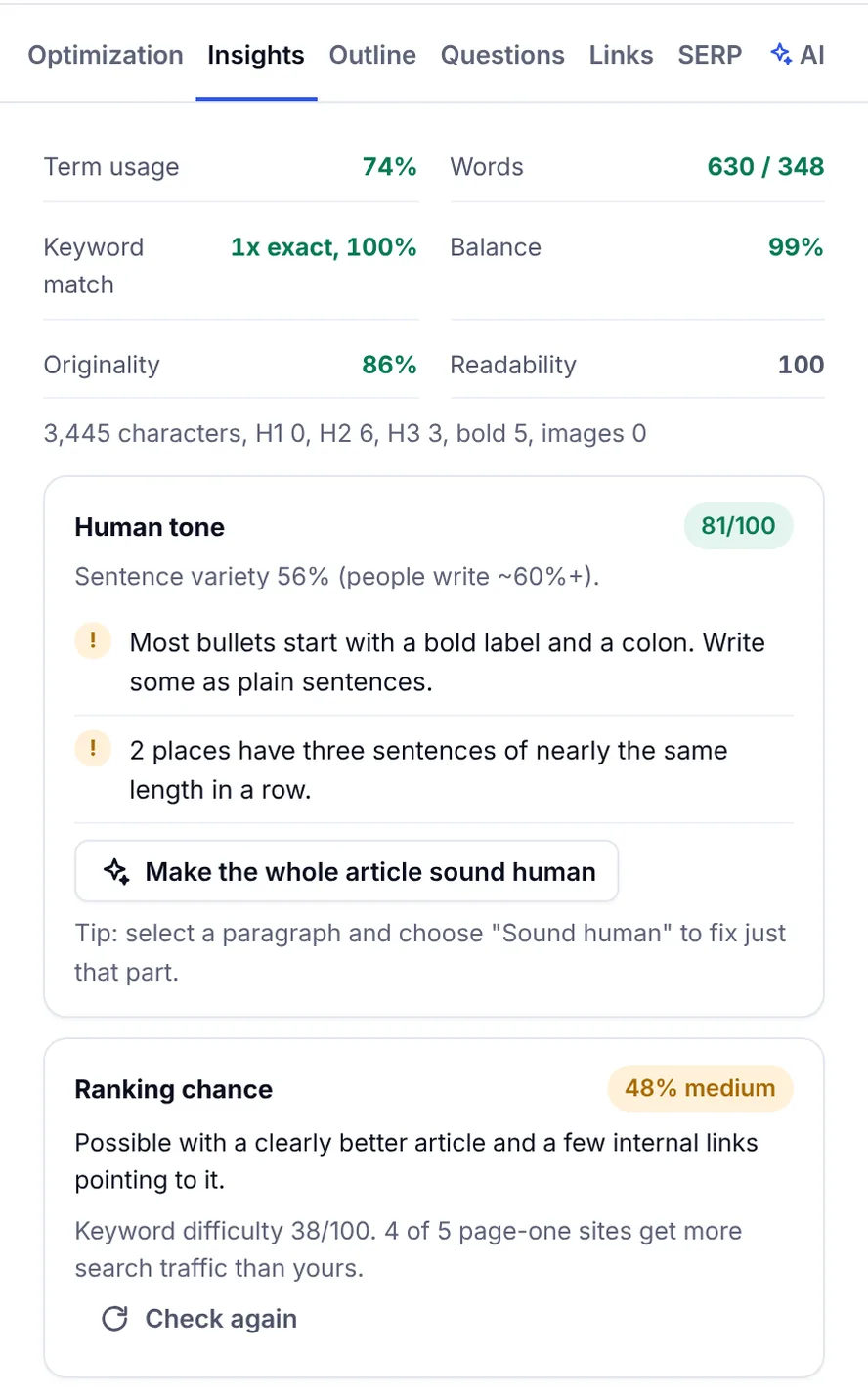
Each post should be the best available answer to its question: direct answer first, then the detail, examples, real-world specifics, case studies where you have them, and clear next steps. Cover the subtopics the top-ranking competitors share (SerpPal's analysis reads the search results and lists the terms, headings and questions they have in common) and add what they miss from your own experience, tailored to your audience. Name authors and show their credentials on topics involving money, health or safety. Content depth means complete for the reader, not long for its own sake; creating content that answers the question in full is the whole approach.
Step 5: Build a strong internal linking structure
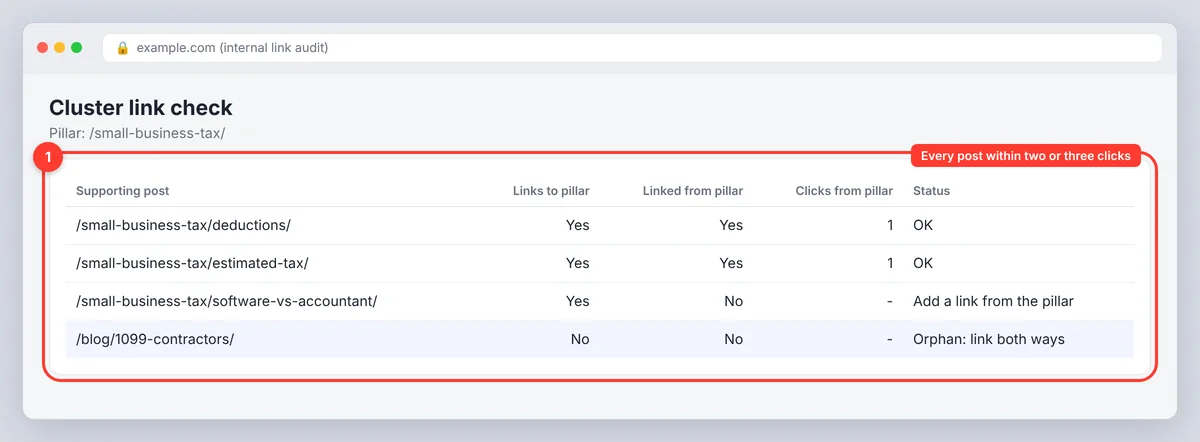
Linked content is what makes a cluster a cluster. Link pillar to supporting posts and back, link siblings to each other where it helps, and use descriptive anchor text that names the destination. Keep every URL in the cluster within two or three clicks of the pillar. When you publish a new supporting piece, go back and link to it from the pillar and from two or three related guides; forward links are the ones everyone forgets. See our guides to internal linking tools and strategies and SerpPal's sitemap and internal links feature, which suggests existing URLs to link while you write.
Step 6: Earn relevant external signals
Backlinks and mentions from sites in your field tell search engines that others treat you as a trusted source. Earn them with original data, useful tools, clear explanations people want to cite, and genuine relationships with publishers in your niche. Link building outside your topic adds little to topical authority; ten mentions from relevant sites beat a hundred from directories. On-page work and technical SEO still matter underneath all of this; authority doesn't rescue a slow or unindexable site.
Step 7: Audit, update and fill content gaps
Every quarter, review the cluster: which questions still lack an answer (content gaps), which posts are outdated, which two compete for the same search (consolidate them), which have thin answers (expand them). Update them with new evidence or clearer steps, not just a new date. Topical authority is a long-term asset that decays if the facts move and your pages don't.
How to measure topical authority: KPIs that show it's working
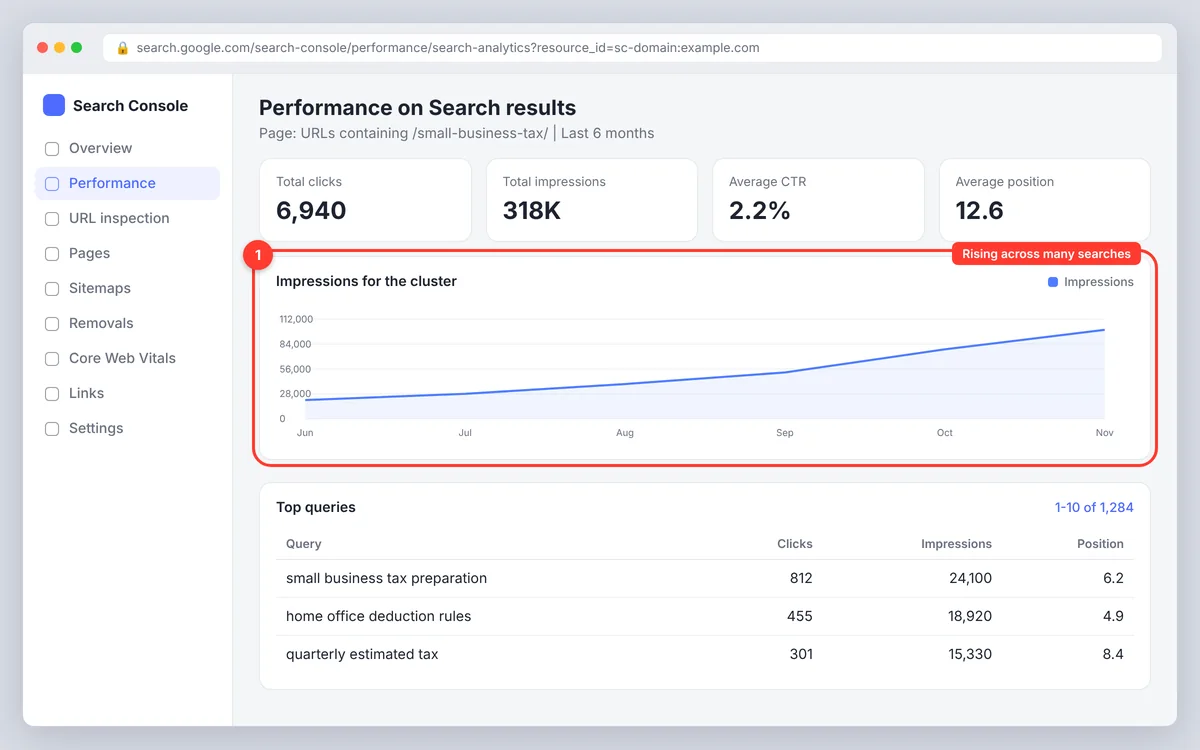
There's no single score, so measure the topic, not the individual URL. Evaluating the following KPIs together gives you a far better picture than any authority score:
- Cluster-level visibility in Google Search Console. Filter by the cluster's URLs (a folder or a regex) and track impressions, clicks, CTR and average position over months. Rising impressions across many searches is the clearest sign search engines are connecting the site to the topic, and keyword rankings across the cluster follow.
- Keyword coverage. How many of the topic's searches does the site rank for at all? Count distinct queries in Search Console for the cluster; growth here is topical breadth.
- Speed to rank for new posts. When a new supporting piece ranks within weeks instead of months, the topic is established.
- Engagement and outcomes in Google Analytics. Visits that move between several posts in the cluster, low bounce rates on the pillar, and conversions from topic content; analytics insights like these show whether the traffic is valuable.
- Mentions. Appearances in AI answers and links from relevant sites, tracked manually or with brand monitoring.
Common topical authority mistakes
- Publishing for volume. Fifty thin posts weaken the signal; fifteen complete ones build it.
- Chasing every adjacent topic. A site that jumps between unrelated subjects dilutes its expertise on all of them.
- One post per keyword variation. Several related keywords with the same intent belong together. Splitting them creates cannibalization.
- No pillar. Supporting posts with nothing tying them together are just a blog archive.
- Confusing link scores with authority. A high domain score and no topical coverage is a big website that doesn't rank for your niche.
- Keyword stuffing. Topical relevance comes from covering the subject, not repeating the phrase.
- Never updating. Outdated advice erodes trust and credibility faster than missing advice.
Topical authority and AI search
AI Overviews and LLM-based assistants assemble answers from sources that explain a topic clearly and completely, and they cite them. The sites they cite most are the ones with depth on the subject, direct answers near the top of each section, and consistent structure. That makes topical authority the foundation of answer engine optimization: the same clusters that rank in classic results are the ones a model can quote. Add a one- or two-sentence answer under every question heading, keep FAQs factual, and the content works in both places.
Conclusion
Topical authority is what happens when a site decides to be the trusted source on one subject and does the work: a defined niche, topic-based keyword research, a pillar page with linked clusters, in-depth posts, strong internal linking, relevant citations and regular updates. It's a content strategy rather than a tactic, it takes months rather than weeks, and it's the most durable SEO strategy available because it produces the thing search engines and readers both want: the complete, reliable answer.
FAQs
What is topical authority in SEO?
Topical authority is a website's perceived expertise on a specific subject, demonstrated by comprehensive, accurate, interconnected content on that subject. Sites with topical authority tend to rank for more searches in their niche and rank new posts faster.
How does Google determine topical authority?
Google doesn't publish a topical authority score. Its systems evaluate relevance, helpfulness and expertise using content, structure, links and entity understanding. Covering a topic thoroughly with well-linked, trustworthy content is how a site satisfies those systems.
How long does it take to build topical authority?
Usually several months to a year for a defined niche, depending on competition, publishing pace and how quickly Google recrawls and reassesses the site. Track cluster-level impressions in Search Console to see progress before rankings move.
What is the difference between topical authority and domain authority?
Topical authority is subject-specific coverage and trust. Domain authority is a third-party number estimating a domain's link strength, popular in digital marketing reports. Neither is an official Google metric, but topical authority describes something Google's systems reward; domain scores mostly describe backlinks.
Do you need backlinks to build topical authority?
Backlinks help, especially from relevant sites, but they aren't a prerequisite. Many niche sites rank through coverage, structure and accuracy before they attract many links. Relevant mentions accelerate the process; link building outside your topic does little.