On this page
- What is a rhetorical analysis essay?
- Key elements of a rhetorical analysis
- How to write a rhetorical analysis essay in 6 steps
- Rhetorical analysis essay outline
- Rhetorical analysis essay example
- Writing tips for a stronger rhetorical analysis
- Rhetorical analysis essay topics and examples
- Why rhetorical analysis matters beyond class
- FAQ
A rhetorical analysis essay explains how an author tries to persuade an audience, not whether the author is right. You pick apart a text, article or ad, identify the rhetorical techniques it uses, and show how each one works on the reader. A good rhetorical essay is analytical, not a summary.
This guide covers what a rhetorical analysis essay is, how to analyze a text, an outline you can reuse, topic ideas, a short example built on a famous address, and tips for timed essays like the one on the AP Lang exam.
Key takeaways
- A rhetorical analysis is about how a text persuades, not about whether you agree with it.
- Start with the rhetorical situation: speaker, occasion, audience, purpose, subject and tone (SOAPSTone).
- The three classic appeals are ethos (credibility), pathos (emotion) and logos (logic).
- Your thesis statement names the author's goal and the main choices, then each body paragraph analyzes one technique and its effect.
- Always explain the effect on the audience. Naming a device without saying why it works is the most common mistake.
What is a rhetorical analysis essay?
Rhetoric is the art of persuasion. A rhetorical analysis essay breaks a piece of persuasive writing or speaking into its components and explains how those parts work together to convince, inform or entertain an audience.
The topic can be almost anything that tries to persuade: a political address, an opinion column, a commercial, a letter, a sermon or a TED talk. Your job is to act like a critic watching a magician. You don't ask whether the trick is real; you explain how it's done.
That's what makes this essay different from an argumentative essay. In an argumentative essay you take a side. In a rhetorical analysis, you stay neutral about the issue and focus on the author's choices and how effectively they convey the message. If you use an AI writer to help you plan, keep that difference in mind: the insights about the author's choices have to come from your own close reading.
Key elements of a rhetorical analysis
Before you write, you need to understand two things: the rhetorical situation and the appeals.
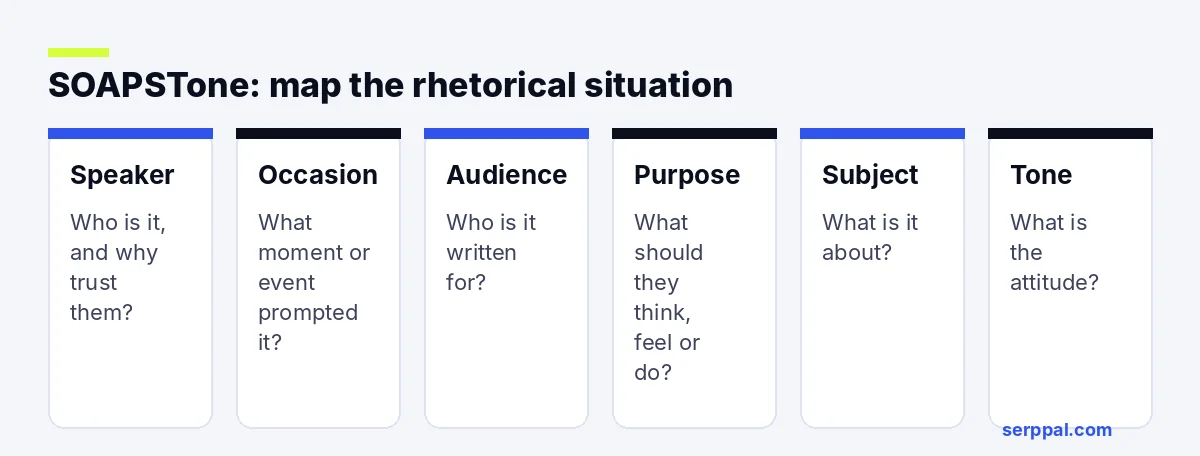
The rhetorical situation (SOAPSTone)
SOAPSTone is a checklist teachers use to map the context of a text. Some use the shorter SOAPS, without tone.
- Speaker: who is the author, and what gives them authority?
- Occasion: when and where was it delivered, and what event prompted it?
- Audience: who was it written for? There may be a primary and a secondary audience.
- Purpose: what does the author want the audience to think, feel or do?
- Subject: what is the text about?
- Tone: what is the author's attitude: urgent, hopeful, angry, solemn?
Ethos, pathos and logos
Aristotle described three ways to persuade, and they are still the backbone of most rhetorical analysis essays.
| Appeal | What it does | Look for |
|---|---|---|
| Ethos | Builds the speaker's credibility and character | Credentials, shared values, fair treatment of the other side |
| Pathos | Appeals to the reader's emotions | Stories, vivid imagery, loaded words, appeals to fear or hope |
| Logos | Appeals to logic and reason | Facts, statistics, examples, cause and effect, logical structure |
Many teachers add a fourth: kairos, the sense of timing that makes a message right for its moment.
Rhetorical devices and techniques
Appeals are the big rhetorical strategies. Rhetorical devices are the smaller tools authors use to carry them out. Common ones include repetition, anaphora (repeating words at the start of sentences), parallel structure, metaphor, imagery, rhetorical questions, allusion, contrast and diction (word choice). Name a device only when you can explain what it does for the author's argument. Experts call this commentary: the explanation that turns a list of rhetorical techniques into analysis.
How to write a rhetorical analysis essay in 6 steps
1. Read the text closely, twice
Read once for meaning, then again with a pen. Mark claims, emotional moments, evidence, shifts in tone and any words that stand out. Note where the author seems to be working hardest to persuade.
2. Map the rhetorical situation
Fill in SOAPSTone. Pay most attention to audience and goal, because every choice you analyze should connect back to them. Understanding the context matters here: the same words land differently in a crisis than on a quiet day. Who is the author trying to move, and toward what? This is where you identify the author's goal.
3. Find the strategies
List the devices and appeals you found, with a short passage or line reference for each. Then group them. Three strong techniques with good evidence beat seven weak ones. Look especially for the emotional appeal and the facts the author chooses to include or leave out.
4. Write the thesis statement
A good thesis names the author, the goal and the main techniques, and hints at the effect. Crafting it takes a few tries, so keep it concise. Formula: In [text], [author] uses [strategy 1], [strategy 2] and [strategy 3] to [purpose] for [audience].
Weak: "Lincoln uses ethos, pathos and logos in the Gettysburg Address."
Strong: "In the Gettysburg Address, Lincoln uses a timeline of the nation's history, solemn imagery of the battlefield and a closing call to action to turn a cemetery dedication into a reason for a grieving Union audience to keep fighting."
5. Outline the essay
Plan one body paragraph per technique, in the order that builds best (often the order they appear in the text). Our guide to writing an outline shows how to plan any essay in five steps.
6. Draft, then revise for analysis
When you revise, look at every piece of evidence. After each one, do you explain how it works and why it affects the audience? Double-check the effectiveness of each paragraph: is it analysis or summarizing? If a paragraph is mostly summary, cut the summary and add analysis.
Rhetorical analysis essay outline
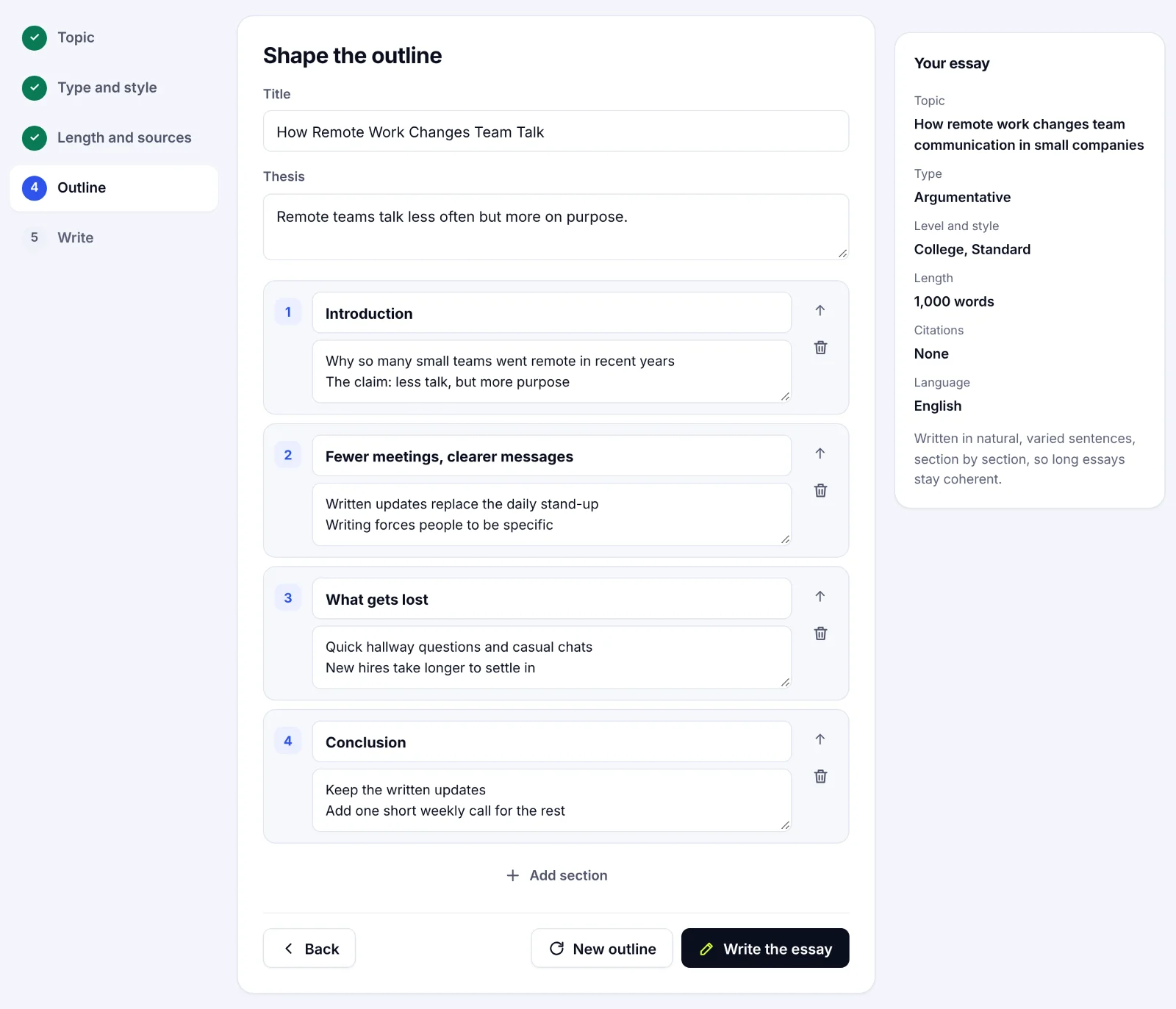
Here is a rhetorical analysis essay outline you can reuse for most texts. A typical essay has five or six paragraphs; see our guide to how many paragraphs an essay needs if your assignment sets a word count.
- Introduction:
- A brief hook about the text or its moment.
- The rhetorical situation: author, occasion, audience and aim in two or three sentences, to introduce the context.
- The thesis statement.
- Body paragraphs (one per technique):
- Topic sentence naming the technique and what it is for.
- Evidence: a short quote or a specific example from the text.
- Analysis: how it works and its effect on the audience.
- Link back to the author's overall purpose.
- Conclusion:
- Restate the thesis in new words.
- Explain how the elements work together.
- Close with why the text still matters or what it shows about persuasion.
Rhetorical analysis essay example
Here is a short sample on the Gettysburg Address, which Abraham Lincoln delivered in November 1863 at the dedication of a military cemetery in Pennsylvania. The address is under 300 words, which makes it a classic text for practice. Below is an analyzed version in three parts.
Example introduction
Four months after the Battle of Gettysburg, Abraham Lincoln was asked to say "a few appropriate remarks" at the dedication of a cemetery for the Union dead. The crowd was grieving, and the war's outcome was still uncertain. In about two minutes, Lincoln uses a timeline of the nation's history, solemn imagery of the battlefield and a closing call to action to turn a cemetery dedication into a reason for a grieving Union audience to keep fighting.
Example body paragraph
Lincoln opens not with the battle but with the founding: "Four score and seven years ago." By reaching back to 1776 and the promise that all men are created equal, he frames the war as a test of the nation's founding idea rather than a regional dispute. The biblical rhythm of "four score" lends the moment a sermon-like weight, which builds ethos for a president speaking at a grave site. For an audience that had just buried its sons, this framing gives the losses a meaning larger than one battle. The timeline then moves to the present war and, in the final sentence, to the future, so the address itself walks listeners from past sacrifice to the work still ahead.
Example conclusion
Lincoln's address works because each choice points toward the same request. The appeal to history gives the war meaning, the imagery honors the dead, and the call to action turns grief into resolve. In fewer words than most news articles, he shows that persuasion depends less on length than on purpose.
Notice what the example does: every piece of evidence is followed by an explanation of its effect on this specific audience. That is the difference between analyzing and summarizing, and it's what makes a rhetorical analysis essay compelling and engaging to read.
Writing tips for a stronger rhetorical analysis
- Use strong verbs. Instead of "the author uses pathos", write "the author stirs fear", "evokes pride", "establishes credibility" or "undercuts the opposing view".
- Keep the present tense. Write about texts in the present: "Lincoln argues", not "Lincoln argued".
- Don't summarize. Assume your reader knows the text. Spend your words on how and why.
- Avoid complicated language. Clear, logical sentences make your analysis easier to follow than jargon does.
- Stay neutral. Your opinion of the issue doesn't belong in the essay. Your judgment of the text's persuasiveness does.
- Quote briefly. Short phrases woven into your sentences are stronger than long block quotations. A well-structured paragraph quotes once or twice and explains a lot.
Rhetorical analysis on the AP Lang exam
On the AP English Language and Composition exam, the rhetorical analysis is one of three free-response essays, alongside synthesis and argument. You get a passage and have to analyze the writer's choices in about 40 minutes. Scorers look for a defensible thesis, specific evidence and commentary that explains how the choices serve the writer's goal. Many students find it the hardest of the three because it rewards close reading under time pressure, so practice with old prompts from the College Board.
Good practice texts include Martin Luther King Jr.'s "Letter from Birmingham Jail", famous inaugural addresses, and commencement speeches. Analyzing a few of them before the exam makes the techniques easier to spot.
Rhetorical analysis essay topics and examples
If you can choose your own text, pick one with a clear audience and a clear goal. Some good starting points:
- A presidential inaugural address and how it unites a divided audience.
- A famous commencement address and how the speaker builds trust with graduates.
- A public health ad and how it uses emotional appeal to change behavior.
- An opinion column on a local issue and how it handles the opposing argument.
- A product launch keynote and how it makes a new device feel necessary.
- A charity appeal letter and how it moves readers to donate.
For each one, ask the same questions: who is the audience, what does the author want, and which choices do the most work?
Why rhetorical analysis matters beyond class
Rhetorical analysis is not only an academic exercise. Every day you read ads, headlines, posts and pitches built to persuade you. Writing a rhetorical analysis trains you to notice how an argument is built before you accept it, which is a useful skill in real-world contexts as different as voting, shopping and reading the news.
It also makes you a better writer. Once you see how others persuade, you start choosing your own evidence, structure and tone on purpose instead of by accident.
FAQ
How do you start a rhetorical analysis essay?
Start with a short hook about the text or its moment, then give the rhetorical situation: who the author is, the occasion, the audience and the aim. End the introduction with a thesis that names the main techniques and what they achieve.
What are the 3 main parts of a rhetorical analysis?
The introduction with the rhetorical situation and thesis, the body paragraphs that each analyze one technique with evidence, and the conclusion that explains how the parts of the essay work together.
Do I have to use ethos, pathos and logos?
No. They are useful labels, but a stronger essay often organizes body paragraphs by the author's specific strategies, such as historical framing or vivid contrast, and mentions the appeals inside the analysis.
How long is a rhetorical analysis essay?
Class assignments are often 800 to 1,500 words, about five or six paragraphs. A timed AP Lang essay is usually shorter, around four to six paragraphs written in about 40 minutes.