On this page
A narrative essay is a true story from your own life, told in the first person, that builds to a point or lesson. It has characters, a setting, a sequence of events with a turning point, and a reflection on why the experience mattered. Think of it as storytelling with a purpose: it recounts what happened and conveys what it meant.
This guide explains what a narrative essay is, its key elements, a narrative essay outline, how to write a narrative essay step by step, a short example, and how it differs from the other main types of essays.
Key takeaways
- A narrative essay tells a real personal experience, usually from the first-person point of view, and ends with its significance.
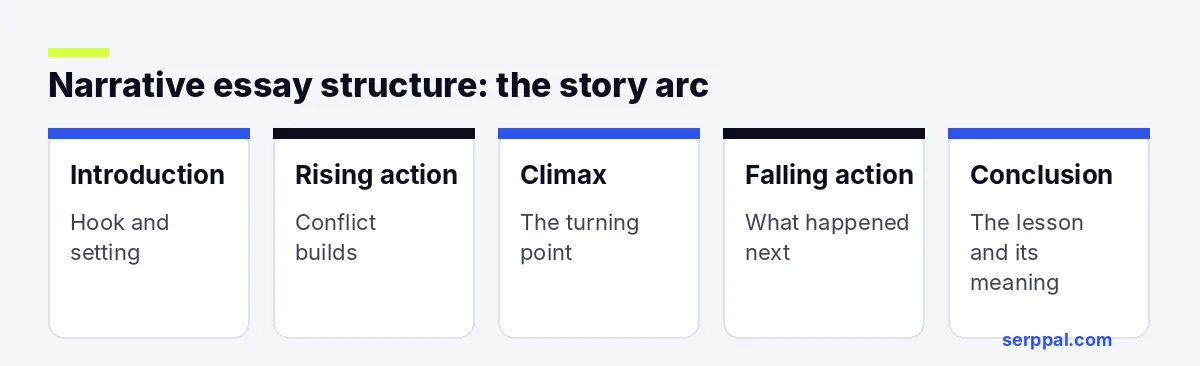
- It follows a story arc: an introduction, rising action, a climax, falling action and a conclusion with a lesson.
- Vivid descriptions, sensory details and a little dialogue make the story come alive.
- Most narrative essays are told in chronological order, though some open at the most dramatic moment and flash back.
- The other main essay types are descriptive, expository, argumentative and persuasive; each has a different purpose.
What is a narrative essay?
A narrative essay is a piece of nonfiction that tells a story about something that happened to the author. Unlike a short story, the events are real. Unlike a diary entry, the story is shaped to make a point: what you learned, how you changed, or what the experience revealed.
Teachers assign narrative essays because they teach storytelling, structure and reflection at the same time. They're common in middle school, high school and college composition classes, and the personal statement for college applications is often a narrative essay too.
Narrative essay vs personal narrative essay vs college essay
The terms are often used the same way. A personal narrative essay always centers on your own experience. A broader narrative essay might tell a story you witnessed closely. In school assignments, assume "narrative essay" means a personal narrative unless the prompt says otherwise. A college essay for admissions often uses the same narrative essay format with a shorter word limit and a clear introduction that gets to the point fast.
Key elements of a narrative essay
- First-person point of view: "I" tells the story, so the reader experiences it through you.
- Characters: you and the people who matter in the story, shown through actions and what they say.
- Setting: where and when the events happen, described so the reader can see the scene.
- Plot: connected events that build tension toward a turning point.
- Conflict: a problem, challenge or tension that drives the story.
- Theme and significance: the lesson learned or insight the story conveys.
- Tone: your attitude toward the events, from funny to serious, which shapes the reader's emotions. Keep the tone consistent from start to finish.
Narrative essay outline
Use this narrative essay outline to plan before you write:
- Introduction: a hook that drops the reader into the scene, a little context, and a hint at the theme. Some writers include a one-line thesis statement about what the story shows, allowing the reader to see where it's going.
- Rising action: the events that build toward the turning point. Introduce the characters and the conflict.
- Climax: the most intense moment, where something changes or is decided.
- Falling action: what happened right after, and how things settled.
- Conclusion: reflect on the lesson you learned and why it still matters.
Our guide to writing an outline shows how to plan any essay, and our guide to essay length helps you decide how many paragraphs each part needs.
How to write a narrative essay: 6 steps
1. Choose a meaningful topic
Writing a narrative essay starts with the story. Pick a personal experience with a clear moment of change: a challenge, a mistake, a first time, a loss, a surprise. Small moments often make the best essays. If the prompt gives you essay topics, choose the one where you can show the most specific details.
2. Brainstorm the details
Write down everything you remember: sights, sounds, smells, what people said, how you felt. These ideas become your descriptions later. If you're answering a writing prompt, note how each memory connects to it.
3. Develop your story and outline it
Organize the events in chronological order, mark the turning point, and cut anything that doesn't lead to it. Write one sentence that sums up the theme; it works like a thesis for a narrative essay. Decide what the story means before you begin writing.
4. Write the first draft
Show, don't tell. Instead of "I was nervous", write "My hands left damp prints on the music stand." Use dialogue sparingly to reveal character, and keep sentences varied so the story flows.
5. Reflect on the significance
The conclusion turns a story into an essay. Explain what you learned or how you changed, without lecturing the reader.
6. Edit and revise
Read it aloud, cut slow parts, check that each body paragraph moves the story forward, and proofread. Polishing is where vivid details get sharper and weak lines go. Ask someone to read it and give feedback on language, structure and formatting. A readability checker helps you find long sentences that slow the pace.
Narrative essay example
Here's a short example, written for this guide, showing the opening and the reflection:
Opening: "The bus driver said the route was cancelled just as the rain started, and I realized I had exactly forty minutes to walk six miles to my first job interview."
Middle: the walk, the wrong turn, the stranger who gave directions, arriving soaked with nine minutes to spare, and the interview that went badly anyway.
Reflection: "I didn't get the job. But somewhere around mile four I stopped worrying about what the manager would think and started noticing what I could still control. I've used that walk as a measuring stick ever since."
The example uses a hook, vivid descriptions, a clear turning point and a lesson connected to the story. Each paragraph focuses on one stage of the arc. Famous narrative essay examples, such as George Orwell's "Shooting an Elephant" or Langston Hughes's "Salvation", follow the same pattern: a specific event, told vividly, that reveals something larger.
Narrative essay writing tips and checklist
These storytelling techniques separate a compelling narrative from a list of events. Good narrative writing recounts events and makes them matter:
- Start in the action. Engage readers in the first line rather than with background; the best storytelling techniques hook early.
- Use descriptive language. Specific images and a few well-chosen metaphors draw readers into the scene and engage their emotions.
- Stay in the first person. First-person pronouns (I, me, my) keep the story personal and experiential; avoid switching pronouns halfway.
- Keep the focus narrow. A specific topic and one personal story told well beat a summary of a whole year.
- Use figurative language sparingly. A metaphor or two can evoke a feeling; too many distract from the storyline.
- Finish with personal reflection. A transformative experience only lands if you narrate what changed. That reflection is the meaningful part readers remember.
- Make it coherent. A coherent story uses transitions so the events connect clearly, and check each paragraph for clarity.
- Keep the writing creative but true. Unlike fictional stories, a narrative essay can't invent events, but it can use creative structure and a distinctive tone.
- End with meaning, not a moral. Show what changed for you instead of telling readers what to learn.
Other types of essays, compared
The narrative essay is one of four broad essay families. Creative writing classes favor narrative and descriptive essays; most other courses focus on informative and argumentative writing. Here's how they compare:
| Type | Purpose | Typical prompt words |
|---|---|---|
| Narrative | Tell a true story and reflect on it | "Tell about a time when..." |
| Descriptive | Paint a vivid picture of a person, place or object | "Describe..." |
| Expository (explanatory) | Explain a topic with facts, neutrally | "Explain", "inform" |
| Argumentative | Take a position and prove it with evidence | "Argue", "take a position" |
| Persuasive | Convince the reader to believe or do something | "Convince", "persuade" |
| Compare and contrast | Show similarities and differences | "Compare", "contrast" |
| Cause and effect | Explain why something happens and what follows | "Why", "effects" |
| Definition | Explore what a term or idea means | "Define", "what is" |
| Research | Answer a question using cited sources | "Research", "investigate" |
| Analytical | Interpret a text or issue by breaking it into parts | "Analyze", "evaluate" |
Descriptive essay
Uses detailed description to create a single, clear impression of a person, place, object or event. It's close to a narrative essay, but it focuses on description rather than plot.
Expository (explanatory) essay
An informative essay (sometimes called an informative or expository piece of writing) explains a topic objectively with facts and examples, without the writer's opinion; it doesn't summarize a story but organizes information. Process ("how to") essays are a common kind.
Argumentative and persuasive essays
Both take a side. Argumentative essays rely on evidence and answer counterarguments; persuasive essays lean more on values and emotion.
Definition, personal, research and analytical essays
A definition essay explores the meaning of an idea like "courage". A personal essay reflects on an experience or belief, often overlapping with narrative. A research essay answers a question with cited sources. An analytical essay interprets how a text or issue works; a rhetorical analysis is one example, covered in our guide on how to write a rhetorical analysis essay. An analytical summary essay first summarizes a source, then evaluates its argument.
If you use an AI writer to brainstorm topics or outline, keep the story and the voice your own; a narrative essay only works when the experience is real.
Frequently asked questions
What are the 5 parts of a narrative essay?
Introduction, rising action, climax, falling action and conclusion. Writing each part as one or more paragraphs keeps the format clear. Together they form the story arc, and the conclusion adds the reflection that makes it an essay.
Can a narrative essay be written in third person?
Occasionally, but first person is standard because the story is your own experience. Use third person only if your teacher allows it.
What is the difference between a narrative essay and a descriptive essay?
A narrative essay tells a story with events and a plot. A descriptive essay paints a picture of one person, place or moment without needing a plot.
How long is a narrative essay?
For school, usually 500 to 1,500 words, or five to eight paragraphs. College application narratives are usually 650 words or less.