On this page
A writing outline is a short plan that lists your main points in the order you will cover them, with a few notes under each. Making one before you write turns a blank page into a series of small, clear tasks, so the first draft goes faster and needs less revision later.
This guide shows how to build an outline in five steps, the three common types of outlines, and ready-to-copy examples for a blog post, an essay and a novel.
Key takeaways
- An outline is a roadmap: main points in order, with supporting notes under each one.
- The three common types are the topic outline (short phrases), the sentence outline (full sentences) and the decimal outline (numbered levels like 1.1).
- Build it in five steps: set the purpose, collect ideas, group them, put the groups in order, then check for gaps.
- A blog post outline follows the reader's questions, an essay outline follows the thesis statement, and a novel outline follows the plot.
- Keep it flexible. If the writing finds a better route, change the outline.
What is an outline in writing?
An outline is the skeleton of a piece of writing. It shows the main sections, what each one says, and how they connect. It can be a few lines in your notes app or a full page with headings and bullet points.
Writers use outlines for almost anything longer than a page: blog posts, essays, reports, speeches, scripts and books. In the writing process, the outline is where you make the big decisions about structure and order. The draft is where you make the small decisions about words and sounds. An outline helps you organize rough ideas before you craft sentences around them.
Why outline at all?
- Speed. You never stop mid-paragraph to wonder what comes next.
- Clarity. You can identify a point that repeats, is out of order, or lacks evidence before you have written 2,000 words around it.
- Focus. Every section has a job, so tangents are easy to spot and cut.
- Feedback. A teacher, editor or client can approve a one-page outline in minutes. Changing a finished piece takes hours.
If you use an AI writer, the outline matters even more. An AI tool given a clear outline writes the article you planned. Given only a subject, it writes the average article about it.
The 3 types of outlines
Outlines differ in how much they say and how they show levels. Pick the format that fits the job.
| Type | What it looks like | Best for |
|---|---|---|
| Topic outline | Short phrases: "Benefits of remote work" | Quick plans, blog posts, brainstorming |
| Sentence outline | Full sentences: "Remote work removes the daily commute." | Essays and arguments where the logic must hold |
| Decimal outline | Numbered levels: 1, 1.1, 1.1.1 | Long reports, manuals, technical documents |
The classic school outline is alphanumeric: Roman numerals (I, II, III) for main points, capital letters (A, B) for sub-points, Arabic numerals (1, 2) for supporting details and lowercase letters below that. Keep items at the same level parallel, so they use the same grammar and carry about the same weight.
A sentence outline takes longer, but writing in full sentences forces you to decide what you actually claim. If a point won't fit in one sentence, it is probably two points. An informal outline in short phrases is fine for a short post you know well.
How to write an outline in 5 steps
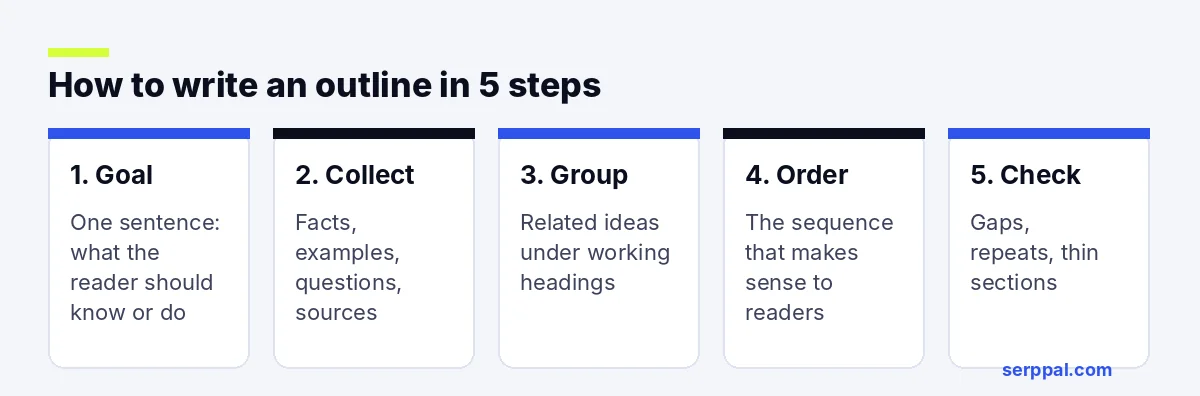
- Set the purpose. Write one sentence about what readers should know, believe or do at the end. For an essay, this becomes your working thesis. For a blog post, it's the question you answer. For a story, it's the central conflict.
- Collect ideas. Dump everything onto the page: facts, examples, quotes, questions, scenes, sources to cite. Don't sort yet. Step 2 is about quantity; you will cut later. For a blog post, add the questions people ask about the topic in search results.
- Group them. Put related ideas together and give each group a working heading. Cut anything that doesn't serve the purpose, even if it's interesting.
- Put the groups in order. Choose the order that makes the most sense to your audience: simple to complex, problem to solution, first event to last, or strongest argument last.
- Check for gaps. Read the outline top to bottom. Does each section lead to the next? Is any section thin? Is anything repeated? Fix it now, while it's cheap.
That's the whole technique. Most outlines take 15 to 30 minutes, and they save far more than that in drafting time. Creating the outline is also when you learn what you don't know yet, so you can explore and research before you start the draft.
Outlining strategies that suit different writers
- Index cards or sticky notes: one idea per card, then shuffle them until the order works. Good for visual thinkers.
- Mind map: put the main idea in the middle and branch out. Useful when the ideas are still rough.
- Beat sheet: a list of the key stages of a story, one line each. Popular with screenwriters and novelists.
- Reverse outline: write a messy draft first, then summarize each paragraph in one line to see the real structure. A great revision tool.
- Worksheets and templates: fill-in-the-blank forms many teachers hand out. Adapt one to your own writing once you know the pattern.
Blog post outline: a template you can copy
A content outline for a blog post follows the reader's questions in the order they ask them. Start with the answer, then explain, then go deeper. Use this template:
- Working title: include the main keyword and the promise.
- Intro (2 to 4 sentences): answer the main question right away, then say what the post covers.
- Key takeaways: 3 to 5 bullets that summarize the post.
- H2 sections: one per question or step, each with 2 to 4 bullet notes and short descriptions of what it must say and which example or data to use.
- Visuals: where a table, screenshot or diagram helps.
- FAQ: 3 to 5 short questions people also ask.
- Ending: one clear next step for the reader.
How do you end a blog post? Not with a summary of everything you just said. End with the single next step: a tool to try, a related guide, or a short checklist. Readers who reach the end are ready to act.
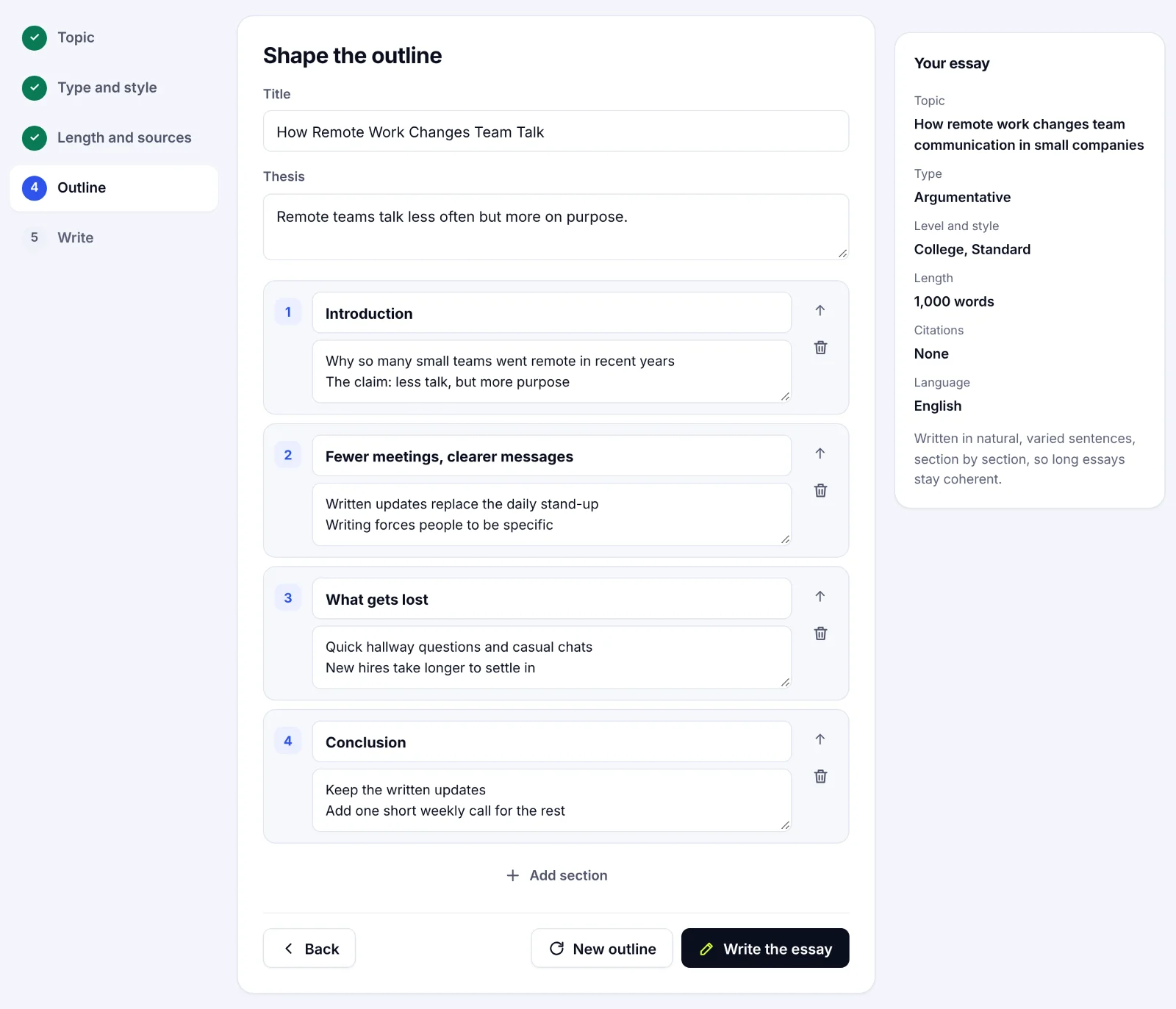
To find out which sections a post needs, look at what the top-ranking pages for your keyword cover. SerpPal's article wizard does this for you: it reads the top results and suggests an outline you can edit before it writes the draft, as our guide to content briefs explains in more depth.

Essay outline: parts and examples
An essay outline is built around the thesis statement. Every body paragraph exists to support it, and the essay outline helps you see whether it does. A standard five-paragraph essay outline looks like this:
- Introduction: a hook, some context, and the thesis statement.
- Body paragraph 1: opening claim, evidence, explanation, link back to the thesis.
- Body paragraph 2: next point, evidence, explanation, transition.
- Body paragraph 3: strongest point, or a counterargument and your response.
- Conclusion: restate the thesis in new words, show why it matters, end with a final thought.
Here's a short essay outline example for an argumentative essay:
- Thesis: High schools should start no earlier than 8:30 a.m. because later starts improve sleep, health and grades.
- Body 1: teenagers' sleep cycles shift later during puberty; cite a health source.
- Body 2: schools that moved start times saw better attendance; give one example.
- Body 3: answer the bus and sports schedule objection.
- Conclusion: propose a one-year trial.
The same essay outline structure works for expository, persuasive and compare-and-contrast essays, and for a personal essay about something you learned. Only the job of each body paragraph changes. A research paper outline adds sections for background, method, findings and discussion, so its essay outline runs longer. If you're writing for a class, check the assignment's lesson objectives and rubric first, then build the outline to match them. SerpPal's essay writer lets you edit an essay outline section by section before it writes, which is a good way to practice outlining.
Novel outline: plot, story structure and chapters
Fiction writers argue about outlining more than anyone. "Plotters" plan the plot before they write. "Pantsers" write by the seat of their pants and find the story as they go. Most authors land somewhere in between, and the right amount depends on the genre: a mystery or thriller usually needs more planning than a quiet literary novel.
Outlining also leaves room for discovery: many authors plan the big stages and explore the details while drafting. A practical novel outline has three layers:
- The one-line story: who the protagonist is, what they want, and what stands in the way.
- The story structure: the big turning points. The three-act story structure (setup, confrontation, resolution) is the most common. Joseph Campbell's Hero's Journey is another, popular in the fantasy and adventure genre.
- Chapter notes: two or three sentences per chapter on what happens and what changes.
Treat any story structure as a tool, not a rule. Rereading your outline every few chapters is refreshing: it reminds you where the protagonist is headed. If a scene that resonates with you doesn't fit the plan, keep the scene and change the plan. A creative outline should help you finish the book, not trap the characters.
What makes a good outline?
A good outline is specific enough to write from and loose enough to change. One final tip for creating a strong outline: check yours against this list before you write a word.
- Every heading says something. "Background" is vague; "Why the 1990s rules failed" is useful.
- Each section has notes on what goes in it: the point, the example and the source.
- Sections are roughly balanced. One huge section usually needs splitting.
- The order makes sense to someone who knows nothing about the topic.
- You can summarize the whole piece by reading only the headings.
Once the outline passes, start writing at whatever section you know best. You don't have to go in order. When the text is done, run it through a readability checker to catch long sentences before you publish.
FAQ
What are the 3 types of outlines?
The topic outline uses short phrases, the sentence outline uses full sentences for every point, and the decimal outline numbers each level (1, 1.1, 1.1.1). Topic outlines are fastest; sentence outlines are best for testing an argument and give you insights into weak points early.
What is the structure of an outline?
An outline has an introduction, main points in a logical order, supporting details under each main point, and a conclusion. In a formal outline, Roman numerals mark main points and letters and numbers mark the levels below.
Is an outline necessary?
Not always. Short or personal pieces can work without one. For anything long, researched, or reviewed by someone else, an outline saves time and catches structural problems early.
How detailed should an outline be?
Enough that you know what each section says and which examples it uses. If you're writing finished paragraphs in the outline, it's too much. If the headings could fit any article on the topic, it's not detailed enough.