On this page
How many paragraphs is an essay? A standard short academic essay has 5 paragraphs: an introduction, three body paragraphs and a concluding paragraph. But there is no fixed rule. The right number depends on the word count, and a good estimate is one paragraph for every 100 to 200 words.
So a short essay usually has four or 5 paragraphs, a 1,000-word essay has six to eight, and a 2,500-word research paper may have fifteen or more. This guide gives you paragraph counts, word counts and page counts by essay type, plus how to plan the structure.
Key takeaways
- The 5-paragraph essay (introduction, three body paragraphs, conclusion) is the classic school format, not a universal rule.
- Estimate paragraphs from the word count: divide the words by about 150.
- One body paragraph should cover one main point, so the number of points you make decides the length.
- Most assignments set a word count or page count, not a paragraph count. Follow the assignment requirements first.
- A college admissions essay (the Common App personal statement) has a 650-word limit, which usually means five to eight paragraphs.
How many paragraphs is an essay? The short answer
Forget the idea of one correct number. Teachers use the 5-paragraph essay to teach essay writing because its structure is easy to follow: you state a thesis, back it with three reasons, and wrap up. Once essays get longer than about 800 words, that format stops working, because each paragraph would need to be far too long. Different essay types and topics bring different complexity, and the length should follow it.
A better way to think about it: an essay has as many paragraphs as it has ideas, plus an introductory paragraph and a conclusion. If your argument has four main points, you need at least four body paragraphs. If one point needs two pieces of evidence that each take a while to explain, it may need two paragraphs.
Essay length: paragraphs, word count and pages
How many pages is that? Use this words-to-pages conversion chart to turn a word count into paragraphs and pages. It assumes paragraphs of about 150 words, a 12-point font like Times New Roman, standard margins and double or single spacing.
| Word count | Paragraphs | Pages, double-spaced | Pages, single-spaced |
|---|---|---|---|
| 300 words | 3 to 4 | about 1 | about half a page |
| 500 words | 4 to 5 | about 2 | about 1 |
| 750 words | 5 to 6 | about 3 | about 1.5 |
| 1,000 words | 6 to 8 | about 4 | about 2 |
| 1,500 words | 8 to 11 | about 6 | about 3 |
| 2,000 words | 11 to 14 | about 8 | about 4 |
| 2,500 words | 14 to 18 | about 10 | about 5 |
These are estimates. Short paragraphs, long quotes, headings and different fonts all change the page count. To check where you stand, paste your draft into a free word counter; it counts words, sentences and paragraphs and shows the reading time. If you write in Google Docs, Tools then Word count gives you the same number.
How many paragraphs are 300 words?
Usually three or four. A 300-word essay is short, so many teachers accept a three-paragraph essay: an introduction with the thesis, one body paragraph, and a conclusion. If the prompt asks for more than one point, use two shorter body paragraphs instead.
Is 10 paragraphs an essay?
Yes. Ten paragraphs is a normal length for an academic essay of 1,200 to 2,000 words, about 5 pages double-spaced. Longer essays simply have more body paragraphs, and sometimes headings to group them.
The five-paragraph essay format
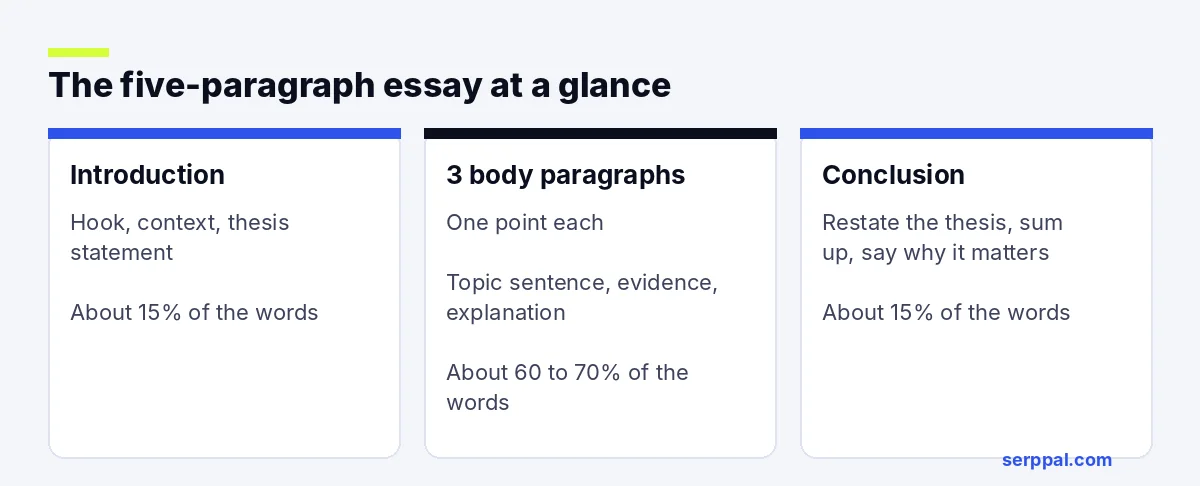
The five-paragraph essay is the essay structure most students learn first. It's concise, it introduces the argument early, and each part has one job. Here is what goes in each paragraph:
- Introduction: a hook, a little context on the topic, and the thesis statement, the one sentence that says what you will argue.
- Body paragraph 1: a topic sentence with your first point, evidence and details, and an explanation of how it supports the thesis.
- Body paragraph 2: a transition, then a new topic sentence with the second point, built the same way.
- Body paragraph 3: the third point, often the strongest, or a counterargument and your answer to it.
- Conclusion: a concluding paragraph that repeats the thesis in new words, sums up the supporting points, and tells the reader why it matters.
A 5 paragraph essay usually runs 500 to 800 words, about two to three pages double-spaced. The three body paragraphs carry the weight: together they should take up about 60 to 70 percent of the essay.
Five-paragraph essay example
Here is a short essay outline example on the topic "Should schools start later?":
- Introduction: a hook that summarizes the problem: many high schools start before 8:30 a.m. Thesis statement: schools should start later because teenagers sleep better, learn more and are safer on the road.
- Body 1 (sleep): topic sentence on how teenagers' sleep cycles shift later; evidence from a health source.
- Body 2 (learning): transition ("Better sleep also shows up in class"), then evidence on attention and grades.
- Body 3 (counterargument): later starts complicate bus routes and sports; answer that schools that changed found ways to adjust.
- Conclusion: restate the thesis, summarize the three reasons and suggest a one-year trial.
Each body paragraph connects back to the thesis, and the paragraphs follow logically from one to the next. That is what makes a typical paragraph plan work at any length.
How long is each paragraph?
In academic writing, a typical paragraph is usually 100 to 200 words, or about four to eight sentences: a topic sentence, two or three sentences of evidence, two or three of explanation, and a sentence that links back to the argument. Introductions and concluding paragraphs tend to be a little shorter than body paragraphs.
When you develop body paragraph 1, write the topic sentence first, then add evidence until the point is proven. If one paragraph runs past 250 words, it probably holds two ideas. Split it. If it's under 60 words, it may not have enough evidence to make its point. Clarity comes from one idea per paragraph.
Essay length by essay type
The types of essays you write in school and college each have their own typical length. The ranges below are common in schools and universities in the US, but your assignment always wins.
| Essay type | Typical word count | Typical paragraphs |
|---|---|---|
| High school essay | 300 to 1,000 | 3 to 7 |
| College application essay | 250 to 650 | 4 to 8 |
| Supplemental college essay | 100 to 300 | 1 to 3 |
| Undergraduate class essay | 1,000 to 3,000 | 6 to 20 |
| Graduate-level essay | 2,500 to 6,000 | 15 to 40 |
| Literature review | 3,000 and up | Organized by themes |
| Research paper | 3,000 and up | Organized by sections |
College essay length
A college application essay is a personal story, so it rarely follows the five-paragraph format. The Common App personal statement that admissions officers read allows up to 650 words, and most strong essays use most of that space in five to eight paragraphs. Some writers use a narrative structure (one story told in order); others use a montage structure (several short scenes tied together by one theme). Both work. Short paragraphs, even a one-line paragraph for effect, are fine in a personal essay.
Argumentative and expository essays
Among the types of essays you'll write most, an argumentative essay needs room for a counterargument, so it usually has at least four body paragraphs once you go past 800 words. An expository essay explains a topic in depth, so its length depends on how many parts the topic has and how much you need to explore each one. Graduate-level essays add an in-depth review of sources and introduce more supporting material. In both, aim for one main idea per body paragraph.
How to decide how many paragraphs your essay needs
- Start with the assignment. Read the guidelines and note the word count or page count, the essay type and the format requirements. Teachers' guidelines are worth mentioning in your plan, because they decide the details. If you're struggling to read the prompt, ask the teacher.
- Write the thesis. A clear thesis tells you how many points you need to prove it.
- List your main points. Each one becomes at least one body paragraph with its own supporting evidence. Arrange them logically, so the reader can follow.
- Divide the words. Clear structure is where you collect easy academic marks on most rubrics. Take about 10 percent for the introduction, 10 percent for the conclusion, and split the rest across the body.
- Outline before you write. A quick outline shows if one point is too thin or two points overlap. Our guide to writing an outline walks through it.
For example, a 1,000-word argumentative essay might get a 100-word introduction, four body paragraphs of about 190 words each, and a 100-word conclusion: six paragraphs in total.
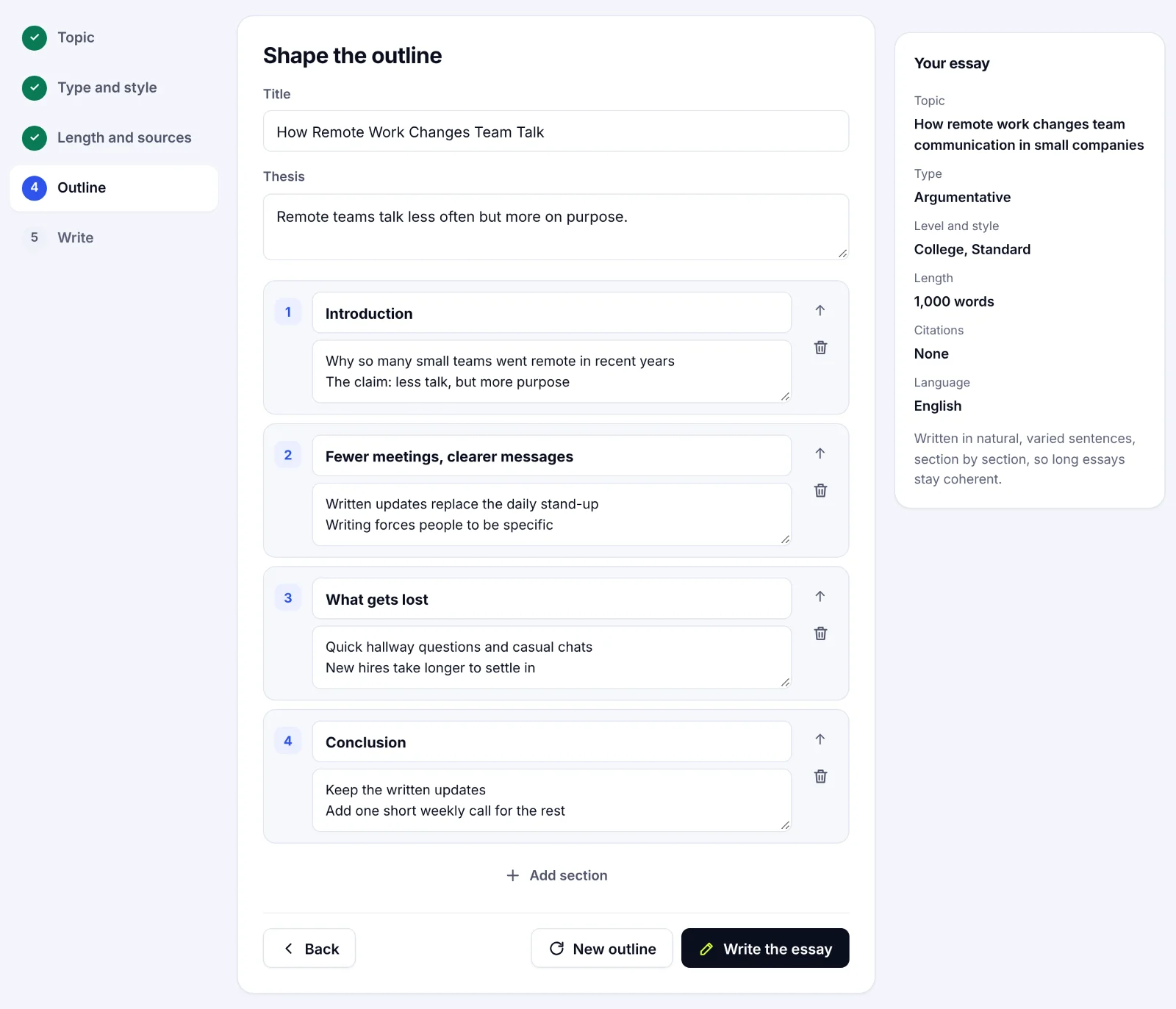
If you want help with the plan, SerpPal's essay writer builds an outline from your topic, essay type and length, and you can edit every section before it writes. It is a useful way to explore how a compelling essay is put together and how different types of essays are built, as long as the final writing is yours.
How long does it take to write an essay?
It depends on the length and how much research the topic needs, but a rough guide helps you plan your essay writing time:
- A short essay: one to two hours for about two pages, including a short outline and a proofread.
- 1,000 words: three to five hours spread over a day or two.
- 2,500 words with research: several days, most of it reading and taking notes.
Leave time to step away, reread and revise. Problems with structure and flow are much easier to spot the next day.
FAQs
Can an essay have 4 paragraphs?
Yes. A four-paragraph essay has an introduction, two body paragraphs and a conclusion. It works well for 400 to 600 words of writing when the prompt asks for two points or a comparison of two things.
How many words should an essay have?
As many as the assignment asks for. Without a limit, a high school essay is usually 300 to 1,000 words and a college class essay 1,000 to 3,000 words. Stay within about 10 percent of any word count you are given.
How many pages is 1,000 words?
About four pages double-spaced, or two pages single-spaced, in a 12-point font with one-inch margins.
Does every essay need a conclusion paragraph?
Almost always. Even a short essay should end with a few sentences that summarize the main argument and show why it matters. Only some personal essays end on a scene instead of a formal conclusion.