On this page
- Formal writing rules for essay format
- Essay structure: the parts of an essay
- Essay outline template: the universal outline structure
- Essay format examples: MLA, APA and Chicago
- College essay format for students
- How to start an essay: opening examples
- How to write a book title in an essay
- Tips for writing an effective essay
- Essay formatting checklist
- Frequently asked questions
A standard essay format uses a 12-point font, double spacing, 1-inch margins and a three-part structure: an introduction with a thesis, body paragraphs that each support it, and a conclusion. The exact details, like where your name goes and how references are listed, depend on the style your teacher asks for, usually MLA or APA.
This guide gives you essay format examples, the formal writing rules most teachers expect, an essay outline template for the most common essay types, the college essay format, and opening examples you can adapt.
Key takeaways
- Default format: 12pt font, double spaced, 1-inch margins, half-inch indents, page numbers top right, text aligned to the left margin.
- Every essay has three parts: an opening, body paragraphs and a conclusion. Outline them before you write.
- Use the outline template that matches the kind of essay: argumentative, narrative, compare and contrast, expository or analytical.
- A college application essay has its own format: plain text in an online box, no header, and a strict word limit.
- Italicize book names; put short works like poems and articles in quotation marks.
Formal writing rules for essay format
Unless your teacher says otherwise, these rules apply to most academic essays:
- Font: a readable 12-point font such as Times New Roman or Arial.
- Spacing: double spaced throughout, with no extra space between paragraphs.
- Margins: 1 inch on all sides. Text aligned to the left margin, not justified.
- Indentation: the first line of each paragraph indented 0.5 inches.
- Page numbers: top right corner of every page.
- Heading: your name, your teacher, the course and the date (MLA), or a separate cover page (APA).
- References: a source list at the end, in the style your teacher uses.
Essay structure: the parts of an essay
Introduction
The opening paragraph grabs attention, gives context, and ends with your thesis statement: the one-sentence claim the essay will prove. In a 1,000-word essay, it's usually 80 to 150 words.
Body paragraphs
Each body paragraph makes one point that supports the thesis:
- Topic sentence stating the point.
- Evidence: a quote, a statistic or an example.
- Explanation of how the evidence supports the point.
- Link back to the thesis or on to the next idea.
Conclusion
The essay conclusion restates the thesis in new words, recaps the main points and answers "so what?" It doesn't introduce new evidence.
Essay outline template: the universal outline structure
Start with your thesis: write the one sentence your essay will prove before anything else. Then use this basic essay outline and adapt it to different essay styles:
- Opening: attention-getter, context, thesis statement with three points.
- Body paragraph 1: topic sentence, evidence, explanation, link.
- Body paragraph 2: topic sentence, evidence, explanation, link.
- Body paragraph 3: topic sentence, evidence, explanation, link.
- Conclusion: restated thesis, recap, final thought.
Template 1: Argumentative essay outline
- Opening: background on the issue and your position.
- Reason 1 with evidence.
- Reason 2 with evidence.
- Counterargument: the strongest opposing view on the other side, stated fairly.
- Rebuttal: why your position still holds.
- Conclusion: restated position and why it matters.
A persuasive essay follows the same shape with more emphasis on appealing to the reader's values. For full models, see our argumentative essay examples.
Template 2: Narrative essay outline
- Opening scene that sets the time, place and people.
- Rising action: what happened and what was at stake.
- Turning point: the moment that changed things.
- Resolution: how it ended.
- Reflection: what you learned and why it matters now.
Template 3: Compare and contrast essay outline
- Opening: the two topics and your thesis about how they relate.
- Point 1: how both compare.
- Point 2: how both compare.
- Point 3: how both compare.
- Conclusion: what the comparison reveals.
Organizing by point, rather than covering one side fully and then the other, keeps the comparison logical and easier to follow.
Expository and analytical essays
An expository (informative) essay explains a topic with facts and examples, in a neutral voice, and a descriptive essay paints a picture with sensory detail; use the basic outline with one subtopic per body paragraph. An analytical essay argues for an interpretation of a text or event; each body paragraph pairs evidence with analysis. Our guide on how to write an analytical essay has a full outline and example.
Essay format examples: MLA, APA and Chicago
| MLA | APA | Chicago | |
|---|---|---|---|
| Common disciplines | English, humanities | Psychology, social sciences | History, some humanities |
| First page | Name block top left, heading line centered | Separate cover page | Usually a cover page |
| Page numbers | Last name and number, top right | Number, top right | Number, top right or bottom |
| In-text citations | (Author page) | (Author, year) | Footnotes or author-date |
| Source list | Works Cited | References | Bibliography |
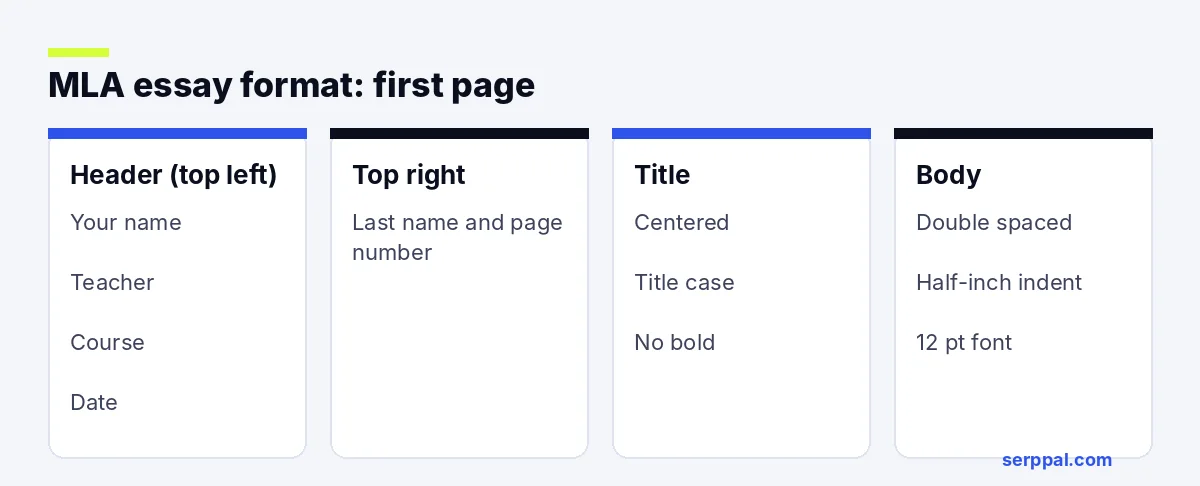
MLA, the language of the humanities: put your name, your teacher's name, the course and the date at the top left of page one, double spaced. Center the essay's name on the next line in title case, with no bold or underline.
APA (7th edition): use a cover page with the paper's name in bold, your name, school, course, instructor and due date. Level 1 section headings are centered and bold.
Chicago: commonly uses footnotes for citations and a bibliography at the end; check whether your teacher wants a cover page.
College essay format for students
College application essays follow different rules from class essays, because you paste them into an online form:
- No MLA or APA header. The application already has your name.
- No title needed. On the Common App, everything in the box counts toward the word limit, so most applicants skip a heading.
- Plain text. Bold, italics and special formatting may be lost when you paste, and so can formatting copied from a PDF. Use a blank line between paragraphs.
- Word limit. The Common App main essay allows 250 to 650 words; supplements are usually shorter. Our guide to college essay word count lists the limits.
- Structure. A college essay is personal, not academic. Admissions readers on the Common Application want to see what you value and how you think; it's a chance to craft one story effectively and connect it to who you are. It doesn't need a rigid structure; it needs one specific story and real reflection.
How to start an essay: opening examples
Start with a hook that leads to your topic, add a sentence or two of context, then state your thesis. Avoid dictionary definitions and broad openers like "Since the beginning of time." Three examples for an essay arguing that schools should start later:
- Fact: "Most teenagers' body clocks don't let them fall asleep before 11 p.m., yet many high schools start before 8 a.m. Schools should start no earlier than 8:30."
- Scene: "At 6:45 a.m., half the bus is asleep before it leaves the driveway. A later start would let students arrive ready to learn."
- Question: "What if the easiest way to raise grades cost nothing? Moving the school day later is that change."
Each gets to the thesis quickly. For more models, see our essay examples.
How to write a book title in an essay
| Type of work | Format | Example |
|---|---|---|
| Books, novels, plays | Italics | To Kill a Mockingbird |
| Films, TV series, albums | Italics | The Wizard of Oz |
| Newspapers, magazines | Italics | The New York Times |
| Short stories, poems, articles | Quotation marks | "The Raven" |
| Songs, episodes, chapters | Quotation marks | "Chapter 1" |
Capitalize the first word and all major words. When handwriting, underline book names instead of using italics. The first time you mention a book, give its full name and the author's full name: "In Of Mice and Men, John Steinbeck..."
Tips for writing an effective essay
Format gets you the marks for presentation; the writing earns the rest. Good essay writing habits matter more than any template, for short essays and long ones. A few habits make writing essays easier and the result stronger:
- Choose essay topics you can argue. A focused question beats a broad concept. "Social media" is a subject; "Should schools ban phones in class?" is an essay.
- Outline before you draft. Writing an essay from an outline is faster and keeps every paragraph connected to the thesis.
- Lead with your main argument. Readers should know your position by the end of the first paragraph.
- Analyze, don't just describe. After each piece of evidence, explain what it shows. That's what separates a good essay from a summary.
- Write for your reader. Assume a smart reader who doesn't know your topic, and define terms the first time you use them.
- Pick a clear essay title. A specific essay title tells the reader what you'll argue; a vague one wastes the first impression.
- Revise in two passes: one for argument and structure, one for grammar and punctuation.
- Reread the prompts. Before you submit, summarize the assignment in one line and check that a strong essay answers it.
These writing skills carry across different essay types and formatting styles, and they're what turn a correctly formatted paper into a compelling one. Students who find writing essays challenging usually improve fastest by outlining more and polishing less, and by building each argument from evidence rather than opinion.
Essay formatting checklist
- Font, size, spacing, margins and indentation match the assignment.
- The heading or cover page follows the required style.
- Every paragraph has one clear idea and the body follows your outline.
- Book names are in italics and short works in quotation marks.
- Every source in the text appears in your source list.
- The word count fits the limit; a word counter checks it quickly.
If you're stuck at the outline stage, SerpPal's AI writer and essay writer can help organize your ideas into an outline with real references. Check your school's AI policy first, and make sure the final essay is your own writing. Sample essays are for studying structure; students learn the skills by writing their own.
Frequently asked questions
What is the standard essay format?
A 12-point font, double spacing, 1-inch margins, half-inch paragraph indents and page numbers at the top right, with an opening, body paragraphs and a conclusion. MLA and APA add rules for the heading and citations.
What are the 5 parts of an essay?
In a five-paragraph essay: an introduction, three body paragraphs and a conclusion. Longer essays keep the same structure with more body paragraphs.
How do you format a college essay?
Write it in plain text without a header, keep paragraphs separated by a blank line, stay within the word limit, and paste it into the application's text box. Check the formatting after pasting.
Do you italicize book names in an essay?
Yes. Books, films and other long works go in italics; poems, short stories and articles go in quotation marks.
How long should an essay introduction be?
About 5 to 10 percent of the essay: 50 to 80 words for a 500-word essay and 80 to 150 words for a 1,000-word essay. It should end with your thesis.