On this page
Essay examples show you what a finished essay looks like: how the introduction sets up a thesis, how each body paragraph supports it, and how the conclusion ties it together. The fastest way to use them is to pick an example of the same type you're writing, study its structure, then write your own version on your own topic.
This guide gives you short essay examples for the main types students write, including college application essays, then walks through the structure every strong essay shares and the mistakes that cost the most marks.
Key takeaways
- Every essay has the same skeleton: an introduction with a clear thesis, body paragraphs that each make one point with evidence, and a conclusion that answers "so what?"
- The type decides the rest. A narrative essay tells a story, an expository essay explains, an argumentative essay persuades, and an analysis essay looks at how something works.
- College admissions essays work differently: the personal statement is about who you are, not what you know.
- Read examples to learn structure and tone. Never copy whole lines; teachers and admissions officers notice, and so does plagiarism software.
- Most marks are lost to a vague main claim, body sections without evidence, and no proofreading.
What is an essay?
An essay is a short piece of writing that makes a point and supports it. In school, most essays run from 500 to 2,000 words and follow a set structure: introduction, body paragraphs, conclusion. The point you're making is your thesis statement, usually a single line near the end of the introduction.
Essays exist to show your thinking, and essay writing is a skill teachers grade with clear metrics: thesis, evidence, organization and language. In academic writing, a teacher wants to see that you can organize ideas, analyze evidence, evaluate sources and explain connections between concepts. A college wants to see your perspective, your values and how you've grown. The format is the same tool used for different goals.
Essay samples: types at a glance
| Type | Goal | Typical length | Key feature |
|---|---|---|---|
| Narrative | Tell a story with a point | 500 to 1,000 words | First person, a turning point, a takeaway |
| Descriptive | Paint a picture | 500 to 800 words | Sensory details |
| Expository | Explain a topic | 800 to 1,500 words | Facts, no opinion |
| Argumentative | Persuade with evidence | 1,000 to 2,000 words | Claim, evidence, counterargument |
| Analysis | Explain how something works or what it means | 1,000 to 2,000 words | Close reading, interpretation |
| Compare and contrast | Show similarities and differences | 800 to 1,500 words | Point-by-point structure |
| College application | Show who you are | 250 to 650 words | Personal, reflective, specific |
Essay examples by type
Each example below is a short model we wrote to show the structure. Use them as models, not as text to reuse.
Narrative essay story example
A narrative essay tells a true story and draws meaning from it, including the feelings and challenges involved. The key is one specific moment, not a summary of a whole year.
Sample introduction: The scoreboard said 0 to 4 when Coach handed me the keeper gloves. I had never played in goal. I had about ninety seconds to decide whether to tell him that, and I didn't. That match taught me more about saying "I don't know" than any class ever has.
The main claim here is the last sentence. The body would cover what happened in goal, the mistake, and what changed afterward. The conclusion connects that moment to now.
Expository essay examples
An expository essay explains a topic clearly and neutrally. There's no "I think"; there are facts, definitions and examples.
Expository introduction: Coral reefs cover a tiny share of the ocean floor, yet they support a large share of all marine species. This essay explains how reefs form, why they are so productive, and what threatens them today.
Notice the roadmap: the reader knows the three sections before they start. Sample informative essays follow the same pattern; "informative" and "expository" are often used for the same thing.
Argumentative essay example
An argumentative essay takes a position and defends it with evidence, then answers the strongest objection.
Sample thesis: Schools should start no earlier than 8:30 a.m., because teenagers' sleep patterns shift later, later start times are linked to better attendance, and the main objection, bus costs, can be solved with staggered routes.
It names the claim and the three reasons, which become the body sections. For a full walkthrough, outline and topic ideas, see our guide to argumentative essays.
Analysis essay example
An analysis essay (including literary analysis) looks closely at a text, a film, a process or data and explains how it works or what it means.
Sample thesis: In The Great Gatsby, Fitzgerald uses the green light to show that Gatsby loves the idea of Daisy more than Daisy herself, a gap the novel treats as the core of the American dream.
Each body section takes one scene, quotes it briefly, and analyzes the language. The quote is evidence; your analysis is the point.
Compare and contrast essay example
Sample thesis: Online and in-person classes teach the same content, but they differ in how students manage time, how they get feedback, and how they build connections with classmates.
Organize by point (time, feedback, connections), discussing both options under each point. It's easier to follow than covering one option fully and then the other.
College essay examples
The college admissions essay, or personal statement, is a different genre. It's often the only part of the application where recognition, grades and scores step aside and your voice comes through. Admissions officers already have your grades and test scores. The essay is the only place they hear your voice, so it should show how you think, what you value and how you've grown.
Most US applicants write their college essay for the Common App, which offers several prompts and a limit of 650 words. Whether you're applying to a state school, MIT or Stanford, the same rules hold: be specific, be honest, and reflect.
College essay introduction example
Here's how a college essay can open:duction
Every Saturday for three years, I fixed bikes at the community workshop behind our library. I started because I needed a working bike. I stayed because of Mr. Ortiz, who never fixed anything for you. He handed you the wrench and waited.
This college essay works because it opens on something concrete, introduces a person, and hints at what the writer learned (independence, patience) without stating it yet.
How to write a college personal statement
- One story, not a résumé. Pick a single experience and go deep. Your extracurricular activities and awards already have their own section of the application, so the essay doesn't need to repeat them.
- Reflection over achievement. Admissions readers care less about what happened than about the lessons you took from it and how they changed your goals. A college essay that demonstrates curiosity says more than one that lists a GPA.
- Specific details. "I love STEM" says nothing. "I rebuilt the same AP Physics lab three times until the pendulum data made sense" says a lot.
- Your real voice. Write the way you talk when you're being thoughtful. Avoid big words and stock phrases chosen to impress.
- Humility and self-awareness. Stories about adversity, mentors or a belief you changed work when they show growth, not when they ask for sympathy.
Supplemental essay prompts in your application
Many schools also ask supplemental essay prompts, such as "Why this college?" or a short answer about your community. Treat each one as a separate opportunity: research the school, be specific, and don't paste the same answer into every dream school's form. Make sure each answer aligns with what that school says it values.
A quick word on "common" or cliché college essay topics
Sports injuries, mission trips and "the big game" aren't banned, but thousands of applicants write them. If you choose a common topic, the angle has to be yours: an image, a mistake or a conclusion nobody else would write. The cliché is the generic takeaway, not the subject.
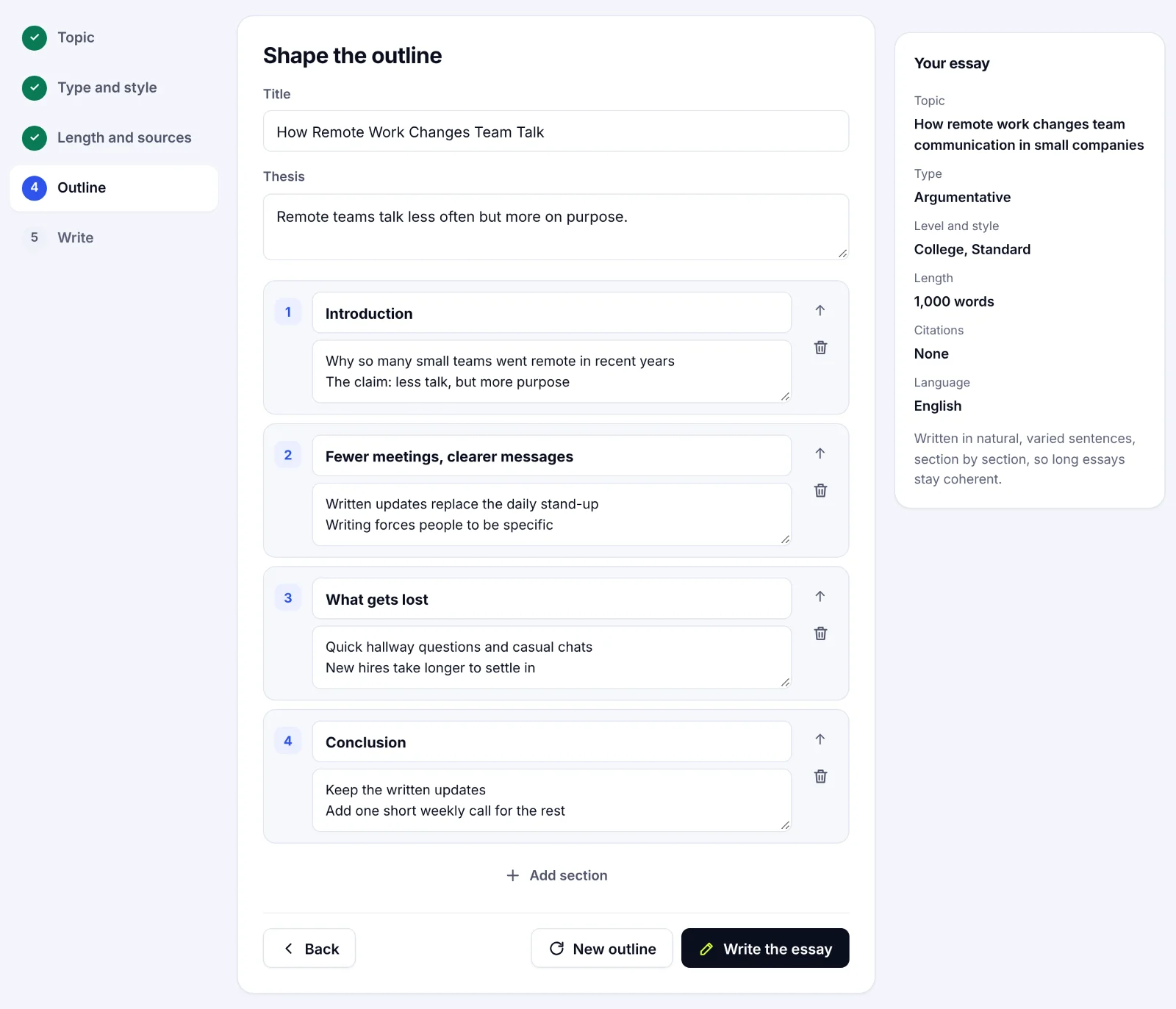
Understanding essay structure: a step-by-step outline
Building your essay from inspiration to original work
If you're unsure where to start, begin with what piques your interest in the prompt. Before you write, brainstorm and map your ideas: list everything you could say, group the points, and pick the three strongest. That outline is the plan for the full essay, and it makes the writing far more straightforward.
Every example above shares the same structure. Here's the outline to start from:
- Introduction. A hook (a fact, a question, a scene), a line or two of context, and your thesis.
- First body section. A topic sentence stating one point, evidence (a quote, data, an example), your explanation of how the evidence supports the thesis.
- Next body sections. Same pattern, one point each, with transitions that show how the ideas connect.
- Counterargument (argumentative essays). The strongest objection, in a paragraph that acknowledges it fairly, and your answer to it.
- Conclusion. Restate your main point in new words, pull the points together, and end with why it matters.
Essay introduction examples
A good essay introduction does three jobs in a few lines: grab attention, give context, state the thesis. Here are three hooks for the same essay on school start times:
- Question: "What if the easiest way to raise grades cost nothing?"
- Fact: "Most teenagers' body clocks don't let them fall asleep before 11 p.m."
- Scene: "At 6:45 a.m., half the bus is asleep before it leaves the driveway."
Any of them works if what follows leads clearly to your claim. The essay begins with the hook; the essay conclusion should echo it, which gives the piece consistency.
Common mistakes in essay writing
- A vague thesis. "Social media has good and bad effects" can't be argued. "Social media harms teenagers' sleep more than their mood" can.
- Points without evidence. Every point needs support: a quote, a figure, an example.
- Summary instead of analysis. Retelling the plot isn't analyzing it. Explain how and why.
- Circular reasoning. "This policy is good because it's beneficial" proves nothing. Give a reason that stands on its own.
- Ignoring the prompt. Read the prompt twice and check that every section answers it.
- Padding to hit a word count. Readers notice repetition. Add evidence or analysis instead.
- Skipping proofreading and editing. Typos and broken grammar make a strong argument look careless.
Proofreading and editing your essay
Revising is the part of the essay writing process where a good draft becomes a strong essay, and essay editing is mostly cutting. Leave the draft for a day if you can, then read it out loud. You'll hear the sentences that don't work. Check your formatting against the assignment (font, spacing, citations), and ask a peer, teacher or counselor for feedback on whether your argument is clear.
Use this revision checklist:
- Step 1: Does the thesis answer the prompt in one clear line?
- Step 2: Does each topic sentence develop one point that supports it?
- Step 3: Is every claim backed by evidence, with your analysis to clarify why it matters?
- Step 4: Did you revise for flow, cut repetition and fix the formatting?
- Step 5: Can you summarize the essay in two sentences? If not, the focus isn't clear yet.
Tools help with the mechanical part. Proofreading software catches spelling and punctuation mistakes, and a plagiarism checker confirms you've credited every source; SerpPal's grammar checker explains each fix so you learn the rule, and the essay grader scores your draft against a typical marking scheme and shows what to fix first. A word counter keeps you inside the limit.
If you're stuck at the start, AI writing tools can spark ideas, help you adapt an example's structure to your topic or build an outline. Students say this has helped them get past the blank page, but AI can also flatten your voice. SerpPal's AI writer and essay writer can draft from your topic and sources, but check your school's policy first, and make sure the final essay, especially a personal statement, is in your own words and about your own experience.
Frequently asked questions
Where can I find good essay examples?
Your teacher and school writing center are the best source, because their models match your assignment. Many universities publish essays from admitted students, and writing guides like this one show short essay samples by type. Read several, then write your own.
How many essay examples should I read?
Two or three of the same type is usually enough. Read them once for the overall structure, then again to see how each section moves the argument forward. More than that and you risk copying someone else's voice.
How long is a typical essay?
High school essays usually run 500 to 1,500 words, college course essays 1,000 to 3,000, and the Common App personal statement up to 650 words. Always follow the word count in your assignment or prompt.
Is it okay to copy parts of an essay example?
No. Copying lines or ideas without credit is plagiarism, and schools use plagiarism detection. Use examples to learn structure, transitions and tone, then write your own essay on your own topic in your own words.
What makes a college essay stand out?
A specific story, honest reflection and a clear voice. Admissions officers read thousands of essays; the ones they remember show how the applicant thinks, not just what they achieved.