On this page
An analytical essay breaks a subject into parts and explains how those elements work together to create meaning or an effect. Here's how to write an analytical essay in brief: pick a focused question about your subject, make an arguable claim that answers it, then support the claim in each body paragraph with evidence and your own analysis of it.
This guide walks through writing an analytical essay step by step, with an outline, a short analytical essay example, a literary analysis example and tips for AP Literature essays.
Key takeaways
- An analysis essay explains how and why something works. It doesn't just summarize, and it isn't a personal opinion piece.
- The thesis is an interpretation someone could disagree with, not a fact about the text.
- Each point in the body follows the same pattern: claim, evidence, analysis, link to your main claim.
- Analysis is the part where you explain what the evidence shows. Aim for at least as much analysis as evidence.
- In AP Lit essays, the rubric rewards a defensible thesis, specific evidence with commentary, and sophistication.
Analytical essay definition
An analytical essay examines a text, an event, a work of art, a process or data, and argues for an interpretation of it. You might analyze how a poet builds tension, why a historical decision succeeded, how an advertisement persuades, or what a film's final scene means.
The key difference from other essays:
| Essay type | Main question | Example |
|---|---|---|
| Summary | What happens? | The novel follows a family during the Great Depression. |
| Argumentative | What should we believe or do? | Schools should assign more contemporary novels. |
| Analytical | How or why does it work? | Steinbeck uses the turtle to show the family's endurance. |
Writing an analytical essay: step-by-step guide
Step 1: Understand the prompt and choose a source
Underline the task words. "Analyze how" asks about techniques; "analyze why" asks about causes or purposes. If the prompt names a focus, such as imagery, structure or tone, the whole essay should stay on it.
If you choose your own source, as in a critical analysis essay for a college assignment, pick something rich enough to discuss from more than one angle: a speech, a short story, an ad campaign or a scholarly article. Credible sources with clear perspectives give you more to discuss and analyze than a text you simply agree with, and they help you relate your topic to other ideas.
Step 2: Read closely and find textual evidence
Read the text more than once. Mark patterns: repeated words or images, shifts in tone, surprising decisions, contrasts and similarities. In fiction, look at characters, the narrator, symbolism, irony and figurative language; in nonfiction, at rhetorical choices and how the author structures the argument. For each one, note your thoughts on what it might mean and what elements it connects to. This textual evidence is the raw material for every claim you make. The best analysis starts with choosing one detail and asking why the author chose this word, this order or this image instead of another.
Step 3: Coming up with a thesis
Your thesis answers the question and states an interpretation. Compare:
- Weak (a fact): "The Great Gatsby uses a green light."
- Weak (too broad): "The Great Gatsby is about the American dream."
- Strong: "In The Great Gatsby, the green light shows that Gatsby loves the idea of Daisy more than Daisy herself, a gap the novel treats as the flaw at the center of the American dream."
A strong thesis is specific, arguable and points to how you'll prove it.
Step 4: Outline your main arguments
An analytical essay outline keeps the paper focused. Narrow your essay topic to one question, then list the points that demonstrate your reading of the text.
Choose two to four points that develop your argument, each with its own evidence. Order them so the argument builds, often from the most obvious point to the most surprising.
Step 5: Draft with the claim, evidence, analysis pattern
Each body paragraph needs:
- A claim (topic sentence) that states one part of your argument.
- Evidence: a short quotation, a detail or data; cite it in the format your teacher uses.
- Analysis: two to four lines explaining how the evidence supports the claim. Focus on specific words and techniques.
- A link back to your main claim, to relate the point to the whole.
Step 6: Write the introduction and conclusion
The essay introduction gives context (title, author, the focus) and ends with the thesis. The conclusion explains what the analysis shows when you look at the text in its entirety. The conclusion explains what your analysis reveals about the work as a whole. Don't just restate your claim; say why the interpretation matters.
Step 7: Revise, then proofread
Check that each paragraph logically builds on the last and that your ideas, not the text's plot, drive the essay. If a paragraph doesn't contain a new idea, merge or cut it.
Read each paragraph and highlight the lines that only retell what happens. If retelling outweighs analysis, cut it and add explanation. Then proofread carefully for grammar and formatting.
Analytical essay structure and outline
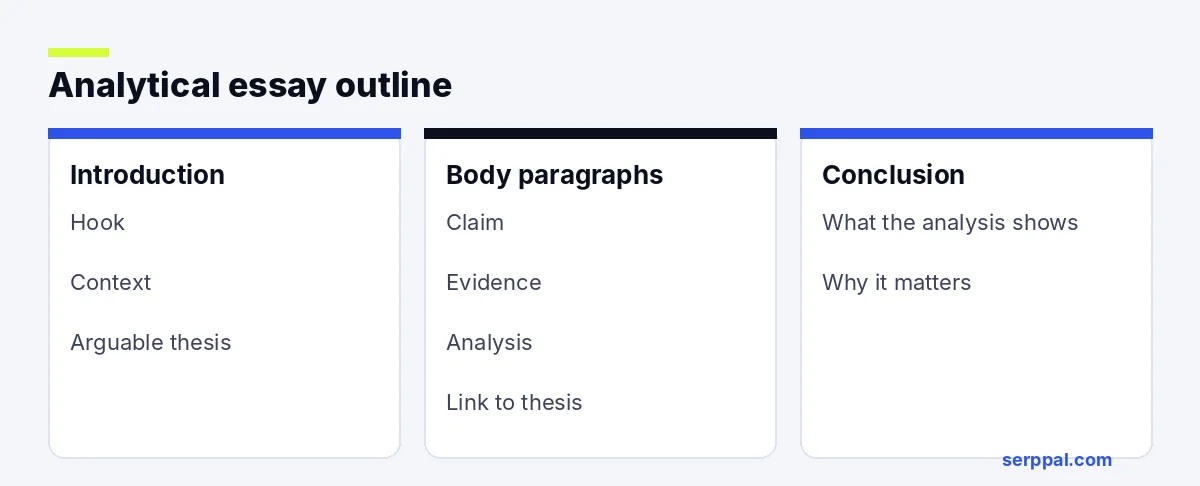
Use this outline for a 1,000 to 1,500 word analysis essay:
- Introduction: hook, context (title, author, subject), thesis statement.
- Point 1: first technique or point, evidence, analysis, link.
- Point 2: second point, evidence, analysis, link.
- Point 3: third point, evidence, analysis, link.
- Conclusion: what the analysis shows, why it matters, a final insight.
Analytical essay example

Here's a short example from a rhetorical analysis essay on a speech, showing the claim, evidence, analysis pattern:
Claim: In his "I Have a Dream" speech, Martin Luther King Jr. uses repetition to turn a list of grievances into a shared vision. Evidence: The phrase "I have a dream" opens eight lines in the final section. Analysis: Each repetition starts from the same words but ends in a new place, from the red hills of Georgia to a future for his four children, so the audience hears the dream grow larger with each line. The repeated opening makes the hope feel certain, while the changing endings make it feel concrete. Link: By the end, repetition has done what argument alone could not: it has made listeners rehearse the future King describes.
Notice that the evidence is brief and the analysis does most of the work. The quoted phrase is a single sentence; the commentary around it is what makes the paragraph convincing and in-depth. That balance is what teachers look for.
Literary analysis essay example
A literary analysis essay applies the same method to fiction, poetry or drama. Here's a sample thesis statement and analysis:
Thesis: In Of Mice and Men, Steinbeck uses the setting of the river pool at the beginning and end of the novel to show that the dream of the farm was never reachable.
Analysis: The novel opens and closes in the same place, a quiet pool by the Salinas River. In the first chapter, the setting is peaceful and hopeful: George and Lennie rest there and talk about the farm. When Lennie returns in the final chapter, the same place feels like a trap. The repetition of the setting creates a circle rather than a journey, suggesting that the men have gone nowhere. Steinbeck's choice to end where he began shows that, for workers like George and Lennie, the dream was a story that kept them moving, not a place they could reach.
For more models of different essay types, see our essay examples, and for argument-based essays, our argumentative essay examples.
AP Lit essay examples and tips
The AP English Literature exam has three free-response essays: poetry analysis, prose fiction analysis, and a literary argument about a work you choose. Each is scored on a 6-point rubric:
| Rubric row | Points | What earns them |
|---|---|---|
| Thesis | 0 to 1 | A defensible interpretation that answers the prompt |
| Evidence and commentary | 0 to 4 | Specific evidence with commentary explaining how it supports the thesis |
| Sophistication | 0 to 1 | Complex thinking, such as tensions in the text or a nuanced argument |
Tips for timed AP Lit essays:
- Spend 5 to 10 minutes planning. Read the passage twice and write a one-line thesis statement before you start.
- Lead with your claim. A short introduction is fine; the defensible claim is what's scored.
- Quote briefly. Short phrases woven into your own writing show close reading better than long block quotations, and add citations if the prompt asks for them.
- Explain every piece of evidence. Commentary is where most points are earned.
- Go for complexity. Acknowledge tensions or contradictions in the text to aim for the sophistication point.
Common mistakes in analytical essays
- Summarizing instead of analyzing. Retelling the plot earns little credit.
- A thesis that's a fact. If no one could disagree, there's nothing to analyze.
- Evidence without commentary. Evidence doesn't explain itself.
- Listing literary devices. Naming a metaphor isn't analysis; explaining its effect is. Use examples to illustrate the point, then explain. Don't paraphrase the text and call it analysis either.
- Ignoring the reader. Make sure your writing meets the prompt and helps the reader see something new in the text. Use the topic sentence of each body paragraph to convey one clear idea.
- Wandering from the prompt. Every body paragraph should answer the question asked.
Tools that help
Analysis is your thinking, so tools work best at the edges. A word counter keeps you inside the limit, and SerpPal's AI writer and essay writer can help you brainstorm angles or organize an outline from your notes. Check your school's policy on AI first, and make sure the interpretation and the final words are yours.
Frequently asked questions
What is the difference between an analytical essay and a summary?
A summary tells what happens; it can summarize a plot in a few lines. An analytical essay explains how or why it happens, or what it means, and argues for that interpretation with evidence.
How do you start an analytical essay?
Open with a hook related to your subject, give brief context such as the title and author, and end the introduction with an arguable thesis that names your interpretation.
How many paragraphs is an analytical essay?
Usually five: an introductory paragraph, three body paragraphs and a conclusion. Longer papers add more, each analyzing one point.
What makes a good analytical thesis?
It's specific, arguable and focused on how or why something works. It should be possible for a thoughtful reader to disagree.
How do you analyze evidence in an essay?
Introduce the quote with enough background information for the reader to follow, then explain what specific words or techniques do, how they create an effect, and how that supports your argument. Spend more words on the explanation than on the evidence itself.