On this page
- Why the opening line of your college application essay matters
- How to start a college essay: 7 hooks with essay examples
- College essay introductions to avoid (common mistakes)
- What should I write my personal essay about?
- Examples: what college essays that worked have in common
- Tips for writing the rest of your college admissions essay
- Resources for college applications
- FAQ
To start a college essay, open with a specific moment, image or thought that only you could write, then quickly show why it matters. The best essay introductions drop the reader into a scene, in medias res, or start with an intriguing fact instead of announcing the topic, quoting someone famous or defining a word.
This guide covers seven hooks with examples, the essay introductions to avoid, how to choose what to write about, what college essays that worked have in common, and tips for writing the rest of your application essay.
Key takeaways
- Your first line has one job: make the admissions officer want to read the second one.
- Specific beats impressive. Small, vivid description is more memorable than a big claim.
- Strong hooks start in a scene, with a surprising fact, an honest claim, a line of dialogue or a quiet thought.
- Avoid quotes, dictionary definitions, rhetorical questions and "Ever since I was a child".
- Write your intro last, or at least revise it after the draft is done. You'll know what the essay is really about by then.
Why the opening line of your college application essay matters
Admissions officers at colleges from state universities to Harvard, Stanford and Columbia read thousands of application essays each season. Your grades, GPAs and test scores such as the SAT already tell them how you do academically. The essay is the one part of the application process where they hear your voice, and the first few lines decide how closely they read the rest.
A good start doesn't need to be clever. It needs to be yours. An effective essay hook is often found by recalling one moment in detail rather than summing up years. The Common Application personal statement allows up to 650 words, so you can't spend 100 of them warming up. Get into the story fast and earn the reader's attention early. Start early in your senior year, so you have time to brainstorm topics and revise.
If you're stuck before you even begin, brainstorming and an outline help. Our guide to writing an outline shows how, and an AI writer can help with brainstorming questions to ask yourself, as long as the final essay is written in your own words.
How to start a college essay: 7 hooks with essay examples
These example hooks were written for this guide to show each technique. Use them as patterns, not templates.
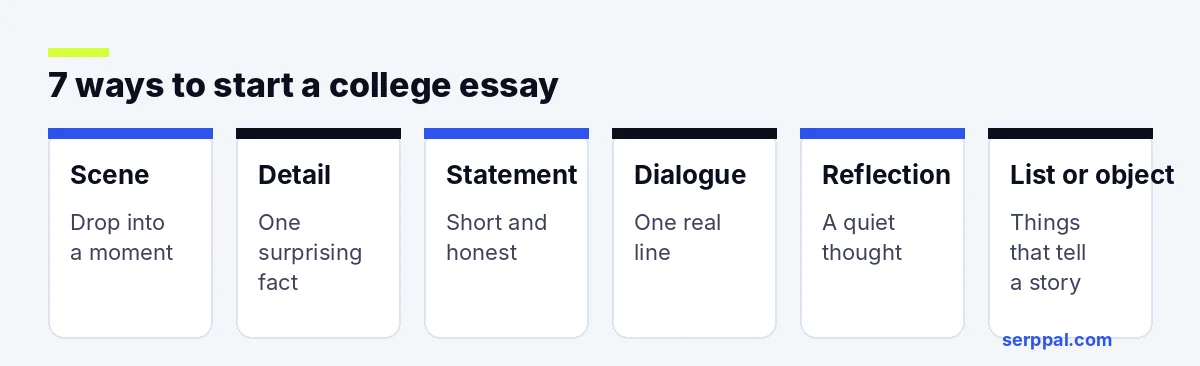
1. Start in the middle of a scene
Drop the reader into a moment that's already happening. This is the most common hook in essays that work, because it creates tension right away and grabs reader attention.
Example: "The smoke alarm went off for the third time that evening, and my grandmother waved a dish towel at it without looking up from the pot."
The reader wants to know who these people are and what's cooking. A few lines later, you step back and explain why this kitchen matters to you.
2. Lead with an intriguing fact
A fact that doesn't seem to belong makes the reader curious and invites them in.
Example: "I own forty-two copies of the same paperback, and I've read none of them."
One unusual detail like this works better than a list of achievements, because the essay shows curiosity instead of claiming it.
The essay then explains it (maybe you run a book exchange), and that explanation reveals your interests and character.
3. Make an honest, bold claim
A short, confident line can carry an intro if it's sincere and specific.
Example: "I was the worst player on the worst team in our league, and I loved every minute of it."
Avoid claims that sound like slogans ("Failure is the key to success"). The best bold hooks are personal, not philosophical.
4. Open with a line of dialogue
Dialogue works when the line is surprising and short.
Example: "'You're holding it upside down,' the seven-year-old told me, on my first day teaching her to read music."
Keep it to one line, then move into the scene.
5. Begin with a quiet thought
Some essays start with a thought rather than an action. This suits quieter, more thoughtful topics, and it's a good place to show your funny side if humor comes naturally to you.
Example: "I didn't notice how much I narrate my own life until my little brother started doing it too."
6. Use a short list
A list of unexpected items can sketch a personality fast.
Example: "Things I carry in my backpack: two calculators, a bag of birdseed, and a laminated map of the city bus routes from before they changed."
7. Start with an object or an anecdote
An object can hold a whole story: a worn notebook, a family recipe card, a broken instrument. So can a short anecdote.
Example: "The violin in my closet has three strings, a cracked bridge and my great-uncle's initials scratched under the chin rest."
College essay introductions to avoid (common mistakes)
Admissions committees see some essay introductions again and again, especially at selective schools. Steer clear of these; they aren't wrong, but they waste your first impression and a reader's short attention span:
- Famous quotes. The reader wants your words, not a poet's.
- Dictionary definitions. "Webster's defines courage as..." signals a generic essay.
- Rhetorical questions. "Have you ever wondered what it's like to...?" feels like a speech, not a story.
- Childhood clichés. "Ever since I was young, my passion has always been..."
- Restating the essay prompt. The reader already knows the question.
- Repeating your resume. Listing accomplishments and extracurricular activities belongs in the activities section.
- Thesaurus phrases. Fancy vocabulary sounds added to impress. Use the words you'd actually say.
What should I write my personal essay about?
A great opener needs a story worth telling. Good topics are rarely the biggest events in your life; they're moments that demonstrate how you think. Ideas flow more easily when you start from questions like these:
- What do I do when nobody is making me do it?
- What's something I changed my mind about, and why?
- What small daily routine says something about me?
- When did I face a challenge, and what lessons did I take from it?
- What strengths would my favorite teacher or counselor say I have?
Good topics for a college application essay
| Topic | What it reveals |
|---|---|
| A part-time job | Responsibility and how you treat people |
| A hobby nobody expects | Curiosity and personality |
| A family tradition | Background and values, if you focus on your role |
| A problem you tried to fix | Initiative, even if it didn't work |
| A belief you changed | Growth and honesty |
Whatever essay topic you choose, connect it to your interests and values; the right essay topic is one only you could write. Topics to handle with care: sports injuries, mission trips and the big game. They can work, but they're common, so they need an unusual angle.
Examples: what college essays that worked have in common
Essays that admissions offices share, such as the "Essays That Worked" collection Johns Hopkins publishes on its admissions site, tend to share a few traits:
- A clear, consistent voice. They sound like a real high school student, not a brochure.
- Vivid moments. Names, places, sounds, numbers, in descriptive language.
- A turn. Something changes: an understanding, a decision, a habit.
- Thoughtful meaning. The writer reflects on what the experience means and what they learned, without lecturing.
- A small story with a big point. The topic is often ordinary; the thinking isn't.
Ivy League essays follow the same rules. There's no secret topic that gets students into Harvard or Columbia. What stands out to college admissions officers is honest insight and writing that sounds like the candidate, with a unique perspective and an authentic voice.
Tips for writing the rest of your college admissions essay
- Draft the whole essay first. Write the story and what it means to you; you can edit later.
- Find the most vivid moment. Reread the draft and mark the line with the strongest image or tension.
- Move it to the top. Often your best hook is buried in the second or third paragraph.
- Cut the warm-up. Delete lines that only set the stage.
- Bridge to the point. Within the first paragraph, hint at why this moment matters.
- Edit for length. Check the word count against the limit for each prompt, including supplemental essays. Cut any sentence that doesn't move the story.
- Proofread and read it aloud before you submit. Fine-tuning a vague line into a clearer one is where a good essay becomes a strong essay. If it doesn't sound like you, revise in plainer words. A readability checker points out long, tangled lines.
- Have at least one other person edit your essay. Fresh eyes catch what you miss. A teacher, counselor or family member can tell you whether the essay sounds like you and whether it answers the questions at hand. Then submit with confidence.
How to end your essay
The ending is the place for a final reflection. It should connect back to your first scene without repeating it, sometimes as a metaphor that has grown over the essay. Return to the image you started with and show how it looks different now, or end on a forward-looking thought about what you'll do next. Avoid summarizing everything or ending with "and that's why I'm applying to your school" in a personal statement.
Resources for college applications
- The Common Application's prompts and essay instructions on its website.
- Each college's admissions blog, where officers often explain what they look for.
- Your school counselor and English teacher, who can read drafts.
- Our guide to college essay format for length, titles and pasting into the application.
FAQ
Can I start my essay with a quote?
You can, but it's rarely the best choice. A famous quote puts someone else's words in your most valuable spot. A line of dialogue from your own life works better.
How long should the introduction be?
Usually one short paragraph of two to five lines, about 50 to 100 words. In a 650-word essay, the story needs room to unfold.
What do admissions officers look for in a college essay?
Your voice, self-awareness and how you think. They want to learn something about the applicant that grades, test scores and a transcript can't convey, told in a compelling, engaging way. It doesn't have to be about something you're passionate about; it has to be true.
Is it okay to use AI for essay writing help?
Check each college's policy. Using AI for brainstorming or to catch grammar mistakes is very different from having it write the essay. Admissions readers want your voice, and an essay that doesn't sound like you defeats its purpose.