On this page
A college essay template gives you a simple outline to fill in: a hook, context, the story, reflection and an ending. The standard format for applications is simple too: plain text, about 500 to 650 words, five to eight short paragraphs, no title or header required, and a blank line between paragraphs. If you upload a document instead of pasting into a text box, use a 12-point readable font, one-inch margins and your name at the top unless the college says otherwise.
This guide gives you an essay outline template with examples, explains when you need a header or a title, shows how to format essays for the Common App and for class assignments, and covers how to title an essay and use headings.
Key takeaways
- Application essays pasted into a text box don't need a header, title, special font or double spacing.
- Write in a document first, then paste. Check that paragraph breaks survive, and fix any lost italics or symbols.
- Use a clear outline: an opening scene or moment, the story, reflection, and a closing that looks forward.
- Class essays use a different 5-paragraph structure: an introduction with a thesis, body paragraphs and a conclusion.
- Class essays follow a citation style such as MLA or APA, which sets the header, title and spacing.
- A title is optional for most application essays; if you add one, keep it short and specific.
College essay format for applications
Most college application essays go into a text box in the Common App, the Coalition Application or a college's own portal. These boxes accept plain text, so most visual formatting disappears. Focus on these rules instead:
| Element | Application essay (text box) | Uploaded essay (document) |
|---|---|---|
| Length | Follow the limit; the Common App essay is 650 words max | Follow the limit or page count given |
| Header | Not needed | Name (and applicant ID if asked) at the top |
| Title | Usually skipped | Centered if used |
| Font | Set by the portal | 12-point Times New Roman, Arial or similar |
| Spacing | Single, with a blank line between paragraphs | Single or double, as instructed |
| Indents | Skip them; they may be removed | Your choice |
| File type | None | PDF unless told otherwise |
How to paste your essay into the Common App
- Write and edit the essay in Google Docs or Word, where you can track your word count.
- Copy the final text and paste it into the text box.
- Check the paragraph breaks. Add a blank line between paragraphs if they ran together.
- Look for lost formatting: italics on book titles, accented letters, smart quotes and dashes can change when pasted.
- Preview the application PDF to see exactly what the college will see.
Count your words before you paste. A free word counter gives you the same total the portal will, plus characters, which some essay prompts limit instead of words.
College essay outline template
There's no required structure for a personal statement, but most strong ones follow a shape like this. Brainstorm ideas first, then fill in each part; a structured plan gives your storytelling clarity. Use it as a roadmap and adapt it to your story and your experiences. It works for an essay of 500 words or a full 650.
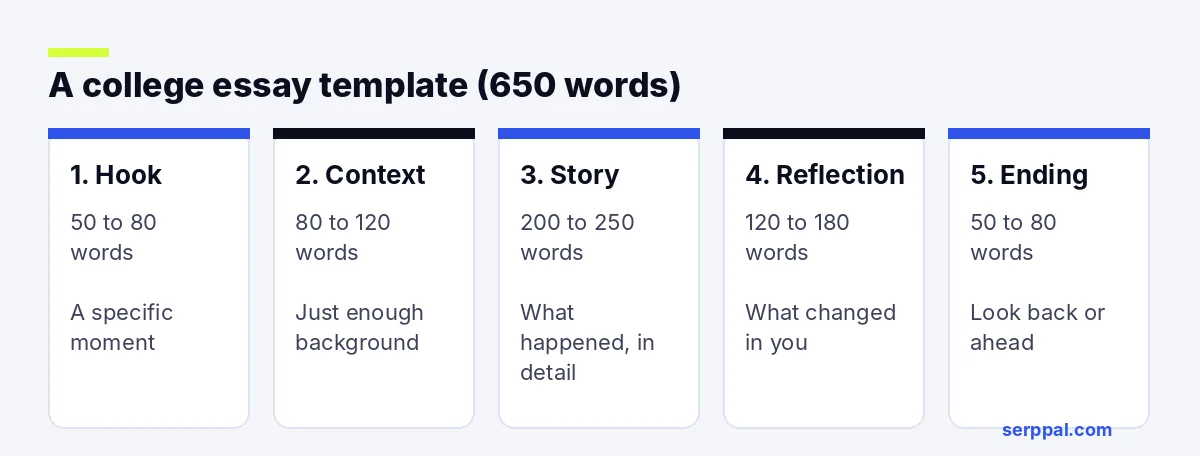
- Hook (about 50 to 80 words): start in a specific moment, image or thought. Our guide on how to start a college essay has seven ways to do it.
- Context (about 80 to 120 words): just enough background for the reader to follow.
- The story (about 200 to 250 words): what happened, what you did, what got hard. Use specific details.
- Reflection (about 120 to 180 words): what changed in how you think or act, and why it matters.
- Ending (about 50 to 80 words): return to the opening image or look ahead to what you'll do next.
Montage essay outline
Some essays use a montage structure instead: several short scenes tied together by one theme, such as a recurring object or question.
- Theme line: introduce the object or idea that links everything.
- Scene 1 to 3: three short moments from different parts of your life, each showing a different side of you (curiosity, talents, values).
- Connection: what the scenes have in common and what that says about you.
- Ending: how the theme points to what you want to do next.
Montage essays suit students whose story isn't one big event. Narrative essays (one story told in order) suit a single turning point. Both need logical transitions between parts.
College essay outline examples
Here are two filled-in outline examples, written for this guide, to show how the outline format works in practice. Both are college essay examples of structure, not finished essays.
Example 1: narrative outline
- Hook: the smoke alarm going off while my grandmother cooks, again.
- Context: after school, I help run her small catering business.
- Story: the night a large order went wrong and I had to fix it with her recipes and my spreadsheet.
- Reflection: discovering that I like solving problems under pressure, and that tradition and planning can work together.
- Ending: back in the kitchen, the alarm goes off, and this time I know what to do.
Example 2: montage outline
- Theme: maps.
- Scenes: drawing maps of my neighborhood as a kid; mapping bus routes for a school project; tracing my family's migration.
- Connection: I make sense of things by mapping them, places, systems and people.
- Ending: the subjects I want to study next, and the maps I haven't drawn yet.
The same template works for short supplemental prompts, such as "Talk about a creative moment in your life (300 words)": one scene, one reflection, one line of conclusion. Notice that neither outline lists accomplishments, grades, test scores or extracurricular activities. The rest of the application covers those; the essay demonstrates who you are.
Five-paragraph essay outline for class essays
For a school assignment rather than an application, use the classic 5-paragraph essay outline:
- Introduction: introduce the topic with a hook and context, then a thesis statement that answers the question. This structure is the base of most writing essays for high school and undergraduate humanities classes.
- Body paragraph 1: topic sentence, supporting evidence (a quote, example or statistic), explanation, transition.
- Body paragraph 2: second point, built the same way.
- Body paragraph 3: third point or a counterargument and your response.
- Conclusion: restate the thesis in new words, connect the points, and conclude with why it matters. A strong conclusion doesn't add new evidence.
Toulmin argument outline
For argumentative class essays, some teachers use the Toulmin model instead:
- Claim: the position you argue.
- Grounds: the evidence that supports it.
- Warrant: why the evidence supports the claim.
- Backing: extra support for the warrant.
- Qualifier: limits on the claim ("in most cases").
- Rebuttal: the strongest counterargument and your answer.
Our guide to writing an outline covers topic, sentence and decimal outlines in more detail.
Common mistakes with a college essay template
- Making the thesis too broad. When you restate a thesis in the conclusion, it should still be specific. In class essays, "Technology changed society" can't be proven in five paragraphs; narrow it.
- Filling the outline mechanically. College admissions officers can tell when every part is the same length and tone. Let the story decide.
- Listing strengths instead of showing them. Your GPA and activities are elsewhere in the Common Application; the essay should show who you are through a moment.
- Skipping the reflection. The admissions committee wants to know what you think, not only what happened. Reflect on what changed.
- Forgetting to restate the thesis in class essays, or restating it word for word. Recap the idea in fresh language.
- Not asking for feedback. A teacher or one of your school counselors can spot gaps fast. Revise after their notes, then proofread.
Ivy League essay examples follow the same principles: a clear structure, honest reflection and a writer's real voice. Admissions readers remember standout essays for a specific moment, not for polished vocabulary. There's no special format for selective schools.
Do college essays need a title?
No. The Common App essay and most other essay prompts don't ask for a title, and many admissions readers never see one because the prompt sits at the top. If a portal or upload gives you space for a title, a good one can add personality, but a weak one costs more than no title.
How to title an essay
- Keep it short: two to six words.
- Be specific: pull a phrase or image from the essay itself, such as "Three Strings and a Cracked Bridge".
- Avoid labels: "My Essay" or "Personal Statement" add nothing.
- Write it last: once the essay is finished, the best title is often already in it.
College essay header: when you need one
You don't need a header in an application text box; the portal already attaches your name. You may need one when you upload a document for an extra essay, a scholarship or an honors program. Then include your name and other identifiers at the top, such as an applicant ID or the prompt, if the instructions ask for them. Never put a header inside a pasted essay.
For class essays, the header follows the citation style your teacher uses.
MLA format header
- First page, top left, double-spaced: your name, your instructor's name, the course, and the date.
- Title centered on the next line, in normal text (no bold, underline or quotation marks).
- A running header in the top right corner of every page: your last name and the page number.
- 12-point font, double spacing and one-inch margins throughout.
APA format
APA student papers use a title page with the title, your name, the course, the instructor and the due date, plus page numbers in the top right corner. The body is double-spaced in an accessible font such as 11-point Calibri or 12-point Times New Roman.
Headings for an essay: should you use them?
In a personal essay or a short class essay, no. Headings break up a story that should flow. In longer academic papers, reports and research essays, headings help readers navigate. APA defines five heading levels, from centered bold for main sections down to indented, bold italic run-in headings; most student papers only need the first two.
If you use headings, make them descriptive ("Methods", "How the Policy Changed") rather than clever, and keep the same style for every heading at the same level. Our guide to how many paragraphs an essay has helps you plan sections by length.
College essay formatting checklist
- Within the word or character limit.
- Paragraphs separated by a blank line, not indents.
- No header or title in a pasted text box.
- Italics and special characters checked after pasting.
- Uploaded files saved as PDF with your name on top.
- Read once on screen and once in the application preview.
Before you submit, read the essay aloud and run it through a readability checker to catch long sentences that trip readers up.
FAQ
Should a college essay be double-spaced?
Not in an application text box, where spacing is set by the portal. For an uploaded essay, follow the instructions; if there are none, single spacing with a blank line between paragraphs or double spacing are both fine. Class essays in MLA or APA style are double-spaced.
What font should I use?
For uploads, use a standard 12-point font such as Times New Roman, Arial or Georgia. In a text box, the portal chooses the font for you.
Can I use bullet points or bold?
Avoid them in a personal statement or supplemental essay. Text boxes may strip them, and a story reads better in paragraphs. Activity descriptions and some short-answer questions are the exception.
Does a college essay need to be five paragraphs?
No. College admissions essays rarely follow the five-paragraph format. Use as many paragraphs as the story needs, usually five to eight for a full-length essay, with a short conclusion.