On this page
If you're wondering how to make an essay longer, the answer is to add substance, not fluff: another example, deeper analysis of your evidence, a counterargument with a response, or a clearer explanation of a step you skipped. Each of those adds words and makes the essay better, while tricks like a bigger font size or wordier phrasing make it worse and are easy for teachers to spot.
This guide gives you 12 ways to lengthen your essay that add value, a five paragraph essay outline to see what's missing, and word count tips that keep your essay honest.
Key takeaways
- Find the gaps first. Most short essays are missing analysis, examples or a counterargument.
- Unpack your quotations. One quote usually deserves two or three lines of commentary.
- Address counterarguments. A fair objection and your response can add 100 to 200 words and strengthen the argument.
- Avoid padding: repeated points, long phrases like "due to the fact that," and formatting tricks.
- Check your word count as you go, and stop when the essay is complete, not just when it hits the number.
Diagnose why the draft is short
Before you add anything, compare your draft with what the assignment asks for. Reread the prompt and the rubric, then ask:
- Does every point have evidence and an explanation of that evidence?
- Have I answered every part of the prompt?
- Would readers who don't know the topic follow every step?
- Have I addressed the obvious objection?
The answers usually show the gaps and exactly where to expand. Fill the gaps before you lengthen anything else.
12 ways to expand an essay and make the paper longer
1. Unpack your quotations
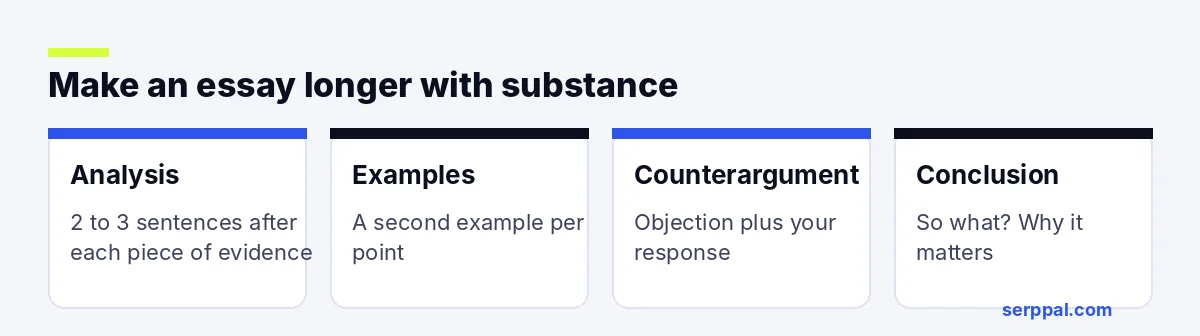
This is the biggest and most useful addition, and one of the best strategies for essay writing in general. After each quote or fact, say what it shows, why it matters and how it relates to your thesis. A quotation followed by one line of commentary can usually take two or three more, with a citation in the style your teacher uses. Readers understand your argument through your explanation, not the quote itself.
2. Add more examples
If a point has one example, add a second that shows the same idea in a different setting. Two examples make a pattern; one can look like a coincidence. Real-world cases, data from your research and descriptive details all work, and incorporating them engages the reader.
3. Address counterarguments thoroughly
State the strongest objection to your thesis fairly, then answer it. This works in a persuasive essay, analytical essays, research papers and many informative essays, and it shows you've considered the issue from more than one side.
4. Explore different perspectives
Beyond a single counterargument, consider how different groups see the issue: students and teachers, patients and doctors, critics and supporters. Exploring perspectives adds depth and length at the same time.
5. Define key terms
If your essay relies on terms readers may find unfamiliar, define them the first time you use them. A clear definition with an example can add 40 to 80 words and makes the argument easier to follow.
6. Integrate relevant background information
Readers may need context: a short history, the situation that makes the topic matter, or the key facts behind a debate. Add it near the start, where it helps readers understand what follows.
7. Strengthen the conclusion: answer "so what?"
At the end of each point and in the conclusion, show why it matters: its consequences, who it affects, or what it reveals about the bigger topic.
8. Split a big point into two
If one section covers two ideas, separate them and develop each fully with its own evidence.
9. Add a new point
If the essay has room, add another point that supports your thesis. Check your notes and sources for ideas you left out, and include quotes from additional credible references where they fit.
10. Use specific, descriptive details
Replace general statements with specific ones. "Many students struggle with sleep" is shorter and weaker than "In a class of 30, ask how many slept eight hours last night, and you'll see a handful of hands."
11. Use transitions to improve flow
Transitions, transitional phrases and transition words like "because," "as a result," "however" and "for example" connect ideas, add clarity and make your reasoning visible. Use them sparingly, though: one per sentence is plenty. Changing the order of points so each builds on the last can also reveal where an explanation is missing.
12. Get feedback and revise
Ask a classmate, tutor or teacher which part they'd like to hear more about. The answer is usually the part you rushed. Revisit that section first; good writers revise with the reader in mind, not the word count.
What not to do: avoid padding
Teachers have seen every trick to make a paper longer. These add words but weaken the essay:
- Repeating points in slightly different words. Repetitive writing is the first thing readers notice.
- Wordy phrasing such as "in order to," "due to the fact that" and "at this point in time." Unnecessary words make writing harder to read.
- Long quotes that do work your own explanation should do.
- Font, spacing and margins. Changing them doesn't change the word count, and many assignments set a word limit for exactly this reason.
- Removing contractions just to add words ("do not" for "don't"). It adds length, not quality.
- Irrelevant tangents that don't support the thesis. Every addition should have clear relevance to your main ideas.
- Redundant summaries that restate the body paragraphs before the conclusion does.
Five paragraph essay outline
A five paragraph essay is a good method to check which part is too thin. For a 1,000-word essay, the rough word count for each part is:
| Part | What it contains | Approximate words |
|---|---|---|
| Introduction | Hook, context, thesis with three points | 100 to 150 |
| Point 1 | Topic sentence, evidence, analysis, link | 200 to 250 |
| Point 2 | Same structure | 200 to 250 |
| Point 3 | Same structure | 200 to 250 |
| Conclusion | Restated thesis, synthesis, "so what" | 100 to 150 |
If one part is far below its share, that's where to add.
Five paragraph essay example
Here's a compact outline on why schools should start later:
- Introduction: Teenagers' sleep cycles shift later, yet school starts early. Thesis: schools should start no earlier than 8:30 a.m. because it improves health, learning and safety.
- Health: teenagers need eight to ten hours of sleep; early starts make that hard. Evidence from health guidance, then analysis.
- Learning: tired students struggle to focus in first period. Example, then analysis of the effect on grades.
- Safety: drowsy teenage drivers are a risk. Evidence, then analysis.
- Conclusion: the three benefits together outweigh the scheduling costs; schools that have changed show it's possible.
Each point can grow by adding a second piece of evidence and more analysis without changing the structure. For more models, see our essay examples.
Essay word count tips
- Quality over quantity. These techniques extend an essay by enhancing it; applying them makes longer essays more convincing, not just longer.
- Check the count often. A word counter shows words and sentences as you write, so you know which section is short.
- Know your essay length in pages. About 275 words fit on a double-spaced page; our words to pages chart covers the rest.
- Leave room for editing. Write a little over the minimum, then cut weak lines and proofread.
- Use these strategies in order. Applying the first three usually does more to enhance an essay than any of the rest.
- Don't exceed the maximum. Going far over a limit is as much a problem as falling short.
AI writing tools can suggest where an argument needs more support, but the added ideas and words should be yours. Check your school's AI policy before using one on graded work.
Frequently asked questions
How can I make my essay longer quickly?
Add two or three lines of analysis after each piece of evidence, then add a counterargument section. Those two changes often add 200 to 300 words to a short essay and improve it at the same time.
Is it bad to make an essay longer with filler?
Yes. Filler, such as repeated points and wordy phrases, makes the essay weaker and is easy to spot. Teachers grade the quality of the ideas, not just the word count.
How do you add words to an essay without changing the meaning?
Develop your existing points in more depth: define key terms, add background information, give a second example, and spell out how your evidence supports your claim.
How many words is a five paragraph essay?
Usually 500 to 1,000 words: about 100 to 150 words for the introduction and conclusion and 100 to 250 for each point in between.
Do teachers notice if you change the spacing or margins?
Usually, yes. Many teachers check formatting, and online submissions often show the word count. Add substance instead.