On this page
- If you paraphrase, do you need to cite?
- Quoting vs paraphrasing vs summarizing
- How to cite a paraphrase in APA style (7th edition)
- How to paraphrase in MLA (9th edition)
- Citing a long paraphrased passage
- How to paraphrase a direct quote, step by step
- Reference list and Works Cited entries
- Common challenges when citing paraphrased information
- FAQ
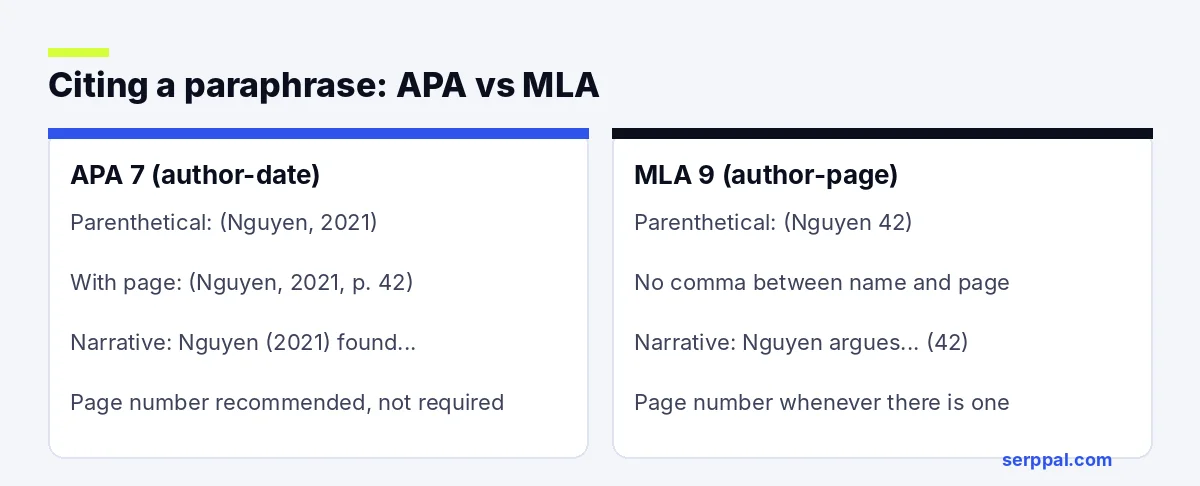
To cite a paraphrase, put the original passage in your own words and add an in-text citation right after it. In APA style, include the author's last name and the year, for example (Nguyen, 2021), and a page if it helps people find the passage. In MLA style, give the author name and the page number, for example (Nguyen 42). Then list the full original source in your references or Works Cited page.
Paraphrased text always needs a citation, even though the wording is yours. This guide covers the in-text citation formats for the two main citation styles, how to handle a long paraphrased passage, how to turn a direct quote into your own words, and how quoting, paraphrasing and summarizing differ.
Key takeaways
- If you paraphrase, you credit the source. Changing the words doesn't change who had the idea.
- APA citation: author and year in parentheses; a page is recommended but optional.
- MLA in-text citation: author name and page, no comma between them.
- Use a signal phrase ("Nguyen argues...") or a parenthetical citation, not both for the same point.
- A real paraphrase changes the words and the sentence structure of the original text; swapping a few synonyms is copying.
If you paraphrase, do you need to cite?
Yes. Paraphrasing restates someone else's idea, so the idea still belongs to the author. Leaving out the citation counts as plagiarism in academic writing, even if none of your sentences match the original text word for word.
The only things you don't need to credit are common knowledge (facts most people know or can find in many general publications) and your own argument, analysis and claims.
Quoting vs paraphrasing vs summarizing
| Quoting | Paraphrasing | Summarizing | |
|---|---|---|---|
| Wording | Exact words of the original passage | Your own words | Your own words |
| Length | Same as the original | About the same as the passage | Much shorter; main points only |
| Quotation marks | Yes | No | No |
| Citation needed | Yes, with a page | Yes | Yes |
| Best for | Memorable or precise wording | Explaining one specific idea clearly | Giving the gist of a long text |
The differences matter because each approach introduces the source material in a different way. Quoting shows exactly what the author said; paraphrasing shows you understood it; a summary shows you can pull out the main argument. Most students should paraphrase more than they quote, because it keeps your own voice in charge of the essay and improves the flow of your writing. When you summarize, you still credit the original source.
How to cite a paraphrase in APA style (7th edition)
The American Psychological Association uses author-date citations. For paraphrased material, include the author's last name and the year of publication. The style encourages, but doesn't require, a page or paragraph number, especially for long texts.
Parenthetical citation
Put the author and year in parentheses at the end of the sentence, before the period.
Example (Nguyen, 2021 is a made-up source used throughout this guide): Teenagers who start school later get more sleep on school nights (Nguyen, 2021).
With a page: ... more sleep on school nights (Nguyen, 2021, p. 42).
Narrative citation with a signal phrase
Name the author in your sentence with a signal phrase, and put the year in parentheses right after the name.
Example: Nguyen (2021) found that teenagers who start school later get more sleep on school nights.
Useful signal verbs include argues, finds, notes, suggests, agrees, presents and challenges. A writer who agrees with a source says so differently from one who disputes it, and good academic writing makes that clear. Pick one that matches what the author does; "suggests" and "proves" indicate very different levels of certainty.
Multiple authors
- Two authors: (Nguyen & Patel, 2021), or Nguyen and Patel (2021).
- Three or more authors: (Nguyen et al., 2021), or Nguyen et al. (2021).
No author or no date
If there's no author, use the title (shortened if long) in place of the author name. If there's no date, write "n.d.": (Nguyen, n.d.).
How to paraphrase in MLA (9th edition)
MLA uses author-page citations. Include the author's last name and the page where the idea appears, with no comma between them.
Parenthetical: Teenagers who start school later get more sleep on school nights (Nguyen 42).
With a signal phrase: Nguyen argues that later school start times give teenagers more sleep on school nights (42).
For web pages and other texts without pages, give only the author: (Nguyen). If there's no author, use a shortened title in quotation marks.
Citing a long paraphrased passage
When paraphrasing runs over several sentences, you don't need a citation after every sentence. Make it clear where the borrowed material starts and ends:
- Start with a signal phrase: "According to Nguyen (2021), ..."
- Keep referring to the author so it's clear the ideas are still theirs: "She also notes...", "Her data indicate..."
- When your own argument begins, make the switch obvious: "These findings suggest to me...", "However, this overlooks..."
In APA style, if you mention the author again in the same paragraph with a narrative citation, you can leave out the year after the first time. If you switch sources or start a new paragraph, cite again.
Long quotations are different
If you quote rather than paraphrase a long passage, format it as a block quotation: in APA, any quotation of 40 words or more is a block quotation, indented half an inch from the left margin without quotation marks; in MLA, more than four lines of prose, also indented. Many writers overuse the block quotation; paraphrasing long passages reads more smoothly and shows you can present the original source accurately.
How to paraphrase a direct quote, step by step
- Read the original passage until you understand it.
- Close the original source and write the idea from memory, as if explaining it to a friend in everyday language.
- Change the structure, not only the words: start with a different part of the idea, combine or split sentences.
- Keep technical terms that have no good synonym.
- Compare with the original text. If any phrase of three or more distinctive words matches, put it in quotation marks or change it.
- Add the citation.
Original passage: "Adolescents whose schools began after 8:30 a.m. reported significantly longer sleep duration on school nights than peers at earlier-starting schools" (Nguyen, 2021, p. 42).
Weak version (too close): Teenagers whose schools started after 8:30 a.m. reported much longer sleep on school nights than students at earlier schools (Nguyen, 2021).
Good version: Students at high schools with an 8:30 a.m. or later start slept noticeably longer on weeknights than those whose classes began earlier (Nguyen, 2021).
If you use a paraphrasing tool to get started, check the result against the original passage and always add the citation; our guide to paraphrase generators explains how to use one responsibly.
Reference list and Works Cited entries
Every in-text citation needs a matching full entry at the end of your essay, so the reader can find the original source. For three or more authors, the reference lists every author even though the in-text citation uses et al.
- APA reference (journal article): Nguyen, L. (2021). Title of the article in sentence case. Journal Name, 12(3), 40-55. https://doi.org/...
- MLA Works Cited (journal article): Nguyen, Lan. "Title of the Article in Title Case." Journal Name, vol. 12, no. 3, 2021, pp. 40-55.
Both use a hanging indent: the first line starts at the left margin and the following lines are indented. SerpPal's citation generator builds the reference and the matching in-text citation in APA, MLA, Chicago, Harvard or IEEE from a link, DOI, ISBN or details you enter; check every entry before you submit.
Common challenges when citing paraphrased information
- Forgetting the citation because no quotation marks are needed. Paraphrased and quoted material both need one.
- Patchwriting: keeping the original structure and swapping a few words.
- Citing only at the end of a long paragraph, so readers can't tell which claims are borrowed.
- Mixing styles, such as an author-date year with an MLA page format.
- Crediting the tool instead of the original source.
- Copying the author's order of ideas point by point, which is close paraphrasing even with new words.
When writing a research essay, decide early which sources you'll quote and which you'll summarize or paraphrase; a block quotation with no page number is a common error. Ask for feedback from a teacher or writing center if you're unsure; they see these mistakes every day. Accurately crediting sources is a core part of academic writing, and every academic essay is judged on it.
FAQ
Do you need a page number when you paraphrase in APA?
It's not required, but the APA manual encourages it, especially for long books or when it helps someone find the passage. In MLA, include the page whenever the source has one.
How do you cite a paraphrase in Chicago style?
In Chicago notes-bibliography style, add a footnote number after the paraphrased sentence and give the source in the footnote, including the page number. Author-date Chicago works much the same: (Nguyen 2021, 42).
Is a summary the same as a paraphrase?
No. Paraphrasing restates a specific passage at about the same length. A summary condenses the main points of a longer text; to summarize a whole chapter, you might write one paragraph. A summary and a paraphrase both need an in-text citation, and leaving it out is plagiarism.
Can I paraphrase multiple sources in one sentence?
Yes. Put both citations in the same parentheses, separated by a semicolon: (Nguyen, 2021; Patel, 2019) in APA, or (Nguyen 42; Patel 17) in MLA.