On this page
The best AI for writing essays depends on the job. General AI assistants such as ChatGPT, Claude and Gemini are best for brainstorming, planning and feedback; an AI essay writer that searches real sources is best for research-based drafts with correct citations; and grammar tools are best for the final polish. Whatever you use, the ideas and the final words should be yours, and you should follow your school's AI policy.
This guide compares the best AI essay writer tools for students, with pros and cons for each, explains what to look for, and gives a step-by-step way to use AI writing tools honestly.
Key takeaways
- No single AI is best at everything. Match the tool to the step: research, outline, feedback or editing.
- General chatbots are flexible but can invent sources. AI essay writers that search for real sources and build citations from them are safer for academic work.
- Free versions exist for most tools, with limits on length, sources and features.
- Marketing AI writers (built for blogs and ads) are rarely the best choice for academic essays.
- Submitting AI-generated text as your own breaks most academic integrity policies, and AI detection tools and teachers often notice.
What to look for in an AI essay writer
Before comparing tools, decide what you need from the writing process. A good AI essay writer for students should offer:
- Real sources: it finds actual articles and papers rather than inventing references.
- Correct citations: APA, MLA or Chicago built from each source's real author and date.
- Control over the structure: you shape the thesis and sections before any text is generated.
- A clear interface: simple prompts and customization options, so you spend time on essay writing, not on settings.
- Essay types and levels: argumentative, expository and research papers at high school or college level.
- Customization: tone, length and instructions, so the output fits the assignment.
- Feedback and suggestions: help improving your own draft, not only generation, so the output is coherent and in your tone.
- Honest limitations: clear about what the AI can't do, such as verify facts.
- A clear interface and privacy policy: simple to use, with clear rules on what happens to your input.
Quick comparison table: best AI essay writer tools
| Tool | Best for | Real sources and citations | Free version |
|---|---|---|---|
| SerpPal essay writer | Research essays with real references | Yes, searched on Google, 5 citation styles | Yes, monthly AI words |
| ChatGPT | Ideas, explanations, feedback | Not reliable unless verified | Yes |
| Claude | Long feedback and careful editing | Not reliable unless verified | Yes |
| Gemini | Working inside Google Docs and Gmail | Not reliable unless verified | Yes |
| Microsoft Copilot | Working inside Word | Can cite web results; verify them | Yes, with limits |
| QuillBot | Paraphrasing and grammar | Citation generator | Yes, with limits |
| Grammarly | Proofreading and writing assistance | Citation features | Yes, with limits |
| Jasper AI, Writesonic, Rytr | Marketing and SEO content | Not designed for academic sources | Free trial or limited plans |
| Textero, MyEssayWriter and similar AI essay generators | Generating full essay drafts | Varies; verify every reference | Limited free use |
Free limits and features change often, so check each tool's site before you rely on it.
1. SerpPal essay writer: best for research essays
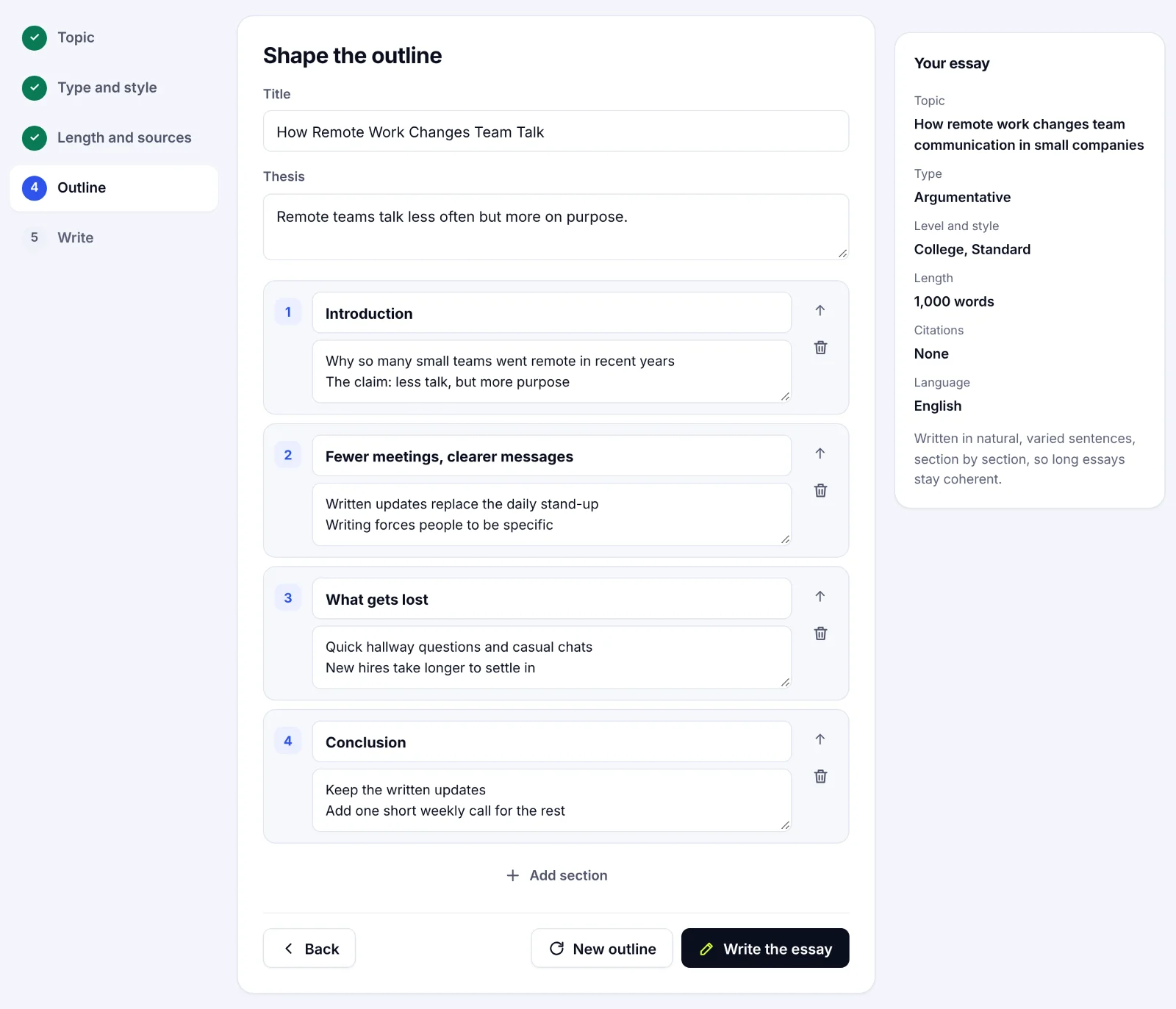
SerpPal's AI writer includes an essay writer built around the academic workflow: topic, essay type, level, length, real sources found on Google, a plan you edit, then the essay written section by section with in-text citations and a reference list in APA, MLA, Chicago, Harvard or IEEE.
Pros:
- References come from real sources you pick, never made up.
- You control the thesis and structure before generation.
- Many essay types, from argumentative to literature review.
- Works on the free plan with a monthly allowance of AI words.
Cons:
- You still need to read the sources and check every claim.
- Long essays use more AI words than short ones.
2. ChatGPT: best for ideas and explanations
ChatGPT is the most widely used AI writing assistant. It's great at turning a vague topic into thesis ideas, explaining complex topics simply and giving feedback on paragraphs.
Pros: very flexible; models like GPT-4 and later are strong at prompts for ideas and counterarguments; large free tier. Cons: can invent sources and quotes; generic tone unless you guide it; generated essays often read as AI-generated.
3. Claude: best for feedback and editing
Claude is often praised for careful, detailed feedback and for handling long documents, which makes it useful for reviewing a full draft.
Pros: thoughtful feedback on your writing; good with long texts; clear writing; free tier. Cons: same source problem as other chatbots; free usage limits.
4. Gemini and Microsoft Copilot: best inside your documents
Gemini works alongside Google Docs and Gmail, and Copilot sits inside Microsoft Word, so you can ask for suggestions without switching apps.
Pros: convenient where you already write; good for summaries and rewording. Cons: features depend on your account and plan; check any sources they mention.
5. QuillBot, Grammarly and Paperpal: best for polishing
These writing tools focus on paraphrasing, grammar and clarity rather than generating whole essays. Paperpal is aimed specifically at academic writing, with language suggestions tuned for research papers. Each works as a writing assistant for text you already wrote. They're the least controversial way to use AI in school, because they improve text you already wrote.
Pros: catch errors; improve flow; free versions; easy interface. Cons: heavy paraphrasing can flatten your voice; premium features cost extra.
6. Jasper AI, Writesonic and Rytr: built for marketing
Jasper AI, Writesonic (known for speed) and Rytr are AI-powered tools designed for blogs, ads and SEO content creators, with templates and keyword features; older tools such as Article Forge built long articles from a keyword. Jasper and the others can generate high-quality marketing copy, but none is designed around academic sources, citations or essay structure. Many started on models like GPT-3.5 and now use newer ones.
Pros: fast, creative content generation; many templates; brand voice and writing style settings. Cons: no academic source search; not built for academic writing; paid plans after the free trial. Jasper's pricing and Rytr's pricing both favor marketers who publish often.
7. AI essay generators: Textero, MyEssayWriter, PerfectEssayWriter, CollegeEssay
A group of sites focuses on essay generation: you enter a topic and they generate essays with an outline, paragraphs and sometimes references. Textero, MyEssayWriter, PerfectEssayWriter and CollegeEssay.org's AI essay writer are examples. Many advertise high-quality, plagiarism-free or undetectable output.
Pros: fast, polished drafts; built-in structure; some offer built-in plagiarism checks and citation help. Cons: "plagiarism-free" only means the text doesn't match existing sources, not that using it is allowed; references need checking; and handing in a generated essay breaks most academic integrity rules. If you use Textero, MyEssayWriter or a similar tool, treat the output as an example to study, not as your essay.
Free AI essay writing tools: what you give up
- Length: caps on words per response or per month.
- Sources: fewer or no source searches, and limited citation styles.
- Model quality: free versions may use smaller models.
- Extras: plagiarism detection and history may be premium.
For most students, a free general assistant for ideas plus a free grammar checker covers a lot, and few tools are truly unlimited. Add an essay writer with source search for research papers.
How to use AI essay writing tools effectively and honestly
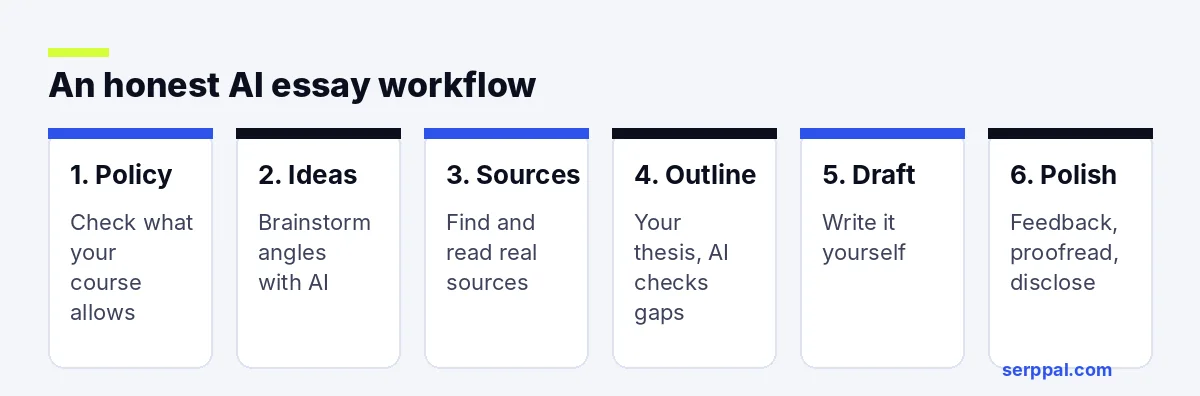
- Read your AI policy. Your syllabus decides what's allowed. Many courses allow AI for planning or editing with disclosure, so you can use it responsibly.
- Brainstorm with AI. Ask for angles, questions and counterarguments. Pick the ideas that interest you.
- Find and read real sources. Take your own notes.
- Build your plan. Write your thesis and ask AI to point out gaps. Our guide to writing an outline helps here.
- Write the draft yourself. This is where learning happens and where your voice and creativity come from. Good academic writing comes from your own reasoning.
- Get feedback. Ask what's unclear or which claim lacks evidence.
- Proofread and check originality. Use a grammar checker and, if your school uses one, a plagiarism checker.
- Disclose AI use if your course asks. APA and MLA both have guidance on citing AI tools.
Can teachers detect AI-generated essays?
Often, yes. Teachers notice a sudden change in voice, generic arguments without class-specific details, and sources that don't exist. Many schools also run AI detection tools, though they make mistakes. Tools that promise "undetectable" essays don't change the rules: if your course bans AI-generated text, disguising it is still a breach. Our guide to the AI detectors teachers use explains how schools check.
Best AI for different essay assignments
- Argumentative essays: general assistants for counterarguments.
- Research papers: essay writers with real source search.
- Analytical essays: AI can explain techniques, but the analysis must be yours. See our guide on rhetorical analysis essays.
- College application essays: idea generation and proofreading only. Admissions readers want your voice.
Conclusion
The right AI for essay writing is a set of tools used at the right steps: a chatbot for ideas, an AI essay writer with real sources for research, and a grammar tool for polish. Used that way, artificial intelligence makes you faster without doing the thinking for you.
FAQs
What is the best free AI essay writer?
For brainstorming and feedback, the free versions of ChatGPT, Claude and Gemini work well. For research essays with citations, choose a tool that searches real sources, such as an essay writer on a free plan. Combine either with a free grammar checker.
Is using an AI essay writer cheating?
Submitting AI-written text as your own work is cheating under most academic integrity policies. Using AI to brainstorm, find sources, get feedback or proofread is often allowed, but check your course rules.
Can AI write a whole essay?
It can generate one, but the result is usually generic, may contain errors or invented sources, and won't reflect what you learned. It's more useful as a helper at each step.
Which AI is best for citations?
Tools that search real sources and build citations from their actual details are the most reliable. General chatbots can format a citation you give them, but don't trust them to supply sources.