On this page
- What is an AI story generator?
- What AI does well (and badly) in story writing
- How to use AI story generation, step by step
- Best AI story generation tools for writers
- Story prompts that work across different genres
- Questions writers ask: how do I keep my voice with AI writing?
- Publishing AI-assisted stories: disclosure and copyright
- Is AI story writing worth it?
- Frequently asked questions (FAQs)
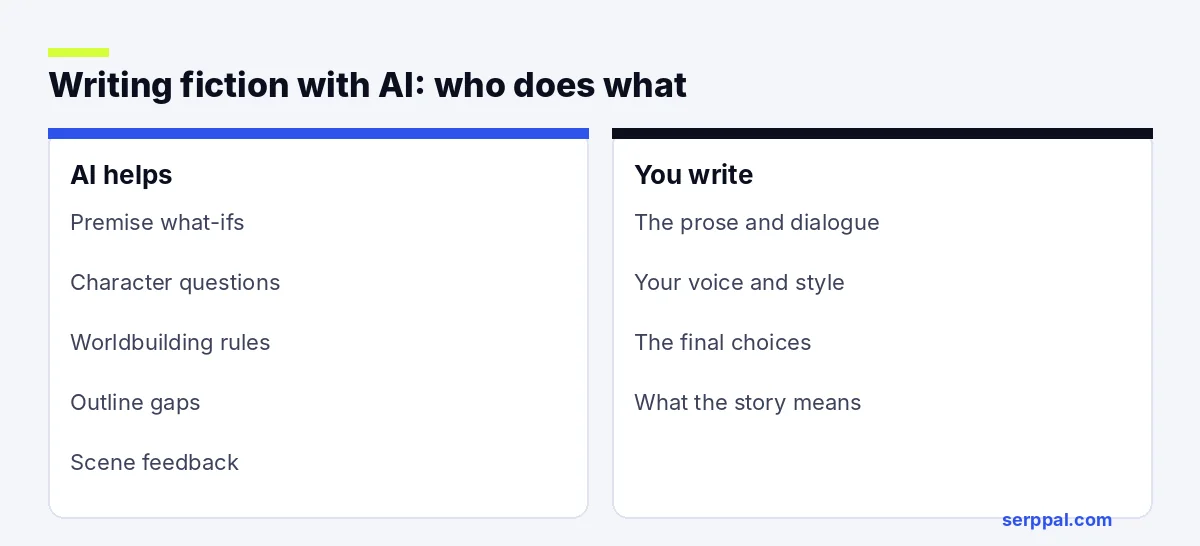
AI story writing works best when the AI is your brainstorming partner and editor, not your ghostwriter. Use an AI story generator or AI chat to spark story ideas, test plot twists, build character arcs and get feedback, while you write the actual story yourself. That way you get the speed of AI assistance without losing the voice that makes the story yours.
This guide covers how AI story generators work, what they do well and badly, how to use one step by step, the best AI for creative writing, prompts that work across different genres, and what to know about publishing and copyright.
Key takeaways
- An AI story generator turns a premise into a short story, an opening, a plot outline or character profiles in seconds.
- AI is strong at ideas, structure and feedback; it's weak at original voice, subtext and consistency across a full story.
- General AI chat tools handle most story writing tasks; dedicated story apps add memory for characters and plots.
- Keep your voice by writing the prose yourself and using AI for options and critique.
- Check platform rules on disclosing AI content before you publish fiction.
What is an AI story generator?
An AI story generator is a writing tool that uses AI models to write story text from your premise or instructions; AI story generation adapts to the genre, length and tone you set. You describe the genre, characters, setting and tone, and it generates an opening, a plot, a scene or a full short story. Some tools are one-click plot generators; others are AI story writers with built-in memory that remembers your characters and world as you work.
Writers use them to beat writer's block, explore concepts and themes quickly, and see several versions of a scene before choosing one. Beginners use them to learn structured storytelling; experienced storytellers use them to test plots and pacing. Game designers use them for scripts and branching dialogue too.
What AI does well (and badly) in story writing
| AI story generators are good at | They struggle with |
|---|---|
| Generating many story ideas fast | A distinctive, consistent voice |
| Suggesting story plots and "what if" twists | Subtext and what characters don't say |
| Character arcs and backstory questions | Keeping details consistent across a long narrative |
| Following genre conventions | Surprising endings that break conventions well |
| Feedback on pacing, tone and dialogue | Avoiding clichés and familiar phrasing |
| Summarizing chapters and tracking threads | Knowing what your story is really about |
Language models predict likely text, which is why a generated story often feels familiar. The most likely next sentence is rarely the most memorable one. Your job is to supply the specific, unlikely choices that make a story feel alive.
How to use AI story generation, step by step
1. Write a specific premise: provide context and constraints
A vague request gets a generic story. Give the AI context and constraints: the protagonist, the turning point you're building toward, the genre-specific tone, and what to avoid. Include the genre, the main character, what they want, what stands in the way, the setting and the tone. "A cozy mystery set in a seaside bakery, told by a retired detective who hates the sea" will generate something far more engaging than "a mystery story".
2. Generate options, not a finished story
Ask for five possible openings, three plot directions or ten complications. Treat the output as a menu. Pick the ideas that excite you and ignore the rest.
3. Build characters and their arcs
Character-driven fiction lives or dies on this step. Ask the AI story writer to interview your character or list questions you haven't answered: What do they want? What are they afraid of? How do they change? You write the answers; the AI makes sure you asked.
4. Structure the plot and chapters
Brainstorming done, share your plot points and ask where the middle sags, which emotional beats are missing, or which scenes don't change anything. You can test a structured approach like three acts or the Hero's Journey. Our guide to writing an outline covers story outlines in more detail.
5. Write the story yourself
This is the step to protect. Write the scenes in your own words and writing style, even if they're rough. If you get stuck, ask for three possible next beats, then write the one you choose your way.
6. Refine with feedback
Paste a scene and ask specific questions: "Where does the pacing drag?", "Is each character's dialogue distinct?", "Are my descriptions doing too much telling?" Then refine. Specific questions get useful answers.
Best AI story generation tools for writers
- General AI chat tools such as ChatGPT, Claude and Gemini are versatile: they brainstorm, outline, give feedback and help develop scenes. All have free tiers.
- Dedicated AI story writers are fiction-first tools with story-specific features: a story bible, character memory, scene cards, and "continue in my style" options. They suit long projects.
- Simple AI story generators are one-click tools for short-form story ideas, writing prompts and quick plot generator results. They're handy for warm-ups, hobbyists and beginner writers.
- Tools for students and educators turn story generation into classroom practice: students create stories from prompts, then revise them, and educators use AI to make manageable writing assignments.
- AI writers with templates, like SerpPal's AI writer, help with the writing around your book: synopses, blurbs, query letters and author newsletters.
Free AI story generator with no restrictions? What to expect
Many free AI story generator tools need no sign-up or login, work on any device and run in any browser. Good storytelling still comes from you. Some advertise unlimited stories, unlimited prompts or an unlimited generator. In practice, "unlimited" usually comes with short output, fewer features or limits on length, and many tools filter NSFW content or restrict genres. Most work in English and several other languages, and some let you switch between multiple languages in the same story, such as Spanish or Portuguese. A free AI story tool is great for trying ideas; for a novel, you'll want a tool that remembers context and stays consistent across chapters.
Story prompts that work across different genres
- Mystery: "List 10 clues for this crime, and mark which ones are red herrings."
- Romance: "Suggest five reasons these two characters can't be together yet, rooted in who they are." Romance readers want compelling obstacles, not contrived ones.
- Thriller: "Give me three ways the villain could stay one step ahead in this chapter."
- Sci-fi: "If this sci-fi technology existed for 50 years, what would everyday life look like? Give me three consequences."
- Fantasy: "My magic costs memories. What rules and limits follow from that?"
- Literary fiction: "Which of these three themes is strongest in my draft, and where does it show?"
- Any genre: "Read this scene and point out every place I tell an emotion instead of showing it. Don't rewrite anything."
The same approach works for game scripts, short story contests and longer narratives: ask for options and critique, then make the creative choices yourself. Novelists and sci-fi writers use it to check continuity across storylines; an AI story writer that keeps notes helps most here.
Questions writers ask: how do I keep my voice with AI writing?
- Write first, ask second. Draft before you ask for help, so the AI reacts to your voice instead of replacing it.
- Ask for options, not answers. "Give me five ways this scene could end" leaves the choice to you.
- Never paste generated prose straight in. If a suggested line is good, rewrite it in your own words; that's where your storytelling instincts come in.
- Share a style sample. Include a paragraph you love and ask the AI to judge new scenes against it.
- Cut the tells. Watch for stock phrases and every character sounding equally articulate. Our guide to signs of AI writing lists the patterns.
- Track your progress against genre norms with our guide to novel word counts by genre.
Publishing AI-assisted stories: disclosure and copyright
- Disclosure. Some platforms ask whether a book contains AI-generated content. Amazon's Kindle Direct Publishing, for example, asks authors to disclose AI-generated text, images or translations, while AI-assisted editing doesn't need to be disclosed. Check each platform's current rules.
- Copyright. The US Copyright Office has said that material generated entirely by AI isn't protected by copyright; protection covers the human-authored parts. Our guide on AI content and copyright explains more.
Many literary agents and magazines also have policies on AI submissions, so read the guidelines first.
Is AI story writing worth it?
For most writers, yes, as a support tool. AI shortens the blank-page phase, helps you develop structure early and gives instant feedback on descriptions and dialogue. It doesn't replace finding what your story means or the craft of storytelling, the part that makes fiction compelling. Used that way, it boosts creativity and storytelling skill and makes you a faster writer without making you a different one. Relying on it for the words themselves is where fiction loses its voice.
Frequently asked questions (FAQs)
What is the best AI story generator?
For most writers, a general AI chat tool such as ChatGPT, Claude or Gemini works as a flexible story generator for ideas, outlines and feedback. Dedicated AI story writers add memory and story bibles for long projects, and simple free generators are fine for quick prompts.
Can AI write a whole story?
It can generate one, but the result tends to be generic and inconsistent over long narratives. Most writers who use AI keep it for planning and feedback, not the final prose.
Is it cheating to use AI for creative writing?
Not in itself. It depends on context: contests, classes and publishers may have rules, and passing off AI prose as fully your own is dishonest where those rules apply.
How do I make AI story writing sound less generic?
Give the AI specific context and a sample of your style, ask for options rather than finished prose, and do the final writing yourself.