On this page
- How copyright law treats AI-generated works
- Who owns AI-generated content? Copyright ownership vs licensing
- How to register a work that contains AI material
- AI and copyright: examples from U.S. decisions
- When AI output can infringe: copyright risks for creators and contractors
- Commercial use: what creators and businesses ask most
- Practical steps to protect your work: a legal checklist for humans using AI
- The future of copyright in the AI era
- Conclusion
- FAQ: AI content and copyright
Can you copyright AI generated content? In the United States, no, not the part a machine made on its own. Copyright law protects original expression by a human author, so purely AI-generated works sit outside copyright protection. What you can protect is your own input: the text you wrote, the substantial edits you made, and the creative selection and arrangement of the pieces.
This guide gives the practical answer for writers, marketers and creators: what counts as human authorship, who has copyright ownership of AI content, how to register it, and the infringement and IP risks that come with generative AI tools.
Key takeaways
- Copyright protection requires human creativity, and that creativity has to show in the expressive choices. Material that an AI program produced without meaningful human creative decisions doesn't qualify for copyright protection in the U.S.
- A work containing AI material can be registered, but only the human-authored portions qualify, and you must disclose the AI portions.
- Prompts alone, even long ones, don't make you the author. Sufficient human editing, selecting and arranging can.
- Permission to use an AI tool commercially is a contract right. It's not the same as owning copyright, and it doesn't stop someone else from using similar output.
- Infringement risk runs both ways: what you put in and the AI output that comes out.
How copyright law treats AI-generated works
U.S. copyright law protects "original works of authorship", and the courts and the U.S. Copyright Office read "authorship" as human. That principle predates artificial intelligence and AI technology; it's the same reason a photo taken by a monkey couldn't be registered, and courts in most jurisdictions agree on it. The Copyright Office's AI guidance applies it to generative AI: material produced by a machine with no human creative input isn't eligible for copyright, whatever the creative process looked like on the user's side.
The key question is human involvement. Did a person make the creative decisions that shaped the resulting work, or did the AI system make them? Typing "write a blog post about budgeting" and publishing the result unchanged gives the AI the creative control. Writing the outline, drafting half the sections yourself, and heavily editing the rest gives you a real claim to those parts.
In practice, most content made with AI falls in the middle. Then the answer is "partly": the human-authored expressive elements qualify, the AI technology's contributions don't, and the work as a whole may qualify as a compilation if your selection and arrangement show originality.
What could make AI generated content ineligible for copyright
- No human expression. You accepted what an AI image or text generator produced as it came.
- Prompts only. The Copyright Office's view is that prompts, even detailed ones, direct the tool but don't control the expressive result enough to count as authorship.
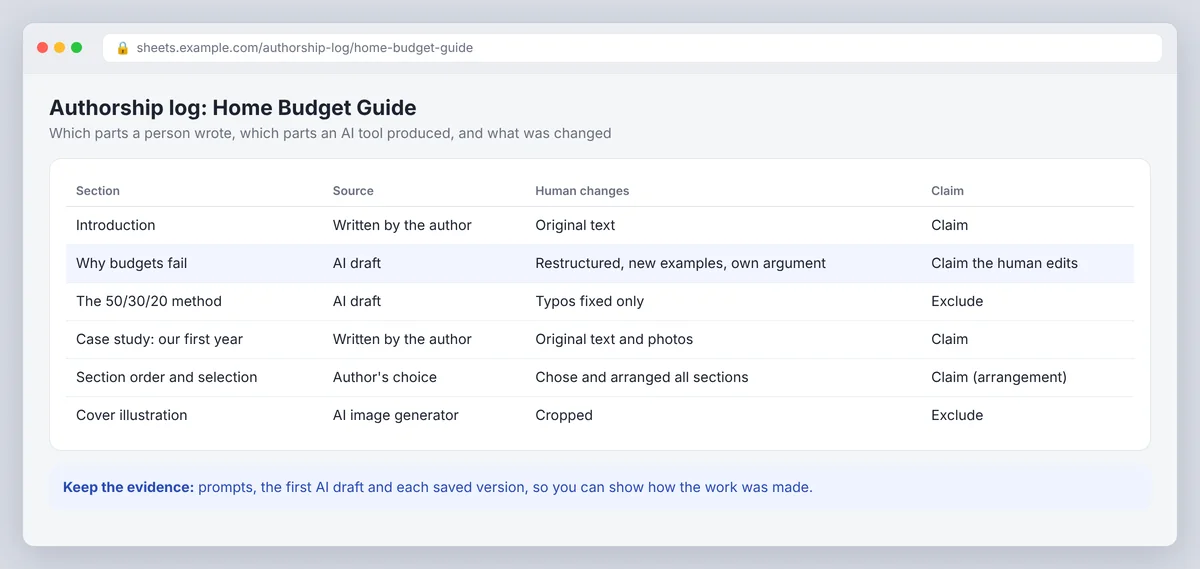
- Trivial edits. Fixing typos, swapping a few words or cropping an AI picture is not creative work; the human modifications have to be sufficiently creative to count.
- Undisclosed AI material in a filing. Claiming machine-made parts as your own can get the whole claim cancelled.
What makes a work made with AI copyrightable
- Human-created text mixed with AI passages: your text is yours and contributes copyrightability to the whole.
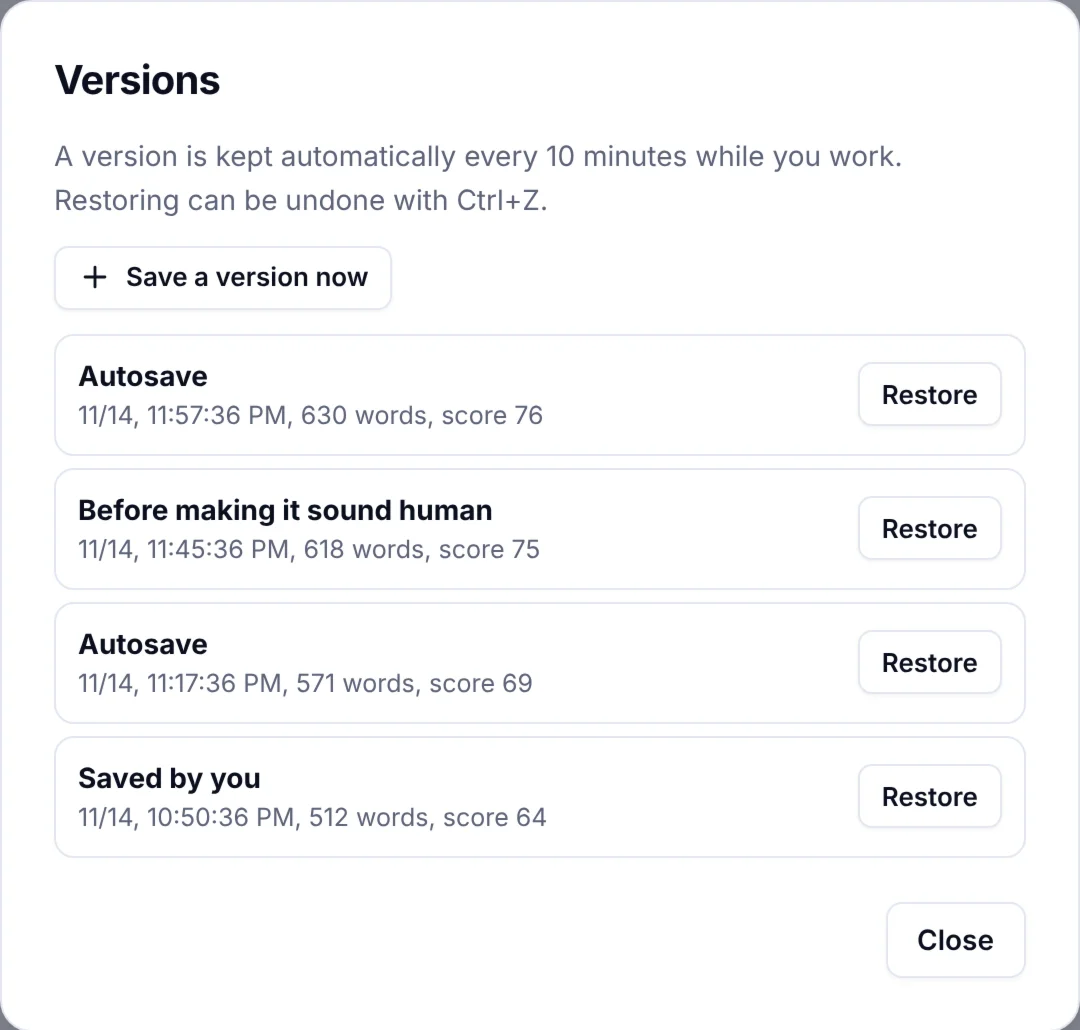
- Substantial creative edits that change the expression, not just the surface. Keep the before and after.
- Creative selection and arrangement, for example choosing and ordering AI pictures into a graphic novel with your own story.
- AI as a tool, not an author. Using AI for research, grammar or a first outline doesn't taint what you then write yourself.
If you use an AI writer to get a first draft, treat that draft as raw material. The more of the final piece reflects your own words and judgment, the stronger your claim, and the better the article usually reads anyway. SerpPal's editor keeps versions as you go, which doubles as a record of your creative process.
Who owns AI-generated content? Copyright ownership vs licensing
Ownership is really three separate questions, and people mix them up constantly.
| Question | Who answers it | What it gives you |
|---|---|---|
| Is it protected by copyright? | Copyright law | The right to stop others copying the human-authored parts |
| Am I allowed to use the result? | The AI platform's terms of service | Licensing or an assignment from the provider, with conditions |
| Who owns it between us? | Your employment, freelance or client agreements | Allocation of whatever intellectual property rights exist |
OpenAI's terms, for example, assign you its rights in ChatGPT output, and Midjourney's terms grant paid subscribers broad usage rights. That's a contractual right. It doesn't create copyright ownership where the law gives none, it doesn't make the result exclusive to you, and it can't hand you rights in someone else's copyrighted works that the result may resemble. Microsoft and Adobe go a step further and offer to defend paying customers against some infringement claims, which tells you how real the risk is.
For businesses, the contract layer matters most. Decide in advance which generative AI tools are approved, require employees and contractors to disclose AI use, and assign the human-made material to the company in their agreements. Without that, a freelancer's hand-written edits belong to the freelancer.
How to register a work that contains AI material
Copyright registration with the Copyright Office isn't required for copyright protection, but you need it to enforce your rights in court in the U.S., and it unlocks statutory damages. For AI-assisted works the Copyright Office asks you to be explicit:
- Identify which portions a person created and which portions the AI produced.
- Claim only the human-authored material. Use the "Limitation of claim" section to exclude the AI material.
- Describe the human contribution briefly, for example "text and selection, coordination and arrangement of AI images".
- Keep your prompts, early versions and edit history. If the Office or a court asks how the work was made, you'll want evidence.
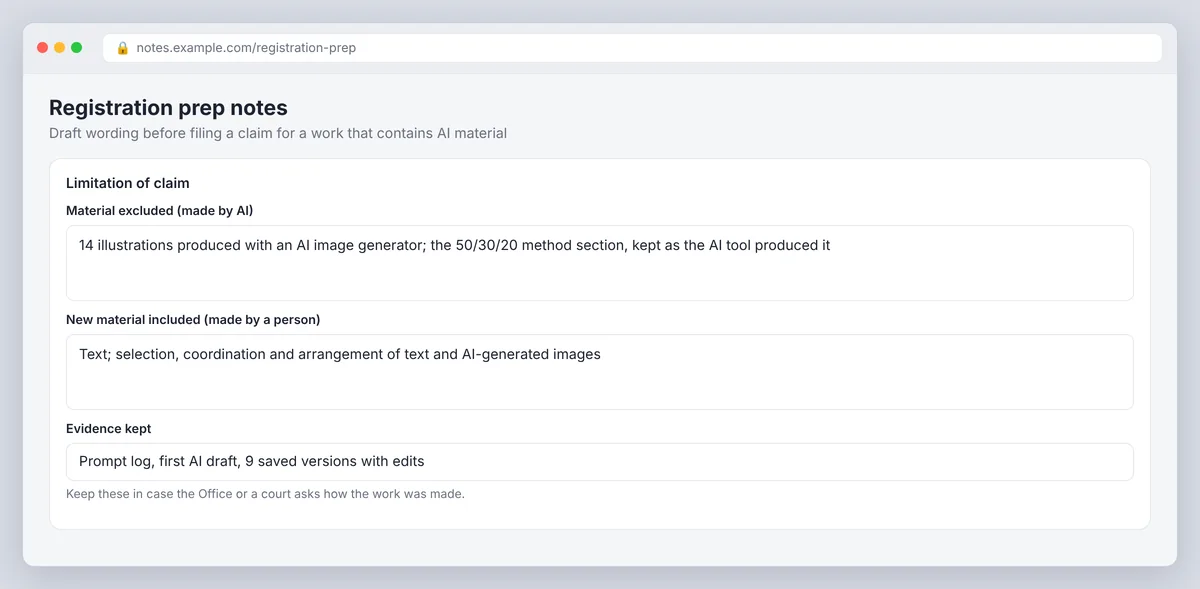
The Office's registration guidance for works containing AI-generated material sets this out in detail. Expect the certificate to cover your part, not the whole piece.
AI and copyright: examples from U.S. decisions
Three cases show how the rules play out, and what they don't decide.
Thaler v. Perlmutter: a machine can't be the author
Stephen Thaler asked the Copyright Office to register an image he said his AI system created autonomously, listing the machine as author. The Office refused, a federal court agreed, and the Court of Appeals upheld the decision: with no human author, there's nothing to register. The litigation confirms the human authorship requirement. It doesn't say that works made with AI can never be protected.
Zarya of the Dawn: partial protection
Kris Kashtanova wrote a graphic novel and illustrated it with Midjourney images. The Copyright Office kept the claim for the text and for the selection, coordination and arrangement of the pictures, but cancelled it for the individual Midjourney images. This is the clearest example of "partly": the human parts stand, the machine parts don't.
Prompt-heavy AI-generated art: still refused
In later disputes the Office refused AI artwork even where the applicant described hundreds of prompt iterations and refinement rounds. Its reasoning was that the user doesn't control how the AI model turns a prompt into pixels, so the expressive choices aren't the user's. The lesson for creators: refine the prompt as much as you like, but your copyright lives in what you do after the image or text comes out.
When AI output can infringe: copyright risks for creators and contractors
Copyright isn't only about what you own. What the AI produces can step on someone else's rights, and so can your inputs.
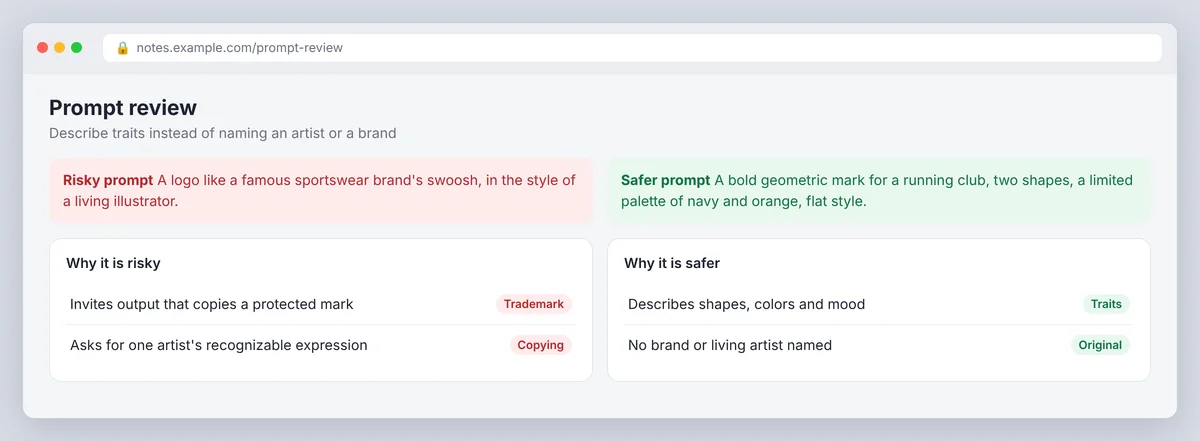
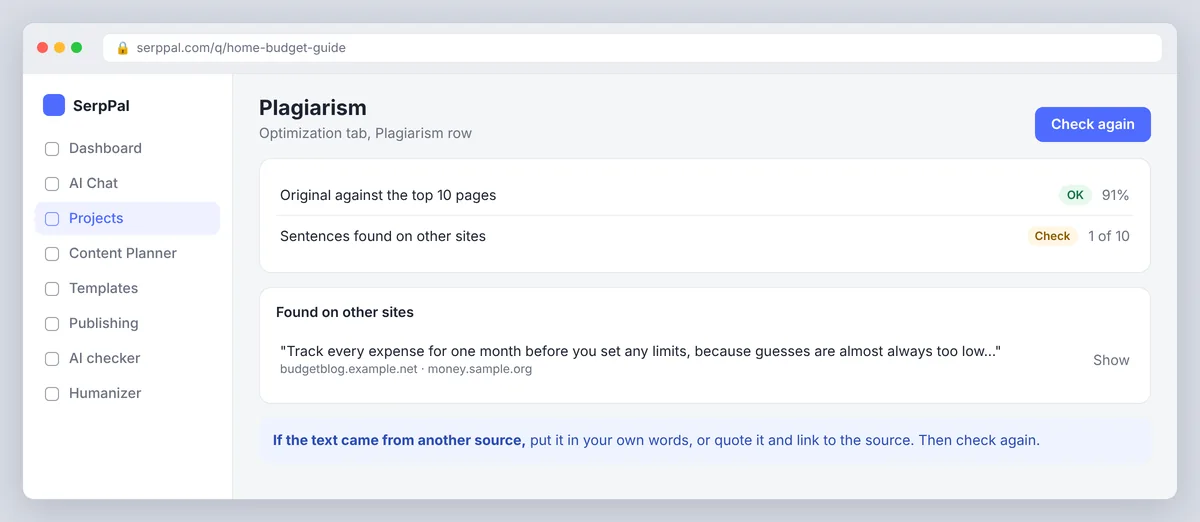
- Results that copy. If a model reproduces copyrighted works, publishing the result can be an infringement, regardless of who or what produced it. Check pictures against known artworks and brands, and run text through a plagiarism check before it goes live. A DMCA takedown applies to a copied AI picture just like any other upload.
- Prompts that invite copying. "In the style of" a living artist, or "a logo like Nike's", creates avoidable risk. Describe traits instead: bold geometric shapes, a limited palette.
- Inputs you don't own. Uploading a client's confidential document or a copyrighted book into a tool may breach a contract or a licence, and some tools use inputs for AI training.
- Training lawsuits. Dozens of lawsuits against AI companies over unauthorized use of copyrighted works in AI training are working through the courts. Well-known examples include The New York Times v. OpenAI and Getty Images v. Stability AI, both about whether companies may train AI on copyrighted works without permission. They affect the providers more than individual users, but their outcomes will shape the legal landscape, so keep an eye on them.
Commercial use: what creators and businesses ask most
Can I use AI images on my website or YouTube channel?
Usually yes, if the tool's terms allow commercial use and the picture doesn't copy an existing copyright or a trademark. Remember that "allowed to use" is not "exclusively yours": someone else can generate and use a near-identical picture, and you can't enforce anything against them. YouTube and other platforms also have disclosure rules for realistic AI media, which are separate from copyright.
Is AI-generated content public domain?
Not automatically. Uncopyrightable material has no copyright owner, which is close to public domain in effect, but the provider's terms may still restrict how you reuse it, and any human-authored parts remain covered. "Copyright free" is also no guarantee that the output doesn't copy a protected work.
What about the "30% rule"?
It's a myth. There is no percentage of changes that makes a work yours or makes copying safe. The tests are human authorship (for protection) and substantial similarity (for infringement), and neither has a number attached.
Can I copyright an AI-generated logo?
Copyright is the wrong tool for most logos anyway. Simple logos often fall below the originality threshold, machine-made ones add the authorship problem, and what you really want is trademark protection, which depends on using the mark in commerce, not on who drew it. Search for similar marks before you commit.
Practical steps to protect your work: a legal checklist for humans using AI
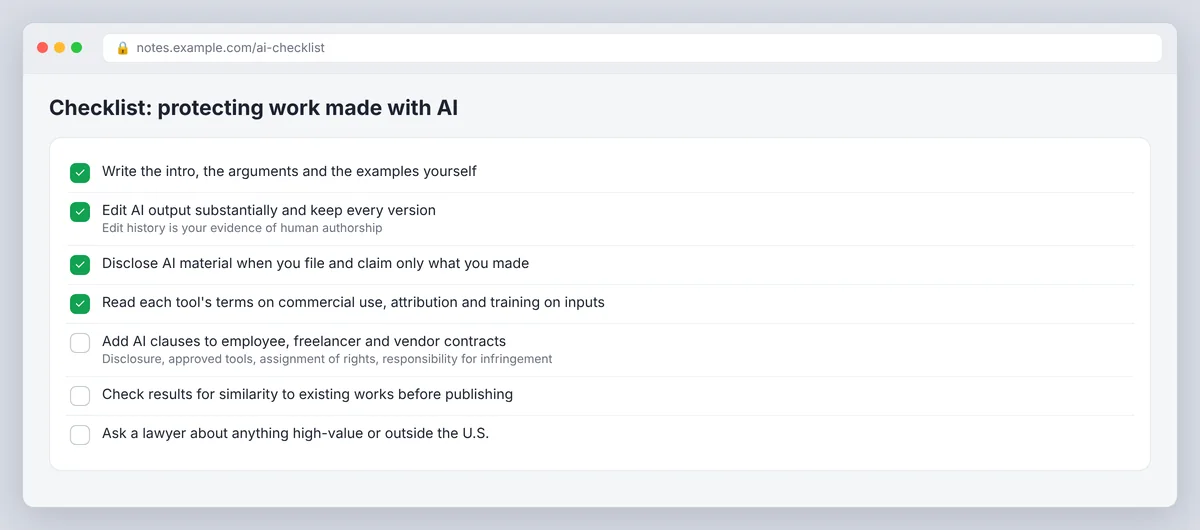
- Write the parts that matter yourself: the intro, the arguments, the examples. Let AI handle the scaffolding, and the copyrightable work stays yours.
- Edit AI output substantially and keep the versions. Edit history is your evidence of human authorship.
- Disclose AI material when you file, and claim only what you made.
- Read the terms of every tool you use, especially on commercial use, attribution and AI training on your inputs.
- Put AI clauses in employee, freelancer and vendor contracts: disclosure, approved tools, assignment of rights, responsibility for infringement.
- Check results for similarity to existing works before publishing, and consult a lawyer for anything high-value.
- Remember this is U.S.-focused. The UK, for example, has a specific rule for computer-generated works, and the EU is still working out its approach. Interpretations differ between jurisdictions.
The future of copyright in the AI era
The law will evolve, but probably slowly. The Copyright Office has published a multi-part report on AI and copyright (Part 2 covers copyrightability) that keeps the human authorship rule while accepting that AI-assisted works can qualify for copyright protection when a person contributes enough. Congress has held hearings without passing new legislation, and the big open question, whether AI training on copyrighted works is fair use, sits with the courts.
For creators the practical advice doesn't change much with each ruling. In a world of AI drafts, the human connection with your readers is your greatest asset, and it happens to be the part the law protects too. Keep humans in the creative process, document who did what, and treat intellectual property as something you build through your own expression rather than something a tool hands you.
Conclusion
Can you copyright AI generated content? Only the parts you made. Write the important sections yourself, edit AI drafts and AI-generated images substantially, keep a record of your changes, and say explicitly which parts were machine-made when you file a copyright claim. This guide is general information, not legal advice; for anything high-value, ask a lawyer about the legal implications where you live.
For more on using AI drafts well, read what AI-generated content is and how it affects SEO. Before you publish anything an AI helped write, run a plagiarism check.
FAQ: AI content and copyright
Is AI-generated art copyrighted?
Not in the U.S. when the AI made the expressive choices. A person who substantially edits the picture, or combines several into a creative arrangement, may own copyright in that part only.
Who owns AI-generated content made at work?
Whatever copyright exists in the human-authored parts belongs to the employer if an employee made it within their job, or to the freelancer unless a contract assigns it. The machine-made parts belong to nobody under copyright law, though the tool's terms still govern their use.
Can you copyright content written with ChatGPT?
You can claim copyright in the text you wrote and the substantial changes you made. Passages ChatGPT produced that you kept unchanged aren't covered, and you should exclude them if you file a claim.
Does using AI to help write infringe anyone's copyright?
Using AI as a tool doesn't break anyone's copyright by itself. Risk comes from results that reproduce copyrighted works and from inputs you had no right to upload. Review outputs for copying and keep sensitive material out of tools that train on it.
Will the rules change?
Probably. The rules are evolving as courts decide the training litigation and the Copyright Office publishes further reports. The human authorship principle itself is stable, so building your workflow around real human contribution is the safest bet.