On this page
- What is AI-generated content? The key definition
- How AI-generated text and images are created
- Types and examples of AI-generated content
- Common uses of AI content
- Is AI generated content good or bad for SEO?
- Benefits of AI-generated content
- Risks and limitations of AI content
- How to detect AI-generated text: identifying the signs
- Ethical, legal and copyright considerations
- Best practices: a content creation workflow for AI-assisted SEO
- Final thoughts on the pros and cons of AI-generated content
- Frequently asked questions
What is AI generated content? It's text, images, audio, video or code that a generative artificial intelligence system produced from a prompt, wholly or in part. Is AI generated content good or bad for SEO? Neither by itself: Google ranks helpful content whatever made it, and demotes thin, unoriginal pages whatever made them. An AI draft that a person checks, improves and adds real experience to can rank. A thousand untouched AI pages usually can't.
This guide explains how AI-generated content is made, the main types with examples, what Google actually says, the benefits and risks, how to detect AI-generated text, and a workflow that keeps the speed without the penalty.
TL;DR summary
- AI-generated content comes from machine learning algorithms (transformers for text, diffusion models for images) trained on huge amounts of text and images.
- Google's position is that using AI tools is fine; publishing unhelpful, mass-produced pages is not, and its spam policies name "scaled content abuse" explicitly.
- The SEO risk isn't the tool, it's the output: generic text, invented facts, no first-hand experience, no originality.
- AI-assisted content, where a person directs, edits and adds expertise, is the practical middle ground that works for most content creators.
- Detectors give a probability, not proof. Use them as a signal to edit, not as a verdict.
What is AI-generated content? The key definition
AI-generated content is material created by an artificial intelligence system rather than typed, drawn or recorded by a person. You give it a prompt, such as "write a 600-word post on budgeting for students", and the system uses what it learned to generate a plausible response word by word, or pixel by pixel.
The label covers a spectrum. At one end sits content a system produced entirely and someone published as is. At the other sits human-written content that only used AI for a headline idea or a grammar check. Most real content creation lands somewhere in the middle, which is why the line between AI-generated and AI-assisted matters so much for SEO and for policy.
AI-generated vs AI-assisted vs human-written content
| Type | Who makes the decisions | Typical SEO outcome |
|---|---|---|
| AI-generated | The system. A person prompts and publishes. | Often generic; competes with thousands of near-identical pages |
| AI-assisted | A person directs, edits, fact-checks and adds experience; AI drafts and structures. | Can rank well when the human layer adds real value |
| Human-created | A person throughout, with ordinary tools. | Ranks on its merits; slower to produce |
How AI-generated text and images are created
Generative AI models learn statistical patterns from large collections of existing content, then apply those patterns to create content that fits a new prompt. Three families of algorithms cover most of what you'll meet.
Transformer models and large language models
Text tools such as ChatGPT run on large language models (LLMs) built on the transformer architecture, the "T" in GPT (Generative Pre-trained Transformer). OpenAI's GPT-3 was the version that made AI writing mainstream, and GPT-4 and Microsoft Copilot took it into everyday office work. AI models of this kind turn your prompt into tokens and predict the next likely token again and again. That's why AI text reads fluent, coherent and confident even when a fact is wrong: fluency is what it optimizes for, not accuracy.
Diffusion models
Image generators such as Midjourney, DALL-E and Stable Diffusion use diffusion. Training teaches the system to remove noise from pictures step by step; at generation time it starts from random noise and refines it into a visual that matches your description. Video generators extend the same idea across frames, which is how AI-generated video and deepfake clips are made.
GANs and other approaches
Generative adversarial networks (GANs) pit two networks against each other, one generating and one judging, and were the standard for realistic faces before diffusion took over. Natural language processing, voice cloning and code assistants round out the toolbox. Generative models differ in the details, but the principle is the same: deep learning finds patterns in its training data and replicates them for a new request.
Types and examples of AI-generated content
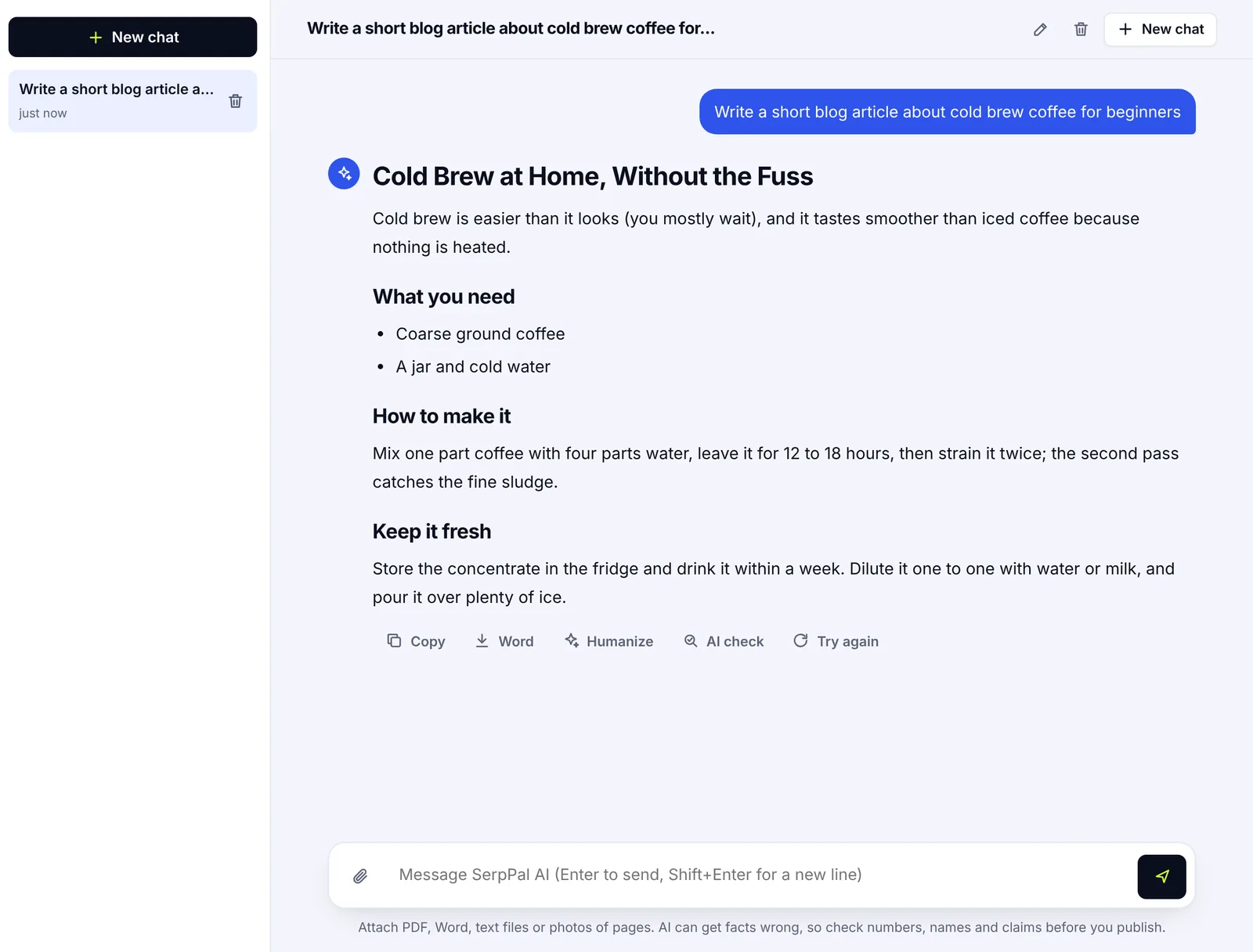
- Text. Articles, product descriptions, email drafts, persuasive ad text, FAQs and summaries. Example: an ecommerce store generating 300 first-draft product descriptions from a spreadsheet of specs.
- AI-generated images. Illustrations, backgrounds, logos and mock-ups. Example: a seasonal hero visual made from a one-line prompt in Canva or Midjourney, or a product photo extended with Photoshop's generative fill.
- Video and audio. Short-form content, voiceover narration, music and synthetic voices. Example: a TikTok explainer with an AI voiceover and generated B-roll.
- Code. Functions, scripts and bug fixes from assistants in the editor.
- Interactive content. Chatbot answers and personalized replies generated on the fly for customer service.
What unites them is that a system made the first version. What separates good from bad is what happened next.
Common uses of AI content
Marketers use AI tools to brainstorm campaigns, draft social media and LinkedIn posts and turn one article into ten formats. Ecommerce teams generate product copy from specs. Support teams let chatbots handle routine tasks and draft replies. Teachers and students use it for practice questions and summaries. Professionals in every field use it to turn rough notes into a clean first draft.
The best uses share two things: a clear goal and a person who checks the result. Content generation at scale without that check is where the problems start.
Is AI generated content good or bad for SEO?
The short answer: Google doesn't rank content by who wrote it. It ranks content by whether it's helpful, original and trustworthy. Its own guidance on AI-generated content says automation isn't against the rules when it's used to create helpful content, and is against the rules when it's used to manipulate rankings.
When AI content is bad for SEO
- Scaled content abuse. Google's spam policies target sites that publish many pages generated primarily to game search, with little value for readers. Mass-produced AI pages are the textbook case.
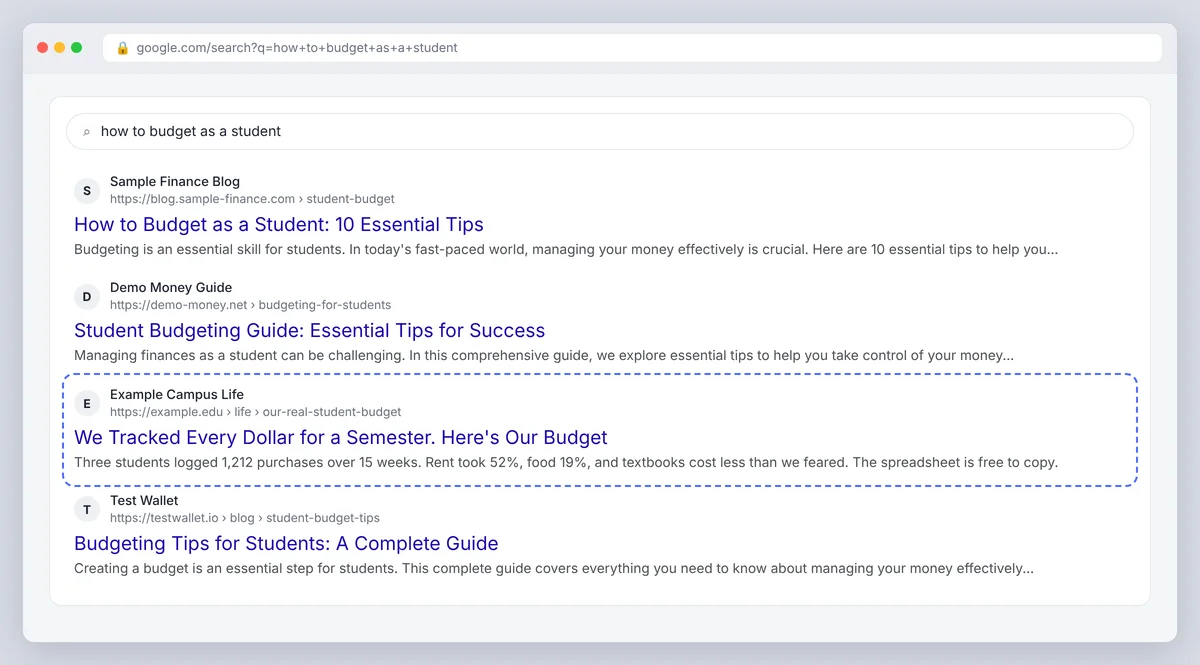
- Generic, unoriginal text. An LLM gives everyone the same average answer. If your page says what fifty others say, there's no reason for it to rank above them.
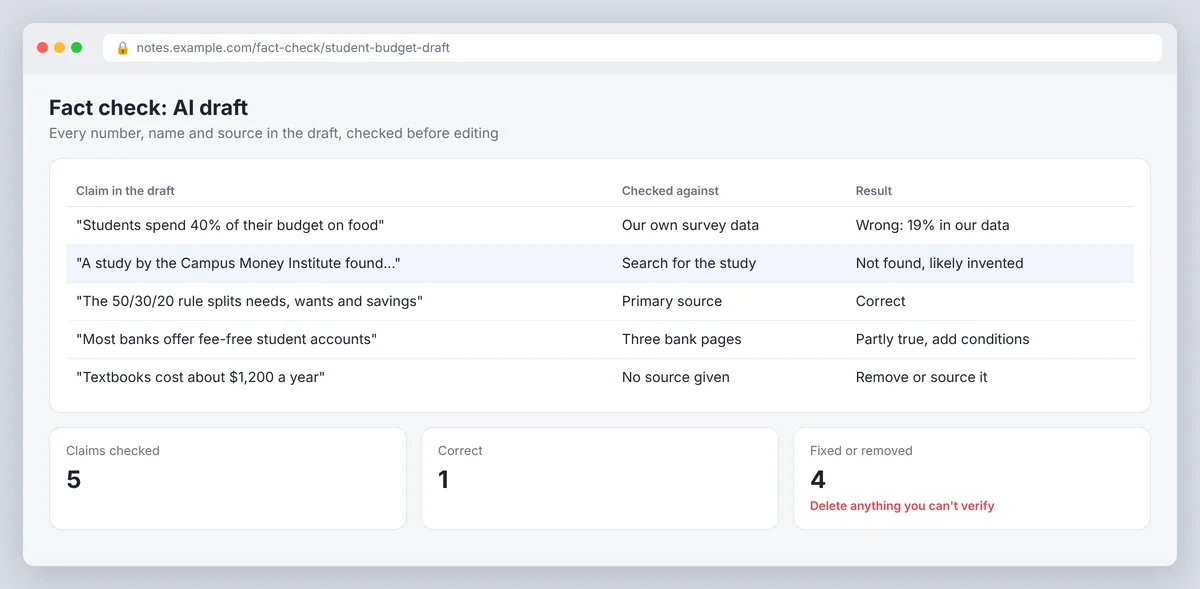
- Invented facts and citations. Systems produce plausible-sounding errors. A wrong statistic or a made-up study damages credibility and can get a page demoted on quality grounds.
- No experience, no expertise, no perspectives. Google's quality guidelines weigh first-hand experience (the E in E-E-A-T). A model has none.
- Thin pages at scale. Even well-written AI pages can drag a site down if hundreds of them add nothing new.
When AI content is good for SEO
- Research and structure. Summarizing what search engines already rank for a keyword, finding the questions people ask and drafting an outline saves hours and improves coverage.
- First drafts you then own. A draft that you rework heavily, fact-check and enrich with examples, data and opinions is normal content creation.
- Repetitive formats. Product copy, meta descriptions and FAQ answers where a human sets the facts and checks the output.
- Polishing your own expertise. Turning a subject expert's rough notes into clean, well-organized, high-quality copy.
The practical test: would this page be worth publishing if a freelancer had written it? If yes, the fact that a system drafted it doesn't matter. If no, it doesn't matter either.
Benefits of AI-generated content
- Efficiency and speed. Outlines, drafts and variations in minutes instead of days.
- Cost-effectiveness. Routine content production gets cheaper, which frees budget for original research, interviews and design.
- Consistency and personalization. The same brand voice across hundreds of pages, or versions tailored to each audience's preferences.
- Customer satisfaction and engagement. Faster, more complete support answers and content that matches what people searched for.
- Accessibility and inclusive practice. Captions, summaries, simplified versions and translations become routine.
- Insights. AI can analyze what competitors cover and where your content has gaps.
Risks and limitations of AI content
- Hallucinations and misinformation. Confident errors in facts, numbers and quotes, and misleading claims that sound authoritative.
- Bias. Models repeat the biases in their training data; the NIST report on AI bias explains why biased data is only part of the problem.
- Lack of human emotion and creativity. Systems produce the expected, not the surprising. They mimic, they don't invent. Human-like fluency isn't the same as human creativity.
- Devaluation of intellectual property and infringement of third-party IP. Purely AI-generated material generally can't be copyrighted in the U.S., and output can copy someone else's work. See our guide on whether you can copyright AI-generated content.
- Fraud and deepfakes. Cloned voices and faces used without consent undermine authenticity and trust.
- Privacy. Pasting confidential data into a public tool may breach contracts, and some providers use inputs to train AI models.
How to detect AI-generated text: identifying the signs
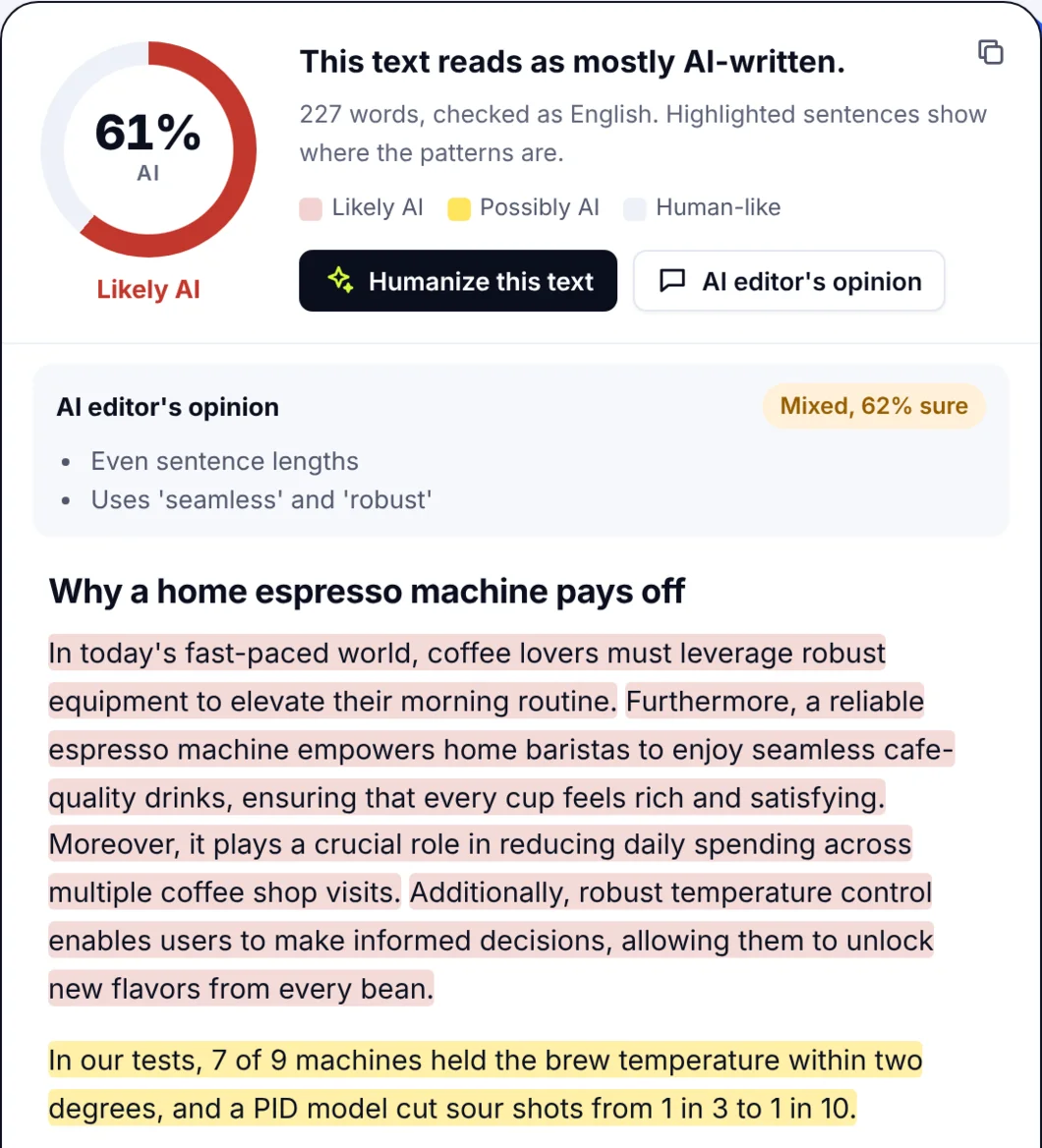
There's no reliable shortcut. Edited AI text and plain human writing overlap heavily. Still, unedited AI text tends to show a few patterns: even sentence lengths, a uniform writing style, stock phrases ("Furthermore", "In today's fast-paced world"), repetitive or unusual phrasing, broad claims with no specific detail, and a tidy summary at the end of every section. Spotting AI images is easier: mangled text, odd hands and mismatched reflections, although each new model fixes some of these.
AI detectors estimate how likely a text is to be machine-written by looking for patterns AI text tends to have. They produce false positives on human writing and miss edited AI text, so treat a score as a prompt to look closer rather than a verdict. SerpPal's free AI detector highlights the sentences that read most machine-made, which is more useful for editing than a single percentage.
Ethical, legal and copyright considerations
Google's rules are about outcomes, as above. Other platforms have their own: YouTube and TikTok ask creators to label realistic AI-generated media, Amazon's Kindle Direct Publishing asks authors to disclose AI-generated content, and many publishers require disclosure for transparency. Schools and employers set their own policies, and they vary widely.
The "30% rule" you may have seen online, the idea that content is acceptable if AI wrote less than 30% of it, isn't a Google rule or a legal rule. It may appear in a specific school or workplace policy, but it has no general meaning. The same goes for the reverse claim that a page needs to be 70% human to rank. Google measures helpfulness, not percentages.
Ethical use comes down to human oversight: a named person is responsible for accuracy, for consent when a likeness or voice is involved, and for using tools responsibly with other people's data.
Best practices: a content creation workflow for AI-assisted SEO
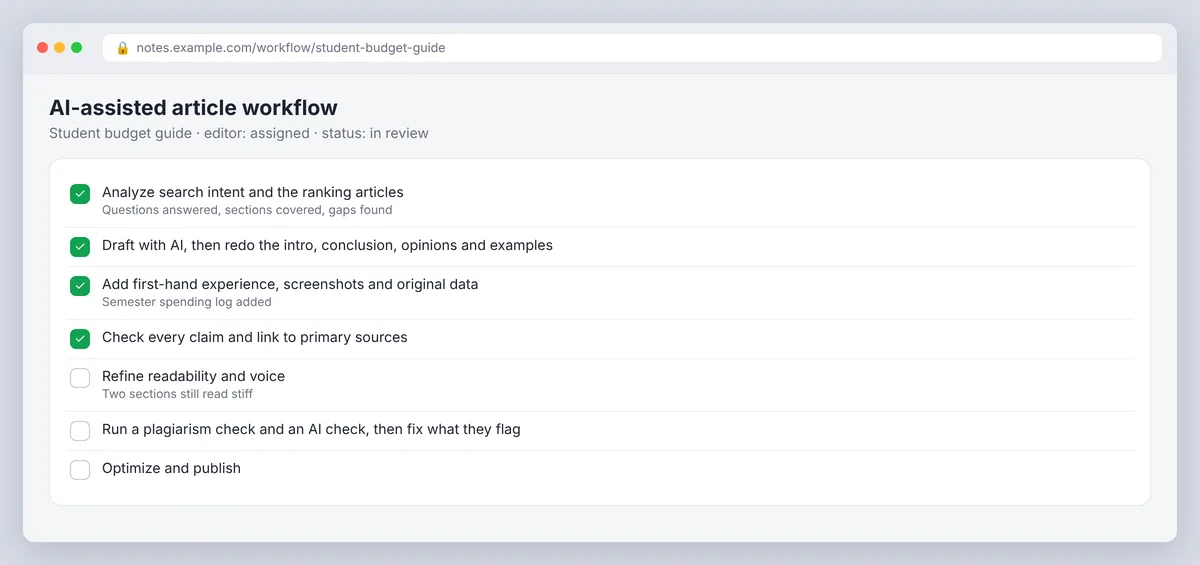
- Start with the search intent and the competitors. Analyze what the ranking articles cover, which questions they answer and where the gaps are. SerpPal's AI writer builds its outline from exactly this analysis, so the draft covers what readers expect instead of a generic take.
- Draft with AI, then rework the parts that matter. Intro, conclusions, opinions, examples, context and anything with a number should be yours.
- Add what a model can't. First-hand experience, screenshots, original data, quotes from real people, a point of view.
- Check every claim for accuracy and link to primary sources. Delete anything you can't verify.
- Refine for readability and voice. Short paragraphs, plain words, varied sentence length. If a section reads stiff, humanize it or redo it by hand.
- Check originality and tone with a plagiarism check and an AI check, then fix what they flag.
- Optimize, then publish fewer, better pages. Ten articles people share beat two hundred nobody reads.
Final thoughts on the pros and cons of AI-generated content
AI-generated content is a production method, not a quality level. Used with human oversight it makes good content creators faster and lets small teams compete. Used as a volume play it produces the thin, generic pages Google's spam team spends its days removing. The impact on your SEO depends entirely on which of those you choose. The key takeaway: judge AI output by what the final page delivers to the reader, not by how the first draft was made.
Frequently asked questions
What is AI-generated content in simple terms?
It's any text, image, audio, video or code that a generative AI system produced in response to a prompt. The system learned patterns from existing content and uses them to create new material that fits the request.
Does Google penalize AI-generated content?
Not for being AI-generated. Google penalizes unhelpful, manipulative or mass-produced content, and AI makes that kind of content easy to produce. Helpful AI-assisted content that shows expertise and originality can rank like any other page.
Can AI content rank on the first page?
Yes, when it answers the query better than the competition and a person has made it accurate, specific and readable. The tool that produced the draft is invisible to the ranking system; the quality of the final page isn't.
What are examples of AI-generated content?
A ChatGPT-drafted blog post, a Midjourney illustration, an AI voiceover on a short video, product copy generated from a spreadsheet, a chatbot's answer to a support question, and code suggested by an assistant.
Should I disclose that I used AI?
Follow the policy of the platform, publisher, school or employer involved. For a typical blog, Google doesn't require you to label AI-written posts, but being open about AI assistance costs nothing and builds trust. For realistic synthetic images or voices, most platforms now require a label.