On this page
- What makes AI writing tools useful for SEO
- How to use an SEO writer AI: from keyword to published blog post
- SEO copywriting on autopilot for blogs and e-commerce sites: does it work?
- SEO AI writers compared: features, pricing and best use case
- Pricing: free plans, free trials and what to compare
- AI writers vs human writers: who does what
- AI search, GEO and what changes for SEO blog writers
- How to choose the best SEO AI writer for your team
- Conclusion
- Frequently asked questions
An SEO writer AI is an AI writing tool that drafts content around a keyword with search intent, recommended terms and competitor coverage built in, instead of writing from a blank prompt. Used well, it turns a keyword into a well-structured, SEO-optimized first draft in minutes. Used badly, it fills a blog with generic AI content that search engines ignore, however polished the content generation looks. This guide covers what a good AI SEO content generator actually does, the AI features that matter, a step-by-step workflow from target keywords to a publish-ready post, pricing, and where human judgment still decides the result.
Key takeaways
- The difference between a generic AI article writer and an SEO writer AI is data: the SEO tool analyzes the pages search engines already rank and writes to match and beat them.
- Features that matter: SERP analysis, a real-time content score, outline and question research, brand voice, internal linking and one-click publishing to your CMS.
- "SEO copywriting on autopilot" works for drafts and repetitive formats. Full automation of blog publishing does not; every page needs a human pass.
- Optimize based on data, not guesswork: term coverage, the headings competitors use, and length targets from real results.
- Free SEO content writing software exists for every step, from keyword density to readability, but the fastest results come from one platform that integrates them.
What makes AI writing tools useful for SEO
A general AI assistant like ChatGPT, Claude, Gemini or Perplexity can write fluent blog posts. What it can't do is see the search results. It doesn't know which subtopics the top ten results cover, which terms they share, how long they are, or which questions people also ask. So it writes the average article on the topic, and the average article gets no visibility.
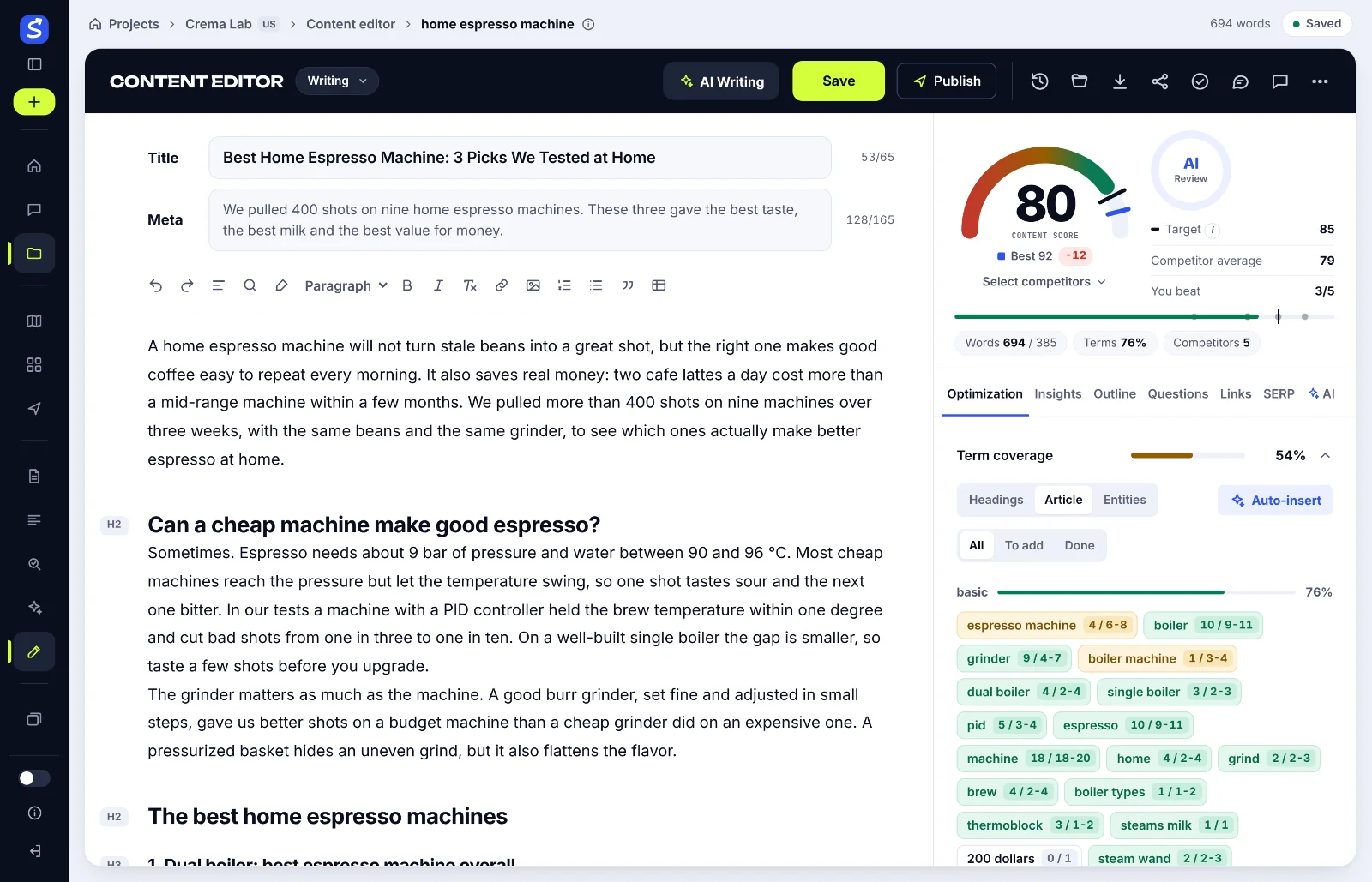
An AI-powered SEO writer closes that gap, and the best AI writer tools make the data visible while you write. Before it writes a word it runs an analysis of the keyword in your country and language, scans the competing pages and builds a brief: terms with target ranges, title phrases, entities, questions, word count and structure. The AI then writes to that brief, and a content score shows how well the draft covers it. That's the whole idea behind "optimize based on data, not guesswork".
AI features worth paying for, from 1-click article generation to publishing
| Feature | What it does | Why it matters for visibility |
|---|---|---|
| SERP analysis | Scans the top results for your target keywords | Tells the AI what readers and search engines expect on the page |
| Content score | Rates your draft against competitors in real time | Shows gaps before you publish, not after |
| Outline and questions | Sections competitors share, plus People Also Ask | Structure that matches intent; FAQ material from real searches |
| 1-click article generation | Title, outline and full draft with terms built in | Saves hours on the first draft |
| Brand voice | Your tone, audience, products and banned words | Tailored drafts that sound like you, not like every other AI blog |
| Internal linking | Suggests links to your own pages from your sitemap | Helps search engines understand your site; keeps readers on it longer |
| CMS integration | Publishes to WordPress, Shopify, Ghost or Webflow | No copy-paste, no broken formatting |
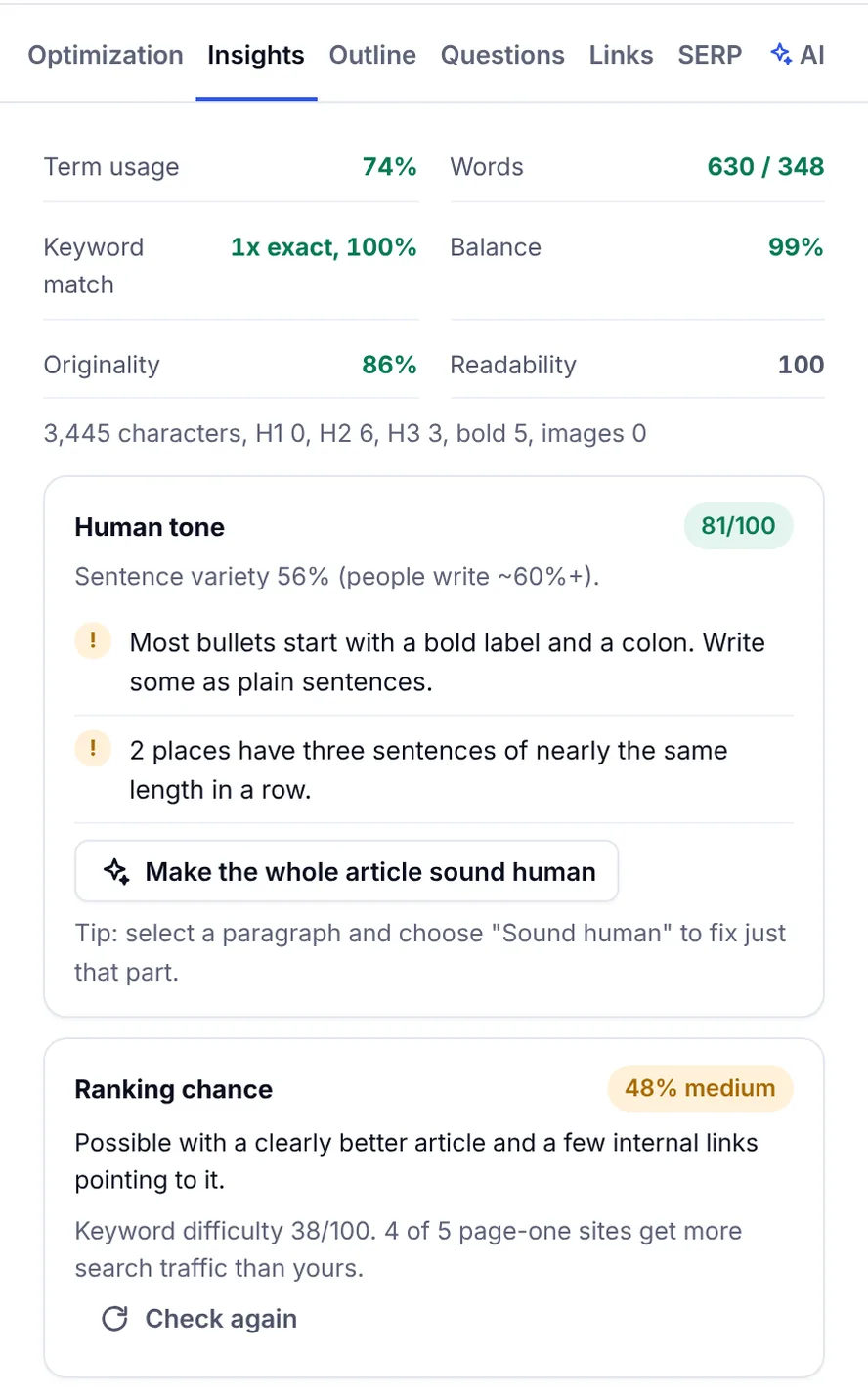
| AI detector and humanizer | Flags stiff, machine-like passages and makes them read human-like | Better reading experience; fewer "obviously AI" pages |
SerpPal's AI SEO writer bundles these into one editor: analysis, article wizard, live score, humanizing and publishing. You can see the editor and its panels in the editor tour.
How to use an SEO writer AI: from keyword to published blog post
1. Start with keyword research, not a prompt
Pick target keywords you can realistically compete for, check the intent (informational, commercial, transactional) and note what the current results look like in a Chrome incognito window. A content planner that groups related keywords into topics helps you plan a cluster of blog posts instead of one isolated page, and gives marketers insights into which topics are worth the effort.
2. Run the analysis and read the brief
Analyze the keyword for your target country. Read the brief before generating anything: the terms list, the shared section titles, the questions, the target length and the AI's summary of the search intent. If the top results are all landing pages and you planned a how-to, stop and rethink your positioning.
3. Generate the outline, then edit it
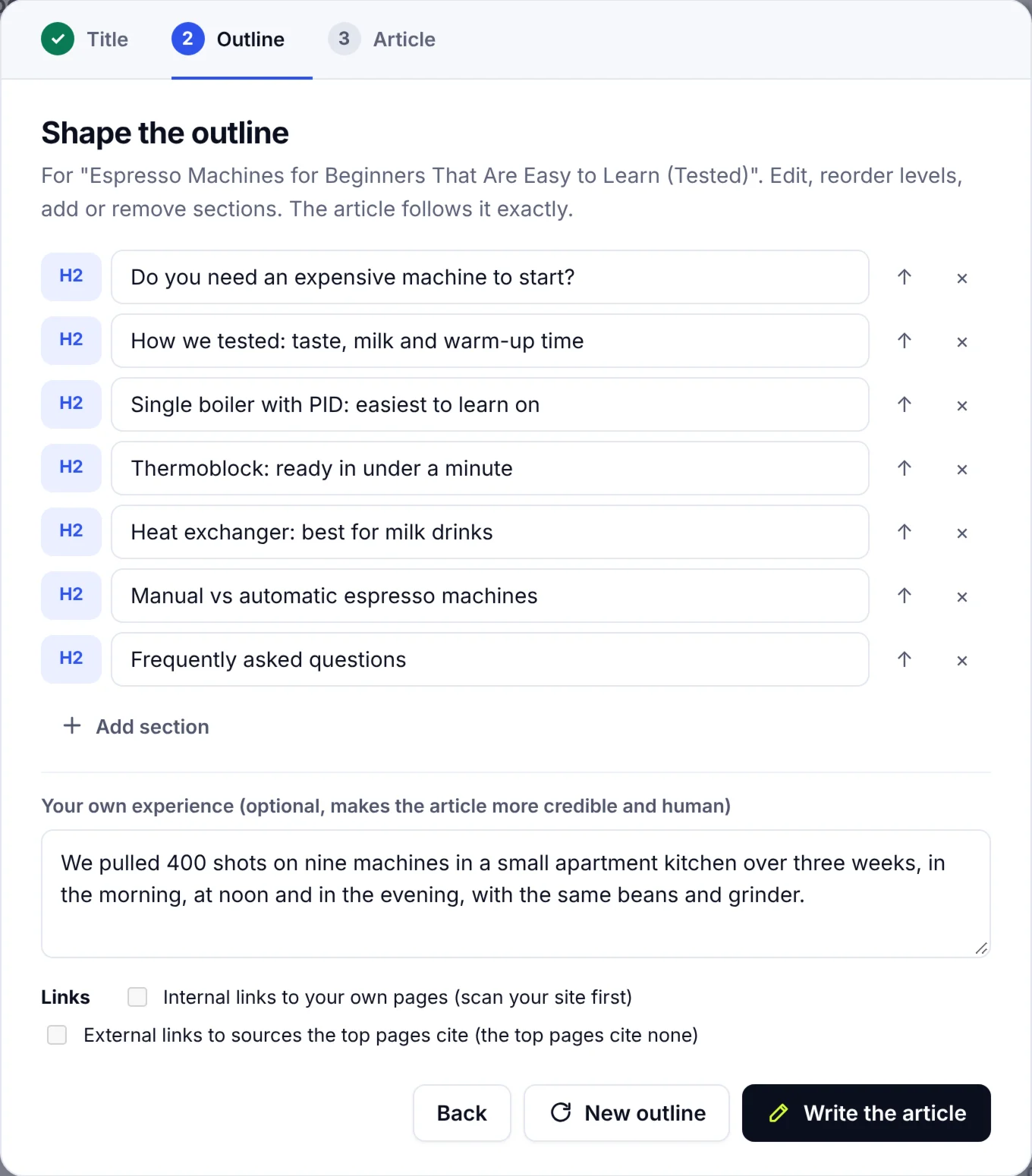
Let the AI propose a title and an H2/H3 outline from the brief. This is the cheapest place to add your angle: cut sections that don't fit, add the one competitors miss, reorder for the reader. Keep the H2s close to the phrases top results use in their section titles. Five minutes here saves an hour of rewriting later.
4. Generate the article with terms and links built in
Now run the full AI article. A good generator writes to your target length, works the recommended terms in naturally, adds internal links from your sitemap and cites trusted sources the top pages already reference. Expect a solid, well-structured, optimized but slightly flat first draft.
5. Make it yours
This is the step automation skips and the step that decides whether the page gets found. Add first-hand experience, real examples, screenshots, factual numbers you can back up, and an opinion. Fix anything the AI got wrong. Cut filler for clarity. If a section reads stiff, humanize it; a good humanizer keeps your facts and terms and makes the text read like a person wrote it.
6. Optimize based on data, not guesswork
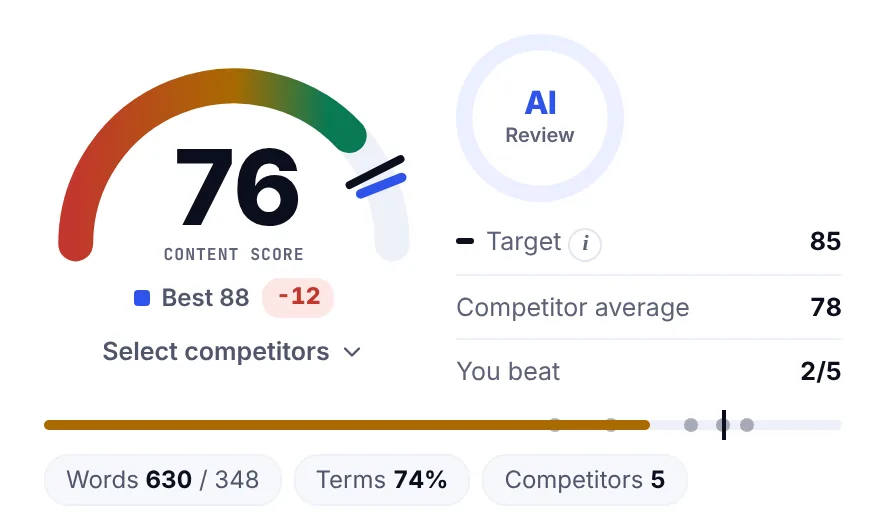
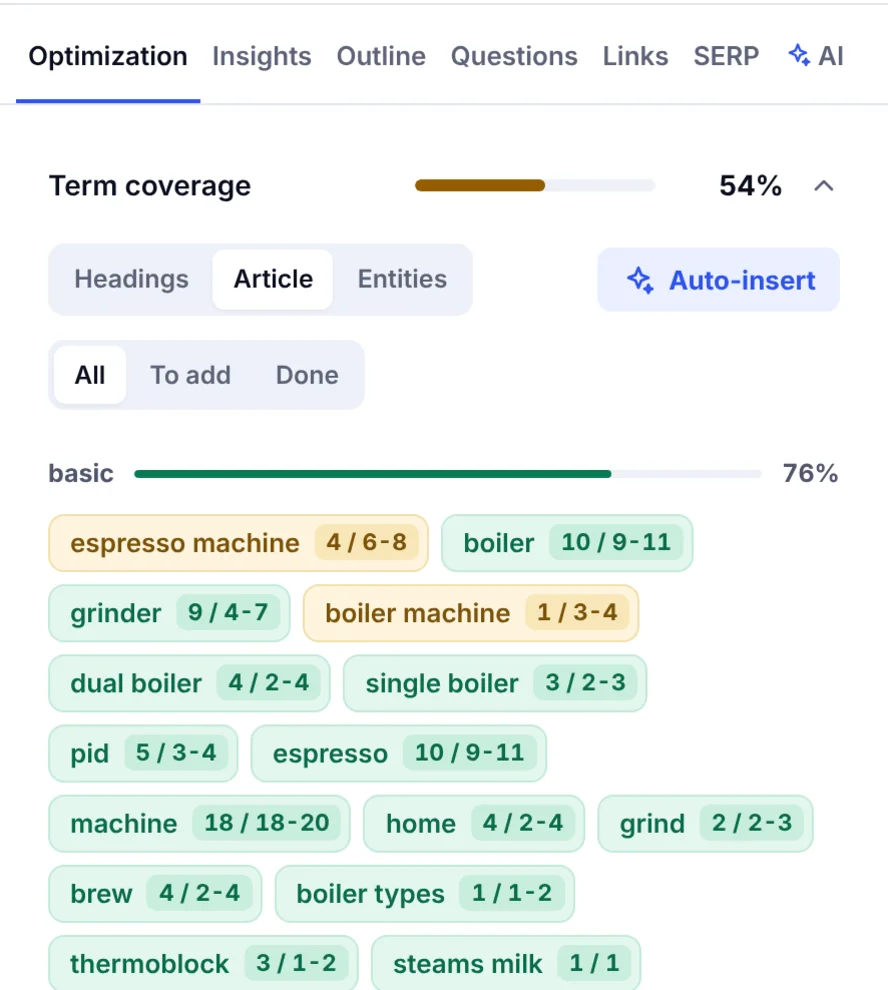
Check the gauge and the terms panel. Fill the gaps that make sense, ignore the ones that would make a sentence worse, and aim for the target rather than a perfect number. Check readability: short paragraphs, plain words, varied sentence length. Write the meta description and title with a SERP preview so nothing gets cut off. This is content optimization, not keyword stuffing.
7. Publish and repurpose
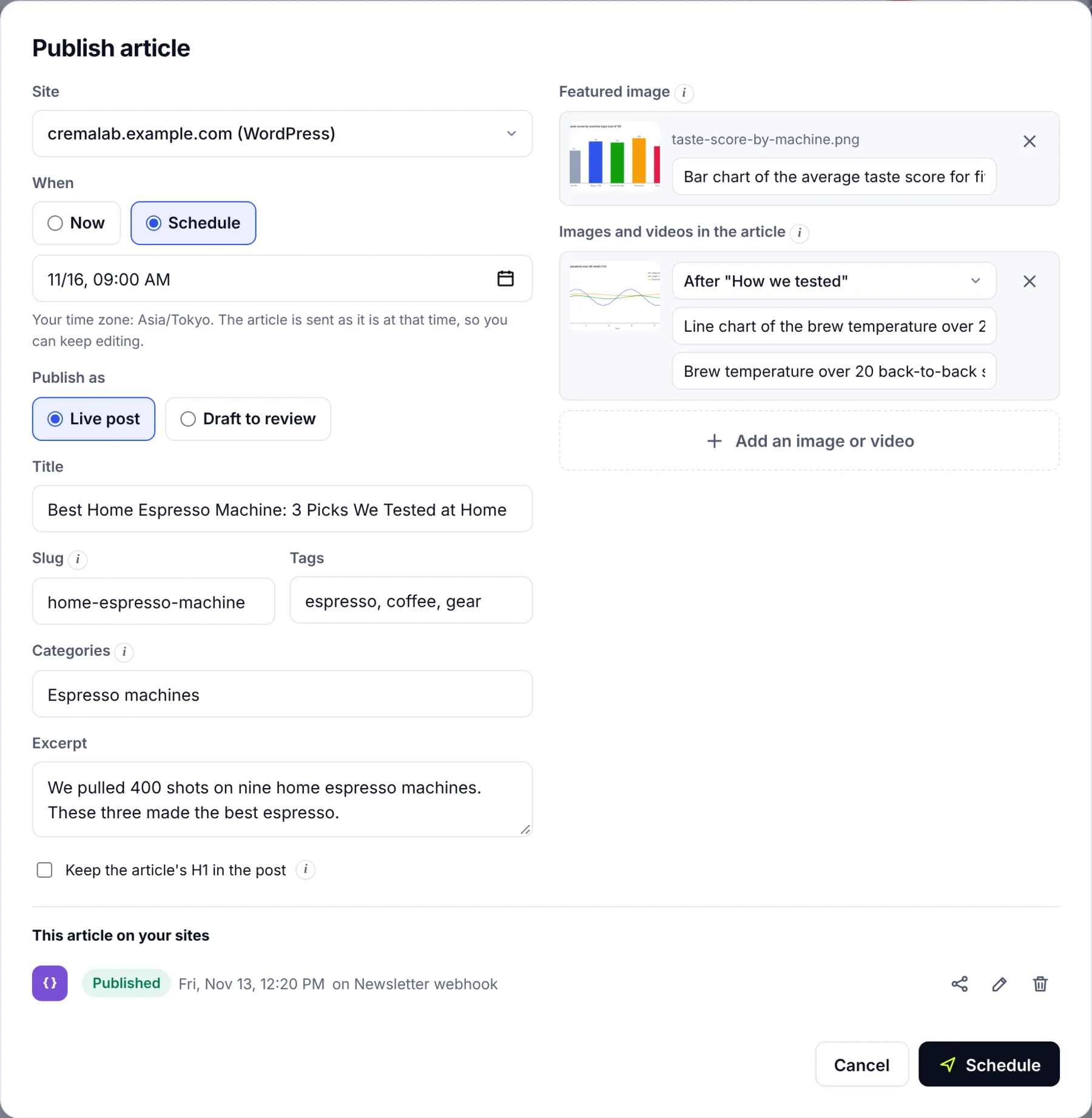
Publish straight to your website with the featured image you upload, categories and tags set, or schedule it. Then repurpose: the same brief gives you a newsletter section, a LinkedIn post, a Reddit answer and a short video script. Track the page with a rank tracker and Google Search Console, and refresh it when it starts losing clicks.
SEO copywriting on autopilot for blogs and e-commerce sites: does it work?
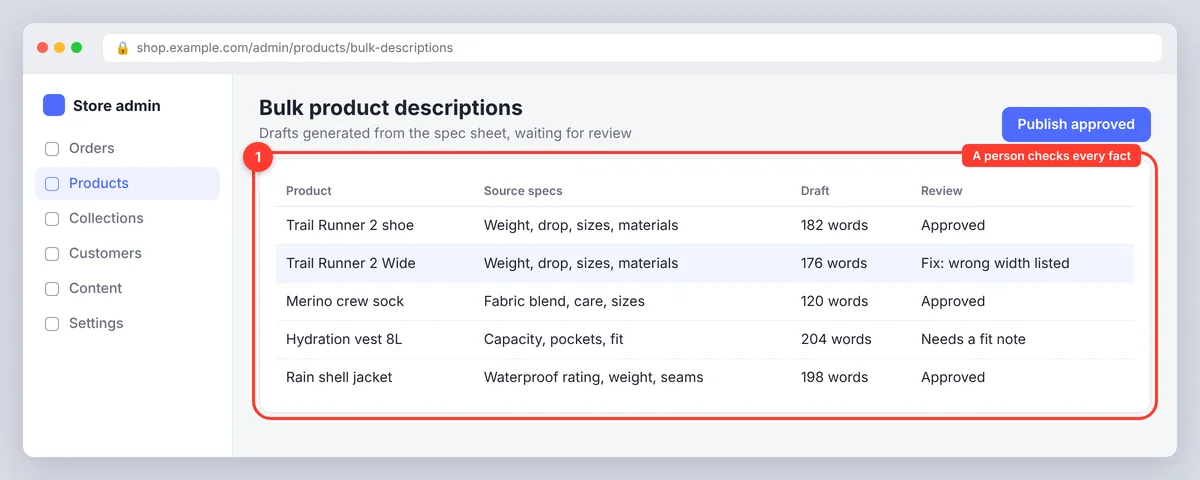
Partly. Bulk generation is genuinely useful when you automate repetitive, fact-driven formats: product descriptions for an ecommerce catalog, category intros, location landing pages, FAQ answers and meta descriptions. The facts come from your data, the AI handles the wording, and a quick human review catches the mistakes. Some writer tools also automate image alt text and schema for them.
For blog posts the answer is no, and Google's spam policies explain why. "Scaled content abuse", publishing many pages mainly to manipulate rankings, is listed as spam regardless of whether a human or a machine made them. Beyond policy, unedited AI-generated content tends to be interchangeable with everyone else's unedited AI-generated content, so there's no reason for it to appear above the rest.
The workable version of autopilot is "AI drafts, human finishes", and it's how most blog writers who automate parts of their workflow actually operate: the tool handles research, structure, terms and the first draft, and a person adds what makes the page worth reading. Remember to augment, not replace.
SEO AI writers compared: features, pricing and best use case
Rather than ranking brands, it helps to compare the three kinds of AI tool you'll meet, because each fits a different job.
| Type | Best use case | Pros | Cons | Typical pricing |
|---|---|---|---|---|
| General AI assistant (ChatGPT, Claude, Gemini) | Brainstorming, outlines, rewrites | Cheap or free, flexible | No SERP data, no score, no publishing | Free tier and paid plans (check the official pricing page) |
| Content optimization platform | Optimizing drafts against competitors | Data-driven on-page guidance | Often no real writer, pricing per article | Mid to high, usually billed annually for the best rate |
| All-in-one SEO writer AI | Keyword to publish-ready post in one place | Analysis, writing, score, humanizer, CMS integration | Learning curve; limits on analyses and AI words | Free plan plus tiers; discounts when billed annually |
Examples of each type
- Content optimization platforms: Surfer SEO, Clearscope and Frase are the best-known. They score structured drafts against the top results, and some now add AI drafting.
- AI writers with SEO features: Jasper, Writesonic and BrandWell focus on generating articles and marketing copy, with different amounts of search data built in.
- All-in-one SEO writers: tools like SerpPal put the analysis, the writer, the humanizer and publishing in one editor.
Plans and features change often, so check each tool's official pricing page, then test your shortlist on the same keyword.
Bonus: ChatGPT and other AI platforms
If your budget is zero, a chatbot plus free SEO tools still works for content creation. Paste the top three results' headings into the chat (or into a Google Docs file), ask for an outline that covers them, draft section by section, then check density and readability with free checkers. It's slower and the score is in your head, but the method is the same.
Pricing: free plans, free trials and what to compare
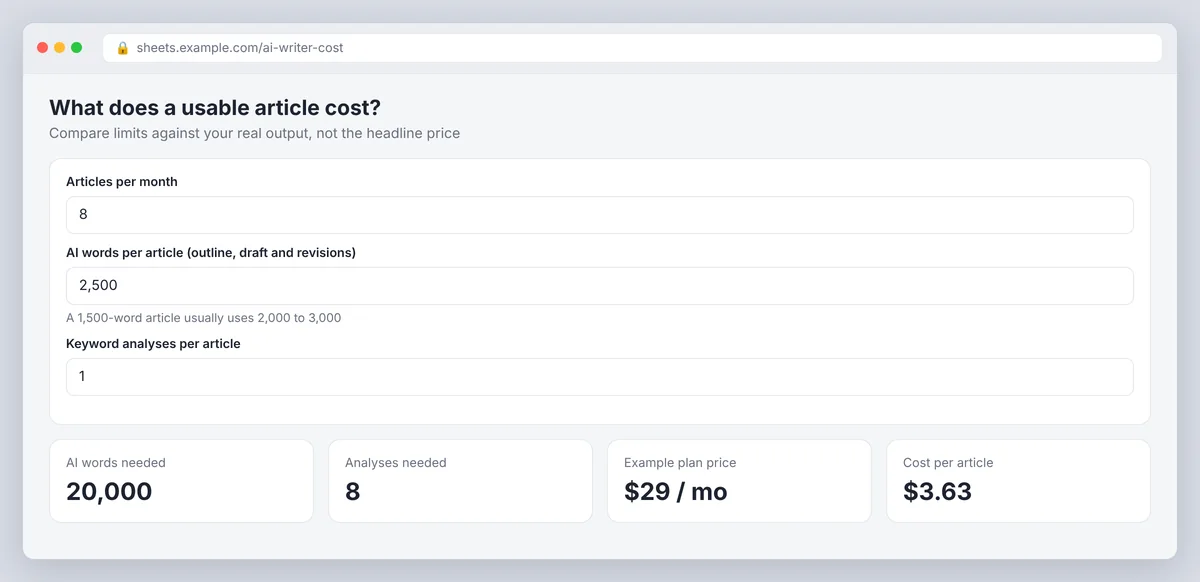
Pricing for AI SEO tools usually comes in three shapes: a free plan with small monthly limits, monthly plans, and the same plans billed annually at a discount. The quoted price rarely tells you the cost of a usable article in your content creation process, so compare these instead:
- Analyses per month. Each keyword you research and score usually costs one.
- AI words per month. A 1,500-word article with outline and revisions uses roughly 2,000 to 3,000.
- Seats and projects. Agencies pay per client site or per user on many platforms. Review sites like Capterra and G2 list the current tiers if the vendor's page is vague.
- Free trial terms. Some tools offer a free trial with full features for a few days; others give a free plan with low limits forever. SerpPal uses the second model, and the pricing page lists each plan's limits.
- Extras. API access, a rank tracker, GEO and AI search visibility reports, plagiarism checker, and custom brand kits are often tier-gated.
AI writers vs human writers: who does what
AI writers are better at speed, structure and coverage. They never forget a subtopic the competitors cover, and they produce a 1,500-word draft faster than a person can outline one. Human writers are better at everything that makes a page worth linking to: experience, judgment, specifics, voice and knowing what to leave out.
The best teams split the workflow accordingly. The writer owns the brief, the angle, the examples and the final edit. The AI owns the research summary, the first draft and the optimization checklist. Quality control stays human: fact-check names, dates and claims, run a plagiarism checker, and disclose AI assistance where your audience or policy expects it. High-quality, SEO-friendly content creation comes from that combination, not from either side alone.
AI search, GEO and what changes for SEO blog writers
Google AI Overviews, ChatGPT search and Perplexity now answer many queries directly, and SEOs are adapting: "generative engine optimization" (GEO, sometimes AEO for answer engines) is the name for getting cited in those answers. The good news is that the same things help: clear structure, direct answers near the top of a section, factual claims with sources, and well-structured pages that align with a specific question. The ranking algorithms behind AI answers reward the same clarity. An SEO writer AI that builds in a key-takeaways box, an FAQ and well-structured headings is already writing for AI search.
How to choose the best SEO AI writer for your team
- Does it analyze the SERP for your country and language? Without that, it's a chatbot with a template.
- Is the rating transparent? You should be able to see how it's built and which terms it wants.
- Does it write in your voice? A brand kit with tone, audience and word lists.
- Can it humanize text and detect AI tone? Stiff drafts cost editing time.
- Does it integrate with your website? WordPress, Shopify, Ghost, Webflow or a webhook.
- What does a usable article cost? Compare analyses and AI words per month against your real output, not the headline pricing.
- Can you test it on a real brief? Run the same keyword through your shortlist and compare editing time, not just the draft.
Conclusion
An SEO writer AI is worth it when it starts from the search results, not from a blank prompt. Let it do the research summary, the outline, the first draft and the optimization checklist. Keep the angle, the facts, the examples and the final edit for yourself. That split gives you speed without the generic pages that search engines skip. To try the whole workflow on one keyword, start on SerpPal's free plan; it needs no card.
Frequently asked questions
Which AI is best for writing SEO content?
For search visibility, a tool that analyzes the search results and scores your draft against them beats a general chatbot, because it writes to what search engines already reward. For brainstorming and rewrites, any strong chatbot works. Many writers use both: a chatbot for ideas, an SEO writer AI for the draft and optimization.
Is AI-written content good for SEO?
It can be. Google ranks helpful, original content regardless of how it was produced, and demotes thin, mass-produced pages regardless of who wrote them. Its quality guidelines (E-E-A-T) reward experience and expertise, which is exactly what SEOs add in the editing step. AI-assisted content with real editing and expertise ranks; untouched AI output rarely does.
How does an AI SEO content writer generate content?
It analyzes the top results for your keyword, builds a brief of terms, headings, questions and length, writes a title and outline, then drafts each section to that brief. Good tools also add internal links from your sitemap and keep your brand voice.
Can the AI match my brand's tone and write in other languages?
Most SEO writers let you define tone, audience, products and words to avoid, and write in the language of the analysis. Have a fluent editor review translated or non-English drafts, especially for local idioms and regulated topics.
Is AI SEO content plagiarism-free?
Generating text produces new wording, but no tool can guarantee originality, and a draft can still echo its sources. Run a plagiarism check before publishing and rework anything that matches too closely.