On this page
The clearest sign of AI writing is text that is fluent, grammatically correct and empty: every line is well formed, every paragraph has the same shape, and nothing in it could only have been written by someone who actually did the thing. Stock phrases, tidy triplets, em dashes everywhere and confident claims with no source are the surface markers. The deeper one is the absence of specific, checkable detail.
This guide lists the ten telltale signs with short examples, explains how to tell if something was written by AI (ChatGPT, Google Gemini or any other LLM) without jumping to conclusions, and covers why detection tools, and the markers themselves, are clues rather than proof.
Key takeaways
- AI writing tends to be smooth, formulaic and evenly paced. Human writers naturally vary their rhythm, commit to opinions and include details only they would know.
- Common tells: stock openers, "not just X but Y" constructions, groups of three, em dashes, hedged conclusions, neat summaries that restate the intro.
- One marker proves nothing. Formal prose by people shares many of them, and edited AI-generated text can lose all of them.
- AI detectors estimate probability from patterns; they produce false positives and false negatives, are never 100 percent accurate, and should never be the only evidence.
- Judge the text on accuracy, originality and usefulness. Those matter whoever, or whatever, wrote it.
Ten telltale signs text was written by AI
Each marker below comes with an example of the kind of line that triggers it. Read them as a pattern: three or four together are suggestive, one alone is just a line of prose. Most of them are the way AI tools write when nobody edits the output: artificial intelligence generating the statistically average article.
1. Stock openers and closers
"In today's fast-paced digital landscape..." "In conclusion, it is clear that..." Language models were trained on millions of blog articles that open and close this way, so they reproduce the habit. Human writers use clichés too, but rarely at both ends of every section.
2. The "not just X, but Y" construction
"This is not just a tool, but a partner." "Success isn't merely about effort; it's about strategy." The contrast-and-reframe pattern appears constantly in AI-generated content because it sounds like original insights while saying nothing the reader did not already assume.
3. Everything in threes
"Fast, reliable and secure." "Plan, execute and measure." Triplets are a classic rhetorical device; AI uses them in nearly every list and most sentences with a list in them. When every enumeration has exactly three items, a model probably chose them.
4. Em dashes and colons as glue
AI writing uses the em dash far more than most people do, often twice in a line, and colons to introduce clauses that did not need introducing. It is one of the most obvious surface markers of the current generation of models, and also the easiest to edit out, so its absence means little.
5. Uniform sentence structures and rhythm
Human prose has short lines next to long ones. It speeds up and slows down. AI prose tends to run at one speed: medium-long, rigid sentence structures of the same shape, each carrying one idea with one subordinate clause. Read a passage aloud and the flatness is audible even when each line is grammatically fine on its own. The consistency is unnatural precisely because it is so consistent.
6. Lack of specificity and conviction
"Studies show that..." with no study. "Experts agree..." with no expert. "Many businesses have found..." with no business. AI generates plausible claims confidently and then hedges them with words like "often" and "typically" instead of supporting them, relying on the reader not to check. Human experts name the study, give the number, or admit they are guessing. The same lack of conviction shows in descriptions: a model will call a product "versatile" rather than say what it is for.
7. Overused vocabulary
A short list of words that AI tends to overuse: "delve", "tapestry", "landscape", "crucial", "robust", "seamless", "foster", "testament", "navigate", "realm", "multifaceted". None is wrong. All of them appearing in one page is unusual for a person and routine for a model. The same tendency shows in a simpler way too: abstract nouns stacked on abstract nouns ("the implementation of optimization strategies") where a person would pick a verb.
8. Summaries that restate the intro
The last paragraph repeats what the first paragraph said, in slightly different words, and the middle paragraphs each end with a mini-summary of themselves. Readers notice this repetition as a feeling of going in circles. It comes from the way models are prompted to "conclude", and it is the structured, overly neat format of a school assignment rather than of anything people read by choice.
9. Neutral tone where the subject calls for a view
Ask a person whether a product is worth buying and you get an opinion. Ask a model and you get "it depends on your needs and preferences", followed by balanced considerations. Flat, bland, agreeable neutrality in a review, an opinion piece or a personal essay is a strong tell; nothing in it resonates because nothing in it was felt.
10. No detail that only the writer could know
This is the deep marker and the one that survives editing. A human who installed the software remembers the step that failed. A human who visited the city remembers the smell of the market. AI writing describes the general case because it has no particular case to describe: no problem-solving, no wrong turn, no authentic detail. If nothing in a text could be checked against reality or traced to an experience, that is the pattern to weigh most heavily.
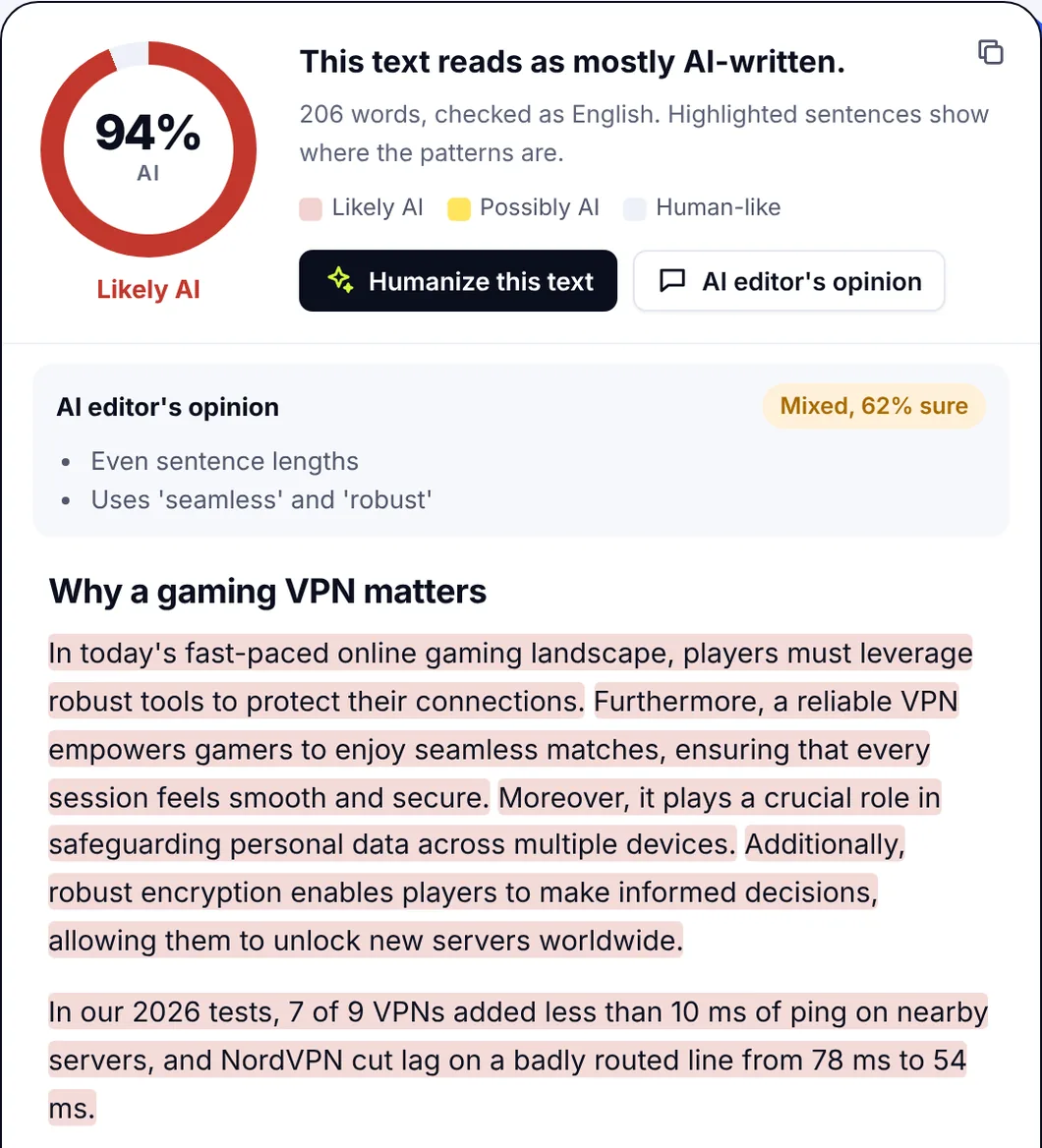
Examples: the same paragraph, AI and human
Here is a typical AI-written paragraph on a mundane topic:
In today's fast-paced world, time management is crucial for success. By prioritizing tasks effectively, individuals can not only boost productivity but also reduce stress. Whether you're a student, a professional or an entrepreneur, mastering this skill can help you navigate the challenges of daily life.
And the same idea from a person:
I only got my evenings back when I started writing the next day's three tasks on a sticky note before leaving the office. Two of them usually get done. The third is where the stress used to live.
The second is not better written in any technical sense. It is specific, it has rhythm, it commits to a claim, and it could only have been written by someone who tried it. That is what "sounds human" means in practice, and it is why the robotic version reads as machine-generated content even to people who could not say why.
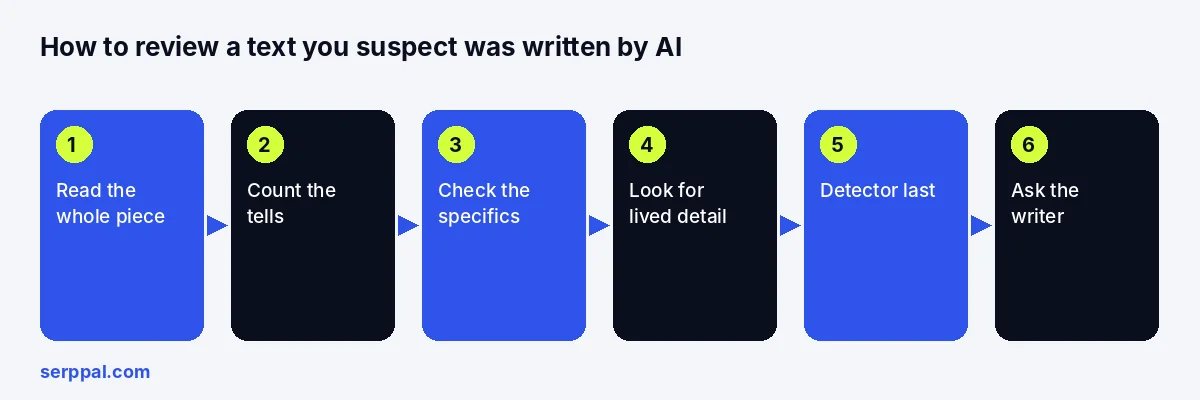
How to tell if something was written by AI
If you need to review a text, whether as an editor, an educator or a reader deciding whether to trust it, use a process rather than a hunch.
- Read the whole piece first. Single sentences prove nothing. Look for the pattern across sections.
- Count the markers. Stock phrases, triplets, dashes, uniform rhythm, restated conclusions. Three or more is worth a closer look.
- Check the specifics. Follow every citation and verify every number against a search or the original source; a Wikipedia entry is a starting point, not a citation. AI-generated citations often point to papers that do not exist; human errors usually point to real ones misread, or to an incorrect page number.
- Look for lived detail. Is there anything here the writer could only know from doing it? Its absence is the strongest signal.
- Compare with the writer's other work where that is appropriate and permitted. A sudden change in voice is a reason to ask, not to accuse.
- Run a detector last, not first. Use it as one more clue. SerpPal's AI detector is free without an account and highlights the lines that read as machine-generated, with explanations, which is more useful for a conversation than a bare percentage.
- Ask the writer. A person who wrote the text can explain any paragraph of it. One who did not, cannot.
Why no single sign proves AI authorship
Every tell on the list is also a feature of some writing by people. Corporate communication is full of stock phrases. Academic prose is uniformly paced and relentlessly hedged. Technical manuals are neutral by design. Plenty of people love the em dash. A careful writer with a formal brief, or one relying on templates, can produce text that exhibits every surface marker and was never near a model.
The reverse is also true. AI-generated drafts that a person has edited, cut, reordered and filled with their own examples can read as entirely human-like, because at that point they largely are. The markers identify unedited model output. They do not identify AI assistance, and they certainly do not prove that AI wrote the final text.
AI detectors and their limitations
A detector estimates how closely a text matches the patterns AI text tends to have and reports a probability. The better ones detect unedited model output most of the time and are wrong often enough on writing by people that a score alone cannot support an accusation. SerpPal's documentation puts it plainly: at the "Likely AI" line (60 percent and up) the checker flags about 91 percent of AI-written texts and about 7 percent of human-written texts, which means that in a class of a hundred honest essays, several will be flagged. Short texts, formal registers and non-native English all raise the false-positive rate.
So treat a detector result as a reason to read more carefully, never as a verdict, and never use it as the only evidence against a student or colleague over assignments or editorial work. Our guide to how AI detectors work explains what the scores can and cannot tell you.
Does writing in "would" signal AI?
No. A popular claim holds that past-habitual "would" ("every summer we would drive to the coast") is a marker of model output. It is ordinary English, common in memoir and fiction for a century before language models existed. The same goes for any single grammatical feature or word choice. Patterns across a whole text are evidence; one construction is not.
Signs of AI writing in fiction and personal essays
Creative writing has its own tells. Characters who all speak in the same polished register, with no variety in how they connect. Emotions named rather than shown ("she felt a deep sense of sadness"). Imagery that is predictable ("the sun dipped below the horizon, painting the sky in hues of orange and pink"). Endings that resolve too neatly, with unnecessary explanations of what the story meant. Personal essays from a model describe feelings in general terms and never include the embarrassing, specific detail that makes a memory real. As with everything above, human beginners produce the same things, which is why workshops exist.
Does it matter if content was written by AI?
For readers, what matters is whether the text is accurate, original and useful. A checked, edited AI-assisted article that teaches you something beats a lazy human one. For SEO specifically, Google's guidance is about helpfulness rather than who wrote it: AI content is not penalized for being AI content, but generic, unverified text performs badly in search whoever produced it, and the markers above are mostly markers of generic text.
Who wrote it does matter where rules, trust or accountability are involved: schoolwork, journalism, legal and medical writing, anything with a byline that implies a person stands behind it. In those settings, transparency is the rule: add a disclaimer where the policy requires it, and take responsibility for the final text either way. The organizations that have stopped talking about AI and started adopting it tend to have one editorial rule: a person checks every claim before launching anything.
If you use AI for drafts and want them to read as your own, the fix is the mirror image of the list: cut the stock phrases, vary the rhythm, replace vague claims with checked facts, add the detail only you know, and run a humanizing pass on anything that still reads stiff. The AI humanizer in SerpPal shows the AI score before and after so you can see what changed, and humanize in the editor explains how to run it on a draft in place.
Frequently asked questions
What are the main signs of AI writing?
Stock openers and closers, "not just X but Y" constructions, groups of three, heavy use of em dashes and colons, uniform sentence rhythm, confident claims without sources, an overused vocabulary of words like "delve" and "crucial", conclusions that restate the introduction, a flat neutral tone, and above all the absence of any detail only the writer could know.
Can AI detectors reliably identify AI content?
They identify unedited model output fairly well and misfire on a meaningful share of human writing, particularly short, formal or non-native text. A detector score is a clue to be weighed with context and close reading, not evidence of authorship on its own.
Is AI content bad for SEO?
Not because it is AI content. Google's guidance targets unhelpful, generic text, and most of the signs of AI writing are also signs of generic text. An AI-assisted draft that a person has verified, edited and made specific can rank; an unedited one usually does not deserve to.
How can I tell if a student's essay was written by AI?
Read the whole essay for the pattern of tells, verify the citations, look for detail from the student's own reading or experience, compare it with their earlier work, and then talk to the student. A detector can support that conversation; it should not replace it, because it will be wrong about some honest students.
How do I make my AI-assisted writing sound human?
Remove the stock phrases, break up the uniform rhythm with short lines, replace every unsupported claim with a checked fact or a clear opinion, add examples from your own experience, and read it aloud. Use the AI tools for a first draft and your prompts for structure, then edit the output as if a stranger wrote it. A humanizing tool can handle the rhythm and phrasing; the specifics have to come from you.