On this page
Turnitin's AI writing detection is only available through schools, so students can't run their own drafts through it, and many teachers want a second opinion. If you need an AI checker Turnitin alternative, the most common choices are GPTZero, Copyleaks, Originality.ai, Winston AI, QuillBot, Grammarly, Sapling, ZeroGPT and SerpPal's free detector. Several are free, but none reproduces Turnitin's exact result.
This guide compares the leading AI detection tools for students and teachers, shows which free options are worth using, explains why results differ between tools, and covers how to use any detector responsibly.
Key takeaways
- Turnitin's AI detection isn't sold to individuals. There's no free Turnitin AI check for students to try before submitting.
- Several tools offer a free checker, including GPTZero's free tier, Grammarly, Scribbr and SerpPal. Paid tools add longer documents, file upload, reports and integrations.
- No alternative gives the same percentage as Turnitin. Each tool uses its own model, training data and thresholds.
- All detection tools sometimes flag human-written text, so no tool is 100% accurate. Treat a result as a reason to review, not as proof.
- For teachers, the best alternatives integrate with your learning platform and show sentence-level highlights you can discuss with students.
Why look for a Turnitin alternative?
Turnitin is best known for its similarity report, which compares submissions against web pages, publications and student papers for plagiarism. Its AI writing report sits in the same workflow. There are good reasons to look elsewhere:
- Students can't access it directly. It's licensed to institutions through tools like Canvas, so you can't check a draft first.
- Teachers want a second opinion before raising a concern with a student.
- Some schools don't enable the AI feature. Several universities, Vanderbilt among them, chose not to turn it on because of false positives.
- Writers outside school, such as freelancers, SEO teams and editors, need a way to detect AI content without an institutional account.
Best AI detectors compared
| Tool | Best for | Free option | Notable features |
|---|---|---|---|
| GPTZero | Students and teachers | Yes, limited | Sentence highlights, file scans, Chrome extension |
| Copyleaks | Schools and teams | Limited trial | AI and plagiarism detection, learning platform integrations, many languages |
| Originality.ai | Publishers and SEO teams | No, paid credits | AI, plagiarism and fact-checking in one report |
| Winston AI | Educators | Trial | PDF and image uploads, printable reports |
| QuillBot | Students | Yes | Free check that also flags AI-refined and paraphrased text |
| Grammarly | Writers already using Grammarly | Yes | Quick free check alongside its writing tools |
| Sapling | Quick checks | Yes, limited | Simple per-sentence results, API for developers |
| ZeroGPT | Short free checks | Yes | Paste-and-check, no account for short texts |
| SerpPal | Writers and students | Yes | Sentence-by-sentence highlights in the browser |
Features, limits and pricing change often, so check each tool's current plan before relying on it.
The leading options in detail
GPTZero: the closest checker similar to Turnitin for teachers
GPTZero is one of the best-known detection tools in education. It highlights sentences that look AI-generated, gives an overall score and probability, offers insights into which parts read as ChatGPT text, lets teachers scan multiple files, and offers a Chrome extension for Google Docs. The free tier covers short checks; paid plans add longer documents and more scans.
Good for: teachers who want a readable second opinion, and students checking a draft.
Copyleaks: an institutional Turnitin alternative
Copyleaks offers AI and plagiarism detection together, supports many languages and integrates with learning management systems. That makes it one of the closest institutional alternatives for schools that want both a similarity check and AI detection in one place.
Good for: schools and departments choosing a platform, and multilingual programs.
Originality.ai
Originality.ai is built for publishers, agencies and website owners checking AI-generated content and machine-generated text at scale, and it works as a plagiarism checker too. It combines AI detection, plagiarism detection and fact-checking, and works on paid credits, with pricing billed per scan or as a subscription.
Good for: content teams and freelance writers rather than students.
Winston AI
Winston AI targets educators with clear reports and support for uploading PDF and docx files, plus images of text. It's used more by individual teachers than as a campus-wide platform.
QuillBot, Grammarly and Sapling
QuillBot and Grammarly both offer free AI checks alongside their writing tools, which makes them convenient if you already use those products. Its checker also tries to flag text that was refined with AI or run through paraphrasing tools. The third offers a simple free detector and an API for developers.
Good for: quick free checks on short texts.
ZeroGPT and Scribbr
Both are simple paste-and-check tools for fast results. They're handy for a first look but give fewer reports and controls than the education platforms.
SerpPal's free detector
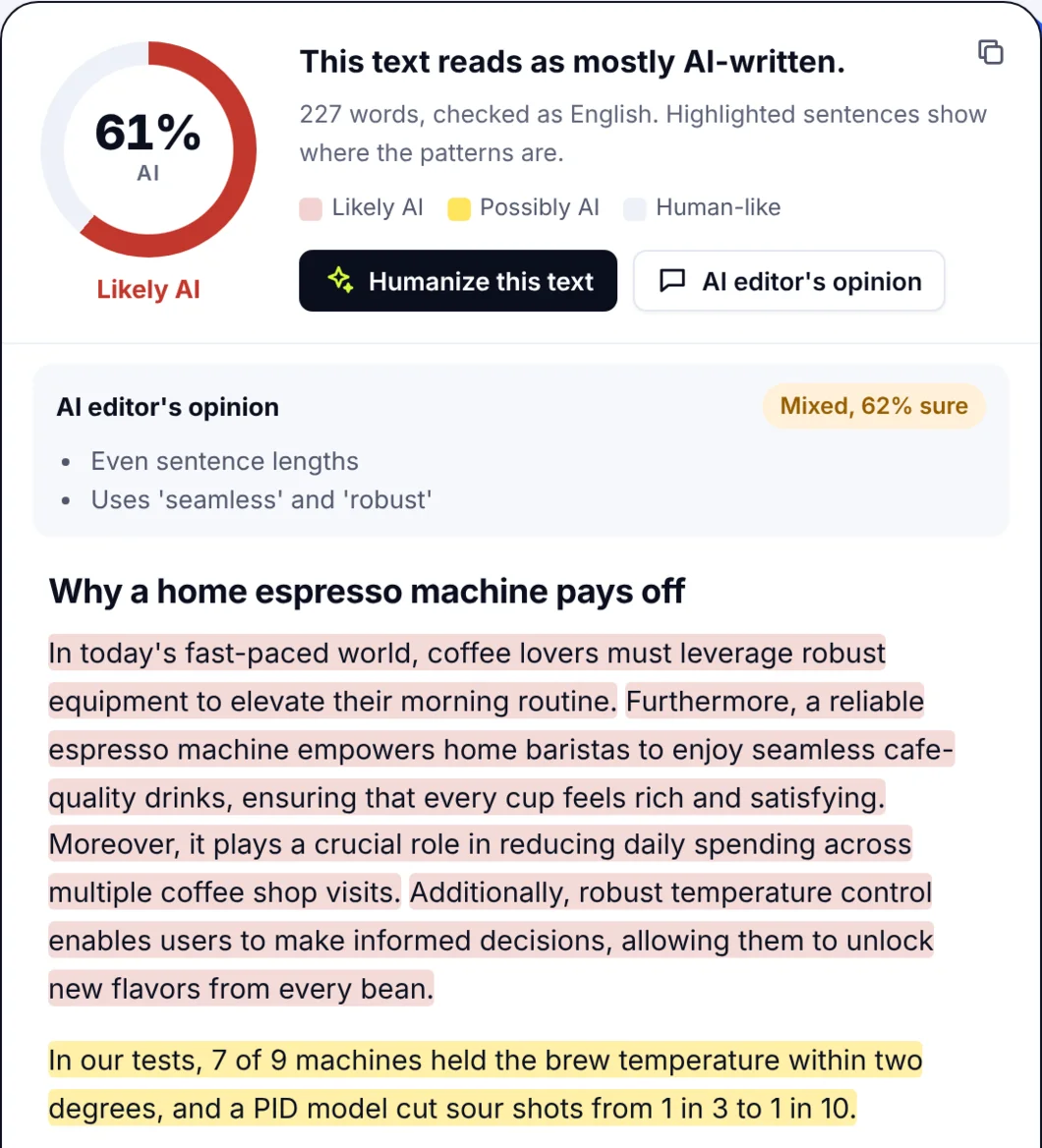
SerpPal's free AI detector estimates how likely a text is to be AI-generated and highlights the sentences that read most like AI, so you can see exactly which parts to review. It runs in the browser, and the free plan includes a monthly allowance of checks. If a passage you wrote yourself reads as generic, the highlights show where to add your own detail.
Free AI detectors compared
These free tools let you paste text and get an AI score without paying, many without sign-up, though most cap scans at a few hundred to a few thousand words (rarely 10,000 words):
If you only need a free check, use one of these and read the highlighted sentences, not just the percentage score:
| Free option | Free version offers | Sentence highlights |
|---|---|---|
| GPTZero free tier | Short scans with an overall probability | Yes |
| QuillBot | Quick checks with AI, AI-refined and human categories | Yes |
| Grammarly | A quick AI check next to its writing tools | Basic |
| Other free checkers | Short paste-and-check scans | Varies |
| SerpPal | A monthly allowance of free checks | Yes |
Free limits change frequently, so confirm them on each site.
Why detection tools give different results
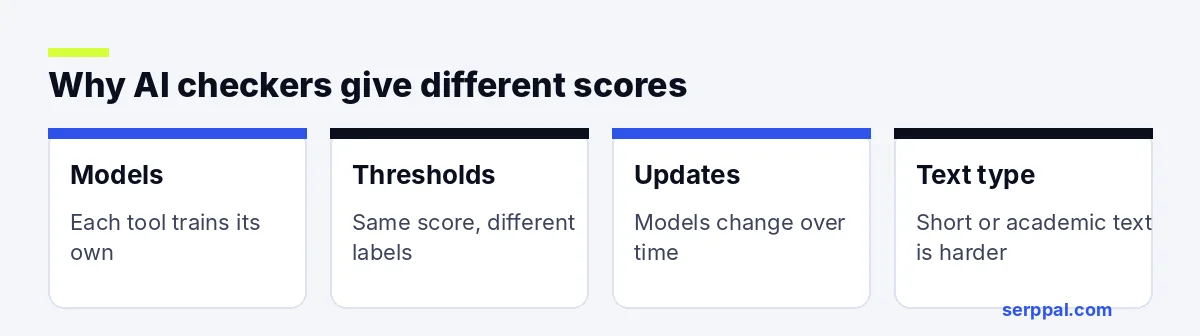
Run the same essay through three detectors and you'll often get three different percentages. That's expected:
- Different models. Each tool trains its own classifier on its own mix of human writing and AI-generated text from models like OpenAI's GPT-4, ChatGPT, Claude and Gemini, so each one analyzes phrases and patterns differently and assigns its own likelihood.
- Different thresholds. One tool may label 30% as "likely human," another as "mixed."
- Updates. Vendors retrain models as LLMs change, so the same text can score differently next month.
- Text type. Short texts, formulaic academic writing, paraphrased text and writing by non-native English speakers are harder for every detector.
Independent research backs this up. A study of 14 detection tools found none fully accurate or reliable, and benchmarks such as RAID have shown that detectors can struggle when text is edited or generated by models they weren't trained on. Turnitin itself describes its AI score as one piece of information for an educator, not a final verdict, and every vendor's accuracy claims come with caveats. Detectors can incorrectly flag human-written text, and they can't reliably identify AI output that has been edited. Our guide to the most accurate AI detector covers accuracy in more detail.
Best AI detector for students vs teachers
For students
- Use a free checker on your own drafts to spot generic passages before you submit assignments. Paste text from Google Docs or upload a file, and look at which sections are highlighted.
- Use it like a free checker for your own AI text risk, not a grade. AI tools that score writing can't see your process.
- Don't expect it to predict Turnitin. A low percentage elsewhere doesn't guarantee a low Turnitin result, and vice versa.
- Keep your drafts and version history. If your work is questioned, your writing process is the strongest evidence. See what to do if you're flagged as AI.
For teachers
- Look for sentence-level highlights, so you can discuss specific passages rather than a single score. Bulk uploads and LMS integration save instructors time when grading a whole class.
- Check learning platform integration and data handling, especially for student privacy.
- Verify with more than one signal: drafts, in-class writing, a plagiarism checker and a conversation with the student. Academic integrity policies usually require it, and students deserve feedback, not just an indicator.
Conclusion: what is the best Turnitin alternative?
For schools, Copyleaks is often the closest institutional alternative because it pairs AI detection with plagiarism checking and integrations. For individual teachers, GPTZero is the most widely used. For students and writers who want a quick, free check, the free tiers listed above, including SerpPal's checker, cover the basics. Whatever you choose, treat the result as a starting point for review, never as proof.
Frequently asked questions (FAQs)
Is there a free Turnitin AI checker for students?
No. Turnitin's AI detection is only available through institutions. Students can use free alternatives, such as the free tiers compared above, but their results won't match Turnitin's exactly.
What is the best AI checker similar to Turnitin?
For schools, Copyleaks is often compared to Turnitin because it combines AI and plagiarism detection with learning platform integrations. For individual checks, the most widely used option in education is a dedicated education detector rather than a general writing tool.
Can I check my essay with Turnitin before submitting?
Usually not, unless your school offers a draft submission option. Some courses allow a practice submission; ask your instructor.
Are Turnitin alternatives accurate?
They're useful but imperfect, like Turnitin itself. Every AI scoring system produces false positives and false negatives, especially on short or heavily edited texts. Treat any result as a signal, not proof.
Why does my essay get a different percentage on each tool?
Each tool uses its own model, training data and thresholds, and models are updated over time. Different results on the same text are normal.