On this page
- How AI detection works, and why it gets it wrong
- Seven patterns in human content that trigger false positives
- Who gets flagged most
- How reliable are AI detectors?
- What to do when your writing is flagged
- Why humanizers and synonym swapping can backfire
- For educators and reviewers: a fair process in an educational context
- Conclusion: focus on quality, not just detection
- Frequently asked questions
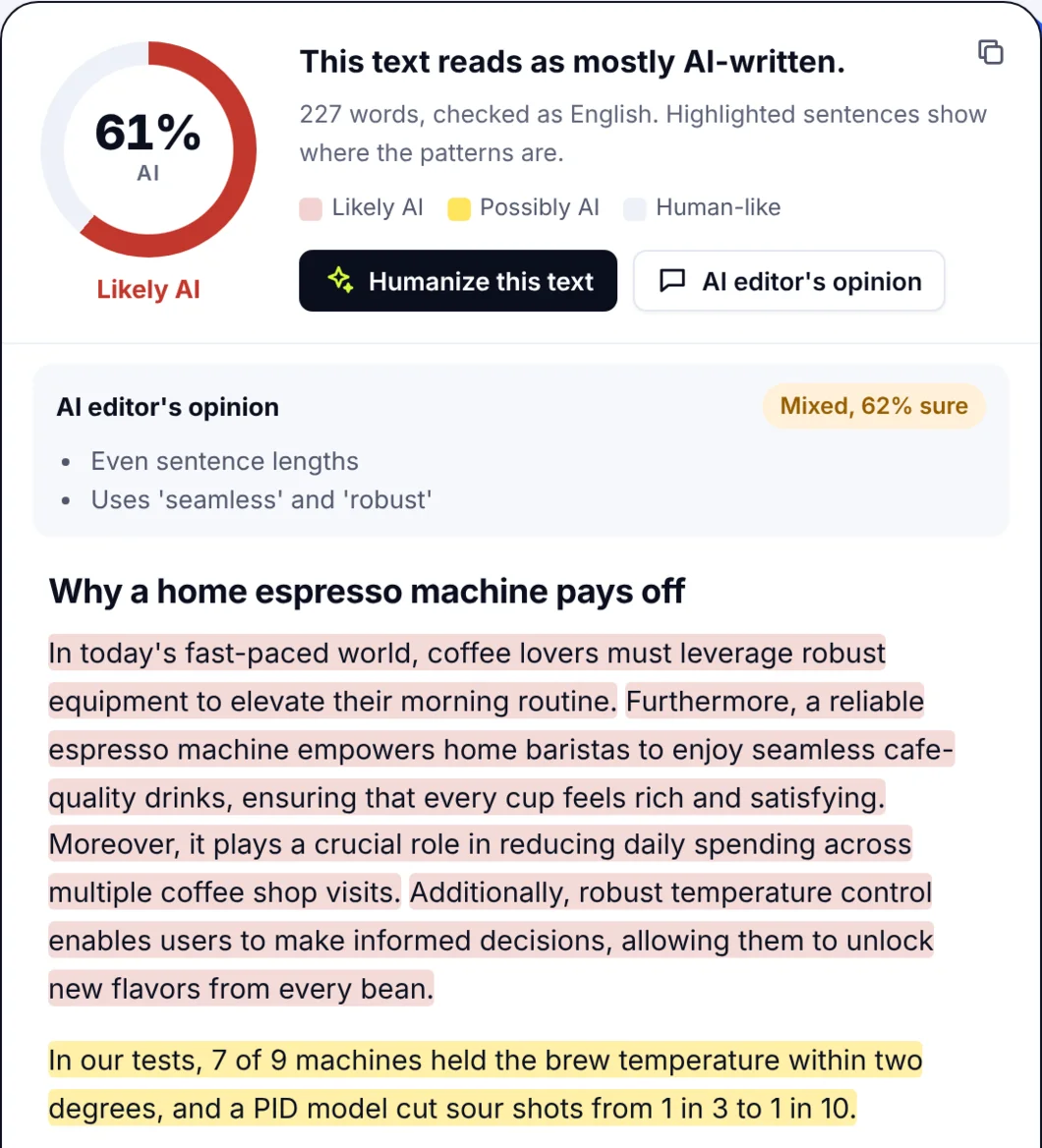
Why do AI detectors flag my writing? Because they do not know who wrote it. AI detection tools estimate how closely a text matches the patterns AI-generated text tends to have, such as evenly paced sentence structures, predictable phrasing, formal structure and a flat tone, and plenty of human-written content has those patterns too, especially short, polished, academic or non-native English. A flag is a probability, not a finding, and a human-written essay can score as "likely AI" without anyone cheating.
This guide explains what the detectors are actually measuring, the seven writing habits that trigger false positives, who gets flagged most, how reliable the tools are, and what to do when it happens to you, whether you are a student, a blogger, an SEO content writer or the educator reviewing the work. It is frustrating to be told your own words look like AI writing; understanding why is the first step, and the insights below apply to AI content checks at work as much as at school.
Key takeaways
- Detectors classify text by statistical patterns. They cannot see your process, so a human-written text with "AI-like" patterns gets flagged.
- The usual triggers: uniform sentence length, stock phrases, formulaic structure, generic claims, heavy polish, short samples and non-native English (ESL) writing.
- False positives are common enough that a score alone should never be treated as evidence; several universities have switched detection off for that reason.
- The right response is evidence of your process (drafts, notes, version history), not frantic rewording.
- Improve flagged text for readers, by adding specifics and varying rhythm. Do not use synonym-swapping tools to chase a score.
How AI detection works, and why it gets it wrong
An AI detector is a classifier. Its algorithms were trained on large samples of text labelled human or machine-generated, and it learned which surface features separate the two on average: how predictable each word is given the ones before it (public detectors often call this perplexity, and low perplexity reads as AI), how much sentence length and syntax vary (burstiness, where low burstiness reads as AI), the distribution of vocabulary, the use of certain transitions and constructions. Given a new text, it analyzes those indicators statistically, predicting how strongly the text resembles the AI side of that training data. In other words, it does not detect AI; it detects AI-like word choices. Language models such as GPT were trained on the same kind of text, which is why the two overlap.
Three consequences follow. The detector never checks who typed the words; it only checks the words. It works on averages, so any human text that happens to sit near the AI average is flagged incorrectly. And it was calibrated on unedited model output, so it is best at catching exactly that and worst on everything in between: edited AI-generated content, AI-assisted human writing, and formal human writing. Even OpenAI withdrew its own AI text classifier in July 2023, citing its low rate of accuracy.
Honest vendors say so openly. SerpPal's own AI detection documentation says plainly that its checker can flag some human-written texts and miss some AI texts. Even a small error rate adds up: across a class of 150 essays, a few percent means several honest students flagged. Our guide to how AI detectors work goes into the mechanics; the short version is that a score is a probability about patterns, and nothing more.
An example you can try
Take a few hundred words of formal, old public-domain prose, such as a passage from Charles Darwin's On the Origin of Species (1859), and run it through two or three AI checkers. Writing like this often scores higher than people expect, and the tools rarely agree with each other. Darwin's prose is measured, formal, evenly paced and free of personal anecdote, which is to say it has many of the writing patterns a classifier associates with model output. He did not use ChatGPT. Formal, careful, well-edited writing looks like AI to a pattern matcher because AI was trained to write like formal, careful, well-edited writing.
Seven patterns in human content that trigger false positives
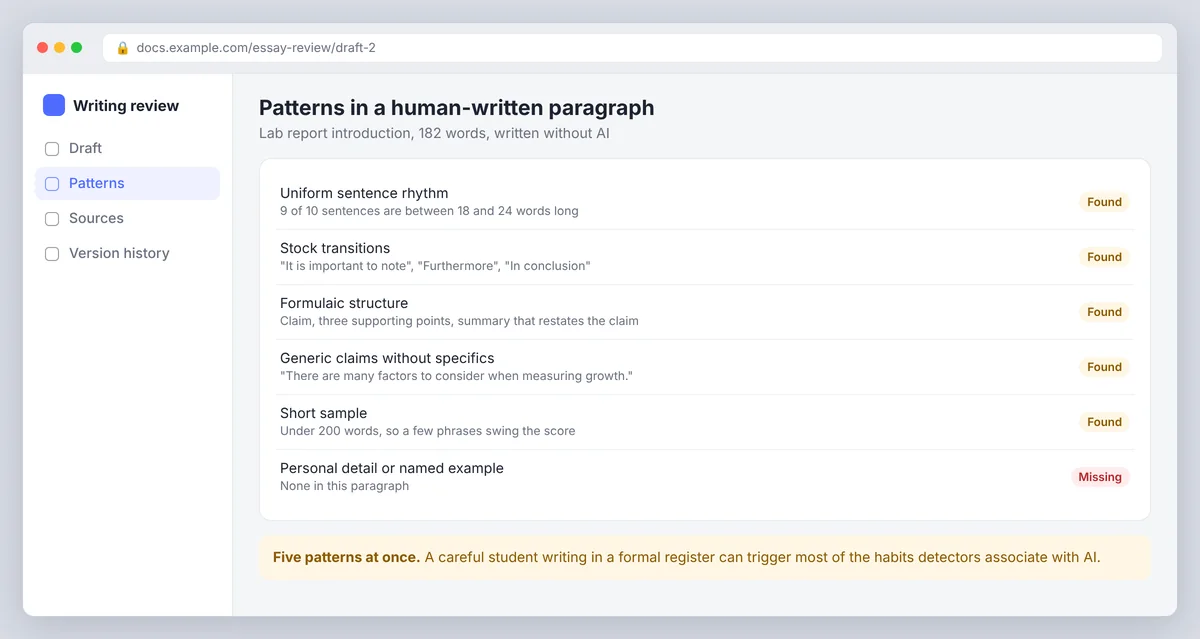
The same handful of habits account for most false positives. None of them is a fault, and some are things teachers ask for.
- Uniform sentence rhythm. Every sentence 18 to 25 words long with one subordinate clause, with no variation in the natural rhythm. Careful editing often produces this repetitive sentence pattern; so does writing to a formal register.
- Stock phrases and transitions. "It is important to note", "in today's society", "furthermore", "in conclusion". Academic writing is full of them because academic writing taught the models.
- Formulaic structure. Introduction with thesis, three body paragraphs each ending in a summary, conclusion restating the thesis. The five-paragraph essay is the most AI-shaped thing a human can write, and research papers with rigid formats are close behind.
- Generic claims without specifics. "There are many factors to consider." A text with no names, numbers, examples or lived detail reads as generated because generated text has none either.
- Consistent polish. Grammar checkers and multiple edit passes remove the small irregularities that mark human writing, and the result can read as polished but robotic; a grammatically perfect, overly optimized text has lost the nuance that gave it away as yours. Flawless prose is suspicious prose, which is absurd, and true.
- Short samples. A 150-word answer gives the classifier almost nothing to work with, and a few common phrases can swing the result. Most vendors warn that short texts are unreliable; most users ignore the warning.
- Non-native English and translation. Writers who learned English later tend to use the safest, most straightforward constructions and vocabulary, which are also the most predictable. Translated text and heavily corrected text show the same effect.
Add a formal topic (a lab report, a legal summary, a literature review) and a student who did everything right can hit four or five of these at once.
Who gets flagged most
Students, because essays are short, formal and structured, and because they are the people being checked. ESL writers, for the reasons above; a Stanford study published in Patterns, GPT detectors are biased against non-native English writers, found that popular detectors flagged a majority of TOEFL essays by non-native speakers while classifying essays by US students as human. Technical and academic writers, whose registers are neutral by design. Anyone who runs a draft through a grammar checker such as Grammarly and accepts every suggestion, which smooths the rhythm into uniformity. And anyone submitting a short piece, because the smaller the sample, the noisier the estimate.
The people flagged least are, uncomfortably, those who write casually and loosely. That is not a reason to write badly on purpose. It is a reason not to trust the score.
How reliable are AI detectors?
Reliable enough to catch most unedited model output, and unreliable enough that they cannot carry an accusation on their own. Understanding the limitations of the detection tools comes down to three facts:
- Detectors disagree. The same essay can come back flagged on one tool, say GPTZero, and clean on another, such as Turnitin or Originality.ai, because each uses different training data and thresholds. A number from one tool says nothing about what another would say.
- Small changes flip results. Rephrasing a couple of sentences can move a score substantially. A measure that unstable is not measuring authorship.
- Institutions have noticed. Several universities, Vanderbilt University among them, turned off the AI detection feature in Turnitin, their plagiarism software, citing false positives and the harm of accusing students on a probability. Vendors themselves tell educators not to act on the score alone, and the tools keep evolving, so last year's threshold is not this year's.
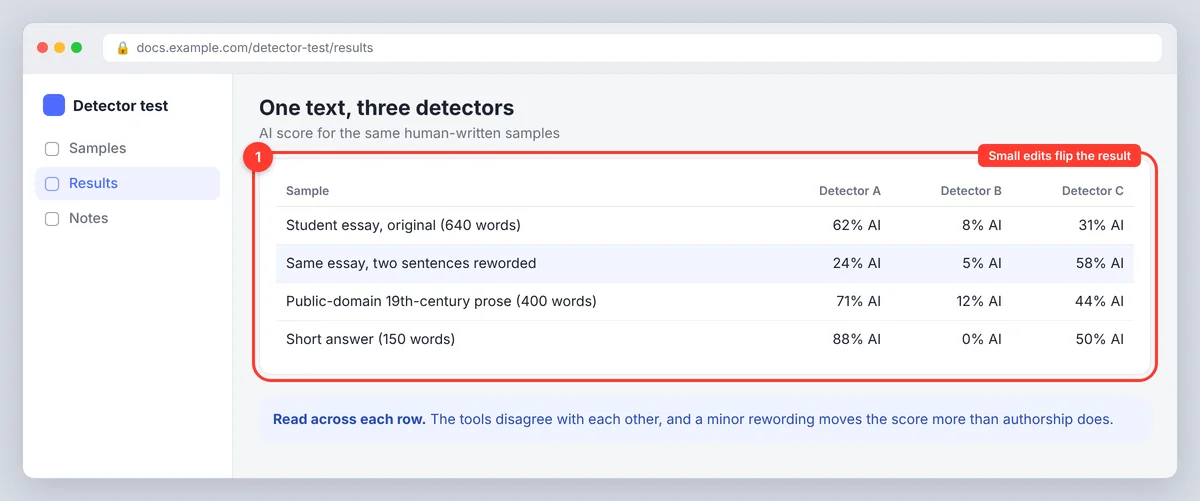
So a detector result is a reason to look closer, not a conclusion. The useful tools say so and show you which sentences drove the score, which at least makes a conversation possible. SerpPal's AI detector does that, free and without an account, and highlights the sentences that read as machine-generated rather than returning a bare percentage.
AI detection is not plagiarism checking
The two get confused. A plagiarism checker compares your text against published sources and reports matches; it answers "was this copied?" An AI detector compares your text against statistical patterns and reports a probability; it answers "does this look generated?" A section can be entirely original and flagged as AI, or copied word for word and pass as human. A similarity score and an AI score are different measurements, and neither one proves authenticity or originality on its own; academic integrity cases need both, plus a human.
What to do when your writing is flagged
Do not start rewording. Start documenting.
- Find out what was flagged, by which tool, at what score. A 30 percent result on a short section is a very different situation from 95 percent on a whole essay, and a red flag on one section is not a verdict on the piece.
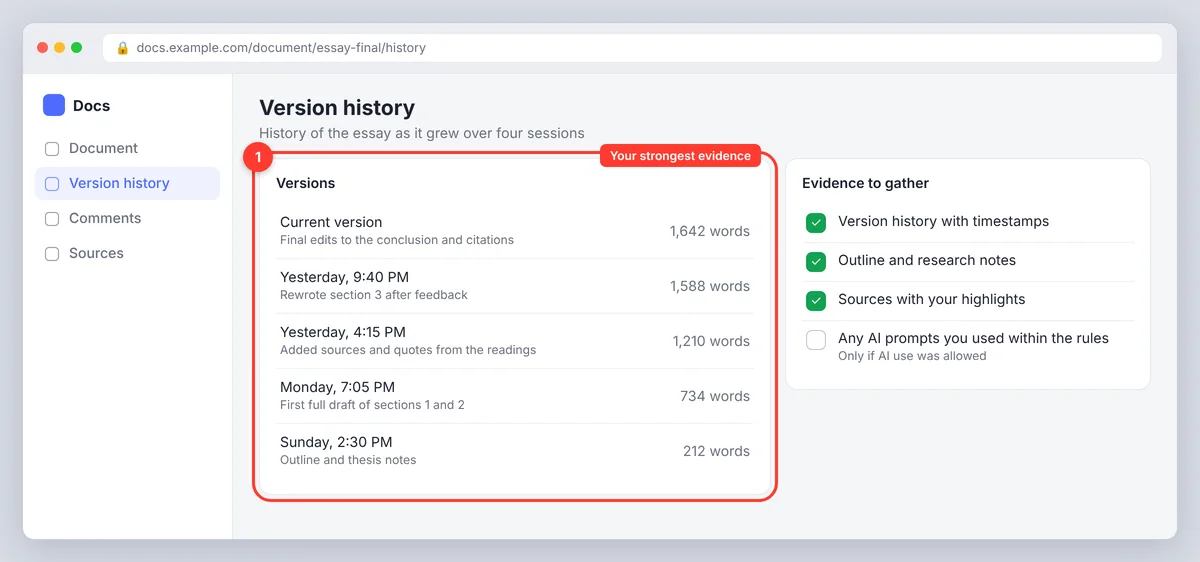
- Gather evidence of your process. Dated outlines, research notes, early drafts, source links with your highlights. Google Docs and most editors keep version history; a revision log that shows the essay growing over hours is the strongest evidence there is.
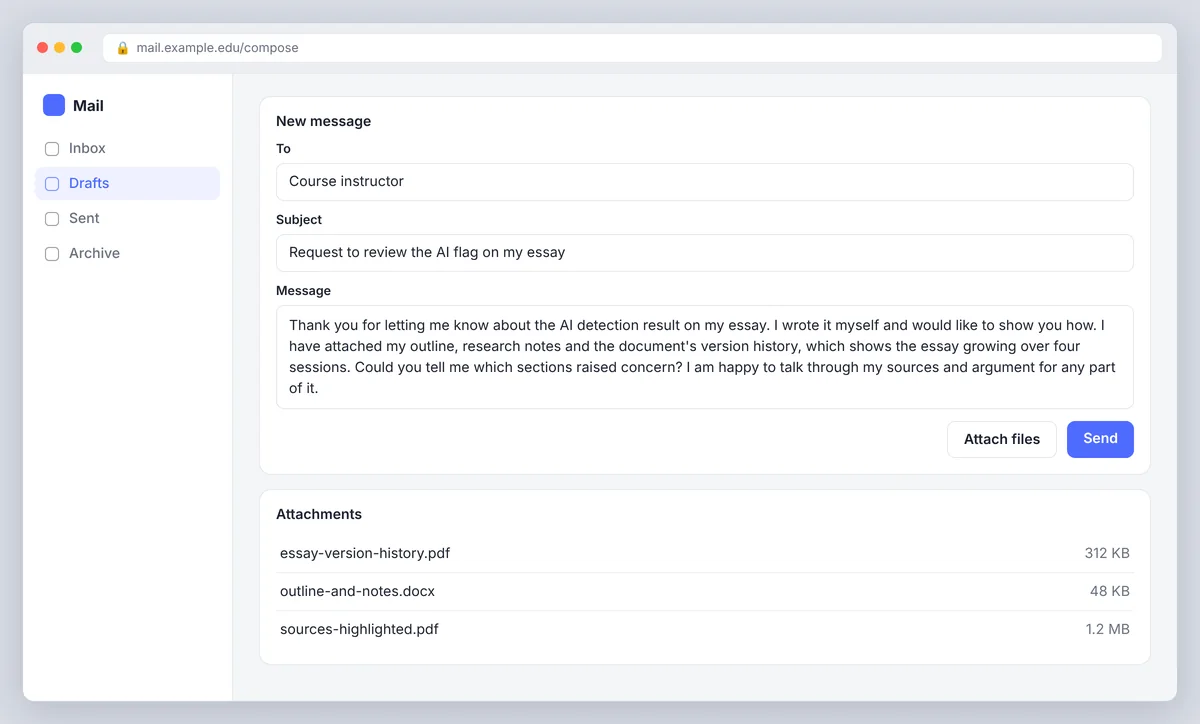
- Ask for a review, calmly. Say that you wrote the work, ask which sections raised concern, and offer your drafts and an explanation of your sources and argument. A person who wrote a text can talk about any part of it; that conversation settles more cases than any score.
- Check the policy. If the course or employer allowed AI tools for brainstorming or proofreading and you used them that way, say so. Disclosure within the rules is not a confession.
- Revise only for readers. If a section genuinely is vague or repetitive, improve it: add the specific example, add the citation, vary sentence length. Refine it because it makes the writing better, not to game a number.
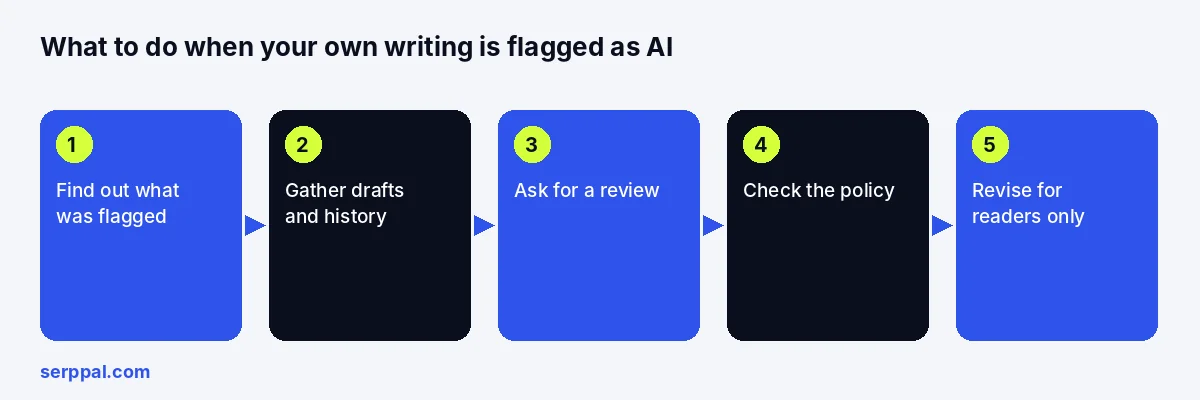
For step 3, a short, calm message that offers your evidence is usually enough to start that conversation.
Common mistakes to avoid, and how to protect yourself before you submit
The common mistakes are panicking, rewording before documenting, and arguing about the number instead of the process. The protection is simple.
Make your writing process visible. Write in a tool with version history and keep it on. Save outlines and notes with dates. Keep the sources you read and the passages you highlighted. If you use AI within the rules, keep the prompts and note what you used it for. Run your own draft through a detector before submitting, not to change it, but so a flag is not a surprise and you already have the evidence ready. None of this should be necessary. All of it is cheap, and it ends most disputes in minutes.
Why humanizers and synonym swapping can backfire
If you wrote the text yourself, running it through a humanizer or a paraphrasing tool to bypass a detector is the wrong move. Machine paraphrasing can change your meaning, introduce errors, flatten your argument, and produce text you can no longer explain line by line, which is the one thing that would have cleared you. It can also still be flagged, because detection tools do not all measure the same patterns, and trying to mimic what a detector thinks human writing looks like is a losing game. And if the dispute escalates, an essay that was "humanized" after the fact looks worse than the original did.
Humanizing has a legitimate use, and it is a different one: making an AI-assisted draft that you are allowed to use read naturally, with the facts kept, before anyone reads it. SerpPal's AI humanizer is built for that case, shows the AI score before and after, and flags any fact that changed. It is not a tool for disguising work, and using it that way is both a policy problem and bad writing advice. For your own writing, the fix is editing: specifics, rhythm, a point of view.
For educators and reviewers: a fair process in an educational context
A detector result should open a conversation, not close one. State the AI policy before the assignment, including what is allowed and whether use must be disclosed. When a flag appears, look at the whole record: the drafts, the version history, the sources, the student's earlier work and their ability to explain the argument. Weigh the known false-positive rate and the known bias against non-native writers. Treat the score as one input, never as the case.
Conclusion: focus on quality, not just detection
AI detectors flag human writing because they measure patterns, not authorship, and formal, polished, structured, short or non-native writing shares the patterns of model output. The flag is a probability with a known error rate, detectors disagree with each other, and no serious institution treats a score as proof. If it happens to you, document your process, ask for a review, and improve the text only where readers would benefit. If you are the one reviewing, start a conversation rather than an accusation. The future of AI detection is more of the same: better at catching raw model output, never able to read a writer's mind, and always one input among several.
Frequently asked questions
Why was my essay flagged as AI when I wrote it myself?
Because the detector matched its patterns, not its author. Formal structure, uniform sentence length, stock academic phrases, generic claims, heavy polish, a short sample or non-native English can all push a human-written essay over a detector's threshold. Vendors publish false-positive rates for exactly this reason; a flag means "looks like AI on average", not "was written by AI".
Is a 20 percent or 30 percent AI detection score bad?
Not by itself. The percentage is the tool's confidence that the text resembles AI output, not the share of words written by AI, and there is no universal "30 percent rule". Different tools give different numbers for the same text. Ask which sentences drove the score and what the policy says before drawing any conclusion.
Can professors tell if I used ChatGPT?
Not from a detector alone. A sudden change in your writing style, claims you cannot explain, missing knowledge of your sources or an argument you cannot defend in person are stronger signals than any score. A professor who suspects AI use will usually ask you about the work; being able to talk about every section is the best evidence that you wrote it.
Should I rewrite flagged sections to lower the score?
No. Rewording to game a detector damages the writing, may still be flagged, and leaves you with text you cannot explain. If a section is genuinely vague or repetitive, improve it for readers by adding specifics and varying the rhythm. Otherwise, keep the original and provide your drafts and version history.
Why do GPTZero, Turnitin and other detectors flag human writing?
They all analyze the same kind of surface signal: how predictable the wording is and how even the rhythm is. Each tool draws its line in a different place, so one may call a text robotic and AI-generated while another calls it human-written content. None of them can see who wrote it, which is why their scores differ and why none of them is proof.
Do AI detectors flag non-native English speakers more often?
Yes. Writers who learned English later tend to use standard constructions and safe vocabulary, which are the most predictable patterns, and research on detector bias has found their work flagged at higher rates. Reviewers should weigh that known bias, and ESL writers should keep drafts and notes as a matter of routine. The same applies to content creators writing blogs and SEO copy in a second language.