On this page
- What is the Scribbr AI detector?
- How Scribbr detects AI-generated content
- Scribbr AI detection accuracy: where it struggles
- Scribbr AI detector alternatives compared
- How to test an AI detector yourself
- Checking your text: how to choose an AI checker
- Scribbr AI humanizer and other humanizers
- Don't submit your assignments before you do this
- Final verdict: is the Scribbr AI detector worth using?
- Your questions, answered (FAQ)
The Scribbr AI detector is a popular checker for essays that estimates whether text is AI-generated, AI-refined or human-written. It's easy to use and has a free version, but like every AI detection tool it isn't perfectly accurate. Good alternatives include SerpPal's free AI detector, GPTZero, QuillBot's AI detector, Copyleaks, Originality.ai and Winston AI, while many schools rely on Turnitin.
This review covers how the Scribbr AI detector works, its accuracy, how it compares with the alternatives, and how to pick the right AI checker for your assignments.
Key takeaways
- Scribbr is an academic writing company (owned by Learneo, which also owns QuillBot) known for proofreading, a plagiarism checker and a citation generator.
- Its detector labels text as AI-generated, AI-refined or human-written and shows an overall percentage.
- No AI detection tool is fully reliable. False positives happen, especially with formal or heavily edited human writing.
- Free versions differ mainly in word count caps, how many checks you get and whether results are shown sentence by sentence.
- Use two tools for important work, and keep drafts as evidence of your own writing.
What is the Scribbr AI detector?
Scribbr offers academic writing services and tools: an AI Proofreader for grammar and spelling, a plagiarism checker, a citation generator for APA, MLA and other styles, a paraphrasing tool and an AI detector. The AI detector scans English text and estimates how likely it is to have been written by AI tools such as ChatGPT (GPT-3.5 and GPT-4 era models and newer), Gemini or Copilot.
The free version checks a limited number of words at a time, and the Premium version handles longer documents and adds more detail. Plans change, so check Scribbr's site for current numbers.
Pricing: how much does Scribbr cost?
The basic AI detector is free. Premium is a paid upgrade that raises the word cap and adds more detailed results; Scribbr's other services, such as proofreading and the plagiarism check, are priced separately. Check Scribbr's pricing page before you buy, and compare it with free alternatives first.
When the premium detector makes sense
Premium makes sense if you regularly check long documents, such as theses or reports, that go past the free word limits, or if you need more detailed results for many submissions. For an occasional essay, free tools are usually enough. Either way, no premium tier can prove authenticity on its own; a generated score is only an estimate.
How Scribbr detects AI-generated content
Like most AI detection tools, Scribbr looks for patterns that AI text tends to have, then gives an AI score. Its results can show categories such as:
- AI-generated: text that reads as written by an AI model.
- AI-refined: human text that was edited or paraphrased with AI, or AI text a person edited.
- Human-written: text that reads as written without AI.
The AI-refined category is useful because so much writing today is mixed: a student writes a draft, then uses a paraphraser or grammar tool. But it's also where detectors disagree most.
Scribbr AI detection accuracy: where it struggles
Scribbr's detector performs reasonably on unedited AI text, like most tools. Detection accuracy drops on:
- Short texts: a paragraph of 200 words gives the tool little to work with, so it detects texts that short less reliably.
- Edited or paraphrased AI text: AI-refined writing is hard to classify consistently.
- Formal human writing: clear, repetitive academic phrasing can trigger false positives.
- Non-native English: research has found that some detectors flag non-native writers more often.
No tool offers high accuracy in every case, so a percentage should never be the only evidence about authenticity; verify with your drafts and sources. Our guide to how AI detectors work explains why, and our test of the most accurate AI detectors shows how much results vary.
Scribbr AI detector alternatives compared
| AI checker | Free option | Best for | Notable features |
|---|---|---|---|
| SerpPal AI detector | Free, no sign-up: up to 1,000 words, 5 checks an hour | Quick checks on essays and articles | Sentence highlighting; humanizer and writing tools in the same account |
| GPTZero | Free plan | Teachers and students | Sentence highlights, education features |
| QuillBot AI detector | Free version | Students already using QuillBot | Same parent company as Scribbr, simple interface |
| Copyleaks | Some free checks | Schools and businesses | AI detection plus plagiarism checker |
| Originality.ai | Paid, pay as you go | Publishers and SEO teams | AI, plagiarism and fact checking |
| Winston AI | Free trial | Educators and publishers | Upload scanned documents in several formats |
| Turnitin | School license only | Teachers and institutions | Built into learning platforms |
1. SerpPal's free AI detector
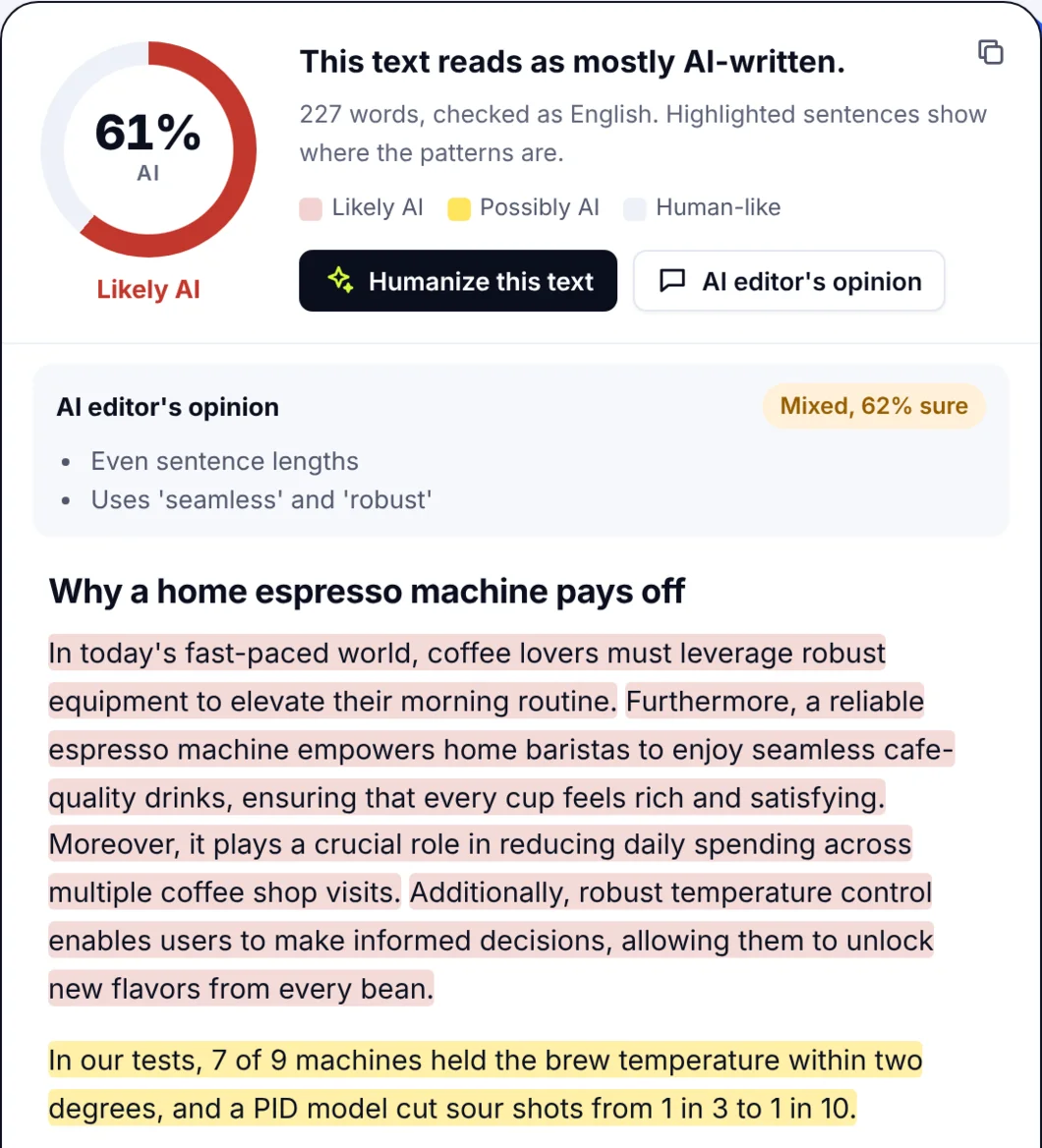
Our free AI detector checks up to 1,000 words at a time, five times an hour, with no sign-up. It shows an overall AI probability and highlights the passages that read most like AI, so you know what to review. A free SerpPal account adds monthly AI checks, and paid plans check any length.
2. GPTZero
GPTZero is one of the best-known AI detection tools in education, with highlighted results, a free plan and paid plans for teachers and schools.
3. QuillBot AI detector
QuillBot shares a parent company with Scribbr, and its AI detector works in a similar way and also identifies AI-refined text. It's convenient if you already use QuillBot for paraphrasing, grammar or editing, and QuillBot's free tools cover a lot for students.
4. Copyleaks, Originality.ai and Winston AI
Copyleaks combines AI detection and plagiarism scanning for schools and businesses. Originality.ai targets publishers with pay-as-you-go credits. Winston AI aims at educators and can read text from scanned documents.
5. Turnitin
Turnitin is what many schools use, but students usually can't run their own checks; it's available through the institution. See our guide to what AI detector teachers use.
How to test an AI detector yourself
Before you trust any detector, run a simple testing methodology of your own. It takes ten minutes and gives you better insights than any review:
- Human sample: paste an essay you wrote before AI writing tools existed. A good tool should score it low.
- AI sample: ask ChatGPT for a short essay on the same topic and check the generated, unedited AI-generated text. This is where tools usually show high accuracy.
- Edited sample: lightly edit the AI-generated text and check it again. This shows how the tool handles AI-assisted and AI-generated content after editing.
- Compare: run all three through two or three detectors and note the scores and false positives.
If one tool flags your human sample, its results on your real submission deserve extra caution.
Checking your text: how to choose an AI checker
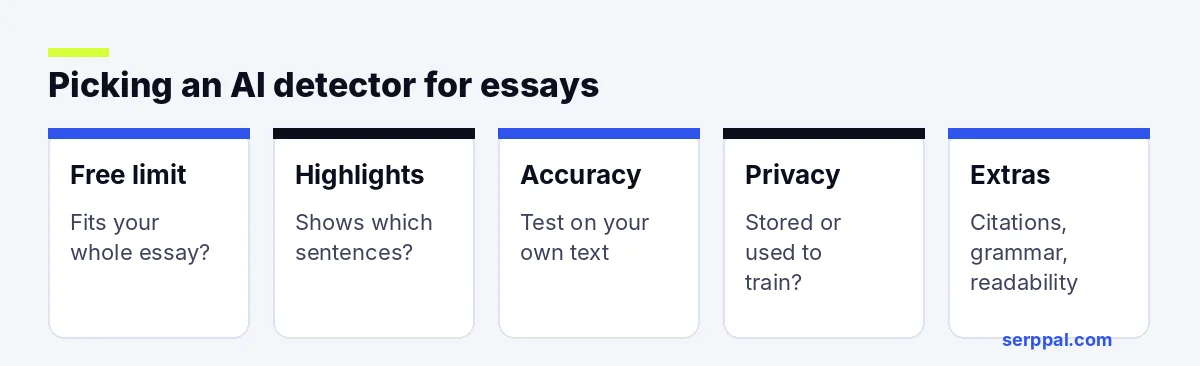
- Check the free limit. Will it handle your whole essay of 500 words or more, or only part of it?
- Look for detailed results. Highlighted passages tell you what to review; a single percentage doesn't.
- Test it on your own writing. Paste human-written text you wrote before AI tools existed. If it scores high, treat that tool's results with care.
- Read the privacy policy. Find out whether your text is stored or used for training.
- Consider extras. Proofreading, citations or a readability check in the same place saves time.
Scribbr AI humanizer and other humanizers
Several writing platforms now offer an AI Humanizer that adjusts AI text so it reads more naturally. That can help with marketing or blog content. In school, the rules differ: if your course doesn't allow AI-generated text, making it harder to detect doesn't make it allowed. Follow your academic integrity policy and disclose AI use when required. For other writing, such as blog posts, you can humanize AI drafts with SerpPal's AI humanizer, which makes them read naturally while keeping facts intact.
Don't submit your assignments before you do this
- Run your text through an AI checker and review the highlighted passages, especially generic or repetitive ones.
- Check grammar and citations in your required styles, such as APA or MLA, verify every source, and run a plagiarism check if your school offers one.
- Keep evidence: version history, notes and outlines, so you can accurately show how your work developed.
- Get feedback from a teacher or writing center if anything is unclear.
Premium tools add more insights, but the basics above matter more than any premium feature. If a detector flags your own work, read our guide on what to do if you're flagged as AI.
Final verdict: is the Scribbr AI detector worth using?
For students who want a quick, free check inside a familiar academic toolkit, yes. Its AI-refined category is a helpful touch. But it has the same weaknesses as every detector, so treat its percentage and score as one signal. For a second opinion, use a free alternative with detailed, passage-level results, and rely on your drafts and sources as the real proof of authorship.
Your questions, answered (FAQ)
Is the Scribbr AI detector free?
Scribbr free checks are available with a word cap, and a Premium version handles longer texts. Check Scribbr's site for the current plans.
Is Scribbr's AI detector accurate?
It's reasonably accurate on unedited AI text, but no detector is fully reliable. Short texts, AI-refined drafts and formal human writing can be misjudged.
What is the best free alternative to the Scribbr AI detector?
For free checks with highlighted results, SerpPal's AI detector and GPTZero's free plan are good starting points. Using two tools gives a fuller picture.
Do teachers use the Scribbr AI detector?
Some do for quick checks, but most schools rely on tools built into their learning platform, usually Turnitin, plus drafts, writing history and a student's usual voice.