On this page
- Do medical schools check application essays for AI?
- How AI detection works on application essays
- What admissions officers actually look for
- Using artificial intelligence responsibly in medical school applications
- AI detectors on research papers and other personal statements
- How to protect your application
- FAQs
Some medical schools may run application essays through an AI detector, but most admissions committees rely on readers, not software. They compare your personal statement and secondary essays with your activities, letters, MCAT and GPA, and interviews, and they notice when an essay sounds generic. AI detectors themselves are least reliable on short, polished, formal writing, which is exactly what med school essays and research papers are.
This guide covers what med school applicants need to know: how medical school admissions handle AI, how AI detection works on application essays and research papers, why human writing gets flagged, and how to use AI tools without putting your application at risk.
Key takeaways
- Few medical schools say publicly whether they use AI detection tools. Assume your essays may be screened, and assume they will be read closely either way.
- Admissions committees (adcoms) read holistically. Authenticity and specific detail matter more than any detector score.
- AI detectors give a probability, not proof, and they are unreliable on formal, heavily edited writing.
- Policies vary. Check each school's instructions on AI use in secondaries, and never submit AI-generated essays as your own.
- Keep drafts and version history for every essay. They're your best evidence if your writing is questioned.
Do medical schools check application essays for AI?
Medical school applications in the US run through a few central services: AMCAS for MD programs (from the AAMC, the Association of American Medical Colleges), AACOMAS for DO programs, and TMDSAS for public medical schools in Texas. Physician assistant programs use CASPA. Each one asks applicants to certify that the application is their own work and accurate.
Whether a school also runs essays through screening or detection software to detect AI is usually not disclosed, and the application process doesn't tell you either. What is clear:
- Readers come first. In the admissions process, adcoms read the main essay, activity descriptions and secondary responses together, and look for a consistent voice and story.
- Secondary instructions matter. Some schools now say in their secondary application instructions whether AI tools may be used and how.
- Interviews test the story. An essay that doesn't match how you talk about your clinical work in an interview raises more concern than a software score.
Med school admissions officers know AI detection is imperfect and inconsistent across tools, and that the technology evolves faster than any policy. Schools deploying detectors usually treat them as one input for human screeners, not a verdict. A high score is more likely to prompt a closer read than an automatic rejection, but an essay that reads as AI-generated can hurt you even without a detector.
How long are med school essays?
| Application | Personal statement limit |
|---|---|
| AMCAS (MD) | 5,300 characters including spaces |
| AACOMAS (DO) | 5,300 characters including spaces |
| TMDSAS (Texas) | 5,000 characters including spaces |
| CASPA (PA programs) | 5,000 characters including spaces |
Secondary essays are set by each school and are often 100 to 500 words. Short essays are hard for any detector to judge reliably.
How AI detection works on application essays
AI detectors are machine learning models trained on large sets of human-written and AI-generated text, including output from ChatGPT, Claude and Gemini. They look for patterns AI-generated content tends to have, such as predictable word choices and an even rhythm, and return a probability that the text was generated.
Med school essays are a hard case for detection:
- They're short. A 5,300-character personal statement is roughly 800 to 900 words; secondaries are shorter. Less text means less reliable scores.
- They're heavily edited. Multiple rounds of review by advisors make prose smoother and more uniform, which can look AI-like.
- They cover common themes. Shadowing, volunteering, a patient encounter, a research project. Thousands of applicants write about similar moments in the same admissions cycle.
- Writers vary. Studies have found that some detectors flag writing by non-native English speakers more often.
An independent study of 14 detection tools found none of them fully accurate or reliable. Our guide to how AI detectors work goes deeper.
The grammar tool problem
Grammar and style tools now use AI models to suggest whole sentences, not just fix commas. Accept too many of those suggestions and your sentence structures and phrasing drift toward the same patterns AI detection systems look for. Use grammar tools to fix errors, but refine the language yourself, so the essay keeps your unique voice. Admissions readers and admissions officers notice when every sentence sounds equally smooth, or when stock phrases and em dashes appear in every line. They analyze the whole file, and they employ judgment no tool has.
What admissions officers actually look for
Adcoms use holistic review: your essays are read alongside your activities, letters of recommendation, MCAT and GPA. Essays that stand out share a few qualities:
- Authenticity. Your own voice, your own reasons, your own reflection. Authenticity is the quality adcoms mention most.
- Specificity. Real patients, real moments, real decisions, not general statements about wanting to help people. Specific narratives are hard to generate and easy to believe.
- Consistency. The story in your personal statement matches your experiences section, your letters and your interview.
- Insight. Evidence that you understand what medicine involves and what you learned along the way, and that you have the competencies schools look for, such as empathy, teamwork and resilience.
Essays written by AI tend to fail on exactly these points, and admissions officers see enough of them to notice. They sound polished but generic, and they can't contain the details only you know. That's a bigger risk to your admissions chances than any detector.
Using artificial intelligence responsibly in medical school applications
ChatGPT and other chatbots can help, but medical school admissions decision-making rests on trust: everything you submit is presented as your own. The same rule holds in college admissions and graduate admissions, and admissions offices increasingly say so in writing.
Many applicants use AI tools for parts of the process. Uses that are usually acceptable, if a school's policies allow them:
- Brainstorming ideas and questions to reflect on.
- Getting comments on clarity and structure of a draft you wrote.
- Checking grammar and punctuation, the way plagiarism and grammar checkers have always been used.
Uses that put you at risk:
- Having an AI write all or part of your personal statement or secondaries.
- Pasting generative AI output and editing lightly so it "sounds like you."
- Using AI to invent or exaggerate what you did.
- Running AI text through a humanizer to bypass detection. It may change the score, but it doesn't make the essay yours, and the content is still generic.
When in doubt, follow the strictest instruction you've seen from any school you're applying to, and write every sentence yourself. Shortcuts that save an hour can cost an admissions cycle. Applicants who use AI ethically, for feedback and not for content, have nothing to hide if their essays face extra scrutiny. If you've used AI for comments, make sure every final sentence is yours.
AI detectors on research papers and other personal statements
The same issues apply beyond medical school. Universities often run papers through Turnitin's AI writing report, and instructors may use other detection tools; our guide to what AI detector colleges use covers them. Academic journals generally require authors to disclose AI use beyond basic language editing and don't allow AI tools to be listed as authors. Law schools and graduate programs increasingly ask applicants to certify that statements are their own.
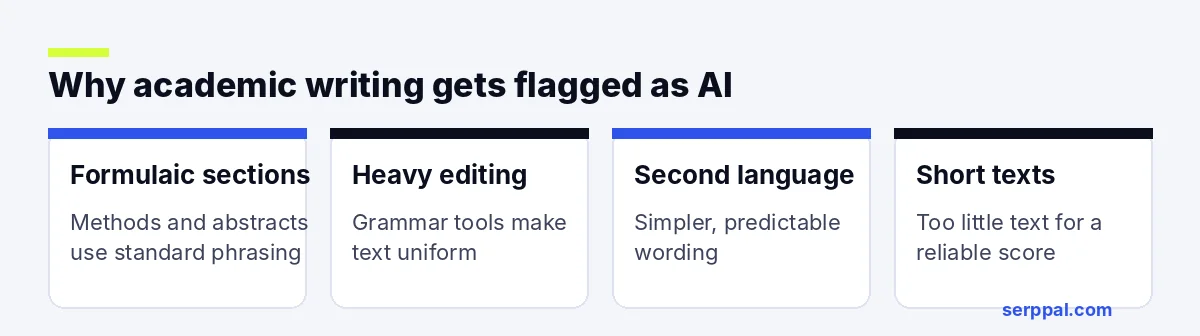
Research papers get flagged for the same reasons med school essays do: formulaic methods sections, technical vocabulary and heavy editing.
How to protect your application
- Write in a tool with version history, like Google Docs or Word with autosave, so your drafting process is visible.
- Keep notes and drafts for every essay, including comments from mentors.
- Follow each school's policies on AI and disclose any permitted use the way they ask. That's the simplest way to ensure authenticity and write authentically.
- Avoid plagiarism. Quote and credit anything you borrow, even in a personal essay. Plagiarism checkers and AI screening often run side by side, and originality matters to both.
- Check your own text. Running a draft through a free AI detector shows which sentences read as generic; those are usually the parts that need your own detail anyway.
- Know what to do if flagged. Stay calm, share your drafts and explain your process. Our guide to what to do if you're flagged as AI walks through it.
FAQs
Do medical schools use AI detectors on application essays?
Some may, but few disclose it. Most adcoms rely on careful human reading and compare your essays with the rest of your application and your interview. Write your own essays and assume they'll be read closely.
Can AI detectors tell if ChatGPT wrote my personal statement?
They can flag text that looks AI-generated, and some tools try to detect AI from ChatGPT specifically, but none can accurately identify the source of every sentence or prove it, especially on short, heavily edited essays. Readers often spot generic AI writing without any software.
Is it allowed to use AI for med school essays?
It depends on the school. Many allow brainstorming or grammar help; few allow AI-written content. Check each school's secondary instructions and the application service's certification.
Why was my original essay flagged as AI?
Formal, polished human writing on common themes resembles AI-generated content to a detector. Heavy editing, short length and writing in a second language also raise false positive rates. Share your drafts and explain your process.
Do AI detectors work on research papers?
Partly. They can flag passages, but checkers misjudge formulaic academic writing. Journals and universities treat a detector score as one signal, alongside reviewers' judgment.