On this page
What AI detector do colleges use? Most rely on Turnitin's AI detection, because it's built into the plagiarism checker they already run through their learning management system. Some schools and individual professors also use GPTZero, Copyleaks or Winston AI, and a few have turned AI detection off entirely because it can flag human writing.
Admissions offices are a different story. Few say publicly which AI detector they use, if any; most rely on trained readers, the rest of your application and, in some cases, an AI checker as one signal among many. This guide covers the best-known AI tools universities use, how they detect AI, how admissions and scholarship committees handle AI, and what to do if your own writing gets flagged.
Key takeaways
- Turnitin is the most common AI detector in higher education, because its AI report sits inside the same assignment workflow as its plagiarism detection.
- GPTZero, Copyleaks and Winston AI are the other names educators use most, often by pasting or uploading text themselves.
- No AI detector is proof. Every tool sometimes flags human writing, and most schools tell faculty to treat a score as a reason to talk, not a verdict.
- College admissions offices rarely disclose their tools. Many read for voice and consistency instead of relying on software, and the Common App treats submitting AI-generated content as your own as a policy violation.
- The safest approach is simple: write your own work, keep your notes, and check your school's AI policy.
The best AI detector for essays: what colleges use
Here's a quick comparison of the tools that come up most often in higher education. There's no single best AI detector for every school; reliability and integration with existing systems drive the choice more than marketing.
| Tool | How schools use it | Pros | Cons |
|---|---|---|---|
| Turnitin | Built into assignment submissions through the LMS | Already licensed by many schools, combines AI and plagiarism checks | Students usually can't run their own work through it |
| GPTZero | Professors paste or upload papers, some schools license it | Easy to use, sentence-level highlights, batch scanning | Scores vary on short or heavily edited text |
| Copyleaks | Institutional licenses and LMS integrations | Covers many languages, AI and plagiarism detection in one tool | Setup depends on the school's systems |
| Winston AI | Individual educators and some departments | Clear reports, can scan uploaded documents | Less common as a campus-wide tool |
Turnitin: built into assignment workflows
Turnitin has been the standard plagiarism checker in universities for years. Its AI writing detection was added to the same report, so when you submit an essay through Canvas, Blackboard, Moodle or another learning management system, your instructor may see an AI score next to the similarity score without doing anything extra.
That's why Turnitin is the answer for most schools: they didn't choose a new AI detector, they switched on a feature in a tool they already paid for. The report highlights passages the model thinks are likely AI-generated text and gives an overall percentage. Because it sits next to the originality report, instructors get both insights in one place, and the integration with the LMS means no extra tasks for faculty.
Pros: no extra step for faculty, one report for plagiarism and AI content, a top AI tool by adoption, and it works at the scale of a whole university. Cons: it's only available to institutions, so students can't usually test a draft first, and like every detector it can flag human-written content.
GPTZero: popular with individual professors
GPTZero became well known as one of the first free AI checkers aimed at educators. Professors can paste text or upload files (PDF and Word are common formats), see which sentences look AI-written, and scan a batch of submissions at once. Some schools license it for faculty.
Pros: easy to use, sentence-level highlights and a free tier for small checks. Cons: like all detectors, its results are less reliable on short pieces, mixed human and AI text, and writing by non-native English speakers.
Originality.ai: built for publishers more than students
Originality.ai is a popular AI content detector (the originality ai name comes from its plagiarism roots) aimed mainly at publishers, agencies and website owners who check content at scale. Some educators use it, but it's less common as a campus tool. Pros: it combines AI, plagiarism and fact-checking features with high accuracy claims for long-form content. Cons: it's a paid tool built around web AI content workflows rather than student submissions, so it's powerful for businesses but less suited to students.
Other free AI checkers students use
Students often test their own work in free tools such as ZeroGPT, Scribbr's AI detector, Sapling, Smodin or Crossplag, and the Chrome extensions some of them offer. These text detection tools are user-friendly and can help you identify passages that read as AI-generated, and most have a limit such as 500 characters minimum or a word cap on free scans, but they aren't what your school uses, and their scores won't match Turnitin's.
Copyleaks and Winston AI: AI content checks for schools
Copyleaks offers AI and plagiarism detection together and integrates with several learning platforms, which is why some universities license it instead of, or alongside, Turnitin. It supports many languages, which matters for international programs.
Winston AI is used more by individual educators than by whole campuses. It scans uploaded documents and images of text, and gives a readable report.
Pros of both: clear reports and support for document upload. Cons of both: they're less often the official campus tool, so results may be one professor's check rather than a formal process.
Understanding the technical side of AI essay detection
How AI detection tools work
AI detectors analyze patterns in text. AI detection tools work by comparing your text with what they learned from a large dataset of human and AI-written content. AI models like ChatGPT (from OpenAI, from GPT-3 and GPT-3.5 to GPT-4 and GPT-4o), Claude or Gemini tend to produce text with predictable word choices and an even rhythm, and generative text often has a uniform sentence structure and familiar phrases. Industry write-ups describe measures like perplexity and burstiness; in practice, each vendor's model analyzes vocabulary and rhythm in its own way, then scores the text. Vendors refine their language models as new AI writing tools appear, so content detection results for the same text can change over time, and the way one tool analyzes a paragraph won't match another. The output is a probability about authorship, not a fact. Whatever the AI content detector, the result means only this: "this text looks like the AI text in our training data."
That's why accuracy has limits. A detector can flag a human essay that happens to be very polished or formulaic (a false positive), and miss AI text that has been edited (a false negative). An independent study of 14 detection tools found none of them fully accurate or reliable. Our guide to how AI detectors work explains the details.
How professors identify AI-generated work without tools
Many instructors rely as much on reading as on software. Finding AI text by hand usually comes down to a few clues: a sudden change in style from a student's earlier work, sources that don't exist or don't say what the essay claims, generic examples, and an argument the student can't explain in conversation. In-class writing and short oral check-ins help educators compare. These strategies don't need a detector at all, and they're often clearer evidence than a score.
Why some universities turned off AI detection tools
Because of wrong flags and the risk of accusing students unfairly, several universities chose not to enable Turnitin's AI detection when it launched, Vanderbilt among them, and others tell faculty never to use a score as the only evidence. Many academic integrity policies now say an AI flag should start a conversation with the student, not end in a penalty.
Do college admissions check for AI?
Some do, and most don't say exactly how. Admissions offices read thousands of applications, and what they look for is consistency: does the personal statement sound like the same person as the short answers, the activities list and the teacher recommendations?
Admissions officers care about authenticity: they want to hear the applicant, not a chatbot. Here's what's generally true about college admissions and AI:
- Policies exist. The Common App's fraud policy covers submitting the substantive content or output of an AI platform as your own work. Many schools add their own guidance on AI in applications.
- Tools are one signal. Some offices run personal statements through an AI content detector, but they know scores aren't proof. A high score is more likely to prompt a closer read than an automatic rejection.
- Human readers notice. Admissions readers are good at spotting generic, polished text with no specific details. AI text tends to sound like everyone; a strong college essay sounds like one person.
- Interviews and writing samples. Some schools compare the essay with a timed writing sample, an interview or a graded paper.
Do scholarships check for AI?
Some scholarship committees use AI detection tools, especially large national programs that receive many applications. Others rely on interviews and readers. Check the scholarship's rules: many now state whether AI help is allowed, and breaking the rule can disqualify you.
When the detector is wrong: handling false positives
Being flagged doesn't mean you'll be punished. Stay calm and show your process:
- Ask what tool was used and what it flagged. Request the report so you can see the highlighted passages.
- Share your drafts. These show the authenticity of your work. Version history in Google Docs or Word, notes, outlines and sources show how the essay developed. Keep them for every important assignment.
- Explain your writing. Talk through your argument and how you found your sources. Knowing your own work is strong evidence.
- Point to the limits. Detectors make mistakes, and most schools' own guidance says a score isn't proof.
- Follow the formal process. If it goes further, use your school's academic integrity process and ask an advisor for help.
Our guide to what to do if you're flagged as AI covers this in more detail.
Academic honesty: how students can use AI tools responsibly
Many universities now allow some use of AI writing tools, such as brainstorming, outlining or checking grammar, as long as you disclose it and the final work is yours. The rules vary by school, by course and sometimes by assignment, so read the syllabus and ask if it's unclear. Academic integrity policies are mostly about transparency: misuse means hiding AI work, not using a good AI tool openly for permitted tasks.
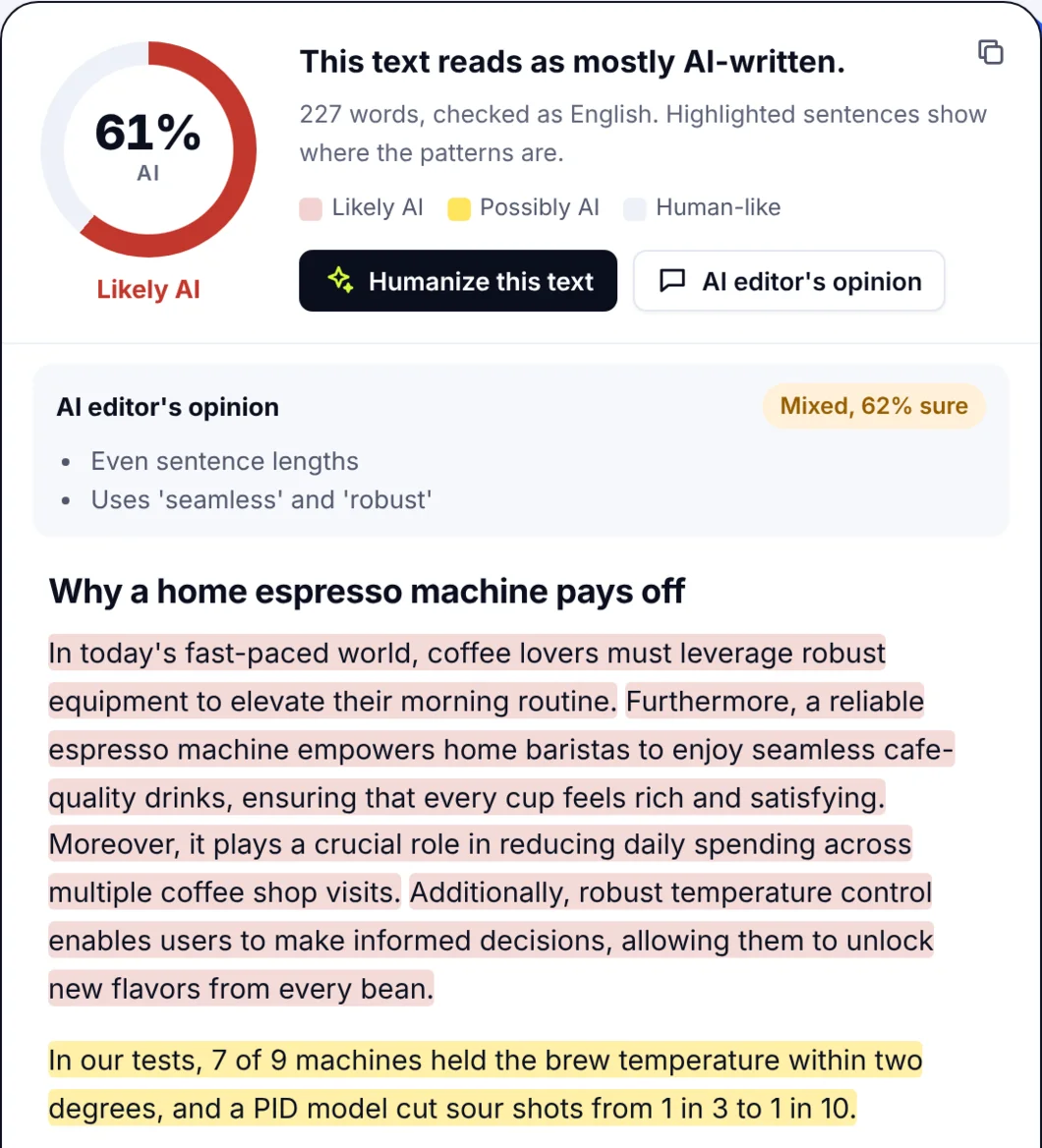
Before you submit, you can run your own text through a free AI detector to see whether any passages read like AI-generated text, the same way you'd check for typos. SerpPal's checker highlights the sentences that look most AI-like, which often turn out to be the generic parts that need your own examples anyway. It's a self-check for AI content, not a way around your school's rules or academic honesty policies: the best protection is writing your own work and keeping your version history. Treat the best AI checkers as a mirror, not a judge: if your own writing looks like AI-generated work, it's usually because it needs more of you in it.
FAQ
What is the most common AI detector in college?
Turnitin, because its AI detection is part of the plagiarism detection many schools already license and connect to their learning management system. GPTZero, Copyleaks and Winston AI are also used, often by individual professors.
Can professors tell if you used ChatGPT?
Sometimes. Detectors can flag AI-generated text, and professors notice when an essay doesn't match a student's earlier work or in-class writing. But no tool is certain, which is why most schools combine a detector score with a conversation and the student's notes.
Do colleges check application essays for AI?
Some admissions offices use AI detectors, and many rely on readers who compare the essay with the rest of the application. The Common App treats submitting AI-generated content as your own as a violation of its policy, so write your personal statement yourself.
Are AI detectors accurate?
They're useful but not reliable enough to prove anything on their own. All AI detection tools make mistakes, especially on short texts, formulaic writing and work by non-native English speakers. That's why their scores should be one piece of evidence, never the only one.
Can I check my essay before I submit it?
Yes. Turnitin usually isn't available to students, but free AI checkers let you scan your text and see which sentences look AI-written. Use the result to identify generic passages, analyze why they read as generated text, and make them more specific, and keep your drafts as proof of your writing process.