On this page
- The direct answer: what SEO for AI is called
- GEO vs AEO vs LLMO vs AI SEO: side by side
- Three types of AI engines: training-based, hybrid and real-time
- How GEO and AEO differ from traditional SEO
- The work is the same no matter the name
- How to measure AI visibility
- Future-proof visibility: which term should you use?
- Frequently asked questions
What is SEO for AI called? Most often GEO, for Generative Engine Optimization: the practice of getting your content included and cited in answers generated by AI systems such as Google AI Overviews, ChatGPT, Perplexity, Gemini and Copilot. You will also see AEO (Answer Engine Optimization), LLMO or LLM SEO (Large Language Model Optimization), AIO, and the plain-English labels AI SEO and AI search optimization. There is no agreed standard; the terms overlap heavily and describe the same underlying work, visibility in generative AI search experiences, with different emphasis. Google's own early name for its version, SGE (Search Generative Experience), has already been retired in favor of AI Overviews, which tells you how fast the vocabulary moves.
This guide defines each term, compares them in one table, explains how they differ from traditional SEO and why none of them replaces it, and ends with the tactics they share and how to measure whether any of it is working. If you want the longer comparison with traditional search, read AI SEO vs traditional SEO next; if you want to check your own visibility, SerpPal's AI visibility check asks the main assistants about your keyword and reports who they name.
Key takeaways
- GEO is the most common name. AEO, LLMO, AIO and AI SEO are used for the same goal with different emphasis.
- The goal is to be included, cited or recommended in AI-generated responses, not only to rank in a list of links.
- None of the terms replaces traditional SEO. Crawlable pages, useful content and authority still decide what AI engines can use.
- The shared strategies: direct answers, factual and citable statements, clear formatting, schema markup where it fits, consistent brand mentions, and third-party sources that are easy to verify.
- Measure with a fixed set of prompts over time, not one lucky answer.
The direct answer: what SEO for AI is called
The plain-English name is AI search optimization or AI SEO: making your content visible in AI-powered search and answer experiences. The most used acronym is GEO. Agencies, tool vendors and writers pick different labels for the same service, so the acronym tells you less than the brief: which platforms, which queries, which outcome.
The terminology confusion in AI search optimization
The confusion has a simple cause. Search behavior changed faster than the vocabulary, and several groups named the same thing at once: academics (GEO, from a 2023 paper), featured-snippet marketers (AEO, from years earlier), LLM practitioners (LLMO, LLM SEO), and agencies that wanted a service name a client would understand (AI SEO, AIO). When you read a proposal or a job description, translate every acronym back to "visibility in AI-generated answers" and ask what is actually included.
GEO vs AEO vs LLMO vs AI SEO: side by side
| Term | Stands for | Main focus | Typical use |
|---|---|---|---|
| GEO | Generative Engine Optimization | Being included or cited in generative search responses | Academic papers, SEO tools, agencies |
| AEO | Answer Engine Optimization | Being the direct answer: featured snippets, voice search, AI answers | Snippet-era marketers, FAQ-driven sites |
| LLMO / LLM SEO | Large Language Model Optimization | How language models understand, retrieve and mention a brand or topic | Practitioners focused on ChatGPT, Claude, Gemini |
| AIO | AI Optimization | Ambiguous umbrella; sometimes the same as AI SEO, sometimes other AI services | Agency packaging |
| AI SEO / AI search optimization | Plain-language label | Visibility across AI-powered search and answers | Business owners, job titles |
They are labels for overlapping goals, not four disciplines with separate playbooks. A single well-made page serves all of them.
GEO: Generative Engine Optimization
GEO is work intended to make your content more likely to be used and cited when a generative engine writes an answer. The term comes from a 2023 research paper, GEO: Generative Engine Optimization, which tested changes to web content and measured how often generative engines surfaced it; adding citations, quotations and statistics helped, keyword stuffing did not. In practice GEO means clear, well-supported statements, named authoritative sources, consistent brand facts, and structure a system can interpret. A citation builds awareness; it does not guarantee a visit.
AEO: Answer Engine Optimization
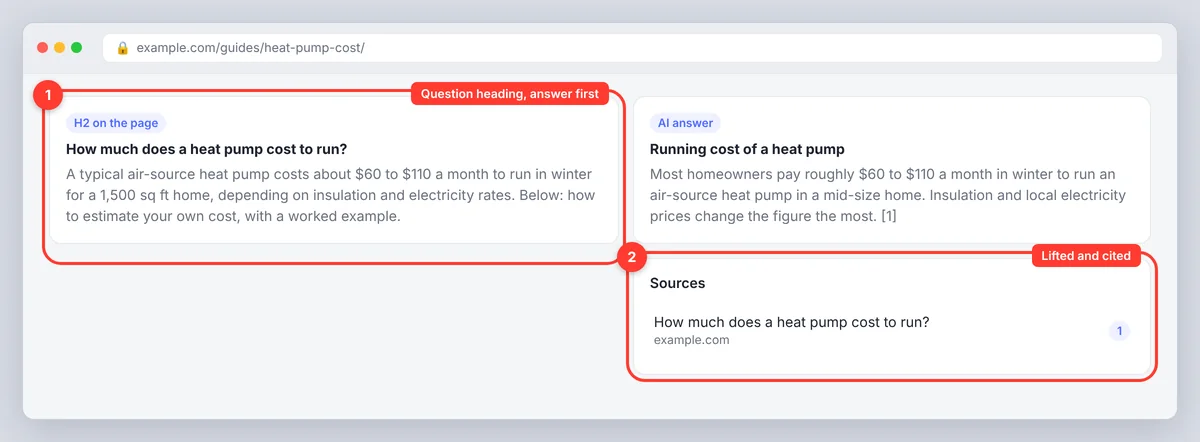
AEO predates generative AI. It grew out of featured snippets and voice assistants: structure a page so a system can lift a direct answer to a direct question. Question heading, one-paragraph answer, then the detail. The same structure now feeds AI responses to conversational user queries, which is why AEO and GEO advice reads alike.
LLMO and LLM SEO
LLMO describes work aimed at how large language models understand, retrieve and talk about a brand or topic: consistent facts across the web, authoritative sources (a Wikipedia entry, industry publications, reviews) that mention you, and pages a retrieval system can find and quote. The part you cannot control is the AI models' training data; the part you can is everything a model with web access pulls in at answer time, which is where almost all of the practical work sits.
AI SEO, AIO and AI search optimization
These are the broad, plain labels. AI SEO is also used to mean "using AI tools to do SEO work", so check which sense a writer intends. It is the least precise label of the set; if someone sells you it, ask them to name the platforms and the metric.
Are GEO and AEO the same?
Nearly, in day-to-day practice. AEO centers on providing the direct answer; GEO centers on being the source a generative engine includes or cites, which also involves brand presence beyond your own site. A clear FAQ answer serves both. Most teams use the terms interchangeably, and nothing is lost by doing so as long as the brief names the platforms and the outcome.
Three types of AI engines: training-based, hybrid and real-time
Understanding what the engine does with your content explains why the tactics work.
- Training-based. A model answers from what it learned in training, with no live search. You influence it only through the broad web footprint it was trained on: consistent, widely repeated facts about your brand.
- Hybrid. The model has training knowledge plus a search tool it uses for some queries (most ChatGPT, Claude and Gemini modes, and Bing-backed AI chatbots). Fresh, crawlable pages matter for the queries that trigger a search.
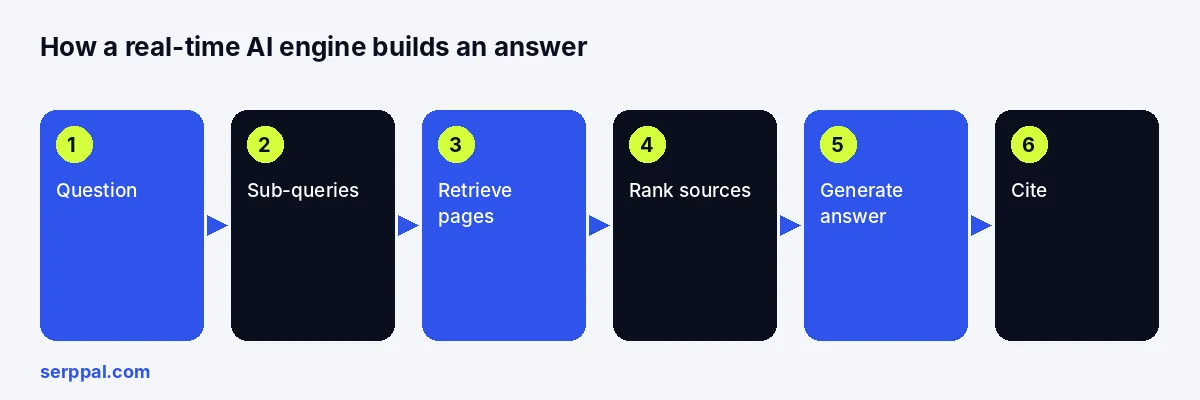
- Real-time. The engine searches first and generates from the results (Perplexity, Google AI Overviews and AI Mode, Copilot in search). Here ranking in the underlying search index is a near prerequisite, and the page must state its facts clearly enough to be quoted. Discoverability comes first, relevance second, clarity third.
How GEO and AEO differ from traditional SEO
Traditional SEO aims for search rankings and a click-through. AI search optimization aims for inclusion, citation or recommendation in a generated response, where the person may never visit your site. That changes the output and the measurement (brand visibility and AI citation counts next to organic traffic); it does not change the inputs much. Relevance, authority signals and technical SEO are the ranking signals for both. Search engines and AI engines still need to discover and understand pages, and people still click through when they want detail, evidence or a transaction.
Does AI SEO replace traditional SEO?
No. Google has said, in its guide to AI features and your website, that AI Overviews and AI Mode use its core ranking systems and that pages must be indexed and eligible for search to appear; there is no special markup or submission. Real-time engines cite what already ranks; hybrid engines retrieve what search can find. Technical health, useful content, the ability of search engines to crawl the site, and expertise remain the foundation, and the AI layer sits on top of it. Traditional search and AI-driven search read the same signals.
Where AI search optimization applies
ChatGPT, Gemini, Claude, Perplexity, Microsoft Copilot and Bing Copilot, and Google AI Overviews and AI Mode. Each gathers and presents information differently, and features change often. Choose the platforms your customers use rather than all of them: a B2B software buyer may ask ChatGPT and read AI Overviews, a researcher may live in Perplexity.
The work is the same no matter the name
How to optimize content for AI search engines
- Answer the question in the first two sentences under each heading, then add evidence.
- State citable facts: a number with its source, a definition, a step. Vague claims are paraphrased away; specific ones get quoted.
- Structure content for AI understanding: descriptive headings, concise sections that stand alone, lists and tables where they fit, so a sub-answer can be extracted without the rest of the page. Structuring content this way also improves accessibility for readers.
- Show who wrote and reviewed it and link claims to reputable sources.
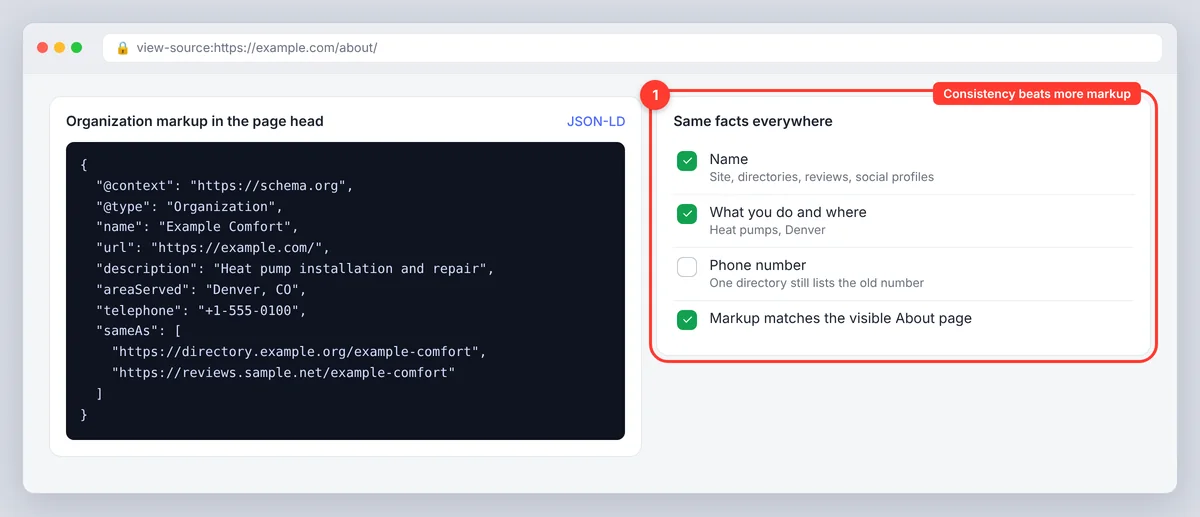
- Keep brand facts consistent everywhere: name, what you do, where, prices, policies.
- Use structured data (JSON-LD schema markup for Article, FAQ, Product, Organization) when it describes visible content. Schema helps search engines understand the page; FAQ schema does not buy a citation, and no schema is read as a ranking factor by AI engines.
Citable resource creation
The pages most often referenced in AI responses are the ones that add something: original data, a tested comparison, a definition clearer than the others, a checklist that is actually complete. If you have limited time, prioritize one citable resource over ten thin pages. The GEO paper's finding that statistics, quotations and citations raised visibility is the research version of the same point.
Establish brand authority with your content and beyond it
Influencing AI moved the emphasis from keyword optimization to brand authority. AI models build their picture of a brand from text across the web, so unlinked brand mentions in credible third-party publications, directories, forums and reviews count alongside backlinks as authority signals. Earn them by publishing things worth referring to, and make sure your own site stays the source of truth for product details and expertise.
Research and analysis: understanding AI-generated responses
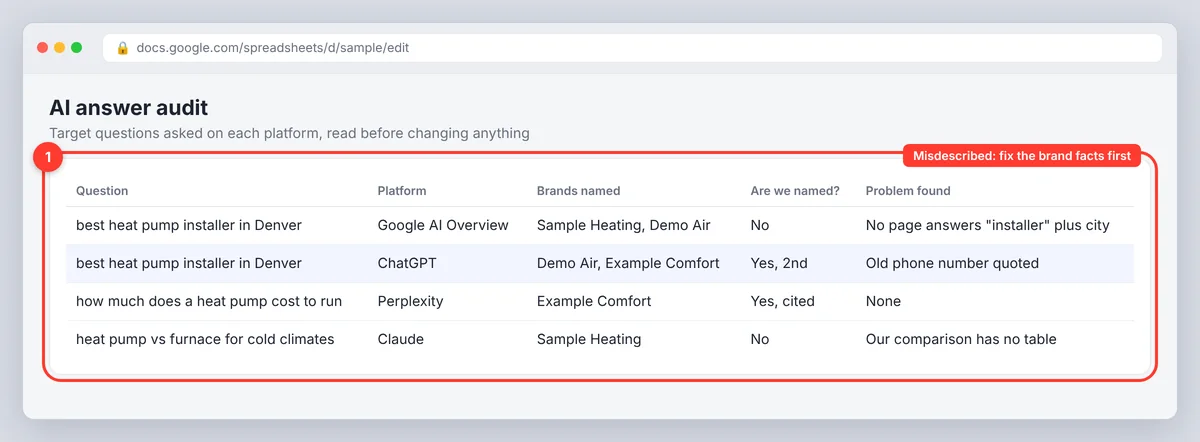
Before changing anything, ask the engines your target questions and read the answers. Who is named? Which facts are quoted? Where are you misdescribed? That audit tells you which pages need clearer answers, which brand facts are inconsistent, and where the gaps are; the insights usually point at two or three pages, not the whole site. Repeat it after the changes. Our guide to ranking in AI Overviews walks through the Google side in detail.
How to measure AI visibility
AI responses vary by query, platform, phrasing and time, so a single screenshot proves nothing. Track a fixed set:
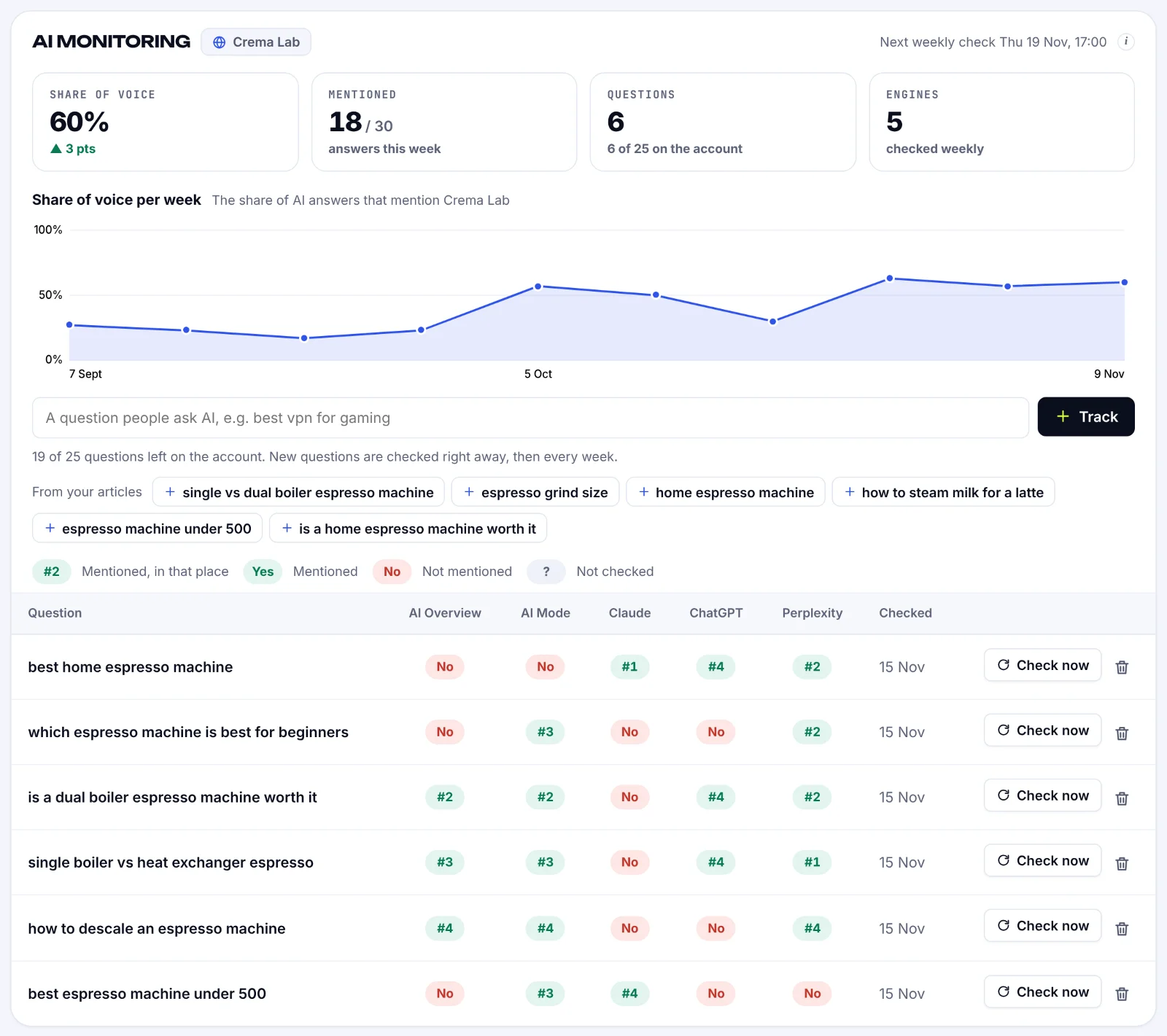
- Mentions and citations for a stable list of questions on the platforms that matter, recorded on a schedule. SerpPal's AI visibility check asks Google's AI Overview, ChatGPT and Claude about an article's keyword and reports whether you are mentioned and who is named instead; the AI Monitoring add-on repeats a set of questions weekly so you see the trend.
- Accuracy of what the engines say about you: product details, service areas, claims.
- Google's own data, where you have it. Since mid-2026 Google has been rolling out a Generative AI performance report in Search Console to some properties. It shows impressions from AI Overviews and AI Mode by page, but not clicks.
- Referral traffic from AI platforms where analytics can identify the source, plus branded search volume as a proxy for people who heard about you in an answer.
- Conversions, because a citation that never becomes an inquiry is a vanity metric.
Future-proof visibility: which term should you use?
Use AI search optimization when you need an umbrella term a non-specialist understands. Use GEO when the brief is specifically about citations in generative answers. Use AEO when the job is direct answers and snippets. Define LLMO only if your audience needs the model-specific distinction. In any proposal, name the platforms, the questions and the metric ("be cited for these 20 questions in AI Overviews and ChatGPT, checked monthly") rather than the acronym, because the acronym will have changed again by the time the work pays off and the fundamentals will not.
Frequently asked questions
What do you call SEO but for AI?
GEO (Generative Engine Optimization) is the most common name. AEO (Answer Engine Optimization), LLMO (Large Language Model Optimization), AIO and AI SEO are also used; AI search optimization is the clearest plain-English label. None is a formal standard.
What does GEO mean in SEO?
Generative Engine Optimization: improving the chance that your content is included or cited when an AI system generates an answer. The term comes from a 2023 research paper and now covers the whole practice of optimizing for AI-generated responses.
Are AEO and GEO the same?
They overlap almost completely in practice. AEO focuses on being the direct answer to a question; GEO focuses on being a cited source in a generated response, which also involves your brand's presence across the web. Most teams use them interchangeably.
Is SEO dead because of AI?
No. AI engines that search in real time cite pages that already rank, and models with search tools use what search can find. AI changes where some answers appear and how you measure visibility; it does not remove the need for crawlable, useful, trustworthy pages.
What is the difference between SEO and GEO?
SEO targets rankings and clicks in search results. GEO targets inclusion and citations in AI-generated answers, where the person may not click at all. The strategies overlap too; GEO is optimizing the same pages for a second kind of reader. The inputs overlap (technical health, clear content, authority); the output and the measurement differ.