On this page
- Define traditional SEO and AI SEO
- Compare the approaches side by side: seven differences
- What has changed in search
- What remains foundational
- Explain GEO and AEO
- Optimize content for answers and citations: how AI SEO helps
- Build authority across the web
- Distinguish proven guidance from speculation
- Measure performance beyond rankings
- Actionable steps for the age of AI search
- A hybrid SEO strategy by business problem
- Conclusion
- Frequently asked questions
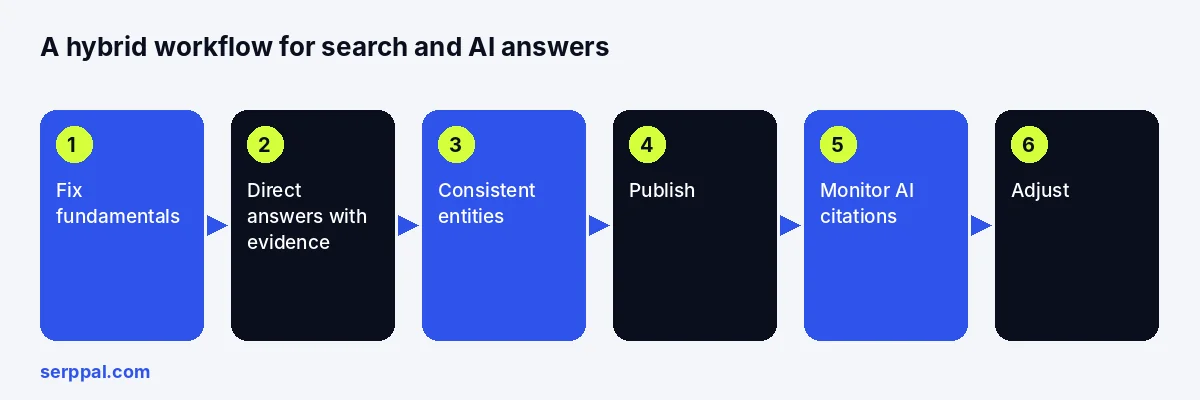
AI SEO vs traditional SEO is not a choice between two systems. Traditional SEO gets your content crawled, indexed and ranked in the list of blue links in traditional search results; AI SEO extends the same work so that AI engines (Google AI Overviews and AI Mode, ChatGPT, Perplexity, Claude, Gemini, Bing Copilot) understand your content, select it and credit it in generated answers. The foundations are shared. What changed is the output you are optimizing for, how people phrase what they want, and how you measure whether it worked.
The phrase "AI SEO" is used two ways: using AI tools to do SEO work faster, and optimizing for visibility in AI-generated answers. This guide is mostly about the second, with a section on the first, because confusing them is how teams end up with a thousand generated articles and no visibility in answers. Tools that cover both, such as SerpPal's content editor and AI visibility check, treat the two as one workflow: write for the SERP, then see whether the AI answers mention you.
Key takeaways
- Same foundation: crawlable content, useful information, technical SEO, links and trust still decide who is eligible to be ranked or credited.
- Different output: traditional SEO earns a ranking and a visit; AI SEO earns a citation or a name-check, often zero-click.
- Different queries: conversational, long-tail questions that AI systems break into sub-questions (query fan-out).
- Different metrics: rankings and traffic miss a growing share of search visibility; add AI referrals and branded search.
- Google's guidance: AI Overviews use the normal search systems; there is no special markup or submission. Most "AI SEO tactics" are unproven.
Define traditional SEO and AI SEO
Traditional SEO improves a site's visibility in conventional search results, where traditional ranking factors decide the order of ten blue links. The work is keyword targeting, content that answers the search intent, technical SEO (crawlers, indexing, speed, mobile), internal linking, meta tags and headers, and earning credible backlinks as authority signals. Traditional SEO focuses on a ranking, a click and organic traffic you can see in analytics.
AI SEO is work intended to make your brand and content appear in AI-generated answers and summaries. AI SEO focuses on being the trustworthy, authoritative source an LLM reaches for. It overlaps with two newer labels: GEO (Generative Engine Optimization) and AEO (Answer Engine Optimization). None of the three is about replacing traditional SEO; they add a layer about how LLMs and answer engines interpret, select and present information, and how you check whether they picked you.
Keyword stuffing vs semantic context: how SEO has changed
Twenty years ago a page ranked by repeating the keyword. Ten years ago it ranked by covering the topic better than the competition. Now the same page is also read by AI-driven systems that compress it into a two-sentence answer, so what matters is whether it contains a clear, well-supported statement a model can lift and attribute. Semantic context (entities, relationships, evidence) replaced density long before AI search; AI search just made the penalty for vagueness immediate.
Compare the approaches side by side: seven differences
| Area | Traditional SEO | AI SEO |
|---|---|---|
| Primary goal | Rank in results, earn the click | Be credited, named or recommended in the AI answer, as well as ranking |
| How people search | Short keywords, browsing a list | Conversational questions with context and follow-ups |
| What the content needs | Covers the topic and matches intent | Also states direct answers, evidence and definitions a system can extract |
| Signals | Crawlability, relevance, links, trust | The same, plus consistent entities in knowledge graphs, brand credibility and verifiable claims |
| Workflow | Research, write, fix technical issues, earn links | All of that, then check how AI platforms represent you and whether they cite your sources |
| Outcome measured | Rankings, clicks, traffic, conversions | Those plus AI referrals, branded search and answer appearances |
| Control | You shape the snippet; Google decides the display | You make facts easy to use; nobody can guarantee a citation |
The difference is the output, not a magic checklist. Content that ranks well and states its answers clearly is already most of the way to being credited; content built only for AI engines without the fundamentals is rarely eligible in the first place.
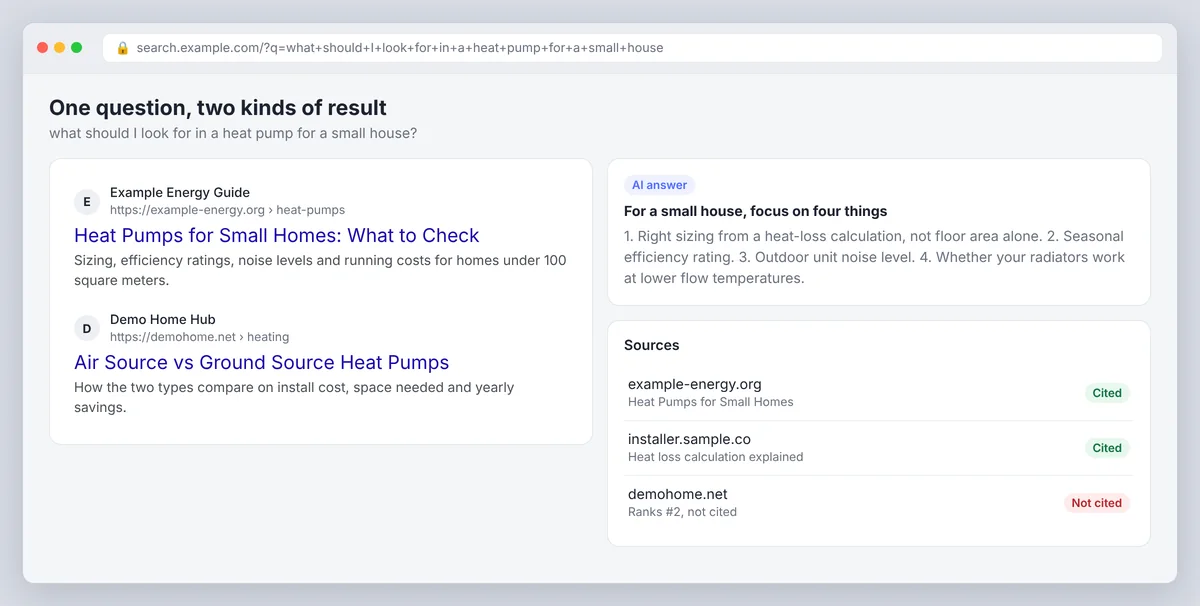
Top-ranking pages still influence AI results
Google's AI Overviews are built from its index and lean heavily on URLs that already rank for the query and its sub-queries. Independent analyses of AI answer sources regularly find that most credited URLs rank in the top results for a related search. Ranking first is not a guarantee of a citation, but not ranking is close to a guarantee of being left out by Google's systems. Other AI engines use their own search and retrieval, so the overlap is looser, but the pattern holds: what search engines trust is what models see.
What has changed in search
The rise of conversational and generative search
People ask chatbots full questions ("what should I look for in a heat pump for a small house?") and get a synthesized answer with a few sources, instead of a list of ten results. Google's AI Overviews and AI Mode do the same inside Search. The visible effect is zero-click searches, fewer visits per query: Pew Research found that users clicked a result on about 8 percent of visits where an AI summary appeared, compared with 15 percent where it did not, in its 2025 analysis of Google search behavior. The query still happened. Your content may still have informed the answer. The visit is what went missing.
Optimizing for query fan-out and long-tail intent
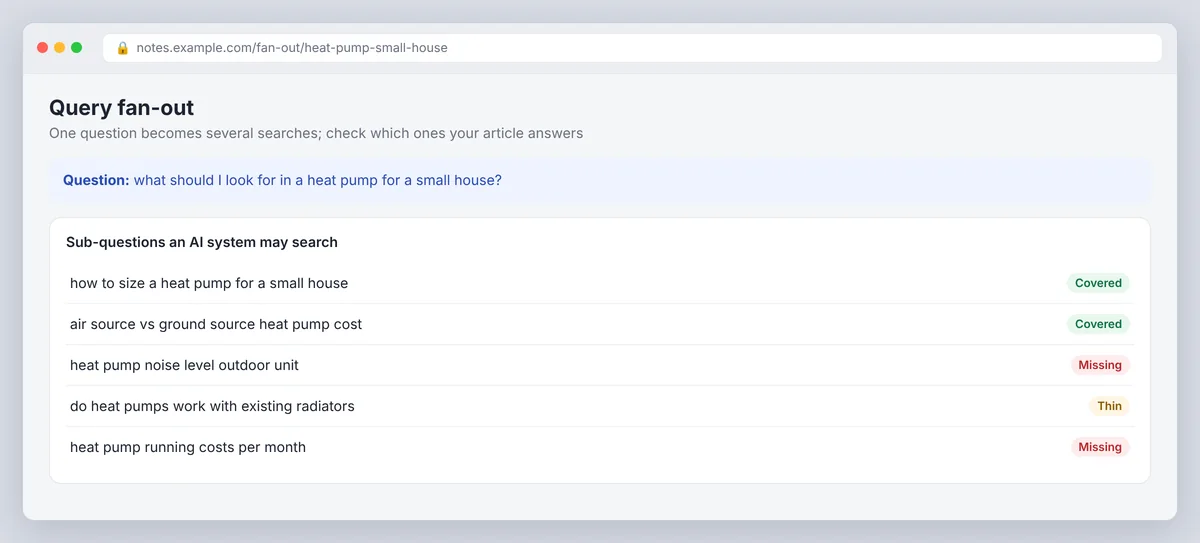
AI systems break a question into several sub-questions, search for each, and assemble the answer: this is query fan-out. An article that covers one narrow keyword well can be credited for a sub-question it never targeted, and a comprehensive one can be skipped because the specific fact it needed was buried. The practical response is content structure: complete, self-contained sections with descriptive headers, so each part can stand alone as an answer.
Rankings no longer equal visibility
A brand can be named in an AI answer without a link, linked without a visit, or credited for a query it does not rank for. Rank tracking still matters, since ranking feeds AI-driven search, but it no longer describes the whole of your search visibility. Treat it as one input, and adapt the metrics you report.
What remains foundational
Everything that made content eligible before still does:
- Crawlable and indexable URLs. If crawlers cannot index a URL, no AI feature built on Google's index can use it.
- Useful content that answers the intent. Depth, accuracy and original information still beat volume.
- Technical health. Speed, mobile rendering, clean structure and working internal links.
- Links and reputation. Backlinks remain a trust signal, now joined by unlinked brand mentions and credibility across the web.
- Structured data and schema markup that describes what is on the page, which helps systems understand it; it does not buy a place in answers.
E-E-A-T as an active ranking consideration
Google's quality framework (experience, expertise, authoritativeness, trustworthiness) is not a score, but it describes what Google's systems try to reward and what LLMs prefer to credit: named authors with real credentials, first-hand detail, sources for claims, and a brand that other sites describe consistently. It ensures the long-term signals line up with the short-term ones. Write as if a careful reader will check, because a model effectively does.
Explain GEO and AEO
Generative Engine Optimization
GEO is the practice of making content more likely to be used and credited by generative AI engines: clear statements, quotable facts with sources, definitions, comparison tables, and consistent brand information across the web. Most GEO advice is restated SEO fundamentals plus "make the answer extractable". Treat it as a lens, not a new discipline.
Answer Engine Optimization (AEO)
Answer engine optimization is the older term, from the featured-snippet era: structure content so that a system can pull a direct answer to a direct question. Question headings followed by a one-paragraph answer, then the detail, is the whole method. It targets Google's answer features and voice search as much as chatbots.
GEO, AEO and local SEO in one minute
GEO: get credited in generative answers. Answer engines: get pulled as the direct answer. Local SEO: get shown for "near me" and map queries, which still runs on your Google Business Profile, consistent contact details, reviews and location pages. A local business should prioritize local SEO before either of the others, because the AI engines recommending plumbers are reading the same profile data.
Optimize content for answers and citations: how AI SEO helps
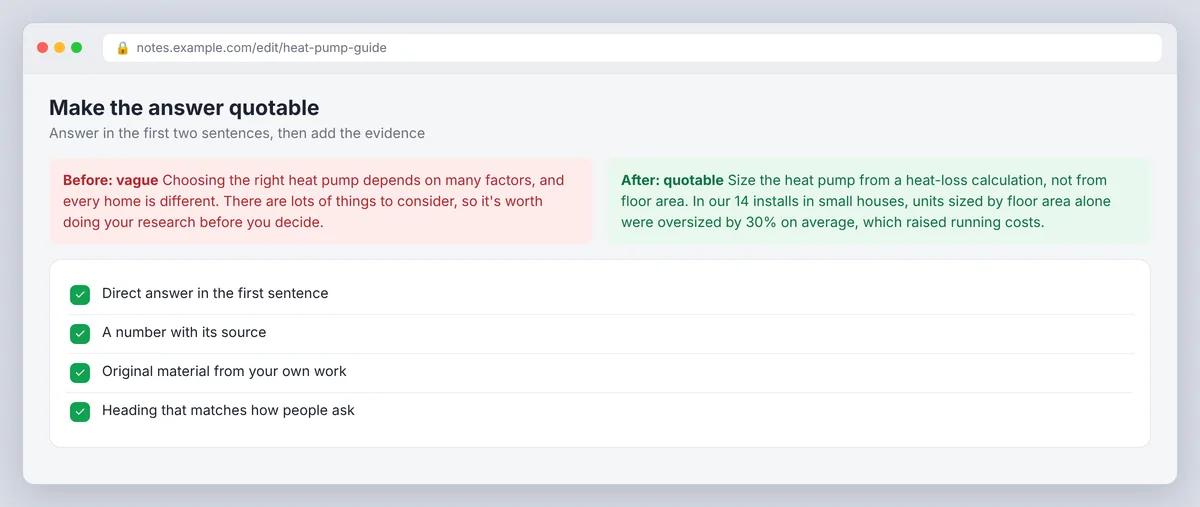
- Answer the question in the first two sentences under each heading, then add the evidence.
- State facts a model can quote: a number with its source, a definition, a step. Vague claims are summarized away.
- Use descriptive headings that match how people ask, so each section survives being extracted alone.
- Add original material: your data, your test, your experience. Models prefer sources that add something they cannot get elsewhere.
- Cite your sources with links. It helps readers, and it makes the article look like the kind of source that gets credited.
- Keep facts current and dated where it matters.
Structured data and schema markup
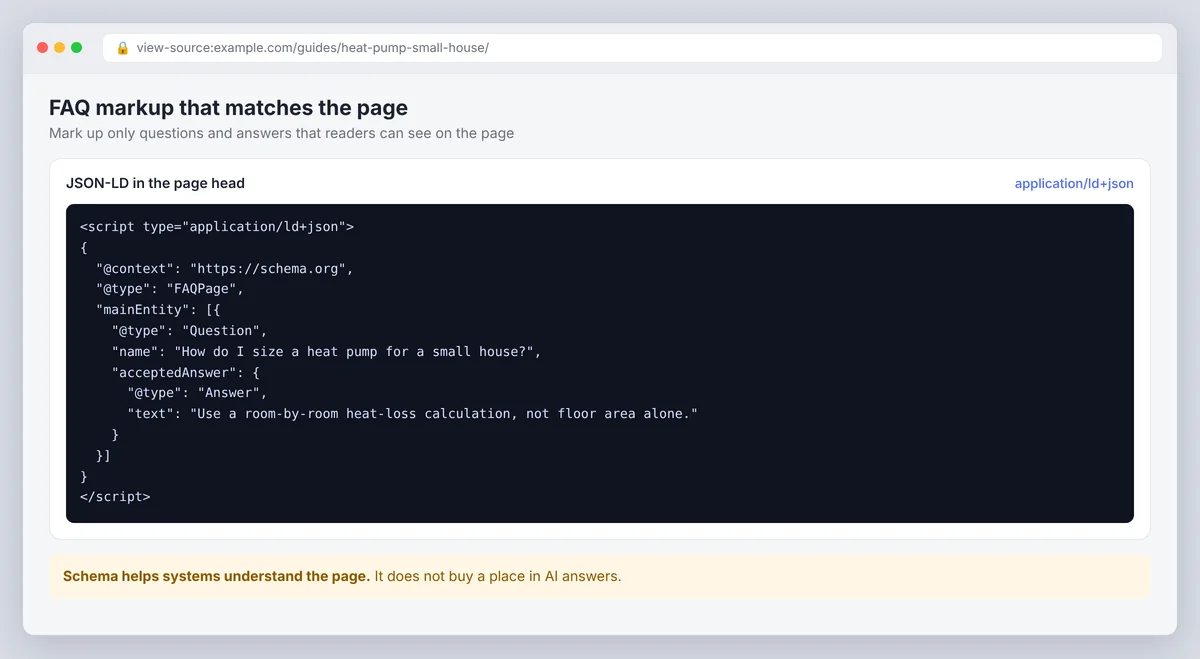
Mark up what is actually on the page: Article, FAQ, Product, HowTo, Organization. It helps search engines understand the content and can earn rich results. It does not make an AI engine credit you, and Google has said there is no special markup for AI features. See how to rank in AI Overviews for the full on-page checklist.
Build authority across the web
Brand mentions and citations alongside backlinks
Backlinks still pass trust. Unlinked brand mentions in credible places (industry publications, directories, forums, reviews) now matter too, because models build their picture of a brand from text, not from link graphs alone. Make sure your name, what you do and where you operate are described the same way everywhere, fix wrong profiles, and earn coverage by being worth covering: original research, tools, clear explanations. Authority, in this approach, is something other people say about you.
Build topical authority with content clusters
One good article is a weak signal. A cluster of interlinked articles that covers a topic from several angles tells both search engines and models that you are an authoritative source on the subject, and gives query fan-out more sub-answers to find on your site. Plan the cluster from real questions rather than keyword variants, and link the articles to each other with descriptive anchor text. This is the SEO strategy that compounds: each new piece makes the others more credible.
Distinguish proven guidance from speculation
Google's documentation on AI features in Search is explicit: AI Overviews and AI Mode use Google's core ranking systems, content needs to be indexed and eligible for search to appear, there is no special markup or opt-in, and the usual advice about helpful, people-first content applies. That is the proven part.
The speculative part is everything sold as a trick: a magic word count, a fixed answer format, "AI-optimized" schema, repeating the question as the first sentence of every section. Some of these overlap with good writing and are harmless; none is demonstrated to move results reliably across platforms, and the platforms change monthly. Record what you change, watch what happens, and believe your own data over anyone's checklist, including this one.
Measure performance beyond rankings
Traffic reports miss a growing share of visibility
Keep tracking rankings, organic traffic, click-through rate and conversions. Then add what analytics cannot see on its own:
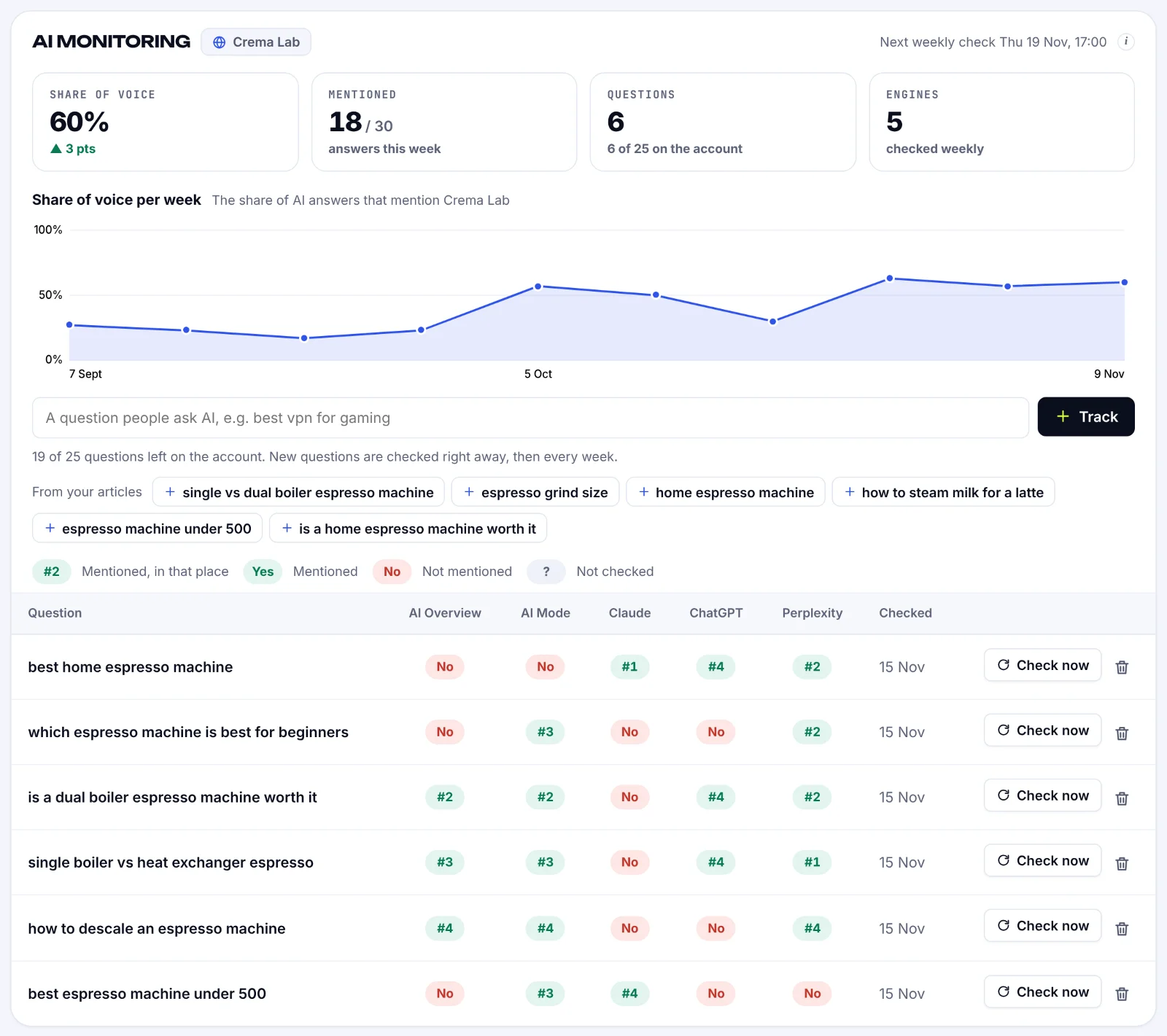
- Answer appearances: ask the chatbots your target questions and record whether you are named. SerpPal's AI visibility check does this for an article's keyword across Google's AI Overview, ChatGPT and Claude and reports who is named instead; the AI Monitoring add-on tracks a set of prompts weekly and gives you the trend as insights over time.
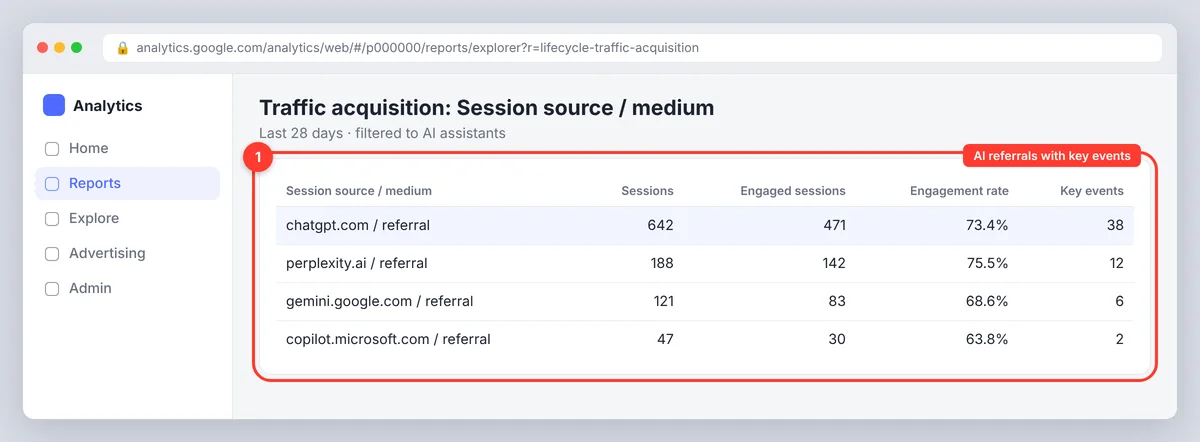
- AI referrals: traffic from chatgpt.com, perplexity.ai, gemini.google.com and similar sources in your analytics referral report.
- Branded search volume in Search Console, as a proxy for people hearing about you in answers and searching for you afterwards.
- Conversions by landing page, because an answer appearance that never turns into an inquiry or sale is a vanity number; converting visibility into revenue is the metric that matters.
Actionable steps for the age of AI search
AI-powered SEO strategies that compound over time
The other meaning of AI SEO: AI-powered automation of the work. Use models to cluster keywords, analyze competitor content, draft outlines, find gaps and flag unclear passages; those are tasks where speed matters and errors are cheap to catch. Use them to generate finished articles at scale and you get the content Google's spam policies describe as scaled content abuse and that models have no reason to credit. Integrate the tools into the research and execution steps, not the judgment. A person checks facts, adds experience and signs off. SerpPal's editor follows this split: the AI drafts against a brief built from the ranking pages, the content score checks coverage, and the AI visibility check tells you whether the result shows up in answers.
A hybrid SEO strategy by business problem
Set priorities by the business problem, not by whichever AI feature is in the news. An optimized approach combines the two layers rather than choosing one.
- Pages not indexed? Fix crawlability and technical errors before anything else.
- Traffic low? Revisit keyword research and intent; make sure pages answer what buyers ask.
- Traffic but no conversions? Fix the pages, not the search strategy.
- Competitors named in answers, you are not? Add evidence, direct answers and original material to the priority content, then make your brand information consistent across the web.
- Local business? Google Business Profile, reviews and location pages first.
Conclusion
AI SEO vs traditional SEO is a false choice. Traditional SEO makes your pages eligible: crawlable, useful, linked and trusted. AI SEO makes them easy to quote and gets them cited in answers. Combining the two is simply good SEO in 2026. Prioritize the fundamentals, write sections that answer one question each with evidence, keep your brand facts consistent, and add AI citations and AI referrals to the numbers you report. The page that delivers the clearest, best-supported answer still wins, whether the reader is a person or a model.
Frequently asked questions
Do you have to choose between AI SEO and traditional SEO?
No. Traditional SEO makes content eligible and trusted; AI SEO makes its information easy to extract and attribute. Traditional search optimization and AI search optimization are two layers of one strategy. Build on the SEO foundation you have rather than replacing it, then add the measurement that shows whether AI answers mention you.
What is the difference between GEO and AEO?
GEO (Generative Engine Optimization) targets being credited in generative answers from AI engines like ChatGPT, Perplexity and AI Overviews. AEO (Answer Engine Optimization) targets direct answers to direct questions, from featured snippets to voice assistants. They overlap heavily, and neither has a fixed definition.
What does Google say about AI Overviews and AI Mode?
That they use Google's normal search systems, that content must be indexed and eligible for search, that there is no special schema or submission, and that the standard guidance on helpful content applies. Anything beyond that is inference from observed results.
Does AI SEO replace traditional SEO?
No. Most sources credited in AI Overviews already rank for a related query, and no AI feature built on Google's index can use a URL Google cannot crawl. AI SEO is a layer on top of the fundamentals, not a substitute for them.
How do I measure AI visibility?
Ask the chatbots your target questions on a schedule and record whether you are named or linked, track referral traffic from AI domains, watch branded search volume, and tie all of it back to conversions. Tools can automate the asking; the interpretation is still yours.