On this page
- What an AI writer does (and what it doesn't)
- The workflow: seven steps from keyword to published post
- Reviews and comparison of the best AI article writer tools: capabilities to look for
- Do AI-written articles rank? SEO and GEO
- Pricing: free AI article writers and paid plans
- Other AI article writers you'll come across
- How to test any AI writer in 30 minutes
- Conclusion
- Frequently asked questions
An AI article writer takes a keyword or an assignment and produces a structured article: title, outline, sections, FAQ and meta description. The best AI article writer for you is the one that matches how you publish, not the one with the longest feature list. This guide walks through the full workflow, from picking the keyword to publishing on WordPress, and shows where a person still has to do the work. It also covers free AI writing options, what AI article writer tools cost, how a dedicated writer differs from ChatGPT, and whether AI-generated articles rank.
Key takeaways
- AI-powered article writers differ from a general chatbot by what they know before writing: search intent, competitor coverage, your brand voice and your site's pages.
- The workflow has seven steps: keyword, analysis, outline, generate, edit, optimize, publish. Steps five and six are where the quality comes from.
- AI-generated content ranks when a human adds accuracy, experience, citations and originality. Mass-produced content doesn't.
- Free AI article writers exist, with caps on analyses and words. Paid plans are usually cheaper billed annually; the pros and cons of each tier come down to how much you publish.
- Judge any tool on one real brief: editing time, factual errors and how the draft reads out loud.
What an AI writer does (and what it doesn't)
Under the hood every AI-powered writer is an LLM, a large language model, that predicts the next word. A plain assistant like ChatGPT or Claude writes from your prompt alone. A dedicated AI article writer wraps the model in a content creation workflow: it researches the keyword, builds an outline from what already ranks, writes to a target length with the right terms, adds internal links and citations, and gets the post into your publishing platform.
What none of them do is know your facts. The tool doesn't know your product's real price, your customer's actual complaint or the thing you learned last week that nobody else has written about. Those are the inputs that turn generated text into high-quality content, and they come from you.
AI article writer vs AI article generator
The labels overlap. "Generator" usually means one-click output from a prompt: paste a keyword, and it generates complete, structured articles in a few formats. "Writer" tends to mean an editor with AI built in, where you generate, then edit, humanize, optimize and publish in the same place. Most serious tools are both. Judge by what it does with the draft after generating it.
AI article writer vs ChatGPT
| ChatGPT or Claude | Dedicated AI article writer | |
|---|---|---|
| Knows the search results | No | Yes, analyzes the top pages first |
| Content score and term targets | No | Yes, updates as you type |
| Brand voice | Only if you paste it each time | Saved per project |
| Internal links from your sitemap | No | Yes |
| Humanizer and AI check | No | Built-in |
| Publish to WordPress | Copy and paste | One-click, with featured image and schedule |
| Cost | Free tier and paid plans (check the official pricing page) | Free plan; paid tiers by usage, cheaper billed annually |
| Formats | Anything you prompt | Blog posts, listicles, how-tos, product pages, FAQs |
ChatGPT is good enough for occasional drafts if you bring the research yourself. For a blog that publishes every week, the workflow tools pay for themselves in time saved.
More reasons to choose an AI writer over a plain assistant
- Every draft starts from the same analysis, so a team produces consistent posts.
- Versions are saved, so you can compare the AI draft with your edit.
- Terms, links and FAQ come built in instead of being prompted for each time.
- The score tells you when to stop optimizing.
The workflow: seven steps from keyword to published post
Step 1: Pick the keyword and the intent
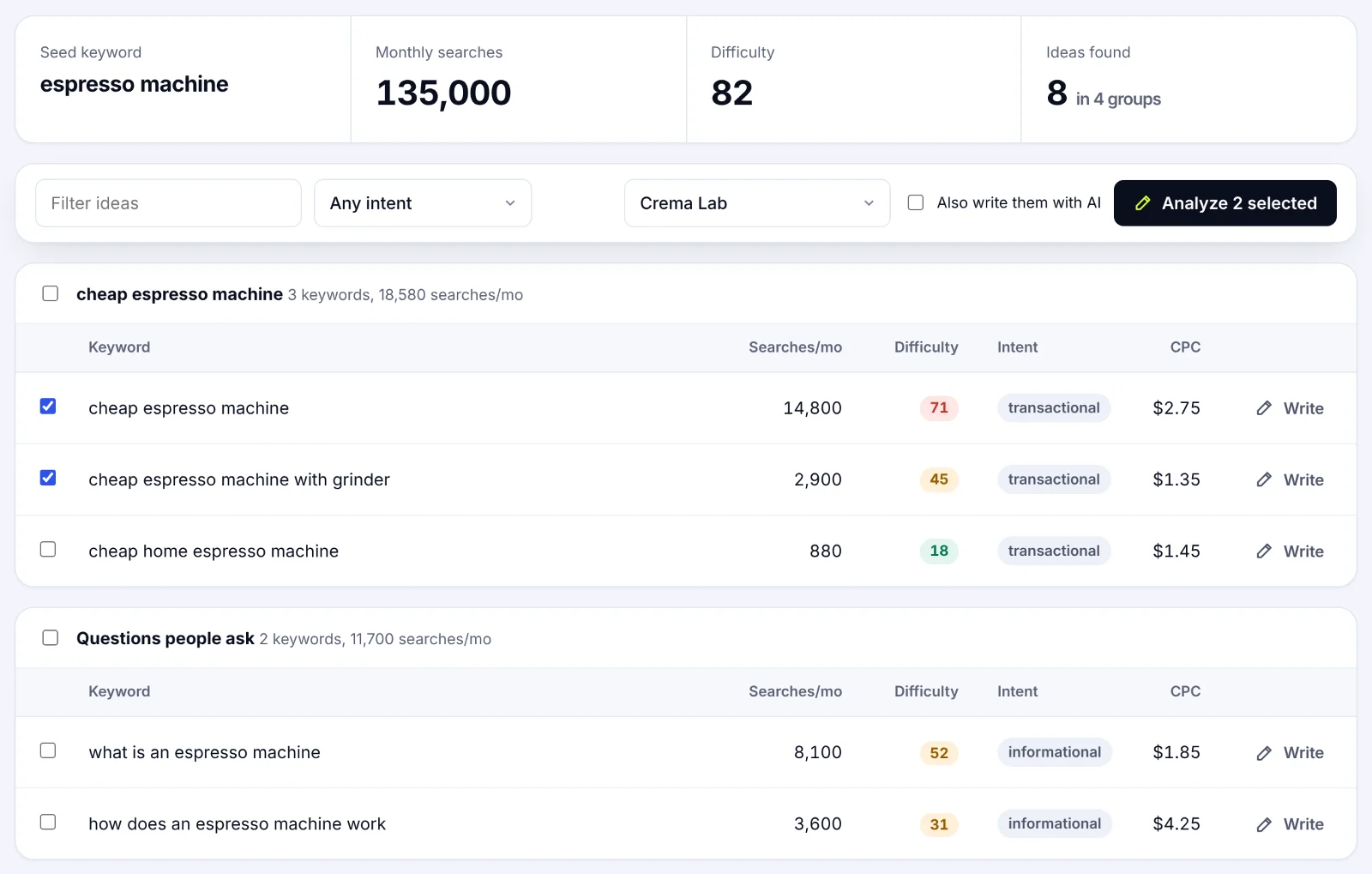
Start with a keyword people search for and you can realistically rank for. Check the intent: a how-to, a comparison, a definition, a product page? The article has to match it. A content planner that groups keywords into topics gives you the next ten posts as well, which is handy for bloggers and marketing teams planning a month of blog posts ahead.
Step 2: Analyze the top results
Run the keyword through the analysis. The methodology is simple: the tool reads the top results and extracts the terms they share, the headings they use, the questions people also ask, entities, a target word count and a short brief on the angle. Read it for insights. If every ranking page is a 600-word explainer and you planned 3,000 words, adjust.
Step 3: Generate the title and outline
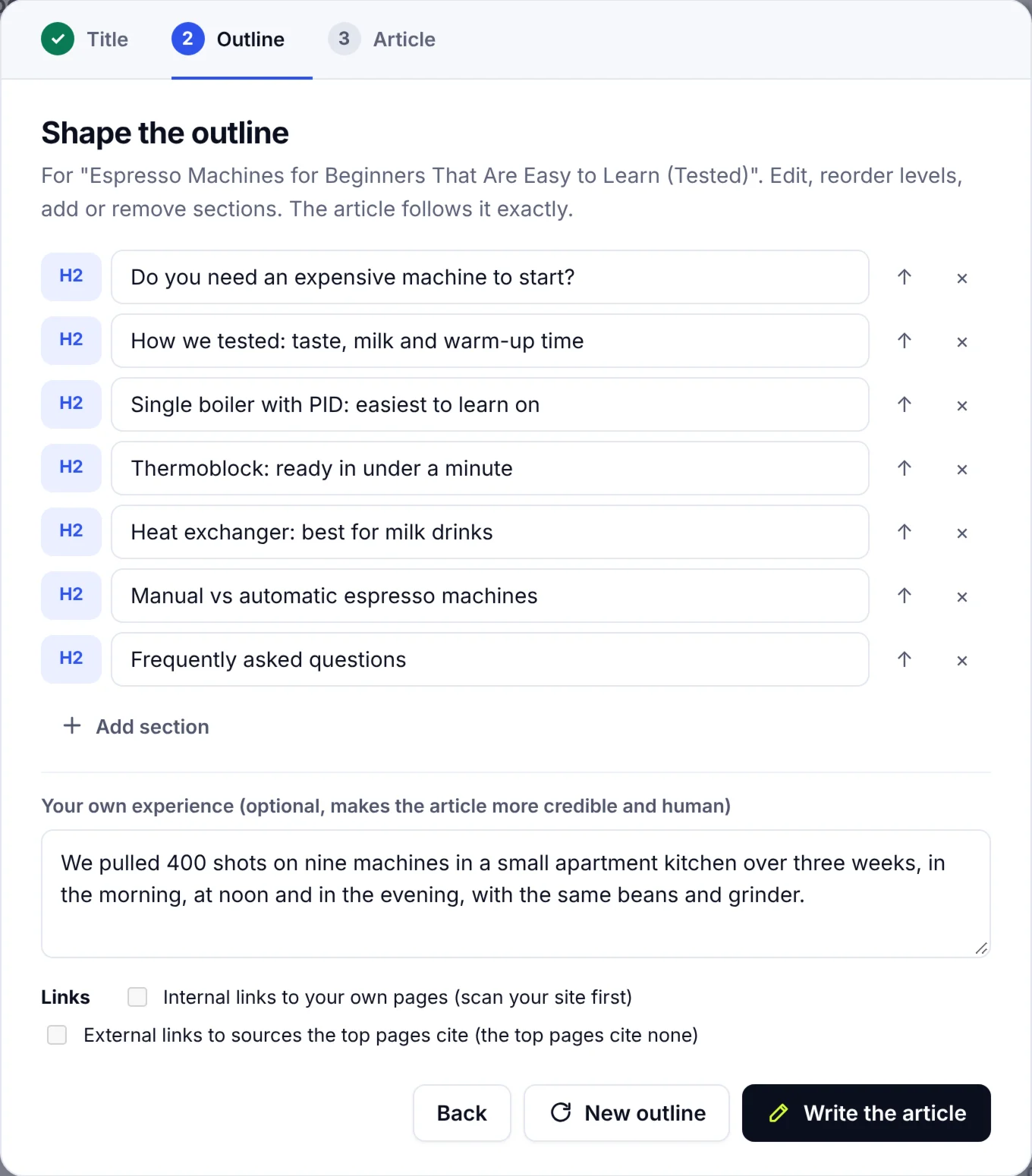
Let the writer propose titles and an H2/H3 outline from the analysis, then edit it. Cut what doesn't fit, add the section competitors miss, decide where your experience and ideas go. In SerpPal this is the article wizard: title, outline, then the full article.
Step 4: Generate the article
Generate the full draft to your target length; most writing tools finish a 1,500-word article in a minute or two. A good tool writes the recommended terms in naturally, adds internal links to your own pages, keeps short paragraphs and leaves you a structured article with an intro, sections and an FAQ, in the tone you set. Expect the generated article to be comprehensive but flat. That's fine; flat is easier to fix than wrong.
Step 5: Revise like an editor, not a proofreader
This is the step that separates engaging blog posts from AI filler. Replace generic claims with your examples. Add a screenshot where it helps, and a second screenshot if the first needs context. Check every number, name, date and citation. Delete sentences that say nothing. Add an opinion or a short case study from your own work. If a section still sounds robotic, humanize it: SerpPal's humanizer keeps the facts, links and terms and makes the paragraph read like a person wrote it.

Step 6: Optimization with data
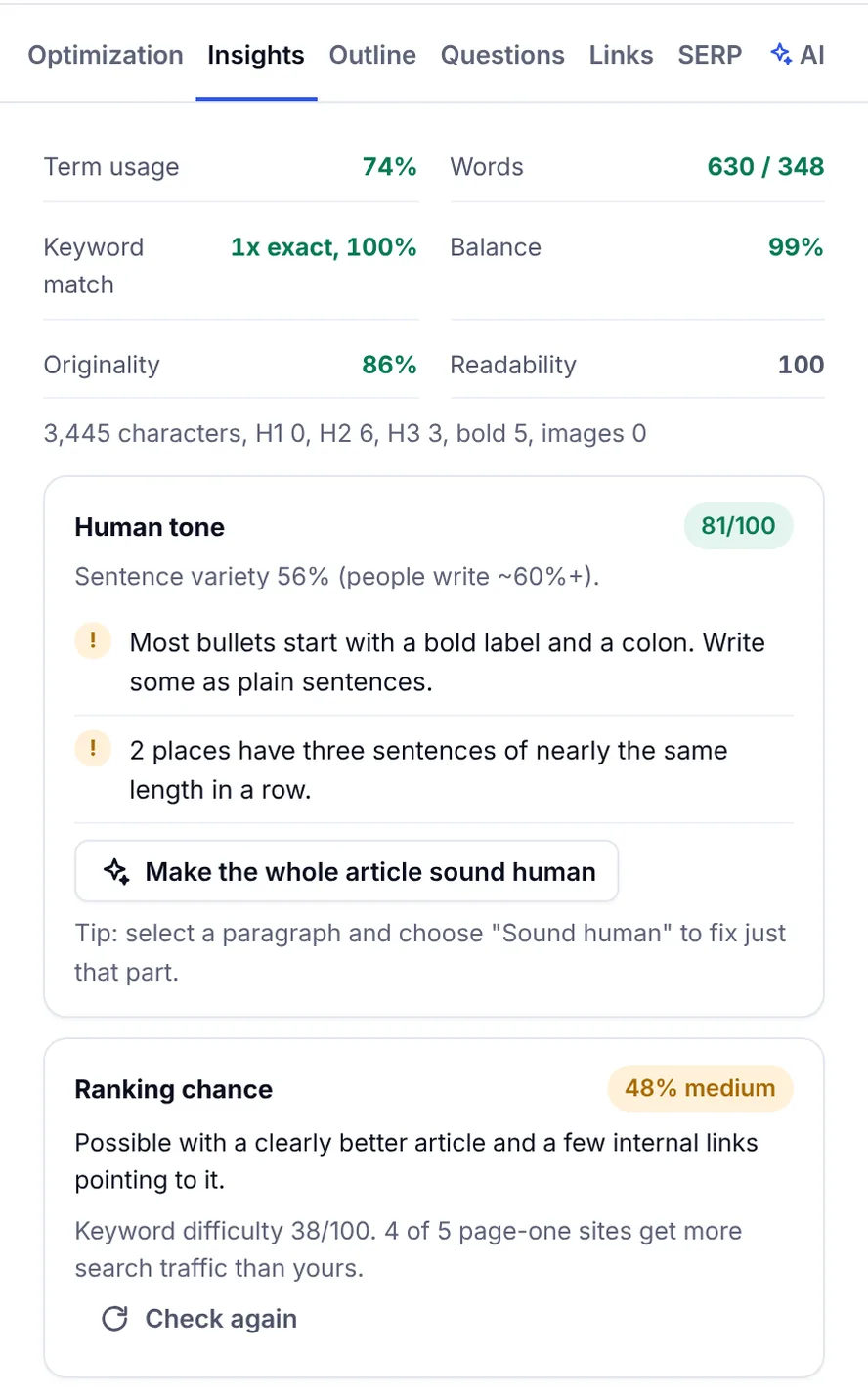
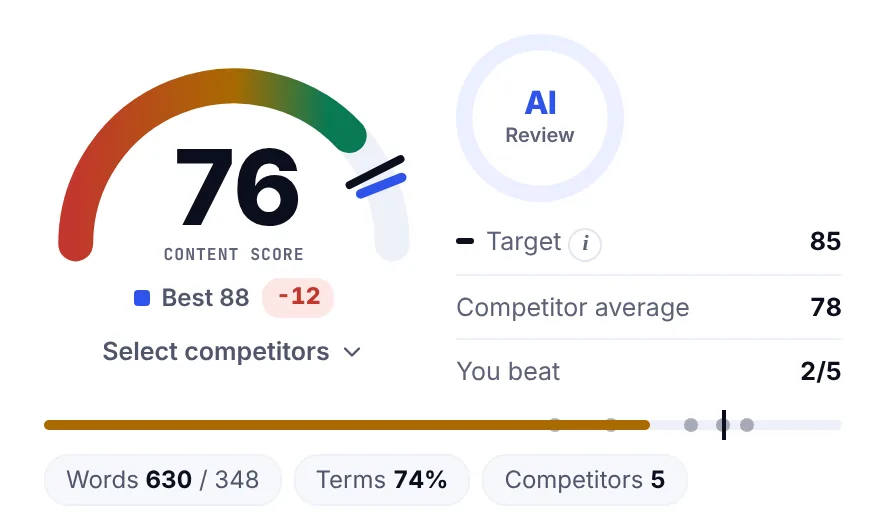
Check the on-page content score against the target (it updates in real time as you edit), fill the gaps that read naturally and ignore the ones that don't. Review readability: short paragraphs, plain words, a mix of sentence lengths. Write the meta description, check the SERP preview and add the FAQ schema if your tool supports it.
Step 7: Publish and track
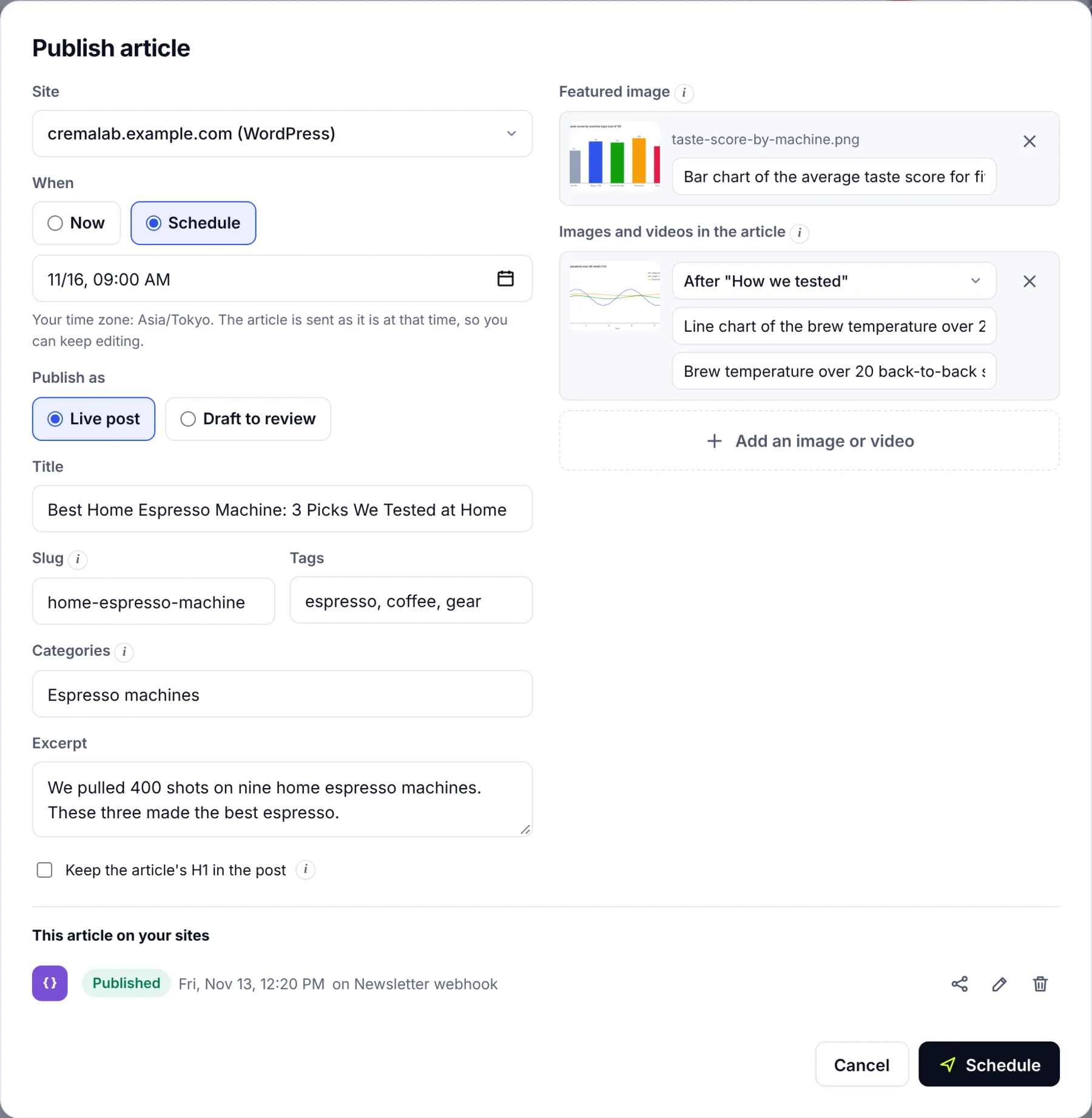
Send it to WordPress, Shopify, Ghost or Webflow with the featured image, category and tags set, or schedule it for later. Then watch the blog posts you publish: rank tracking shows where each lands, Search Console shows which searches it appears for, and both tell you when it needs a refresh.
Reviews and comparison of the best AI article writer tools: capabilities to look for
- Research built in. SERP analysis, People Also Ask, competitor outlines, a real content score. Marketers get the brief without a separate tool.
- Brand voice and languages. Tone, audience, products, banned words, and writing in the language of the analysis, not just English.
- Editing controls. Expand, simplify, humanize or transform a selection; ask the AI a question about the draft.
- Accuracy aids. Citations to sources the top pages cite, a plagiarism checker, an AI checker.
- Publishing and integrations. WordPress and other platform connections, media library, scheduling, webhooks and an API for custom pipelines.
- Results. Rank tracking, Search Console data and AI search visibility so you can see whether the post works.
- Bulk and automation. Automated runs that analyze and write a batch of keywords at once when you have a cluster to produce. Useful for marketers and bloggers with a content calendar who want to streamline AI-driven production; dangerous without a review step. With a shared brand kit and saved settings, your top performer's process becomes a team workflow.
SerpPal's AI writer covers this list in one editor, and the AI writing guide describes each action in detail.
Do AI-written articles rank? SEO and GEO
Yes, when they're good, and no, when they're not. AI content isn't a ranking factor either way; what the page delivers to the reader is. Google's guidance is clear that it rewards helpful content however it's produced and treats mass-produced, unhelpful pages as spam however they're produced. The quality signals it cares about, experience, expertise, originality and accuracy, are exactly what a person adds in step five. Marketing teams that treat the AI as a drafting assistant and keep an editor in the loop stay compliant with Google's rules and get the boost without the risk.
AI search changes little here. Google AI Overviews, ChatGPT search and Perplexity cite pages that answer a question directly, with clear structure and sources, and an AI answer tends to quote the sentence that states the point plainly. GEO, generative engine optimization, is mostly good writing with a direct answer near the top of each section. Can Google detect AI articles? Detectors are unreliable and Google says it doesn't penalize AI text as such; it penalizes bad pages.
Pricing: free AI article writers and paid plans
Most AI platforms follow the same pricing pattern: a free AI article writer tier with low monthly limits, then paid tiers priced by usage of AI content, with a discount when billed annually. On a 12 or 24 month plan billed annually the saving is often two months free. Compare the numbers that matter rather than the headline price:
- Analyses per month: one per keyword you research. Agencies generating dozens of articles need more.
- AI words per month: a 1,500-word article with outline and edits uses around 2,000 to 3,000.
- Seats and projects: agencies pay per client site or per user.
- Humanizer and AI checks: sometimes counted separately.
- Publishing and API: often gated to higher tiers.
Pros of a free plan: you can test the whole workflow on a real keyword before paying. Cons: the allowance runs out fast if you post weekly, and the word cap is the usual pinch point. SerpPal's pricing page lists the limits for each plan so you can match them to your output.
Other AI article writers you'll come across
Jasper and Writesonic are two of the best-known AI writing platforms. Jasper is aimed at marketing teams that need one brand voice across many content types. Writesonic leans toward SEO articles and tracking how brands show up in AI search. Both offer templates, long-form generation and integrations, and both change their plans often, so check their official pricing pages before you compare costs.
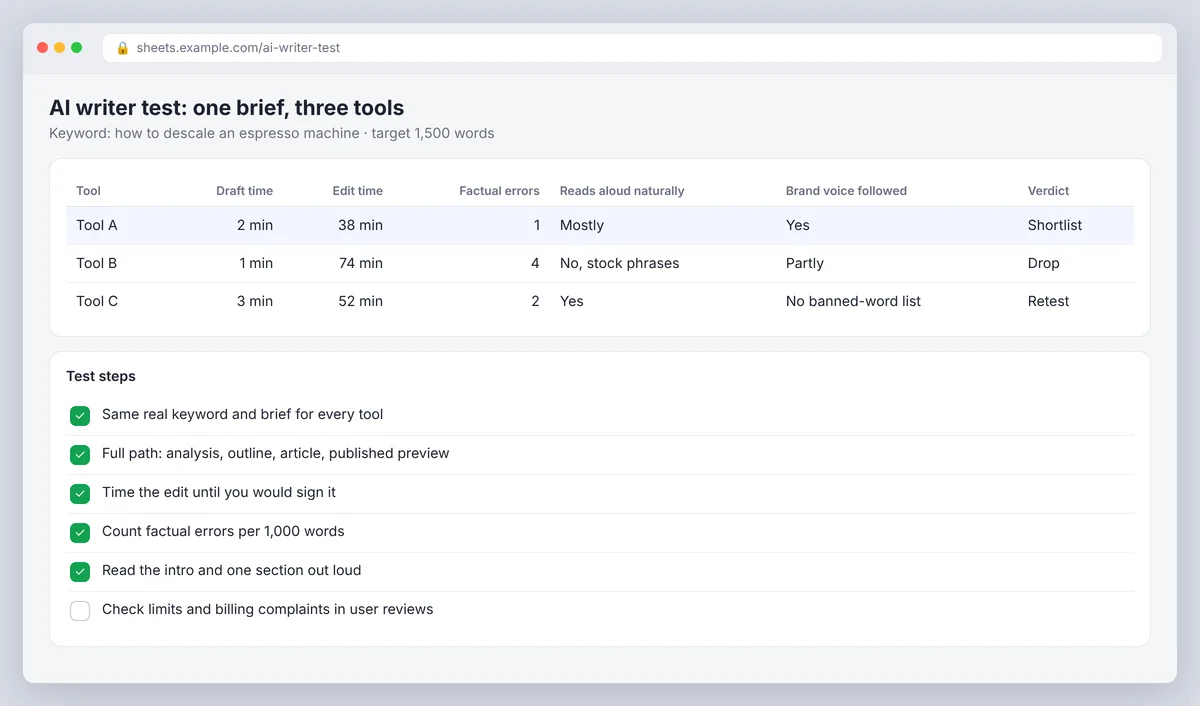
Whichever tools you shortlist, give them the same real brief and the same test below. The right one is the tool that gives you the most publish-ready draft for your niche with the least editing, whatever the review sites say. Content creators who publish weekly should weigh editing time above everything else, because that's where the hours go.
How to test any AI writer in 30 minutes
- Pick one real keyword from your calendar.
- Run it through the tool's full path: analysis, outline, article, preview of the published page.
- Time how long the edit takes to reach something you'd put your name on.
- Count factual errors. Two in a thousand words is a warning sign, and alignment between the draft and your assignment matters as much.
- Read it aloud. If it sounds like every other AI blog, check whether the humanizer can transform it into something you'd say, and whether the AI writing tools can transform a dull list into a paragraph.
- Check the brand voice: did it use your terms and avoid your banned words?
- Look at reviews on Reddit and review sites for complaints about limits and billing, which rarely show on the pricing page.
Conclusion
An AI article writer saves the most time on research, outlines and first drafts. The quality still comes from you: your facts, your examples and a careful edit for relevance and accuracy. Pick a tool that fits how you publish, test it on one real keyword, and keep a person between the draft and the publish button. To try the whole workflow, start on SerpPal's free plan; it needs no card.
Frequently asked questions
What is the best AI article writer?
The one that fits your publishing: a chatbot for occasional drafts, a dedicated writer with SERP analysis and publishing for a regular blog, a transform-and-humanize editor for AI-generated drafts you already have, and a bulk tool with a review step for large catalogs. Test on one real keyword and judge by revision time and accuracy. The best AI tools are the ones that effortlessly fit the way you already work.
Is ChatGPT good enough to write articles?
For a first draft with a careful prompt and your own research, yes. It won't tell you what the ranking pages cover, score your draft or send it to your site, so expect to do that work elsewhere.
Can an AI article writer publish directly to my site?
Many can, usually to WordPress and sometimes to Shopify, Ghost, Webflow or a webhook. Keep a human review before anything goes live on your homepage or blog.
How much does an AI article writer cost?
From free with monthly limits to a few hundred dollars a month for agency tiers. The cost per usable article depends on analyses and AI words, so compare those, and check the discount for paying annually. Many platforms also charge extra for API access.
How do I keep my brand voice?
Set up a brand kit with your tone, audience, products and words to avoid, and the AI writer follows it on every draft. Then edit in your own voice; the kit gets you close, not all the way.