On this page
To paraphrase means to express someone else's ideas in your own words while keeping the original meaning. A paraphrase is usually about the same length as the original passage, it changes both the wording and the sentence structure, and when the content comes from a source, it still needs a citation.
This guide gives you the paraphrase definition in plain English, what the dictionary says, paraphrased examples, the difference between paraphrasing, summarizing and quoting, and a simple method to paraphrase effectively and accurately.
Key takeaways
- Paraphrasing is expressing a text in different words and a different structure, with the same meaning and roughly the same length.
- A summary is shorter and keeps only the central points; a quote copies the exact wording inside quotation marks.
- Changing a few terms but keeping the original structure is "insufficient paraphrase," and many schools treat it as plagiarism.
- Paraphrased material still needs a citation, because the thinking belongs to the author.
- Paraphrasing is one of the most important skills in academic writing, because it shows you understand the source.
Paraphrase definition
The noun "paraphrase" means a restatement of a text or passage in other language. The verb "to paraphrase" is the act of doing it: "She paraphrased the report for the team." The past tense is "paraphrased," and the process is "paraphrasing."
In everyday writing, paraphrasing involves three steps, and effective paraphrasing involves all of them:
- Understanding the original point fully.
- Restating it with your own vocabulary and sentence structures.
- Crediting the source when the point isn't yours. Giving credit is part of the process of restating, not an optional extra.
What the dictionary says
A dictionary entry for paraphrase usually lists two senses, along with notes on usage. The first is the familiar one: a restatement of a text that gives its meaning in another form, which is close to how the Merriam-Webster dictionary puts it. The Webster dictionary entry also notes that the word dates back to the 1500s in English. The second is the verb sense, to express the meaning of something written or spoken using different wording, especially to make it clearer.
The Merriam-Webster entry, like most dictionary pages, also lists synonyms such as rephrase, reword and recast, plus example sentences from published writing. If you want a quick check of a dictionary definition, a Webster dictionary and other major dictionaries agree on the core: same meaning, different expression. Usage notes add that rephrasing and paraphrasing are close, but rephrasing usually means a lighter change to your own sentence, while paraphrasing usually concerns author ideas from a source.
Where the word comes from
The word comes from Greek paraphrazein, "to tell in other words," through Latin paraphrasis. The practice is old. Aristotle wrote about how style changes meaning, and classical teachers of rhetoric who followed Aristotle's tradition had students paraphrase speeches and poems to practice expressing the same content in a new form, and the exercise is still used in classrooms today.
Word of the day: paraphrase in use
If paraphrase were a word of the day, the usage notes would say this:
- Part of speech: noun ("a paraphrase") and verb ("to paraphrase").
- Forms: paraphrase, paraphrased, paraphrasing, paraphraser.
- Common phrases: "to paraphrase the author," "loosely paraphrasing," "a close paraphrase."
- Example: "To paraphrase the Webster dictionary entry, a paraphrase gives the meaning of a text in another form."
The word paraphrase is also used in speech, when you paraphrase someone to show you've understood them: "So what you're saying is..." That spoken habit is a good way to practice the written skill.
Paraphrase and translation
Paraphrase has a second life in translation. In the 1600s the English poet John Dryden described three kinds of translation: metaphrase (word for word), paraphrase (sense for sense, keeping the author's meaning but not the author's exact wording) and imitation (a free adaptation). Translation theory still uses that idea: a paraphrase translation conveys the sense of a sentence rather than mapping it word by word. Translators still debate how much freedom a translation should take, and that debate is about exactly this skill.
That's also why a translation of the word "paraphrase" into most European languages looks familiar: paráfrasis in Spanish, paraphrase in French, Paraphrase in German. The concept of restating meaning in a new form crossed languages along with the word.
Paraphrase examples
Here's what good and weak paraphrasing look like with the same original passage.
Original: "Regular physical activity improves sleep quality, reduces stress and lowers the risk of several chronic diseases."
- Good paraphrase: People who exercise often tend to sleep better, feel less stressed and are less likely to develop some long-term illnesses.
- Insufficient paraphrase: Regular exercise improves sleep quality, cuts stress and lowers the chance of several chronic diseases.
The second version only swaps a few terms. The structure is still the author's, so it reads as copying.
Examples of paraphrased in a sentence
- "The teacher paraphrased the poem so the class could grasp its meaning."
- "In the meeting, Sam paraphrased the client's request to clarify what he needed."
- "The article paraphrased complex concepts from a study for a general audience."
Paraphrasing vs summarizing vs quoting
These three ways of using information from sources are easy to mix up:
| Paraphrasing | Summarizing | Quoting | |
|---|---|---|---|
| Length | About the same as the original | Much shorter | Exactly the same |
| Wording | Your own | Your own | The author's |
| Content | Everything in the passage | Only the key points | A specific phrase or sentence |
| Quotation marks | No | No | Yes |
| Citation | Required | Required | Required |
Use a direct quotation (a direct quotation keeps every word) when the exact wording matters: a definition, a striking phrase, or a claim you'll analyze. Paraphrase when you need the detail of a passage but want it to fit your writing. Summarize when only the central point matters, condensing a long text into a few concise sentences.
What is the difference between summarizing and paraphrasing?
Summarizing involves condensing a text to its main ideas, so a summary is much shorter than the original. Paraphrasing keeps all the content and restates it, so a paraphrase is about the same length. Both use your own wording, and both need a citation.
What is insufficient paraphrase?
An insufficient paraphrase stays too close to the original. Typical signs:
- The sentence structure is the same, with only a few terms replaced by synonyms.
- Distinctive expressions from the source appear unchanged and unmarked.
- The order of points matches the original sentence by sentence.
Many universities treat insufficient paraphrasing as plagiarism even when the source is cited, because the expression is still the author's. The fix is to understand the passage first, then write it from memory in a new structure.
How to paraphrase effectively
This method works for students, researchers and professional writers alike, and it's the most efficient way to build the ability to paraphrase accurately:
- Read the passage until you understand it. Look up unfamiliar terms in a dictionary. You can't paraphrase what you can't interpret.
- Note the central points in a few terms each, without lifting whole expressions.
- Put the original away and write it as if explaining it to a friend.
- Change the structure, not just the vocabulary: split long sentences, combine short ones, or start from a different part of the argument.
- Compare with the original text. Check that the meaning is the same and nothing distinctive slipped in. Keep technical terms that have no real alternative; forcing a new word where none fits can change certain parts of the meaning.
- Add the citation in the style your class or publication uses.
Why is paraphrasing important?
Paraphrasing is an essential academic skill, and one of the essential skills in research writing. It proves you understand the material, lets you incorporate information from various sources and their ideas into one clear argument while keeping your original content distinct from theirs, and helps you avoid plagiarism while relying on other people's research and references. Avoiding plagiarism is the reason most teachers give, but paraphrasing well also adds diversity to your writing, so a paper doesn't read like a chain of quotes. It also builds critical thinking skills and the ability to communicate complex concepts simply: to paraphrase a point, you have to grasp how it works and communicate it in your own voice. In academic writing, it's how you show you can engage with sources instead of stringing quotes together.
Paraphrasing skills for elementary and middle school students
In upper elementary classrooms, paraphrasing is usually taught alongside summarizing. A simple routine helps students practice paraphrasing: read a short paragraph, cover it, say the point out loud, then write it down and compare. Elementary teachers often start with familiar texts, then move to short nonfiction passages, so the technique feels natural before students use it in research assignments. Paraphrasing skills are important skills to build early: elementary students who learn to paraphrase find research projects much easier later.
Do paraphrasing tools help?
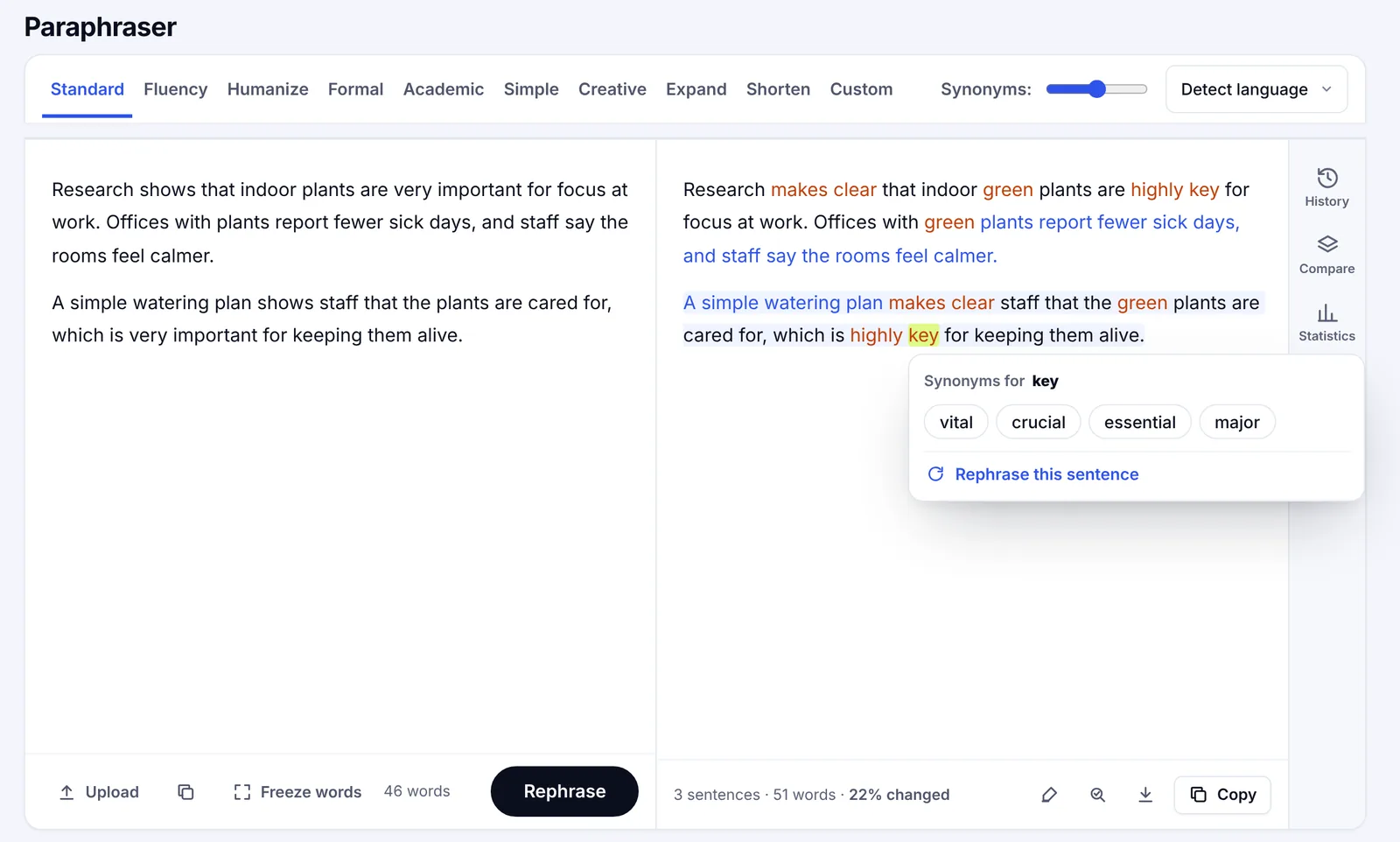
A paraphrasing tool can show you different ways to word a sentence, enhancing your options without changing the meaning conveyed, which is useful for avoiding repetition, when you're stuck or when your phrasing keeps echoing the source. SerpPal's paraphraser offers several modes, lets you click any term for synonyms, and highlights what changed. It sits next to the free tools for readability and word count.
Use a paraphrasing tool as a starting point, not a shortcut. You still need to understand the source, check that the meaning didn't shift, and cite the author. For school assignments, check your teacher's rules on AI tools first.
Frequently asked questions
What does paraphrase mean in simple words?
To paraphrase means to say or write someone else's point in your own words, keeping the same meaning. For example, "The meeting is postponed until Friday" could be paraphrased as "We've moved the meeting to Friday."
Do you need to cite a paraphrase?
Yes. Paraphrasing changes the wording but not the ownership of the thinking. Whenever you paraphrase information from a source, add a citation, just as you would for a direct quote.
Is paraphrasing the same as summarizing?
No. A paraphrase restates a passage at about the same length, with all its content. A summary is shorter and keeps only the central points, reducing the text to its core. Both need a citation.
How much do you need to change to paraphrase?
Enough that both the wording and the sentence structure are your own. If you can still see the original sentence underneath, with a few synonyms swapped in, it's an insufficient paraphrase.
When should you paraphrase instead of quoting?
Paraphrase when you want to convey the meaning effectively and the meaning matters more than the exact wording, or when you want to clarify the author's point for your reader, or when you want to explain a complex passage more clearly. Quote when the exact phrasing is important, such as a definition you plan to analyze.