On this page
- What does summarize mean?
- How to summarize text effectively in 5 steps
- How to summarize a story
- Summarize vs analyze vs paraphrase
- Summary formats
- How AI text summarization works: extractive and abstractive
- AI summarization use cases and workflows
- Embracing efficient workflows with a free AI summarizer
- Frequently asked questions
To summarize means to state the main points of a text, story or discussion in a much shorter form, using your own words, so the content is easier to digest. Summarization is the process of doing that: reading the original, deciding what matters, and condensing it into a concise overview that someone could read in a fraction of the time.
This guide explains what summarizing means, how to summarize a story or a text step by step, how summarizing differs from analyzing and paraphrasing, and how AI text summarization works, from extractive methods to modern language models.
Key takeaways
- A summary keeps the key points and drops the detail. A good one is usually 10 to 25% of the original length.
- To summarize a story, cover who, what, where, the main conflict and how it ends, in order, without your opinion.
- Summarizing tells what a text says; analyzing explains how and why it works. Teachers grade them differently.
- AI summarization comes in two kinds: extractive (picking existing sentences) and abstractive (writing new ones). Most modern AI summarizer tools are abstractive.
- AI summaries save time on long documents, but they can miss nuance or add errors, so check them against the original text.
What does summarize mean?
To summarize is to give a brief statement of the main points of something. You can summarize a book, an article, a meeting, a movie or a research paper. The result is a summary, and the plural is summaries. A summarized version leaves out examples, repetition and minor details, and keeps only what someone needs to understand the whole.
Summarization is the noun for the act or process. In everyday use it simply means making summaries. In computer science, text summarization is also a field of natural language processing, where models are trained to summarize documents automatically.
What makes a good summary?
- Accurate. It reflects what the original says, not what you think about it.
- Concise. It's much shorter than the source and uses no filler.
- Complete. It covers every key point, not just the first few paragraphs.
- In your own words. It doesn't copy sentences from the original, and it credits the source if you use it in your writing.
How to summarize text effectively in 5 steps
These steps work for articles, chapters, reports and papers:
- Read the whole text once without taking notes, to understand the overall topic and purpose.
- Find the key points. On a second read, mark the main claim and the supporting points. Headings and topic sentences help.
- Write each point in a few words. Use your own language, not phrases lifted from the text.
- Combine the notes into a short paragraph or a few bullet points, in a logical order. Start with the main idea.
- Check it against the original. Did you include every key point? Did you add anything the author didn't say? Cut whatever isn't essential.
For a long document, summarize each section first, then summarize your summaries. Document summarization at length works best in stages, whether you're doing it or an AI is, and it keeps important contextual details. This keeps the middle from getting lost, which is a common problem when summarizing long texts.
How to summarize a story
Summarizing a story follows the plot rather than an argument. A simple framework for students is Somebody, Wanted, But, So, Then:
- Somebody: the main character.
- Wanted: what they want.
- But: the problem or conflict.
- So: what they do about it.
- Then: how it ends.
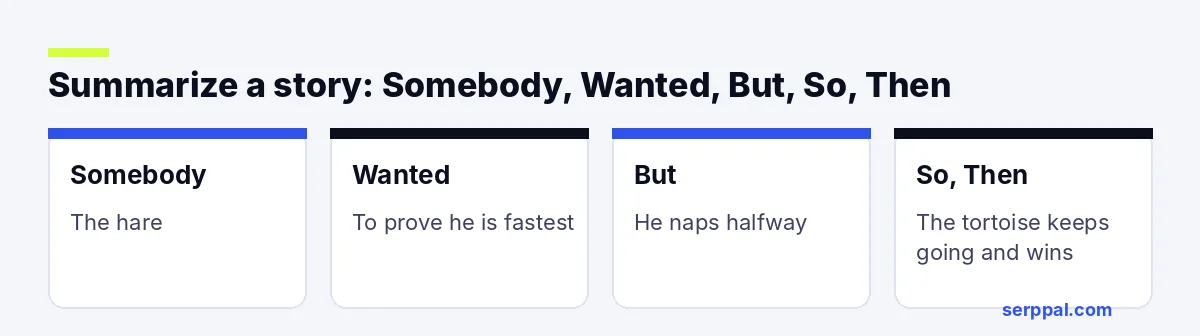
Example, "The Tortoise and the Hare": A hare (somebody) mocks a slow tortoise and agrees to race him (wanted to prove he's fastest). But the hare is so confident that he stops to nap halfway. So the tortoise keeps walking steadily while the hare sleeps. Then the tortoise wins, showing that steady effort beats careless speed.
That's five sentences for the whole story, with the moral at the end. For a longer story or novel, add the setting and one sentence for each major turning point, but keep it to a paragraph or two.
How do we summarize a story in class?
Teachers usually want the summary in present tense, in third person, with no personal opinion, and with the title and author in the first sentence: "In Charlotte's Web by E. B. White, a pig named Wilbur..." Keep quotes out of a summary unless the assignment asks for them.
Summarize vs analyze vs paraphrase
These three tasks get mixed up in assignments. Here's the difference:
| Summarize | Paraphrase | Analyze | |
|---|---|---|---|
| Goal | State the main points briefly | Restate a passage in new words | Explain how and why it works |
| Length | Much shorter than the source | About the same length | Often longer than the source |
| Your opinion | None | None | Yes, backed by evidence |
| Example task | "Summarize chapter 3" | "Paraphrase this paragraph" | "Analyze the symbolism in chapter 3" |
If a prompt says "analyze," a summary alone won't earn the marks. Summarize briefly to set up the point, then spend most of your words on analysis. Our guide on what paraphrasing means covers the paraphrase side in more detail.
Summary formats
Not every summary is a paragraph, and different applications call for different shapes. Pick the format that fits how the reader will use it:
- Bullet points: one key point per bullet, easy to scan.
- Action points: a short list of conclusions a busy reader can act on.
- TL;DR: one to three sentences at the top of a long post or email.
- Executive summary: context, findings and recommendations for business reports.
- Study notes: concepts, definitions and review questions for exams.
How AI text summarization works: extractive and abstractive
AI summarization uses machine learning models to read an input text and generate a shorter output. It grew out of computational linguistics research (much of it published through the Association for Computational Linguistics) and is now one of the most common generative AI tasks. There are two main summarization methods.
Extractive summarization
Extractive summarization picks the most important existing sentences from the original text and puts them together. The model scores each sentence, for example by how central its words are to the document, and extracts the top ones. Extractive summaries are factually safe, because the key sentences all come from the source, preserving the author's wording, but they can read choppy. Classic extractive summarization systems ranked sentences with statistics or a simple classifier.
Abstractive summarization
Abstractive summarization generates new sentences, the way a person would. Transformers, the neural network design behind modern large language models (LLMs), made this practical. A sequence-to-sequence model reads the input and writes the output token by token. Research models such as BART and PEGASUS were trained specifically for the summarization task, and general models like ChatGPT, Claude and Gemini now produce abstractive summaries of articles, papers, transcripts and PDF documents in seconds.
Abstractive summaries read naturally, but they can introduce errors that aren't in the original. Researchers measure quality with evaluation metrics such as ROUGE (ROUGE-1, ROUGE-2 and ROUGE-L count overlapping words and word pairs), which compares a machine summary with human-written ones on a benchmark dataset, and with checks for factual consistency. BLEU, a related metric from machine translation, is sometimes reported too, though ROUGE is the standard for the summarization task. Both metrics reward overlap with a reference summary, which isn't the same as being useful to a reader.
| Extractive | Abstractive | |
|---|---|---|
| How it works | Selects existing sentences | Writes fresh sentences |
| Strength | Stays close to the source | Reads naturally, condenses more |
| Risk | Choppy, can miss context | Can add details that aren't there |
| Typical use | Search snippets, news digests | AI summarizer tools, chat assistants |
Benefits and limits of AI summaries
The benefits are speed and coverage: an AI can turn a 40-page report into a digestible page in seconds and make long reading lists manageable, which is why summarization is among the most used AI applications. The limits come from how the models work, and they show up in a few common myths.
- "Longer documents always produce better summaries." Not true. Very long inputs can push a model to skip the middle. Splitting the document into sections and summarizing each one usually works better.
- "An AI summary is always accurate." Abstractive models sometimes state things the source never said, a problem known as hallucination. Check names, numbers and claims against the original text. Factual errors are the main reason to keep a person in the loop.
- "A summary replaces reading." For decisions, studying or citing, read at least the parts that matter.
AI summarization use cases and workflows
AI-powered summarization shows up in more places than most people notice:
- Meetings. Zoom and Microsoft Teams can summarize meeting transcripts into decisions and next steps. Summarizing long calls is one of the most popular applications.
- Academic research and learning. Students and researchers use AI to simplify reading lists, summarizing long reviews and academic papers and extract key findings before deciding what to read in full.
- Legal and business documents. Long contracts, briefs and reports become digestible overviews for review, with a lawyer or analyst checking the details.
- News articles. News apps and newsletters condense the day's stories into short digests.
- Support and documentation. Teams summarize long ticket threads and technical documentation so the next person gets the context in seconds.
In every case the pattern is the same: the AI handles the first pass, a person checks the output and makes the decision.
Reference: summarization for developers, APIs and foundation models
If you're building summarization into an app, you'll usually call a large language model through an API rather than train your own. Cloud providers let you browse foundation models, read reference documentation and code samples, and send text in as tokens. Open-source libraries such as Hugging Face Transformers offer pre-trained summarization models for many applications, and fine-tuning on your own dataset can help with specialist language like legal or medical text. Watch the input limit: very long documents need to be split, summarized in parts, then combined, the same multi-document summarization approach people use by hand. Retrieval steps that pull only the relevant passages before summarizing can also distill a large input down to what matters, and help you deploy summarization behind a single endpoint at a sensible inference cost.
Embracing efficient workflows with a free AI summarizer
An AI summarizer is useful for long articles, reports, research papers, meeting transcripts and documentation you need to digest quickly. It's one of the most practical AI applications in everyday workflows, for students, researchers and teams alike.
SerpPal's summarizer takes pasted text, a URL or an uploaded PDF or Word file and turns it into bullet points, action-ready insights, a TL;DR, an executive summary or study notes, in a short, medium or long length, so the summaries are customizable to how you'll use them. Long documents are read in parts first, so the middle isn't skipped. It sits alongside SerpPal's free tools for word count and readability.
Summarization tools and how to choose one
- Input types: can it read PDFs, Word files, web pages and transcripts, or only pasted text?
- Formats and length: bullet points, paragraphs, study notes, and a length you control.
- Long documents: does it read the whole document in parts, or cut off after the first pages?
- Accuracy: test it on a text you know well and check what it misses or invents.
- Privacy: check what happens to uploaded files before you summarize confidential documents.
AI summarization tools differ in limits (some free summarization tools cap length, others offer unlimited summaries on paid plans) and in the dataset their models learned from. Summarization techniques vary between tools, and quality varies with the input, so whatever tool you use, treat the result as a draft: compare it with the original, fix anything that's off, and write your own summary when the assignment asks for one.
Frequently asked questions
What does summarize mean in simple words?
To summarize means to tell the most important parts of something in a short way, using your own words. For example, you might summarize a two-hour movie in three sentences for a friend.
What is the difference between summarization and paraphrasing?
Summarization makes a text much shorter and keeps only the key points. Paraphrasing restates a passage at about the same length, in different words. Both should use your own wording and credit the source.
How long should a summary be?
Usually 10 to 25% of the original. A one-page article might become a short paragraph; a book chapter, half a page. Follow the length your teacher or reader asks for.
What is text summarization in AI?
Text summarization is a natural language processing task in which a model reads a document and produces a shorter version. Extractive methods select existing sentences; abstractive methods, used by most modern AI tools, write fresh ones.
Can AI summarize a PDF?
Yes. Many AI summarizer tools accept PDF and Word files, extract the text, and generate a summary. Scanned PDFs without a text layer may need OCR first, and you should always check the summary against the original.