
On this page
- What keyword density is
- How to calculate keyword density: the formula
- What is a good keyword density for SEO?
- How to check keyword density with a free keyword density checker
- Does keyword density still matter?
- Common keyword density mistakes to avoid
- Keyword density vs content optimization: semantic SEO and LSI keywords
- Conclusion
- Frequently asked questions
Keyword density is the percentage of a text's words that are your keyword: the number of times the keyword appears, multiplied by the words in it, divided by the total word count, times 100. A 1,000-word article that uses "running shoes" ten times has a density of 2 percent, and a keyword density checker works that out for every word and phrase in seconds. There is no optimal number that Google rewards; density is a diagnostic metric for spotting overuse and missing terms, not a target to hit.
This guide gives the formula with worked examples, explains what a sensible range looks like, shows how to check keyword density with a free SEO tool, and covers the mistakes that turn a useful check into keyword stuffing. It is written for bloggers, content creators and SEO professionals who want the metric explained once, properly.
Key takeaways
- Formula: (keyword occurrences × words in the keyword) ÷ total words × 100.
- Most pages that rank use their primary keywords in roughly 0.5 to 2.5 percent of the text. Far above that, the writing reads as stuffed.
- Google has no density ranking factor. Content relevance, search intent and content quality decide search engine rankings; density only tells you whether you overdid or underdid a term.
- Analyze keyword density for single words, 2-word and 3-word phrases, not just the main keyword; the SEO value is in the phrases.
- Use a free keyword density checker before publishing, then fix the overuse it finds by rewording, not by deleting every mention.
What keyword density is
Keyword density measures how much of a text a particular word or phrase makes up. It is different from keyword frequency, which is a raw count: a term that appears five times in a 200-word paragraph is dense; the same five occurrences in a 2,000-word guide are sparse. Density puts the count in proportion to the whole text, which is why it is reported as a percentage.
The idea dates from an era when search engines weighted term frequency heavily and web pages with the keyword in every sentence ranked. Modern SEO does not work that way. Search engines now judge relevance from meaning, topical signals, structure and links (Google's own explainer on how results are ranked describes keyword matching as only the start), and Google's spam policies explicitly list keyword stuffing as a manipulation. Density survives in SEO tools as a quick check for two things: a term you have repeated to the point of annoyance, and a term you meant to cover and barely mentioned. Avoiding keyword stuffing is the main reason to run the check at all.
How to calculate keyword density: the formula
The standard formula is:
Keyword density (%) = (number of times the keyword appears × number of words in the keyword) ÷ total words in the text × 100
Two worked examples:
- A 500-word text uses the word "invoice" 10 times. Density = 10 × 1 ÷ 500 × 100 = 2 percent.
- The same text uses the 2-word phrase "invoice template" 4 times. Density = 4 × 2 ÷ 500 × 100 = 1.6 percent. Per 100 words, that is 0.8 occurrences of the phrase.
Some calculators leave out the multiplication by the number of words in the phrase, which gives 0.8 percent for the second example. Both conventions exist; the one above (used by SerpPal's checker) treats a phrase as occupying the words it fills, which makes densities for words and phrases comparable. Whichever a tool uses, compare like with like and do not chase decimals.
A few counting rules matter more than the formula. Decide whether the title and headings count as text (most tools include them). Decide whether "invoices" counts as "invoice" (most tools match exact words, so plurals and variants are separate rows). And remember that a long article dilutes every density, which is why a 3,000-word guide can mention its keyword thirty times and still sit under 1 percent. Density is always relative to length.
What is a good keyword density for SEO?
There is no official optimal keyword density, because there is no ranking factor to satisfy. What exists is a practical range you can observe: when you run the pages on the first SERP for a competitive query through a density checker, the primary keywords usually sit somewhere between 0.5 and 2.5 percent, and the secondary keywords and long-tail phrases each sit lower. Texts well above that range read as unnatural, and texts at zero usually have a different main topic. Density targets beyond that are invented.
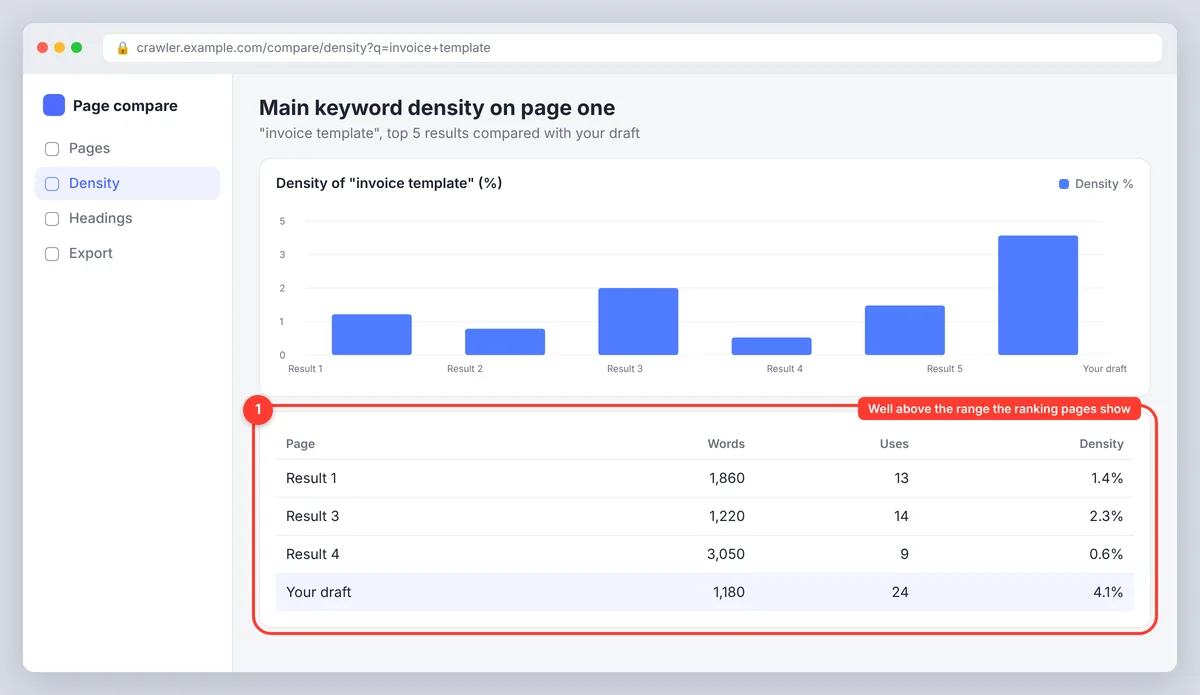
Treat the range as a sanity check for SEO optimization, not a goal:
| Density of the main keyword | What it usually means | What to do |
|---|---|---|
| 0 to 0.3 percent | The text may be about something else, or the keyword is phrased differently throughout | Check the title, first paragraph and H2s mention it naturally |
| 0.5 to 2.5 percent | Normal for an article genuinely about the topic | Nothing; look at the supporting terms instead |
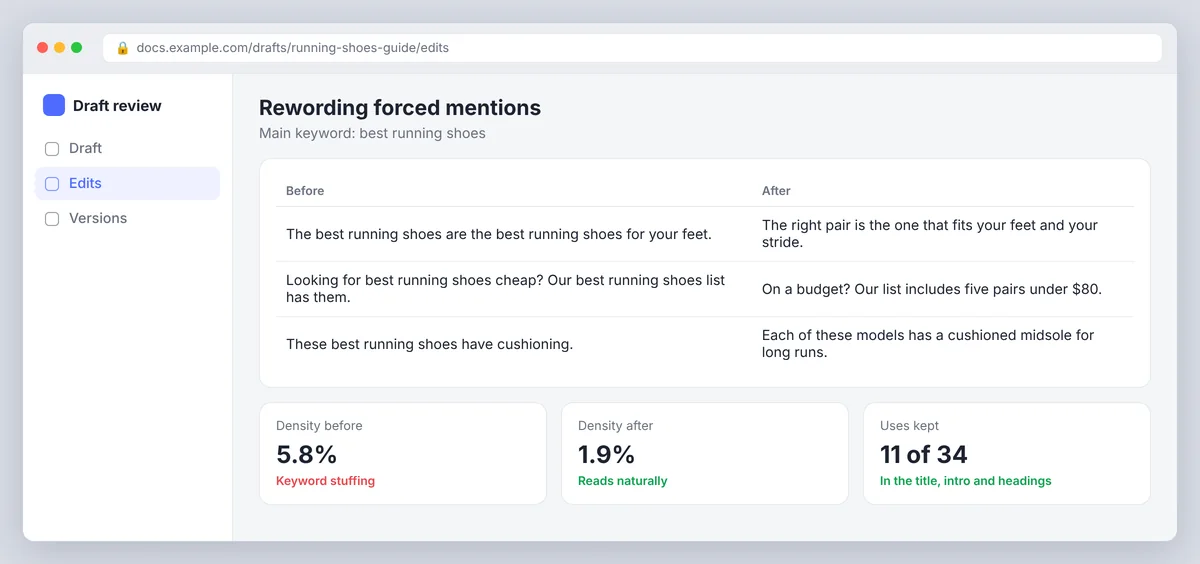
| 3 to 5 percent | Starting to read as forced | Reword a few mentions with pronouns, synonyms or more specific language |
| Above 5 percent | Keyword stuffing, whatever the intent; the density exceeds anything natural | Rewrite the repetitive passages; readers and search engines both notice |
The pattern holds because an article that explains a topic naturally mentions it that often. Writing to the range is backwards; writing the piece and then checking the range is the right order.
How to check keyword density with a free keyword density checker
SerpPal's keyword density checker is a free SEO tool that needs no account and runs in your browser. It works like this:
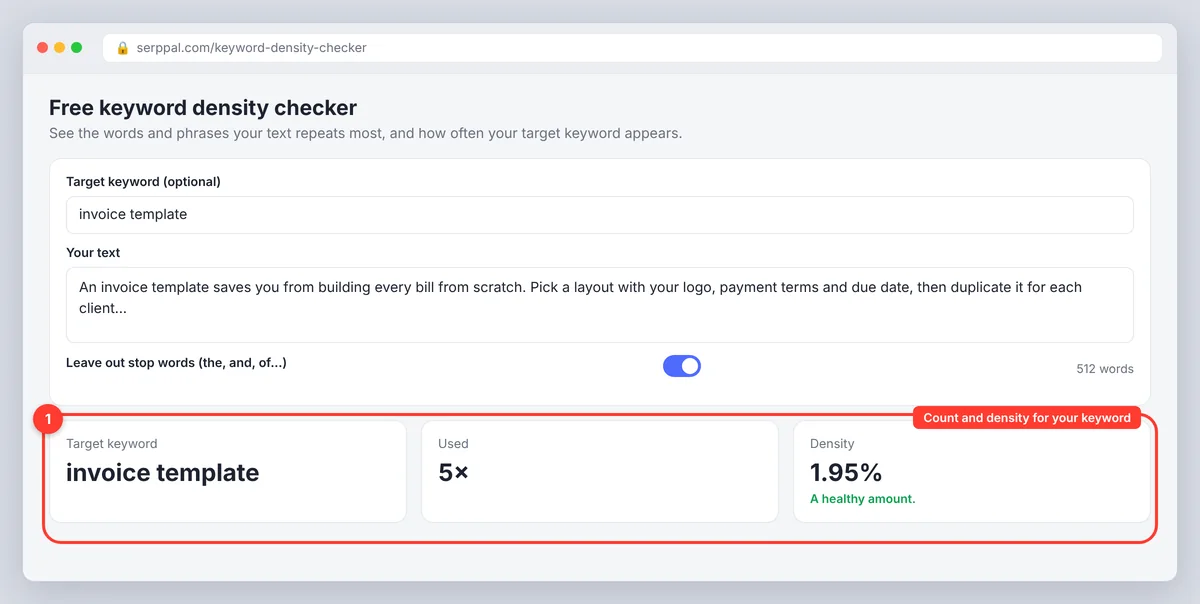
- Paste your text into the box, or type it. Blog posts, landing pages and product copy all work.
- Enter your target keyword (optional). The analyzer shows how many times the keyword or phrase appears and its density, with a note on whether that is low, normal or high.
- Read the tables. The checker lists the single words, 2-word phrases and 3-word phrases your text repeats most, each with its count and density, sorted by frequency. The tool filters stop words out so the topical words stand out, and you can filter the view to words, 2-word or 3-word phrases.
- Revise and recheck. The counts update as you edit, so you can fix a repeated phrase and watch it drop in the list. For a quick manual version, Ctrl+F in your editor counts one term at a time; the checker counts all of them.
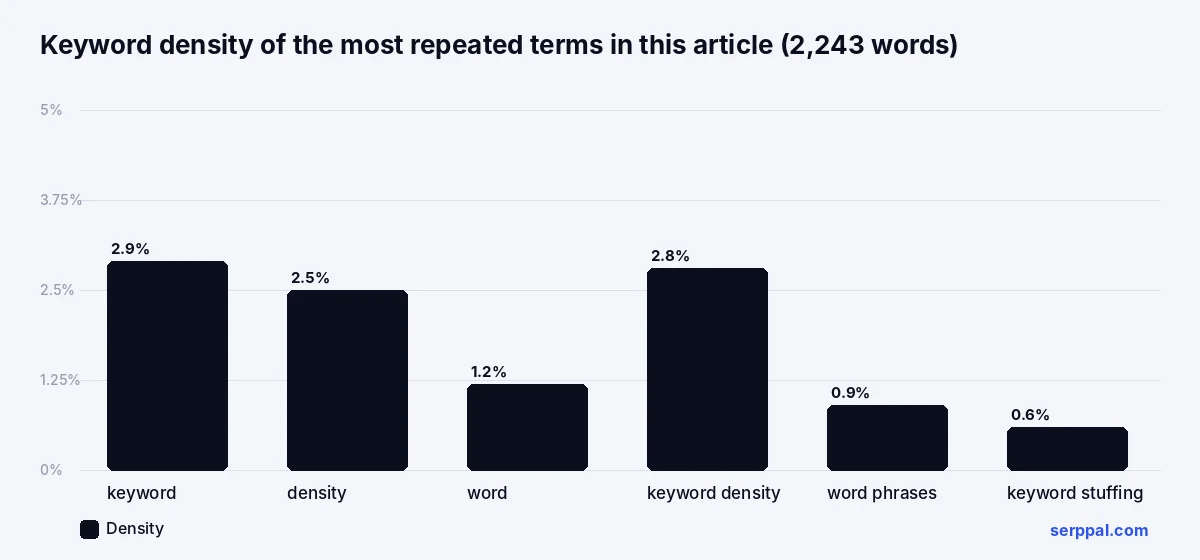
A density report is most useful read from the top: the first few rows are what your text is about, whether you meant it or not. If the top phrase is "click here" or "in order to", you have a different problem from keyword density. The same check on a competitor's copy, pasted in, gives insights into which phrases they lean on and which supporting terms they use that you have not. For a fuller comparison against every ranking page at once, SerpPal's editor does that analysis automatically; the free checker is the quick single-text version.
Keyword density analysis: words, 2-word and 3-word phrases
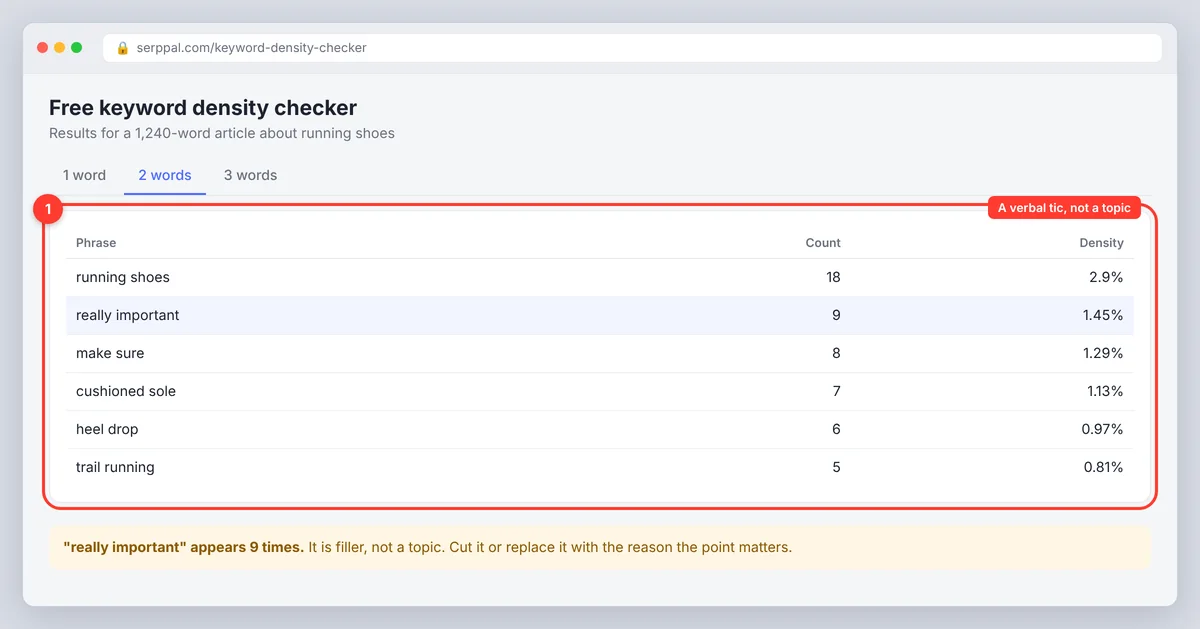
Single words catch brute overuse. Multi-word phrases (bigrams and trigrams, or n-grams) tell you more: they show the exact phrasing the text keeps returning to, which is usually either the topic or a verbal tic. An article about running shoes should show "running shoes" and a handful of related phrases ("cushioned sole", "trail running", "half marathon") near the top. If the 3-word table is all stock phrases ("one of the", "a lot of"), the copy has filler to cut. Precise analysis means analyzing all three tables, not just the first, and the keyword density analyzer makes that a ten-second job.
Does keyword density still matter?
As a ranking lever, no. Google's own guidance on irrelevant keywords and keyword stuffing treats forced repetition as spam, and no amount of density moves a web page that does not answer the search queries behind it. As a diagnostic in on-page SEO optimization, yes, in three situations:
- Before publishing, to catch a term you repeated while editing and stopped noticing.
- When a URL ranks for the wrong query, to see what the text is actually about by frequency.
- When comparing with ranking pages, to find the supporting terms and phrases they use and you do not. That comparison, across many terms rather than one, is what content optimization tools do; see what a content score is for how it works.
What matters instead is content relevance in the sense search engines now measure it: the keyword in the title, the first paragraph, the metadata and a heading or two; the related terms, synonyms and entities a text on this topic would naturally use; headings that answer the informational questions behind the query (intent alignment); readability; and content that is actually helpful. Density is a quick proxy for the first of those and nothing else. The SEO insights that move rankings come from the rest.
Common keyword density mistakes to avoid
- Writing to a percentage. "Hit 2 percent" produces sentences nobody would say. Write the piece, then check; over-optimization is the result of doing it the other way round.
- Deleting every repeat. An article about keyword density has to say "keyword density". Reword the awkward instances, keep the natural ones.
- Ignoring phrases. The main keyword can look fine while a 3-word phrase appears in every paragraph.
- Forcing exact-match phrases. "Best running shoes cheap" is not a sentence. Write the natural form and let the search engine handle the variant.
- Forgetting variants. Plurals, verb forms and synonyms are separate rows in most tools. Add them up mentally before deciding a term is underused.
- Stuffing the invisible parts. Alt text, meta descriptions and hidden text packed with keywords are the classic spam pattern and the easiest for Google to detect.
- Confusing density with difficulty. Keyword density is how often a term appears in your text. Keyword difficulty is how hard a term is to rank for. They have nothing to do with each other.
- Using the checker as the only check. Density says nothing about intent, structure, accuracy or whether the article should exist. Keyword density analysis is one tool in the SEO optimization kit, not the kit.
Keyword density vs content optimization: semantic SEO and LSI keywords
Older SEO advice recommended "LSI keywords" (from latent semantic indexing) as a way to prove relevance. Google has said it does not use LSI, and the term is mostly marketing. The underlying idea is still right: a text genuinely about a topic uses the vocabulary of that topic. An article about keyword density naturally mentions word count, phrases, stuffing, frequency and search engines without anyone planning it.
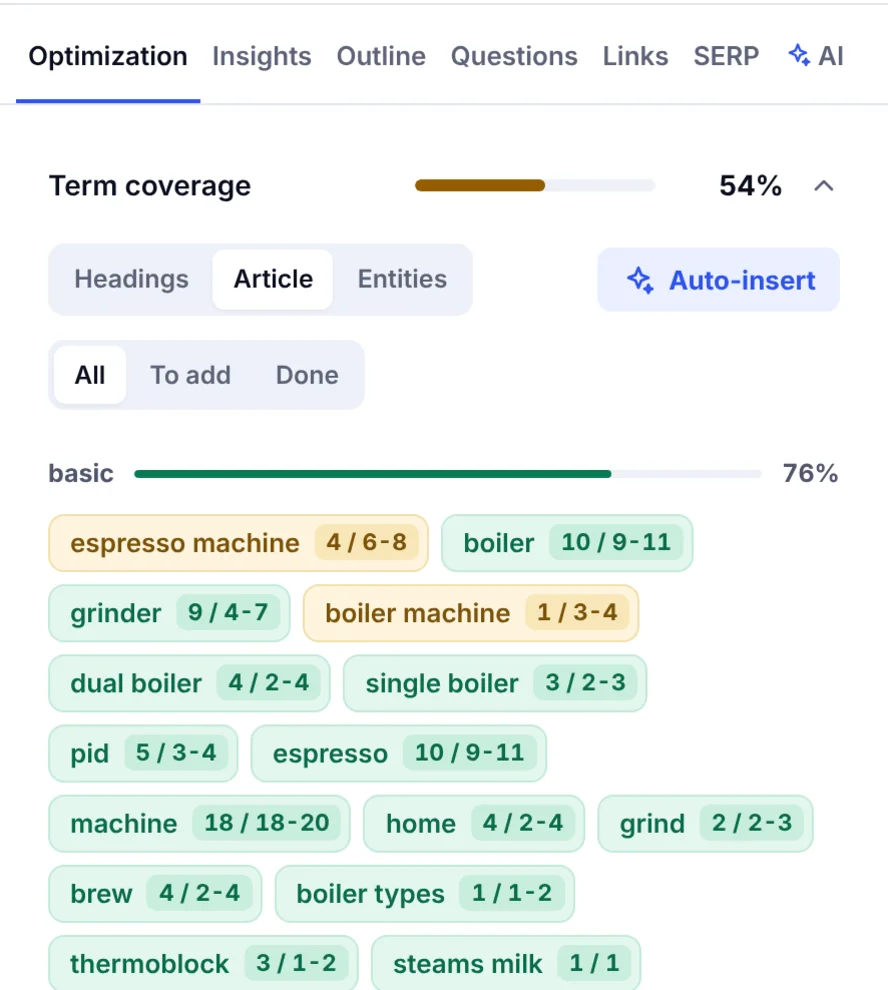
So instead of hunting for LSI keywords, look at the semantic vocabulary the top-ranking pages share and check whether your text covers it. That is the analysis SerpPal's editor runs for every keyword: it reads the ranking pages, lists the terms and phrases they have in common with a suggested range for each, and shows which ones your draft is missing or overusing, so you optimize SEO content against evidence rather than a percentage. Density for one keyword is the first row of that list; the rest of the list is where the content optimization gains are. Semantic SEO, in practice, is covering that list well. Our guide to on-page SEO covers where each of those elements goes.
Conclusion
Keyword density is a simple ratio: how often a term appears compared with the total word count. It is useful as a quick check before you publish, to catch a phrase you repeated without noticing or a topic you barely mentioned, and useless as a target. Write for the reader, put the main keyword in the title, the opening and a heading or two, cover the related terms a good page on the topic would use, then run a free checker to make sure nothing stands out. If a page ranks poorly, the fix is almost never a different percentage; it's better coverage of what the searcher wants. Our guide to writing SEO content that ranks covers that side.
Frequently asked questions
What is keyword density?
The percentage of a text's total words that a particular keyword or phrase makes up: keyword occurrences, times the words in the phrase, divided by the total word count, times 100. It measures frequency in proportion to length, which is why the same ten mentions are dense in a short post and sparse in a long guide.
What is a good keyword density percentage?
There is no number Google rewards. Pages that rank typically use their main keyword in about 0.5 to 2.5 percent of the text, and related phrases less often. Above roughly 3 percent the writing starts to read as forced; above 5 it is keyword stuffing. Use the range to catch problems, not as a target.
How is keyword density calculated?
Count how many times the keyword appears, multiply by the number of words in the keyword, divide by the total words on the page, and multiply by 100. For "invoice template" appearing 4 times in 500 words: 4 × 2 ÷ 500 × 100 = 1.6 percent. Some tools skip the multiplication step, so check which convention yours uses before comparing numbers.
Does keyword density affect Google rankings?
Not directly. Google has no density ranking factor and treats obvious overuse as keyword stuffing, which can hurt a page. What helps is the keyword in the title, intro and headings, plus the supporting terms and helpful content an article on the topic would naturally have. Density is a quick check that you did not overdo the first part.
Can a keyword density checker analyze two and three-word phrases?
Yes. SerpPal's free keyword density analyzer lists the most frequent single words, 2-word phrases and 3-word phrases with counts and densities, and reports the count and density of any target keyword you enter, one word or a phrase. Multi-word phrases are usually the more useful table, because they show the exact wording a page keeps returning to.
How do I avoid keyword stuffing?
Write the first draft without counting, then read it aloud. Wherever the keyword sounds forced, use a pronoun, a synonym or a more specific phrase instead. Run a density checker to catch anything above about 3 percent, and check that alt text and meta tags describe the page rather than repeat the term. A page that stays natural to read is very unlikely to be flagged for stuffing.