On this page
- What is a word frequency counter?
- How word frequency analysis works
- How to find overused words in your writing
- Unique word counter and vocabulary variety
- How to count words and their frequency in any text
- Word counter vs character counter
- Readability score, common words and keyword density
- Word frequency for SEO
- Frequently asked questions (FAQ)
A frequency word counter (also called a word frequency counter) lists every word in a text and how many times it appears, sorted from most to least frequent. Paste your writing in, skip the common filler words, and the words at the top of the list are the ones you lean on too much: the overused words and repeated phrases that make writing feel flat.
This guide explains how word frequency analysis works, how to read the results, which overused words to look for, and how to run a frequency count in a free online tool, in Microsoft Word or with a few lines of code.
Key takeaways
- A word frequency counter shows how often each word appears. Most tools let you hide stop words like "the" and "and," so the meaningful repeats stand out.
- In your own writing, look for content words that appear far more often than they should: a favorite adjective, the same verb, a buzzword.
- A unique word counter shows how many distinct words you used. A higher share of unique words usually means more varied writing.
- Repeated phrases (two- and three-word combinations) are often more noticeable to readers than single repeated words.
- Fix overuse with synonyms, pronouns and restructured sentences, but keep repeated key terms where clarity needs them.
What is a word frequency counter?
A word frequency counter is a tool that counts how many times each word occurs in a text. It splits the text into words, usually ignores capitalization and punctuation, adds up the occurrences, and shows a ranked list. Many tools also show each word's share of the total as a percentage, its density, and repeated phrases.
The same idea goes by several names: word frequency analysis, a repeated words checker, a word occurrence counter or a word cloud generator (which draws the same data as a picture). Writers, editors, students, SEO teams and researchers all use it.
How word frequency analysis works
Most counters follow the same steps:
- Split the text into separate words (tokens). Spaces, punctuation and line breaks mark the boundaries. Tools differ on hyphenated words, apostrophes ("don't") and accented letters, which is why two counters can disagree; good ones handle Unicode so accented English words and other languages count correctly.
- Normalize. "The" and "the" are counted as one word. Some tools also merge forms like "write," "writes" and "writing" (stemming).
- Remove stop words (optional). Very common function words such as "the," "a," "of," "to" and "and" are hidden, because they top every list.
- Count and rank. Each word gets a count and a percentage of the total word count.
- Find phrases (optional). Better tools also count two- and three-word phrases, which catch repeated expressions like "in order to."
In almost any English text, "the" is the most frequent word, and the most common English words are short function words. Word frequencies follow a pattern known as Zipf's law: a handful of words appear very often, and most words appear only once or twice.
How to find overused words in your writing
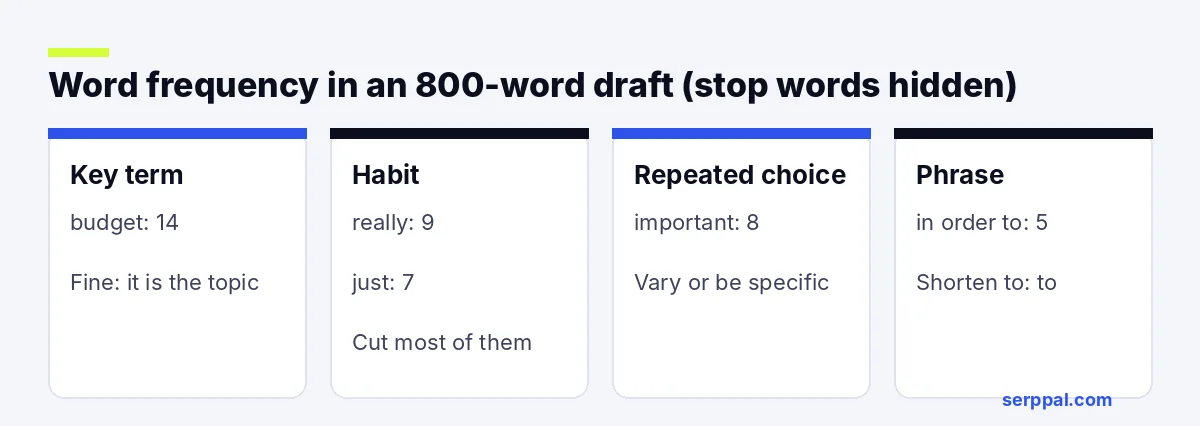
Run your draft through a word frequency counter with stop words hidden, then look at the top 20 results. Ask three questions about each word:
- Is it a key term the piece is about? Repeating "budget" in an article about budgets is fine. Readers expect it.
- Is it a habit? Words like "really," "very," "just," "actually," "simply" and "basically" often appear many times without adding meaning.
- Is it a repeated choice that could vary? If "important" appears eight times in 800 words, some of those can become "key," "central" or a more specific word.
Common overused words to look for
| Type | Examples | Better approach |
|---|---|---|
| Intensifiers | very, really, extremely, incredibly | Pick a stronger word: "furious" instead of "very angry" |
| Filler | just, actually, basically, simply, quite | Delete them and reread |
| Vague nouns | thing, stuff, aspect, element | Name the actual thing |
| Hedges | somewhat, kind of, sort of, seems | Keep only where you mean uncertainty |
| Business buzzwords | utilize, impactful, synergy, solution | Use plain words: use, effective, cooperation |
| Transitions | however, additionally, moreover | Vary them, or let the sentence order do the work |
Repeated phrases matter too
Single words can hide a bigger problem: repeated phrases. "It is important to note that," "in today's world" or a sentence that always starts with "This means" stand out to readers faster than a repeated noun. Count two- and three-word phrases, and rewrite any that appear more than two or three times in a short piece.
Unique word counter and vocabulary variety
A unique word counter shows how many distinct words a text contains. Divide unique words by total words and you get the type-token ratio, a rough measure of vocabulary variety. A short text naturally scores higher than a long one, so compare drafts of similar length rather than different documents.
A low ratio isn't always bad. Instructions and technical writing reuse terms on purpose, because consistency prevents confusion. Variety matters more in essays, stories and marketing copy.
How to count words and their frequency in any text
Online word frequency counters
The quickest option is an online tool in your browser: paste text, and the results appear while typing or after a click. Most of these text tools ignore stop words by default and let you change the setting. Check whether a tool keeps your text private or stores what's uploaded. SerpPal's free keyword density checker shows the words and phrases your text repeats most, with counts and percentages, and the free word counter gives total words, characters, sentences and paragraphs. Neither needs a sign-up.
In Microsoft Word
Word has no built-in frequency list, but you can count one word at a time: press Ctrl+F, type the word, and the Navigation pane shows how many results it found. That's useful for checking a word you suspect, not for finding words you don't. For counting total words, see our guide on how to count words in Microsoft Word. Google Docs has the same limits: the Google Docs word count (Ctrl+Shift+C) shows totals, not frequency, so copy the text into a frequency tool.
In a spreadsheet
For a quick table you can export, paste the text into a spreadsheet, split it into one word per row, then use a pivot table or COUNTIF on that column to count each word. Save it as CSV to share the reports or compare documents.
With a few lines of code
If you work with large texts or many files, a short script does the job. In Python, collections.Counter counts words in one line after you lowercase the text and split it into words; in JavaScript, a short loop over the words with an object or Map does the same. You can also load a .txt transcript or an export of a blog post. Researchers use the same approach, counting tokens across thousands of English words, for corpus analysis and to compare word frequencies across documents.
What to look for in a word frequency tool
A good tool shows the results at a glance and leaves the decisions to you. Useful features:
- A frequency table with each word, its count, its share of the word total, and a sort option (by count or A-Z).
- An option to exclude common words, with stop words on by default and a way to edit the list.
- Phrase counts for two- and three-word combinations, so recurring expressions show up, not just each individual word.
- Word forms. Some tools group related word forms ("analyze," "analyzing," "analysis"); others count them separately. Know which one you're using.
- Upload and export. Paste your text, or upload a .txt or .docx file, then export the table to CSV for spreadsheet software.
- Extra counts. Word count, character counts, sentences, syllables and reading time help you analyze length and word usage together.
- Privacy. Text that stays in your browser, with no signup, is the safer choice for confidential drafts, articles and reports.
Word counter vs character counter
A word counter totals words, sentences and paragraphs, and often adds reading time. A character counter totals characters with and without spaces, which matters for character limits on social media posts, ad copy, meta descriptions and SMS. A frequency counter goes one step further and shows which words dominate. Many online text tools combine all three, so you can check length and repetition in one place; a tool that combines them shows word count, character limits, reading time and occurrences side by side while typing. Reading time is handy for a blog post or a speech.
Readability score, common words and keyword density
Frequency is one lens on prose. A readability score, such as Flesch Reading Ease or the Flesch-Kincaid Grade Level, measures how hard the text is to read from sentence length and word length. Overused long words and filler often show up in both reports. After analyzing frequency, run the draft through a readability checker to see whether cutting repetition also made it easier to read.
Word frequency for SEO
Search engines don't reward repeating a keyword, and stuffing the same term makes text worse to read. A word frequency check in your browser helps you analyze a draft: catch a target keyword you've used too often, check the occurrences of brand names in title tags and headings, and spot related terms you haven't used at all. Our guide to keyword density explains why ranges matter more than a single target percentage.
Frequently asked questions (FAQ)
What is a word frequency counter used for?
Finding overused words and repeated phrases in your writing, checking keyword use in SEO content, studying vocabulary in a text, and comparing how often words appear across documents.
What are stop words in a word frequency list?
Stop words are very common words like "the," "a," "and," "of" and "to." They appear in every text, so most word frequency counters let you hide them to focus on meaningful words.
How many times is too many to use the same word?
There's no fixed number. As a rough guide, a non-essential word that appears more than three or four times in 500 words is worth checking, while key terms the piece is about can appear much more often.
What is a unique word counter?
A tool that counts how many distinct words a text contains. Comparing unique words with total words gives a rough measure of how varied the vocabulary is.
Can I count word frequency in Microsoft Word?
Only one word at a time. Use Ctrl+F to see how many times a word appears. For a full ranked list of every word, paste the text into an online word frequency counter.