On this page
To check readability, paste your text into a readability checker and read two numbers: the Flesch Reading Ease score (0 to 100, higher is easier) and the grade level (the US school grade a reader would need). Most web writing should land at 60 or more on reading ease and around grade 7 to 9. The score tells you where the text is dense; it cannot tell you whether it is clear.
This guide explains what readability metrics measure, how the six formulas differ, what a good score looks like for your audience, and how to get better readability without flattening the meaning.
Key takeaways
- Readability formulas measure sentence length and word length (syllables or characters). That is all they see.
- Flesch Reading Ease gives a 0-100 scale; Flesch-Kincaid, Gunning Fog, SMOG, Coleman-Liau and ARI give a school grade level.
- Different formulas give different grades for the same text. Treat them as a benchmark, not a verdict.
- A good score depends on the target audience: grade 6 to 8 for the general public and healthcare material, higher for academic or technical readers.
- The fastest fixes are splitting long sentences, swapping jargon for plain English and breaking up long paragraphs.
What a readability score tells you
Readability scores estimate how hard a text is to read, usually as a school grade level or a 0 to 100 ease score. They are built from two things a program can count: how long your sentences are and how long your words are. That makes them fast, consistent and useful for spotting dense passages, and it also explains why they miss things a human reader notices at once. Reading difficulty, in other words, is estimated from surface complexity alone.
A formula cannot see whether a word is jargon, whether a sentence is ambiguous, or whether the argument makes sense. "The cat sat on the mat" and "The qat sat on the mat" score the same. Short, simple words arranged confusingly will score as easy. Long, familiar words like "information" will push a score up even though nobody struggles with them.
So read the score as a flag, not a grade. A low reading ease score says "look here"; it does not say what is wrong.
How to check readability online
Any free readability checker follows the same three steps:
- Paste your text (or, with some tools, enter a URL to analyze a published page).
- Click analyze. The tool calculates words, sentences, syllables and characters and runs the formulas instantly.
- Read the results: the scores first, then the flagged sentences and words, which are the useful part. Multiple formulas side by side give more insights than one.
SerpPal's free readability checker shows the Flesch Reading Ease score and the Flesch-Kincaid grade level, marks sentences over 20 words in yellow and over 30 in red, and flags passive constructions, adverbs and complex words. It runs in your browser, so nothing you paste is sent anywhere, and it needs at least 30 words to produce a score. Writers in the SerpPal editor see the same reading-ease number next to the content score while they write.
A few things make a readability analysis more reliable, whichever tool analyzes your text:
- Check a complete section, not a headline or a single sentence. Formulas are unstable on short samples; SMOG was designed around 30 sentences.
- Strip bullet lists, tables and code first, or check them separately. Fragments without full stops make sentences look enormous.
- Check a long page in two or three representative chunks. One dense section can hide behind an easy average.
Six readability formulas and what their scores mean
All 6 readability formulas below were built in the same way: researchers tested passages on real readers, then found the mix of sentence length and word length that best predicted the results. Each one weights those two inputs differently, which is why they disagree.
| Formula | Output | Counts | Best known for |
|---|---|---|---|
| Flesch Reading Ease | 0-100 scale, higher is easier | Words per sentence, syllables per word | General writing, Microsoft Word, most web checkers |
| Flesch-Kincaid Grade Level | US school grade | Words per sentence, syllables per word | The same inputs as Reading Ease, rescaled to a reading level |
| Gunning Fog Index | School grade | Words per sentence, share of complex words (3+ syllables) | Business and journalism; tends to run high |
| SMOG Index | School grade | Polysyllabic words in 30 sentences | Healthcare and patient information |
| Coleman Liau Index | School grade | Characters per word, sentences per 100 words | Fast machine scoring; no syllable tally |
| Automated Readability Index (ARI) | School grade | Characters per word, words per sentence | Technical manuals; no syllable tally |
Flesch Reading Ease
Rudolf Flesch published the Reading Ease formula in the Journal of Applied Psychology in 1948. It subtracts a weighted sentence length and a weighted syllable count from 206.835, which lands most prose between 0 and 100. Roughly: higher scores are easier, 90 and above reads like a children's book, 60 to 70 is plain English that general audiences read easily, 30 to 50 is college-level, and below 30 is dense academic or legal text.
Flesch-Kincaid Grade Level
In 1975 J. Peter Kincaid and colleagues recalibrated Flesch's inputs for the US Navy so the Flesch-Kincaid Grade Level reads as a school grade instead of a 0-100 score. A grade 8 result means a typical eighth grader could follow the text. It uses exactly the same two inputs as Reading Ease, so the two scores always move together.
Gunning Fog Index
Robert Gunning's 1952 formula adds average sentence length to the percentage of complex words (three or more syllables) and multiplies by 0.4. Because the Gunning Fog Index treats every long word as complex, including common ones like "important", it usually gives a higher grade than Flesch-Kincaid for the same passage. A Fog score of 12 corresponds to a high-school senior.
SMOG Index
G. Harry McLaughlin published SMOG (Simple Measure of Gobbledygook) in 1969. McLaughlin's formula takes the polysyllabic words across 30 sentences, takes the square root, then adds about 3. The name was a joke about gobbledygook; the formula was not. The SMOG grade predicts full comprehension rather than partial understanding, which is why it is the standard in healthcare and patient education, where a reader has to get every instruction right. On short samples it is less reliable than the others.
Coleman-Liau Index
Meri Coleman and T. L. Liau built their 1975 formula around character counts rather than syllables, because computers of the time could tally letters reliably and syllables badly. It uses letters per 100 words and sentences per 100 words. The Coleman-Liau Index tends to agree with Flesch-Kincaid on ordinary prose and diverge on text with many short, technical abbreviations.
Automated Readability Index
ARI, developed by Senter and Smith in 1967 for US Air Force technical manuals, also relies on characters per word plus words per sentence. Like Coleman-Liau it needs no syllable tally, so it is cheap to run on anything from a typewriter to a browser. It outputs a reading level, where grade 14 corresponds to a college sophomore.
Why the same text gets five different grades
Run one paragraph through all five grade-level formulas and you get a spread, not a number. The 69-word paragraph that opens the "What a readability score tells you" section above comes out like this:
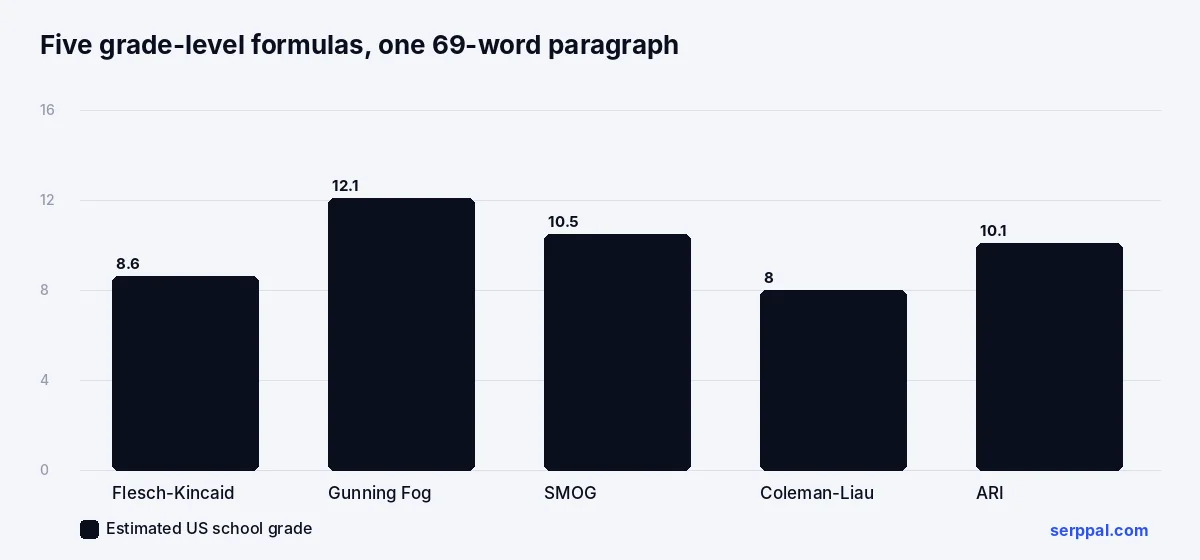
Flesch-Kincaid and Coleman-Liau say grade 8; Gunning Fog says grade 12, because the paragraph contains a few three-syllable words such as "consistent" and "readability" that Fog treats as complex. None of them is wrong. They weight word length differently, and a four-grade spread on the same text is normal. If a checker shows several scores, look at where they agree (long sentences push every formula up) rather than averaging them.
What is a good readability score?
A good readability score is one that matches the target audience and what they need to do with the text. There is no universal pass mark, but the ranges below are reasonable benchmarks to aim for, and most checkers let you set a target reading level.
| Audience and content type | Flesch Reading Ease | Target grade level |
|---|---|---|
| General public, consumer websites, blog posts | 60 to 70 | Grade 7 to 8 |
| Healthcare, patient information, safety instructions | 70 or higher | Grade 6 or lower |
| Marketing and product pages | 60 to 80 | Grade 6 to 8 |
| News and business writing | 50 to 60 | Grade 9 to 10 |
| Professional and technical documentation | 40 to 60 | Grade 10 to 12 |
| Academic papers, legal text | 30 to 50 | Grade 12 to 16 |
Two cautions. First, pushing an academic or technical text down to grade 6 usually removes precision the reader needs; the goal is appropriate, not minimal. Second, the formulas were calibrated on English. Spanish, German or Dutch text can be scored with language-specific variants, but the English constants give only a rough guide for other languages.
Readability for students and educators
Teachers and educators use grade-level scores to match reading material to a class, and students sometimes use them to check an essay. Each grade stands for the years of formal education needed to follow the text. For school assignments the formal education needed should sit at or slightly above the reader's grade, not far below it. An essay that scores grade 5 is not "very readable"; it probably has too many short, choppy sentences.
Improve readability without changing the meaning
A low score usually comes from a handful of patterns. Fix those directly and the number follows; you rarely need to rewrite the whole piece, just simplify the parts that drag.
- Split sentences over 25 words. One idea per sentence. Look for "and", "which" and semicolons as natural break points.
- Swap jargon for plain English where a plain word exists. "Use" instead of "utilize", "start" instead of "commence". Keep technical terms your readers expect, and define them once.
- Prefer active constructions. "The team reviewed the draft" rather than "the draft was reviewed by the team". Passive voice adds words and hides who did what.
- Cut filler adverbs and nouns stacked on nouns. "Implementation process optimization" is three abstract nouns doing the work of one verb.
- Break long paragraphs. Two to four sentences each. White space does not change the formula, but it changes whether anyone reads on.
- Add headings and lists. They help readers navigate, make the page more usable and give skimmers an exit ramp. Plain-language docs and intuitive structure do more for understanding than any formula.
Then recheck. A text that moves from reading ease 45 to 62 after these edits has not lost information; it has lost friction and become more understandable. If you drafted with an AI writing tool, this pass matters more, because AI drafts often have uniform, long sentences that score worse than they read. SerpPal's humanizer reports readability before and after so you can confirm the text got clearer, not just different; see humanize in the editor.
Readability and SEO
Google does not use a Flesch score as a ranking factor, and no SEO tool can honestly claim that a particular number lifts rankings. What readability affects is behaviour: whether people stay, scroll, finish and come back. Those signals, and the links and mentions that readable content earns, are what search engines respond to.
So treat readability as part of optimizing content for the people who land on it, not as a metric to optimize for its own sake. Check the score when you edit, look at the flagged sentences, and fix the ones a real reader would trip over. Our guide to writing SEO content that ranks covers where that fits in the rest of the process.
Frequently asked questions
What is a good Flesch Reading Ease score?
For most web and business writing, 60 to 70 is a good target: plain English that adults read without effort. Consumer health and safety text should aim higher, 70 or above. Technical and academic writing often sits between 30 and 50, and that is appropriate for its readers as long as the sentences are not needlessly long.
Is a Flesch-Kincaid grade of 12 or higher bad?
Not by itself. Grade 12 means a high-school senior could follow the text comfortably, which suits professional documentation and serious journalism. It is a problem when the audience is the general public, or when the high grade comes from 40-word sentences rather than from necessary vocabulary.
Which readability formula should I use?
Use Flesch Reading Ease and the Flesch-Kincaid Grade Level for general writing, because they are the most widely understood and what most tools report. Use SMOG for healthcare and patient material, where it is the accepted standard. Coleman-Liau and ARI are fine for technical documents and for languages or texts where syllable counting is unreliable.
How can I check the reading level of a book?
Copy a representative passage of at least 300 words from two or three different chapters, including both narrative and dialogue, paste your text into a readability checker and run each one. Average the reading levels, then sanity-check the result against the vocabulary and subject matter, because formulas do not see whether the ideas are suitable for a young reader.
Does a readability checker save my text?
It depends on the tool. SerpPal's free checker runs entirely in your browser and sends nothing to a server. Before pasting unpublished research, customer data or confidential documents into any other checker, read its privacy terms.